

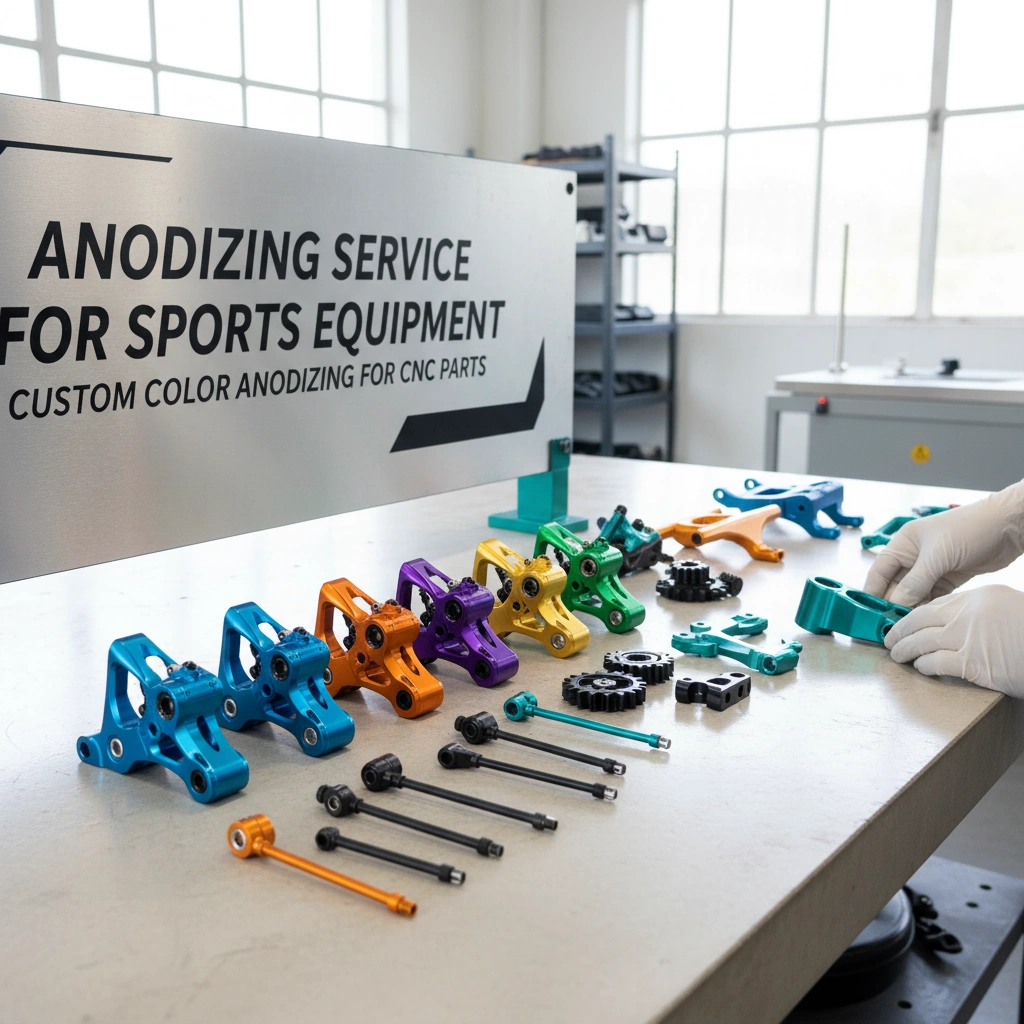
Introduction to Aluminum Anodizing for CNC Machined Parts
Aluminum anodizing is a critical post-processing step that transforms raw CNC machined components into high-performance industrial assets. Unlike plating or painting, which adds a layer on top of the metal, anodizing is a conversion coating. It integrates with the underlying aluminum substrate to create a surface that is exceptionally hard, corrosion-resistant, and aesthetically versatile. For global manufacturers, this process is the gold standard for ensuring part longevity in demanding environments.
The Electrochemical Process Explained
The anodizing process is rooted in controlled electrolysis. The CNC machined part is submerged in an electrolyte bath (typically sulfuric acid) and acts as the anode of an electrical circuit.
- Oxygen Liberation: As electric current passes through the solution, oxygen ions are released from the electrolyte.
- Oxidation: These ions combine with the aluminum atoms on the surface of the part.
- Layer Formation: This reaction creates a coherent, fully integrated aluminum oxide ($Al_2O_3$) layer.
Because this is a chemical conversion rather than a coating, the resulting finish will not chip, flake, or peel under thermal or mechanical stress.
Why Anodize CNC Machined Components?
For precision-engineered parts, anodizing offers a suite of functional and commercial advantages:
- Enhanced Durability: It significantly increases surface hardness, protecting soft aluminum from scratches and wear.
- Corrosion Resistance: The oxide layer acts as a barrier against moisture, salts, and chemical exposure.
- Thermal Management: Anodized surfaces provide improved heat dissipation and are electrically non-conductive.
- Precision Maintenance: When managed correctly, anodizing preserves the tight CNC tolerances required for aerospace and medical applications.
Understanding the Nanoscopic Pore Structure
At a microscopic level, the anodizing process does not create a solid, flat block. Instead, it develops a highly organized nanoscopic pore structure. These pores resemble a honeycomb pattern that extends from the surface down to the base metal.
- Porosity: These microscopic voids are what allow the surface to absorb organic dyes for vibrant decorative finishes.
- Sealing: Once the desired color or functional treatment is applied, the parts are “sealed” in a hot water or chemical bath. This closes the pores, locking in the color and maximizing corrosion resistance.
- Adhesion: This structure also provides an excellent mechanical key for secondary treatments, such as dry-film lubricants or specialized primers.
Type II Anodizing: The Aesthetic and Protective Standard
Key Characteristics of Sulfuric Acid Anodizing
When we talk about aluminum anodizing for CNC machined parts, Type II is the industry standard for a reason. We use a sulfuric acid electrolyte bath to grow a controlled oxide layer that integrates directly with the metal surface. It’s a thinner coating than hardcoat, but it’s exceptionally effective at preventing oxidation and wear in everyday environments.
- Coating Thickness: Typically ranges from 0.1 to 1.0 mil.
- Corrosion Resistance: Excellent for parts exposed to indoor or mild outdoor conditions.
- Dimensional Impact: Minimal build-up, making it easier to maintain tight CNC tolerances.
Color Customization and Decorative Finishes
The real magic of Type II anodizing lies in its pore structure. Right after the electrochemical process, the surface is filled with millions of microscopic pores that act like a sponge. This allows us to “seal” in organic dyes, creating a vibrant, decorative finish that won’t chip or peel like paint.
| Feature | Type II Capability |
|---|---|
| Color Range | Nearly infinite (Black, Blue, Red, Gold, etc.) |
| Finish Options | Matte, Satin, or High-Gloss |
| UV Stability | High (with proper sealing techniques) |
Common Industrial and Consumer Applications
Because it balances looks with durability, we frequently apply this treatment to high-visibility components. It is the go-to choice for consumer electronics, sporting goods, and CNC machining for automotive aluminum parts where a premium look is just as important as performance.
- Consumer Tech: Phone housings, laptop shells, and camera bodies.
- Automotive: Shift knobs, trim pieces, and engine dress-up kits.
- Medical: Diagnostic equipment covers and non-invasive handles.
- Industrial: Valve bodies and manifolds that require a clean, professional appearance.
❌ INTERNAL(13)
Technical Comparison: Type II vs. Type III Anodizing
When we look at aluminum anodizing for CNC machined parts: Type II and Type III hardcoat, the choice usually comes down to the environment the part lives in. While both processes use a sulfuric acid electrolyte bath to grow an oxide layer, the resulting “skin” on your part behaves very differently under stress.
Choosing between these finishes is just as vital as knowing how to select precise CNC machining materials for your specific environment.
| Feature | Type II (Sulfuric) | Type III (Hardcoat) |
|---|---|---|
| Typical Thickness | 1.8 μm to 25 μm | 25 μm to 100 μm |
| Surface Hardness | 20–40 HRC (Equivalent) | 60–70 HRC (Equivalent) |
| Primary Goal | Aesthetics & Corrosion | Wear Resistance & Durability |
| Color Options | Near limitless | Dark Grey, Black, or Bronze |
[Image comparing Type II and Type III anodizing thickness and penetration]
Coating Thickness and Dimensional Build-up
The most critical factor in CNC machining is dimensional growth. We follow the 50/50 rule: roughly 50% of the oxide layer penetrates the aluminum surface, while the other 50% builds up on top.
- Type II: The thin profile means minimal impact on tolerances. It’s the “standard” for parts that need to look good and stay protected without changing their size much.
- Type III: Because the coating thickness is much higher, you must account for significant build-up in your CAD designs. If you don’t plan for this growth, high-precision bores and threads may not fit after treatment.
Surface Hardness and Wear Life Performance
If your part is going to be rubbed, scraped, or hit, you need the surface hardness of a hardcoat.
- Wear Resistance: Type III creates a much denser, more compact pore structure. This results in a surface that can rival hardened tool steel on the Rockwell scale.
- Durability: Type II is great for preventing rust (corrosion resistance), but it will scratch if handled roughly. Type III is designed for industrial “high-traffic” areas like pistons, cylinders, and sliding gears.
Electrical Insulation and Dielectric Properties
Aluminum oxide is naturally non-conductive, making it a great conversion coating for electrical insulation.
- Dielectric Strength: The thicker the layer, the higher the voltage it can withstand before breaking down.
- Type III Superiority: Because Type III is significantly thicker and denser than Type II, it offers much higher electrical resistance. This makes it the go-to choice for heatsinks or housings where you need to prevent electrical shorts or arcing in high-voltage setups.
Critical Design Considerations for Anodized Parts
When we design for aluminum anodizing for CNC machined parts, we have to account for more than just a color change. Anodizing is a conversion coating, meaning it changes the surface chemistry of the metal. If your design doesn’t account for dimensional changes or electrical contact points, your final assembly might not fit.
Managing Dimensional Growth and the 50/50 Rule
Unlike paint, which only sits on top of a surface, anodizing grows both into and out of the aluminum. We follow the 50/50 rule: half of the total oxide thickness penetrates the surface, and the other half builds up on top. This is especially critical for Type III hardcoat, where the thickness is substantial enough to throw off tight tolerances.
| Feature | Type II (Sulfuric) | Type III (Hardcoat) |
|---|---|---|
| Typical Thickness | 0.0002″ – 0.001″ | 0.0005″ – 0.003″ |
| Surface Build-up | ~0.0001″ – 0.0005″ | ~0.00025″ – 0.0015″ |
| Tolerance Impact | Minimal | Significant |
When manufacturing custom CNC machining for automation and robotics parts in Europe, we always recommend undersizing holes or oversizing shafts slightly to compensate for this “growth” to ensure a perfect slip or press fit after treatment.
Impact on Surface Roughness and Sharp Edges
Anodizing generally mirrors the surface finish of the machined part but can slightly increase surface roughness. Sharp corners are a “no-go” because the oxide layer grows perpendicular to the surface, leading to thin coverage or “corner defects” where the coating meets.
- Edge Radii: Always include a small radius (at least 0.015″) on sharp corners to ensure a continuous, durable oxide layer.
- Surface Prep: Matte or bead-blasted finishes hide machining marks, while polished surfaces will appear even glossier after Type II anodizing.
Racking Marks and Strategic Masking Requirements
Every part needs an electrical connection to the electrolyte bath. This requires “racking,” which leaves a small area of bare aluminum where the contact was made.
- Racking Marks: We strategically place these in non-functional or hidden areas, like inside a threaded hole or on an interior face.
- Masking: If your part requires electrical conductivity or has extremely tight tolerances that cannot tolerate any build-up, we use masking. This is common for components used in the energy industry where ground paths must remain raw aluminum.
Material Compatibility: Choosing the Right Aluminum Alloy
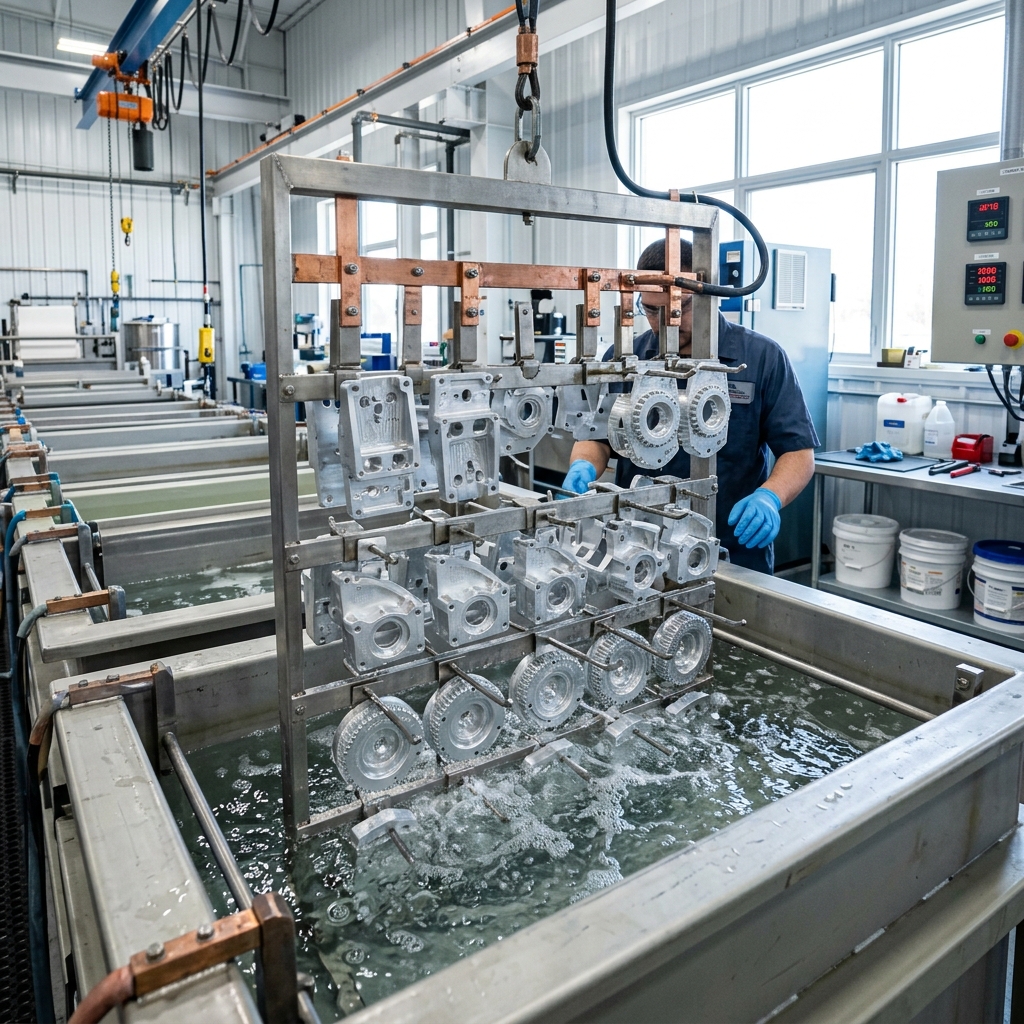
Before we start the sulfuric acid anodizing process, we have to look at the chemistry of the metal. Not all aluminum is created equal. The specific alloy selection determines whether you get a vibrant decorative finish or a burnt, patchy mess. When we handle 5-axis machining services for complex aluminum and stainless parts, choosing the right grade is the first step in ensuring the oxide layer bonds correctly.
Anodizing 6000 Series vs. 7000 Series Alloys
The 6000 series (primarily 6061) is our absolute favorite for aluminum anodizing for CNC machined parts. It’s the “all-rounder” that accepts both Type II and Type III hardcoat beautifully.
- 6061 Aluminum: Yields the most consistent aesthetic finish and deep, rich colors.
- 7075 Aluminum: Great for high-strength needs, but it contains zinc. This often results in a darker, more yellowish/bronze hue during hard coat anodizing, making color matching more difficult.
Challenges with High-Copper 2000 Series Alloys
The 2000 series (like 2026) is a different beast. Because these alloys have high copper content, they are notoriously difficult to treat.
- The Issue: Copper interferes with the electrochemical process, leading to a lower coating density.
- The Risk: In Type III hardcoat applications, 2000 series parts are prone to “burning” in the electrolyte bath. If you need high wear resistance on 2026, expect the finish to be matte grey or olive drab, never truly black.
Anodizing Die Cast vs. Wrought Aluminum Parts
We generally recommend wrought alloys for the best results. If your project involves CNC machining for packaging machinery parts, the material structure matters for long-term corrosion resistance.
| Material Type | Anodizing Quality | Key Characteristics |
|---|---|---|
| Wrought (6xxx, 7xxx) | Excellent | High purity, consistent pore structure, and predictable dimensional growth. |
| Die Cast (A380, A360) | Poor to Fair | High silicon content causes a “smutty” grey appearance and poor surface hardness. |
If you must anodize cast parts, specialized pre-treatments are required to strip the silicon from the surface, or the conversion coating will simply flake off. Always aim for wrought materials if the final look is a priority.
<h2>Selecting the Right Anodizing Type for Your Project</h2>
Identifying Functional vs. Aesthetic Requirements
The choice between Type II and Type III anodizing depends entirely on your part’s final environment. If your goal is a vibrant **aestheticaesthetic finish for consumer electronics or color-coded components, Type II is the industry standard. However, if the part is a “workhorse” in a mechanical assembly requiring maximum wear resistance, we always recommend a Type III hardcoat.
Budget and Lead Time Considerations
Type II is generally faster and more budget-friendly because it uses a standard electrochemical process at room temperature. Type III requires specialized chilled tanks and higher voltage, which increases energy consumption and lead times. When we look at reducing CNC machining costs for large production runs, selecting Type II for non-wear surfaces is a proven strategy to keep your project on budget.
Environmental Resistance and Operating Conditions
While both treatments offer excellent corrosion resistance, they perform differently under stress. Type III provides a much denser oxide layer, making it the superior choice for parts exposed to salt spray, heavy abrasion, or extreme heat.
| Selection Factor | Type II (Sulfuric) | Type III (Hardcoat) |
|---|---|---|
| Primary Intent | Decoration & Light Protection | Industrial Wear & Durability |
| Color Options | Full spectrum (Vibrant) | Dark Grey, Black, or Bronze |
| **Coating DensityCoating Density | Moderate | Very High |
| Typical Hardness | 20-30 Rockwell C | 60-70 Rockwell C |
| **CostCost Profile | Economical | Premium |
- Choose Type II for: Brackets, housings, decorative trim, and color-coded knobs.
- Choose Type III for: Pistons, cylinders, gears, and high-friction aerospace components.
- Consider the Alloy: Remember that your alloy selection will impact how the final color and thickness settle on the surface.
Frequently Asked Questions About Anodizing
How does aluminum anodizing affect tight CNC tolerances?
Anodizing is a conversion coating, meaning it doesn’t just sit on top of the metal; it changes the surface of the aluminum itself. This results in both penetration into the part and dimensional growth outward.
- Type II Anodizing: Typically adds between 0.0002″ and 0.001″ to the surface. It is generally easier to manage during the design phase.
- Type III Hardcoat: Can add 0.002″ or more, which can significantly impact assembly.
When we handle tight tolerance machining, we use the 50/50 rule: roughly half of the coating thickness grows outward while the other half penetrates inward. For critical dimensions, we must undersize the machined part to account for this specific oxide layer build-up.
Can you re-anodize a part if the color is incorrect?
Yes, we can re-anodize a part, but it comes with a major trade-off. To apply a new color, the existing anodized finish must be “stripped” in a caustic chemical bath.
| Action | Result on Part |
|---|---|
| Stripping | Removes the current oxide layer and eats into the base aluminum. |
| Dimensional Loss | Expect a loss of roughly 0.0005″ to 0.002″ of raw material. |
| Surface Finish | The part may become slightly more matte or etched after stripping. |
While re-anodizing fixes aesthetic issues, it can ruin parts with precision tolerances. If the fit is loose to begin with, stripping the part will likely turn it into scrap.
Is it possible to paint or powder coat over anodizing?
It is actually a common practice. Anodizing provides an excellent “anchor” for secondary finishes.
- Superior Adhesion: An unsealed Type II coating has a porous pore structure that acts like a mechanical lock for paint or powder coat.
- Double Protection: This combination offers the best corrosion resistance available. If the paint is scratched, the underlying anodized layer continues to protect the aluminum from oxidizing.
- Type II vs. Type III: We usually recommend Type II for this, as the hardcoat density of Type III is often unnecessary if you are already applying a thick powder layer.
 English
  German
  Dutch
Dutch  Russian
  Czech
Czech  French
  Japanese
  Spanish
  Portuguese
  Korean
Reviews
There are no reviews yet.