


Every seasoned engineer has been there: specifying a tight tolerance "just in case," only to watch the production quote hit the ceiling. In European manufacturing, the line between functional precision and expensive over-engineering is often thinner than a human hair. Whether you’re navigating ISO 2768-mH standards or leveraging 5-axis CNC machining, chasing unnecessary microns is the fastest way to drain your budget. In this guide, I’ll show you how to master the machining cost-tolerance curve and use DFM (Design for Manufacturing) to hit that "Goldilocks zone" of dimensional accuracy—without the exponential price hike.
Would you like me to expand on how ISO 2768 classes specifically impact your project’s lead time and cost?
The European Precision Paradox: Is "Tighter" Always Better?
In European engineering, there is a deep-seated cultural drive for dimensional accuracy. While this commitment to quality is world-class, it frequently leads to the "Over-Engineering" Trap. When designers specify a tight fit for every feature—regardless of its function—it doesn't necessarily result in a better product; it simply results in a more expensive one.
The High Cost of "Just in Case" Precision
Specifying a tolerance of $\pm0.01\text{mm}$ when a standard ISO 2768-mH tolerance would suffice creates an immediate spike in production difficulty. On the machining cost-tolerance curve, the price doesn't climb linearly; it jumps exponentially.
- Tolerance Inflation: Adding a single decimal point to linear and angular dimensions can double or triple the quote.
- The Inspection Burden: Tight tolerances move the workflow from high-speed production to high-frequency CMM (Coordinate Measuring Machine) verification.
- Surface Finish Overkill: Demanding ultra-low Ra values on non-mating surfaces increases cycle times without adding functional value.
ZSCNC’s Philosophy: Precision with Purpose
As an ISO 9001:2015 certified facility, we believe in "Precision with Purpose." Our approach centers on Design for Manufacturing (DFM) to help clients identify where aerospace grade precision is vital and where standard tolerances are more economical.
By leveraging advanced 5-axis CNC machining, we can achieve complex geometries and high-precision medical device manufacturing standards in a single setup. However, our consultative role is to ensure that your budget is spent on critical interfaces, not on "just in case" decimals. This focus on functional necessity is the key to lead time optimization and project scalability in the global market.
ISO 2768: The Blueprint for European Dimensional Accuracy
In the European market, ISO 2768 is the language we speak to ensure everyone is on the same page regarding dimensional accuracy. It removes the guesswork by providing general tolerances for linear and angular dimensions without needing a specific tolerance for every single feature on a drawing.
ISO 2768-1 & 2: Understanding the Classes
We categorize general tolerances into four classes for linear dimensions and four for geometric features. For most European projects, the focus stays on:
- f (Fine): Used for high-precision components where tight fit is mandatory.
- m (Medium): The baseline for general engineering and machinery.
- c (Coarse): Reserved for non-critical parts with wide margins.
- v (Very Coarse): Seldom used in modern CNC environments.
For geometric tolerances (ISO 2768-2), we use classes H, K, and L. As an ISO 9001:2015 certified shop, we see ISO 2768-mH or ISO 2768-mK most frequently. These standards provide a balanced framework for GD&T (Geometric Dimensioning and Tolerancing), ensuring that flatness, symmetry, and runout are controlled without over-complicating the production process.
Why ISO 2768-mK is the "Industrial Sweet Spot"
Most European mechanical assemblies thrive on "medium" tolerances. It is the gold standard for a reason: it guarantees functional dimensional accuracy while keeping costs in check. Choosing ISO 2768-mK ensures that parts fit together reliably in a clearance fit or standard assembly without the exponential price hike of "fine" classes.
For parts requiring complex internal geometries or high-volume precision, our Swiss machining services offer the perfect complement to these ISO standards, hitting the mark where standard milling might struggle.
Stepping Up to ISO 286 for Shafts and Holes
When a project moves beyond general tolerances—specifically for moving parts—we pivot to ISO 286 (IT Grades). This system is essential for:
- Tight fit applications: Press fits or high-speed rotating shafts.
- Cylindrical features: Where the relationship between a hole and a shaft is critical for performance.
- Precision alignment: Ensuring repeatability in robotics or high-end automotive systems.
| Standard | Primary Use Case | Focus Area |
|---|---|---|
| ISO 2768 | General CNC parts | Linear/Angular & GD&T |
| ISO 286 | Bearings, Shafts, Holes | Specific fits (H7, g6, etc.) |
By applying these standards correctly during the Design for Manufacturing (DFM) phase, we help you avoid the "over-engineering trap" while ensuring your project meets every technical benchmark.
The Economic Reality: The Exponential Cost of Precision

In my experience, the biggest shock for European project managers isn't the technical difficulty of tight tolerance machining, but the invoice that follows. There is a fundamental "Economic Reality" in manufacturing: precision and price do not share a linear relationship. When you move from a standard tolerance to a high-precision requirement, the cost curve behaves logarithmically.
Understanding how to reduce machining cost for low-volume automotive CNC parts starts with recognizing that every extra decimal point added to a drawing requires a different tier of machinery, expertise, and environment.
The Logarithmic Curve: Visualizing the Price Jump
When a design shifts from a baseline of $\pm0.1\text{mm}$ to a precision of $\pm0.005\text{mm}$, you aren't just asking for 20 times more accuracy—you are often asking for 10 times more effort.
| Tolerance Level | Relative Cost Factor | Typical Process |
|---|---|---|
| $\pm0.1\text{mm}$ (Standard) | 1.0x | Standard 3-axis CNC |
| $\pm0.05\text{mm}$ (Fine) | 1.5x - 2.0x | High-speed machining |
| $\pm0.01\text{mm}$ (Precision) | 4.0x - 6.0x | Grinding / Jig Boring |
| $\pm0.005\text{mm}$ (Ultra-Precision) | 10.0x+ | Climate-controlled finishing |
Hidden Cost Drivers: Beyond the Cutting Tool
Why does dimensional accuracy get so expensive? It’s rarely about the metal removed; it’s about the variables we have to control to get there.
- Slower Feed Rates: To prevent tool deflection and ensure surface finish (Ra values) remain within spec, machines must run significantly slower.
- Increased Scrap Rates: At $\pm0.005\text{mm}$, even a slight fluctuation in ambient shop temperature can cause a part to expand or contract out of tolerance.
- Specialized Tooling: Achieving aerospace grade precision often requires premium carbide tools that must be swapped out frequently to maintain sharpness and consistency.
- Setup Time: Achieving high accuracy across complex geometries often requires 5-axis CNC machining to finish the part in a single setup, reducing "stack-up" errors.
The Inspection Burden: From Machining to Metrology
Tight tolerances fundamentally change our workflow. We stop being just "machinists" and become "metrologists." When you specify a micron-level fit, the part cannot be verified with a hand micrometer.
This introduces the CMM (Coordinate Measuring Machine). Inspection becomes a dedicated phase of production, often requiring the part to "soak" in a temperature-controlled room for 24 hours before measurement to ensure thermal stability. We focus on 2026 manufacturing strategies for cost and quality to ensure that these inspection bottlenecks don't derail your project timelines, as lead time optimization is just as critical as the physical dimensions themselves.
Sector-Specific Precision: Who Truly Needs the Microns?
While many designers default to tight tolerances out of habit, certain European industries face physical realities where a few microns make the difference between success and catastrophic failure. In these sectors, tight tolerance machining isn't a luxury—it’s a functional requirement. We specialize in identifying exactly where these high-stakes dimensions are necessary to ensure performance without inflating costs.
Aerospace & Defense: Managing Vibration and Thermal Expansion
In aerospace, components operate under extreme pressure and temperature fluctuations. We use 5-axis CNC machining to maintain aerospace grade precision for flight-critical parts where even a $0.01\text{mm}$ deviation can lead to resonance issues or mechanical fatigue.
- Thermal Stability: Materials expand and contract at high altitudes; precise GD&T ensures assemblies remain functional across a $100^\circ\text{C}$ temperature swing.
- Weight Reduction: Tight tolerances allow for thinner walls and optimized geometries without sacrificing structural integrity.
Medical Technology: The Zero-Failure Mandate
Medical device manufacturing demands a "zero-failure" approach, particularly for surgical instruments and orthopedic implants. For these projects, we prioritize biocompatibility and absolute dimensional accuracy.
- Surface Integrity: Beyond just size, we manage Surface finish (Ra values) to prevent bacterial growth and ensure proper osseointegration.
- Strict Compliance: Our medical device CNC machining services in China are built around the rigorous quality standards required for the European healthcare market.
Robotics & High-End Automotive: Repeatability and Fit
For the robotics sector and high-performance automotive engineering, the focus shifts to how multi-component interlocking systems behave over thousands of cycles.
- Tight Fit vs. Clearance Fit: We precisely calibrate tolerances to ensure high-speed robotic arms maintain sub-millimeter repeatability.
- The Role of CMM: Every high-precision component undergoes rigorous CMM (Coordinate Measuring Machine) inspection to verify that complex internal geometries meet the design intent perfectly.
| Industry | Typical Critical Tolerance | Primary Driver |
|---|---|---|
| Aerospace | $\pm0.005\text{mm}$ to $\pm0.01\text{mm}$ | Safety & Thermal Dynamics |
| Medical | $\pm0.002\text{mm}$ to $\pm0.01\text{mm}$ | Biocompatibility & Assembly |
| Robotics | $\pm0.01\text{mm}$ to $\pm0.02\text{mm}$ | Dynamic Repeatability |
Material Selection: The Silent Partner in Tight Tolerance Machining
In my experience, the material you choose is just as important as the machine itself. You can have the most expensive 5-axis CNC machining center in the world, but if the material isn't stable, your tolerances will drift before the part even reaches the inspection bench.
Metals vs. Plastics: Why PEEK is a Challenge
While we regularly hold $\pm0.01\text{mm}$ in stainless steel and other metals, hitting that same mark in plastics is a different story.
- Internal Stresses: Plastics like high-performance PEEK tend to "relax" or deform after machining.
- Thermal Expansion: The coefficient of thermal expansion in polymers is much higher than in metals.
- Moisture Absorption: Some materials swell in humid environments, rendering a "perfect" tolerance useless once it ships.
Thermal Stability and European Climate Standards
European engineering projects often demand high material thermal stability because components must perform across varying operational temperatures. We focus on how the material behaves in its end-use environment, not just in our climate-controlled lab. If a part is destined for a high-heat aerospace application, we select alloys that maintain dimensional accuracy without losing structural integrity or shifting outside of the specified GD&T limits.
Machinability Factors in Tight Tolerance Projects
Choosing the right alloy is a balance between functionality and lead time optimization. We look for materials that support clean shearing and consistent chip formation. This prevents:
- Tool Deflection: Harder materials can push the tool away, ruining a tight fit.
- Heat Buildup: Poor thermal conductivity in a material can cause local expansion during the cut.
- Surface Finish Issues: We select grades that allow for low Ra values without requiring secondary grinding.
By matching the material's physical properties to your project's precision requirements, we ensure that the "tight tolerance" on your drawing actually translates to a high-functioning part in the real world.
Bridging the Gap: How ZSCNC Optimizes European Designs
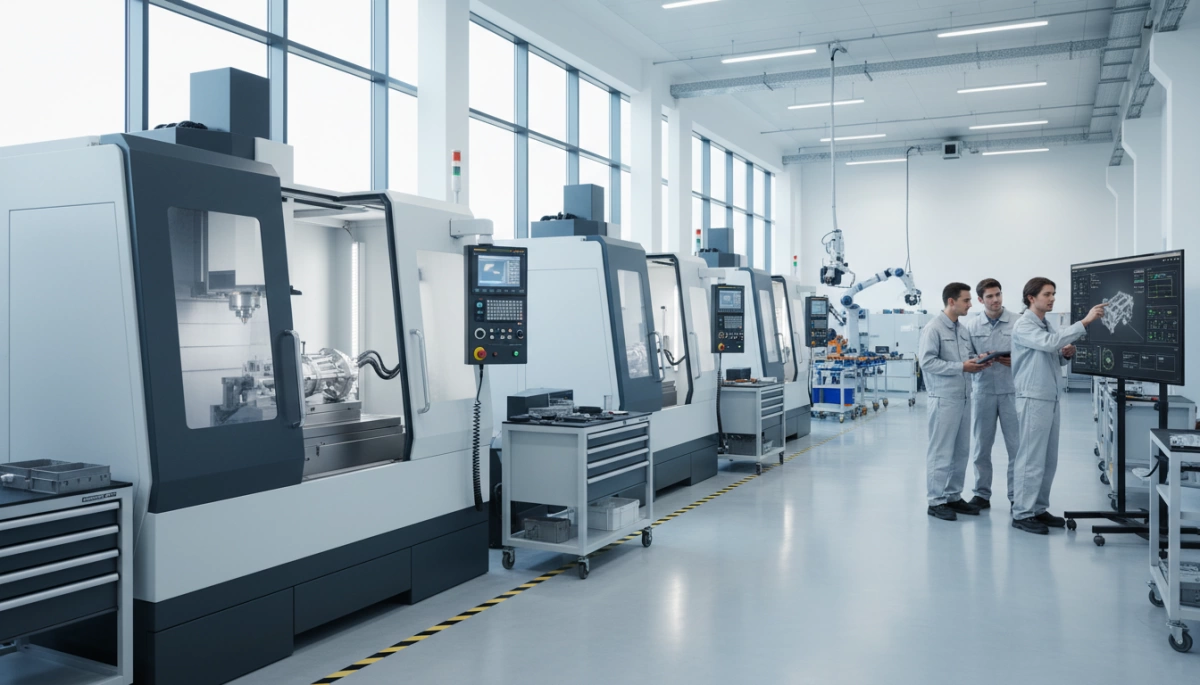
We don't just execute drawings; we refine them to ensure your project is both functional and cost-effective. Many European designs arrive with tight tolerance machining specifications that can unintentionally double production costs. Our role is to align your dimensional accuracy requirements with the most efficient manufacturing path.
Real-Time DFM Feedback
Our Design for Manufacturing (DFM) process starts at the quoting stage. We analyze your GD&T requirements to identify "expensive" tolerances that may not be critical to part function. By spotting these early, we help you navigate the machining cost-tolerance curve, ensuring you don’t pay for microns where a standard ISO 2768-mH fit would suffice.
Advanced Hardware for Complex Geometries
To achieve the high-level repeatability required for aerospace grade precision, we utilize 5-axis CNC machining centers. This technology allows us to:
- Process complex geometries in a single setup, eliminating the errors caused by manual refixturing.
- Maintain strict linear and angular dimensions across multi-sided parts.
- Improve surface finish (Ra values) by optimizing tool engagement angles.
- Drastically reduce lead time optimization by streamlining the workflow from raw material to finished part.
Quality Assurance and Traceability
As an ISO 9001:2015 certified facility, our commitment to quality is data-driven. We bridge the gap between "making" and "measuring" through a rigorous inspection workflow:
- CMM (Coordinate Measuring Machine): We use high-precision CMMs to verify every critical dimension, providing you with a detailed inspection report that guarantees a tight fit vs. clearance fit as designed.
- Material Traceability: Every block of material is vetted for material thermal stability, ensuring your parts perform reliably in their final operating environment.
- Metrology-First Approach: For sectors like medical device manufacturing, we treat the inspection report as importantly as the part itself, ensuring "zero-failure" compliance.
By integrating these advanced tools, we provide precision CNC machining for automation and robotics that meets the strict standards of the European market without the typical overhead of over-engineering.
Practical Checklist: 5 Questions to Ask Before izing Your Tolerances
Before locking in your design, I always recommend a quick reality check to ensure your tight tolerance machining requirements align with actual performance needs. For most European projects, over-specifying tolerances is the fastest way to double your budget without improving the part.
1. Is this a "fit" surface or a "clearance" surface?
This is the most critical distinction in Design for Manufacturing (DFM). A tight fit (like a bearing seat or a press-fit pin) requires micron-level precision to function. However, a clearance fit or a surface that simply exists in "open air" rarely needs more than standard accuracy. If it doesn't touch another component, don't pay for the extra precision.
2. What is the cumulative tolerance stack-up?
In complex European mechanical assemblies, individual parts might be within spec, but the assembly fails because the tolerances "stacked" in one direction. By using GD&T (Geometric Dimensioning and Tolerancing), we can often allow looser tolerances on individual features while maintaining the critical dimensional accuracy of the final build.
3. Can a standard ISO 2768-m class suffice?
For non-critical features, the ISO 2768-mH standard is the industrial "sweet spot" in Europe. Specifying "fine" (f) tolerances for every hole and edge on a part often forces us to use slower feed rates and more frequent CMM (Coordinate Measuring Machine) inspections, which increases lead time. Referencing standard tolerances for 5-axis parts can help you decide where to tighten up and where to relax.
4. Does the material support the requested precision?
Material choice is the silent partner of dimensional accuracy. If you are working with aluminum CNC machining for automation equipment in Germany, the thermal expansion and internal stresses of the alloy must be considered. Some materials simply "breathe" too much to hold $\pm$0.005mm reliably.
5. Is the inspection method cost-effective?
Every tight tolerance requires verification. If you specify a precision of $\pm$0.01mm, it shifts the workflow from "machining" to "metrology." Ask yourself if a manual gauge is sufficient or if the project truly requires a full ISO 9001:2015 certified CMM report for every dimension.
| Feature Type | Recommended Tolerance | Inspection Level |
|---|---|---|
| Mating/Fit Surfaces | ISO 286 (IT6-IT7) | CMM / Air Gauge |
| Functional/Alignment | ISO 2768-f | Calipers / Micrometer |
| Non-Functional/Visual | ISO 2768-m | Visual / Basic Check |
FAQs: Tight Tolerance Machining for European Markets
Understanding the balance between cost and dimensional accuracy is key for any project manager. Here are the most common questions we get about tight tolerance machining: how much precision do European projects really need?
What is the difference between ISO 2768-f and ISO 2768-m?
The main difference lies in the allowable deviation for linear and angular dimensions.
- ISO 2768-f (Fine): Used for precision components where a tight fit is required.
- ISO 2768-m (Medium): The standard for most European industrial assemblies.
Choosing "m" for non-critical features is a major part of Design for Manufacturing (DFM) to keep costs down, while reserving "f" or specific GD&T callouts for functional interfaces.
How does 5-axis machining improve dimensional accuracy?
When we use titanium 5-axis CNC machining services, we can finish complex parts in a single setup. This eliminates the "stack-up error" that happens when a part is moved between different fixtures. For aerospace grade precision, reducing manual handling is the best way to ensure repeatability and tight GD&T compliance.
Why is CMM inspection necessary for tight tolerances?
You simply cannot measure a tolerance of $\pm0.005\text{mm}$ with a standard caliper or micrometer. A CMM (Coordinate Measuring Machine) provides a controlled, automated environment to verify that every micron is exactly where it should be. As an ISO 9001:2015 certified shop, we provide these inspection reports to prove the part meets your exact specs before it leaves our floor.
Can I achieve $\pm0.005\text{mm}$ with any material?
No. Material thermal stability plays a huge role.
- Metals: Stainless steel and specialized alloys hold these tolerances well.
- Plastics: Materials like PEEK or POM expand and contract with temperature changes, making ultra-tight tolerances extremely difficult to maintain outside of a climate-controlled lab.
Does a tighter tolerance always mean a better part?
Not necessarily. In medical device manufacturing or robotics, microns matter for safety and fluid dynamics. However, specifying a tight tolerance on a clearance hole only increases the machining cost-tolerance curve without adding value. Our goal is to help you find the "Industrial Sweet Spot" where performance meets budget.
 English
  German
  Dutch
Dutch  Russian
  Czech
Czech  French
  Japanese
  Spanish
  Portuguese
  Korean