

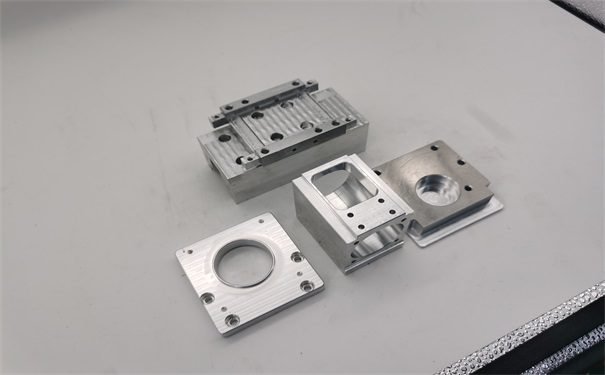
Key Factors in Selecting Materials for Precision CNC Machining
When I select materials for precision CNC machining, I always start with how the part will actually be used — not just what looks good on a datasheet. For tight-tolerance CNC parts, the wrong material choice can mean warping, missed tolerances, rapid wear, or certification failure. Here's how I break it down.

Mechanical Properties for Precision CNC Parts
I match mechanical properties to actual loads and safety margins:
- Strength and Yield Strength — Can it handle peak loads without permanent deformation?
- Hardness — Affects wear resistance, achievable surface finish, and tool wear.
- Fatigue Resistance — Critical for parts under cyclic loads (arms, brackets, shafts).
- Impact Toughness — Important for safety-critical or impact-loaded components.
If the design calls for high-precision moving parts, I typically favor materials with balanced strength and toughness, not just maximum hardness.
Dimensional Stability and Tight Tolerance Control
For tight-tolerance CNC machining, dimensional stability is just as important as strength:
- Thermal Expansion — High expansion makes it harder to hold microns during temperature swings.
- Internal Stress and Distortion — Certain alloys move during machining or after heat treatment.
- Creep and Long-Term Stability — Especially important for jigs, gages, and precision reference parts.
I look for materials with low, predictable thermal expansion and proven stability so that parts hold their tolerances in the real world — not just in the inspection room.
Machinability and Tool Life Considerations
Even the "best" material fails if it destroys tooling or can't meet tolerances:
- Machinability Ratings — How easily it cuts, chips, and finishes.
- Tool Life — Hard or gummy materials increase machining costs.
- Burr Formation and Surface Finish — Affects deburring time and performance.
I always balance performance with clean, consistent cutting behavior so we can hold tight tolerances without endless rework.
Environmental and Corrosion Resistance
The operating environment influences material choice as much as strength does:
- Corrosion Resistance — Humidity, salt spray, sweat, chemicals, cleaning agents.
- Chemical Resistance — Oils, fuels, solvents, coolants, disinfectants.
- UV, Moisture, and Weathering — For outdoor or exposed components.
I prefer corrosion-resistant CNC materials (like stainless steel, titanium, PEEK, or PTFE) where failure would be costly or hazardous.
Weight, Thermal Conductivity, and Electrical Conductivity
Performance often depends on physical properties beyond strength:
- Weight / Density — Aluminum, titanium, and engineering plastics excel where weight reduction matters.
- Thermal Conductivity — Important for heat sinks, cooling components, and high-temperature applications.
- Electrical Conductivity — Critical for connectors, terminals, and EMI shielding components.
Certification and Compliance Requirements
Many industries require documented material traceability:
- Aerospace — AMS specifications, certs for 7075, Ti-6Al-4V, 17-4PH
- Medical — ISO 13485, ASTM F136 (titanium), ASTM F138 (stainless)
- Automotive — IATF 16949, PPAP levels
- Food/Pharma — FDA/USP Class VI, 3-A Sanitary Standards
Always confirm that your supplier's material sourcing meets your target industry's certification standards before production begins.
Cost vs. Performance — Making the Right Trade-off
The best material isn't always the most expensive one:
- 6061 Aluminum — Best all-around value for general precision parts
- 303 Stainless Steel — Good corrosion resistance with excellent machinability
- C360 Brass — Fastest machining, ideal for high-volume production runs
- PEEK — High-performance plastic, expensive but unmatched for demanding environments
Match the material grade to the actual performance requirements — don't overspecify. A well-selected 6061-T6 part often outperforms a poorly specified 7075 part at half the cost.
Quick Reference: Material Selection Checklist
Use this checklist when specifying materials for your next CNC project:
- Define the operating environment — temperature range, exposure to chemicals/moisture
- Identify critical mechanical loads — static, cyclic, impact
- Determine tolerance requirements — ±0.1mm or ±0.005mm?
- Check industry certification needs — FDA, aerospace, automotive?
- Evaluate machinability — can your supplier handle it efficiently?
- Balance cost vs. performance — avoid overspecifying
- Request material certs — always verify sourcing and traceability
Need help choosing the right material for your precision CNC part? Contact ZSCNC for a free engineering review. With experience machining over 50+ metal and plastic alloys, we'll help you find the optimal material for performance, cost, and lead time.
 English
  German
  Dutch
Dutch  Russian
  Czech
Czech  French
  Japanese
  Spanish
  Portuguese
  Korean