
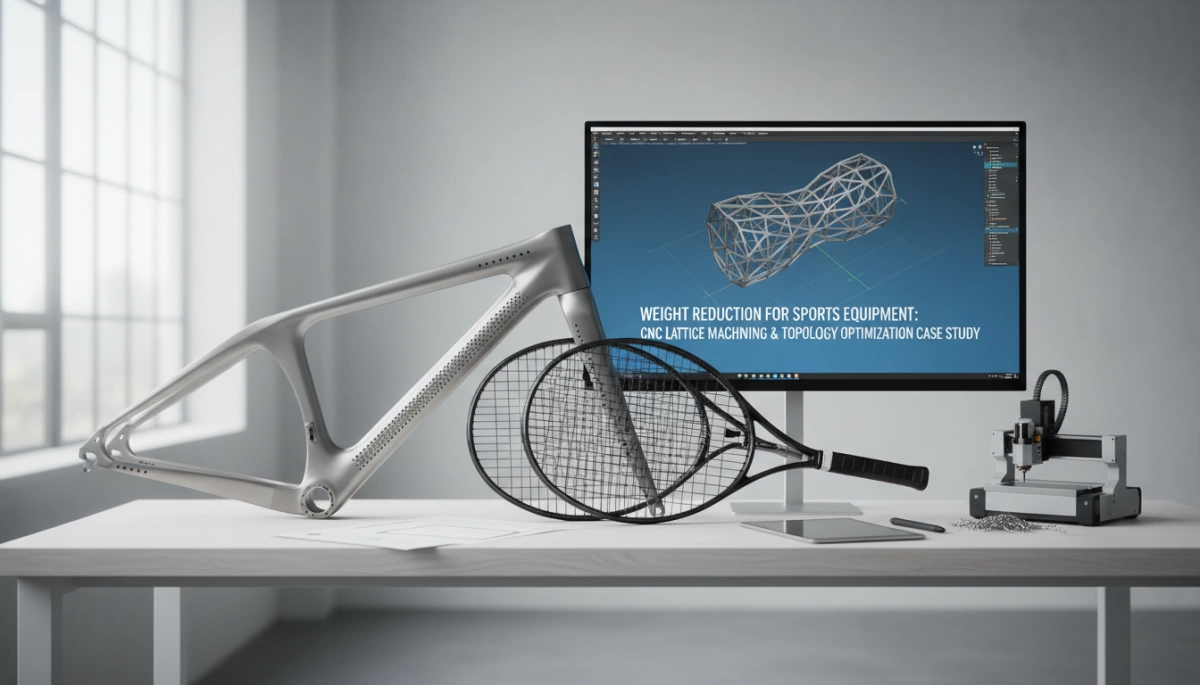
Topology Optimization and FEA Logic
In high-performance sports engineering, every unnecessary gram is a performance penalty. We utilize Topology Optimization (TO) to strip away material from non-critical zones where stress levels are negligible. By running advanced Finite Element Analysis (FEA), we map out the primary load paths of a component. This data-driven strategy ensures that we only retain material where it is mathematically required to support the load.
Integrating Lattice Structures
Where topology optimization defines the "macro" shape, Lattice Structures handle the "micro" volume. We replace solid internal sections with complex geometric patterns to maintain Structural Rigidity while drastically lowering mass. These patterns are engineered to handle specific Mass Reduction Strategies without compromising the part's safety factor.
- Weight Reduction: Achieves 20%–50% lighter parts than traditional solid designs.
- Energy Management: Specific lattice cells excel at vibration dampening for cycling and motorsports.
- Stiffness-to-Weight: Maximizes the High Strength-to-Weight Ratio required for elite-level athletics.
The CNC Advantage: Subtractive vs. Additive
A frequent concern in R&D is whether to 3D print or CNC machine these complex geometries. I prioritize 5-Axis CNC Milling because sports equipment demands extreme Fatigue Resistance. Unlike 3D printing, which can introduce microscopic porosity and anisotropic weaknesses, CNC machining from a solid Aerospace Grade Aluminum 6061-T6 or Titanium billet ensures consistent Structural Integrity.
| Feature | CNC Machining (Subtractive) | 3D Printing (Additive) |
|---|---|---|
| Material Integrity | 100% Dense (No voids) | Risk of internal porosity |
| Surface Finish | Micron-level precision | Often requires heavy post-processing |
| Fatigue Life | Superior for cyclic loading | Prone to crack initiation at layers |
| Mechanical Properties | Isotropic (Strong in all directions) | Anisotropic (Directional weakness) |
By leveraging CAD/CAM Integration, we overcome traditional Subtractive Manufacturing Constraints. We use the precision of CNC to ensure that the finished product meets strict Surface Finish Requirements, which is vital for components that interface with bearings or high-speed airflow. This transition from "un-machinable" concepts to reality is the core of our Precision Engineering for Sports.
Overcoming the "Un-machinable" Myth in CNC Lattice Machining
Many designers believe that complex lattice structures are strictly the territory of 3D printing. I’m here to tell you that’s a myth. While traditional setups might struggle with deep, angled pockets, modern 5-Axis CNC Milling has completely changed the game for high-performance sports equipment.
5-Axis Precision vs. 3-Axis Limits
Standard 3-axis machines often hit a wall when trying to clear material from the intricate, hollowed-out designs required for Weight Reduction for Sports Equipment: CNC Lattice Machining & Topology Optimization. By using 5-axis centers, we can rotate the part and the tool simultaneously, reaching angles that were previously impossible.
Understanding the differences between 5-axis CNC machining and 3-axis CNC machining is the first step in realizing that "un-machinable" is often just a limitation of older hardware. Our 5-axis capabilities allow us to maintain the Structural Integrity of a part while carving out complex internal geometries.
Managing Complex Tool Entries and Toolpaths
Creating a functional lattice isn't just about cutting holes; it's about aggressive Tool Path Optimization. We rely on advanced CAD/CAM Integration to navigate tight spaces without compromising the part.
- Collision-Free Paths: Advanced software simulates every move to ensure the tool holder never touches the workpiece.
- Subtractive Manufacturing Constraints: We design specific entry strategies, like helical or ramped entries, to manage the load on small-diameter tools.
- Precision Pockets: Using specialized cutters to clear lattice "cells" while maintaining Design for Manufacturability (DFM) standards.
By bridging the gap between generative design and the machine shop, we ensure that every weight-reduction strategy is both physically possible and repeatable for small-batch production.
Case Study: Weight Reduction for a High-Performance Rocker Arm
We recently tackled a project involving a mountain bike rocker arm—a component that demands an extreme High Strength-to-Weight Ratio. The goal was a 30% mass reduction without sacrificing any stiffness or increasing deflection under heavy trail loads. This required a shift from traditional pocketing to advanced Weight Reduction for Sports Equipment: CNC Lattice Machining & Topology Optimization.
The Precision Workflow
To achieve these results, we followed a rigorous engineering path:
- Load Case Mapping: We used Finite Element Analysis (FEA) to identify the specific stress paths during high-impact landings.
- Iterative Topology Optimization: Our team ran Generative Design cycles to strip away material from non-critical zones.
- Lattice Infill Integration: We replaced solid sections with complex geometric lattices to maintain Structural Integrity while shedding weight.
- 5-Axis CNC Milling: We utilized high-speed spindles to reach into the complex pockets that standard machines can't touch.
Performance Metrics and Durability
The final prototype wasn't just lighter; it was smarter. By focusing on Design for Manufacturability (DFM), we ensured the part could be machined from a single block of 7075 aluminum. To keep R&D moving, we utilized strategies to speed up CNC lead times and delivered the finished component for field testing within a week.
| Metric | Original Design | Optimized Design |
|---|---|---|
| Weight | 240g | 165g (31% Reduction) |
| Max Deflection | 0.12mm | 0.11mm |
| Safety Factor | 2.1 | 2.0 |
The result was a component that felt noticeably more "flickable" on the bike while surviving rigorous fatigue testing. This case study proves that when you combine subtractive manufacturing precision with modern optimization, you don't have to choose between weight and strength.
Material Selection: The Backbone of Weight Reduction for Sports Equipment
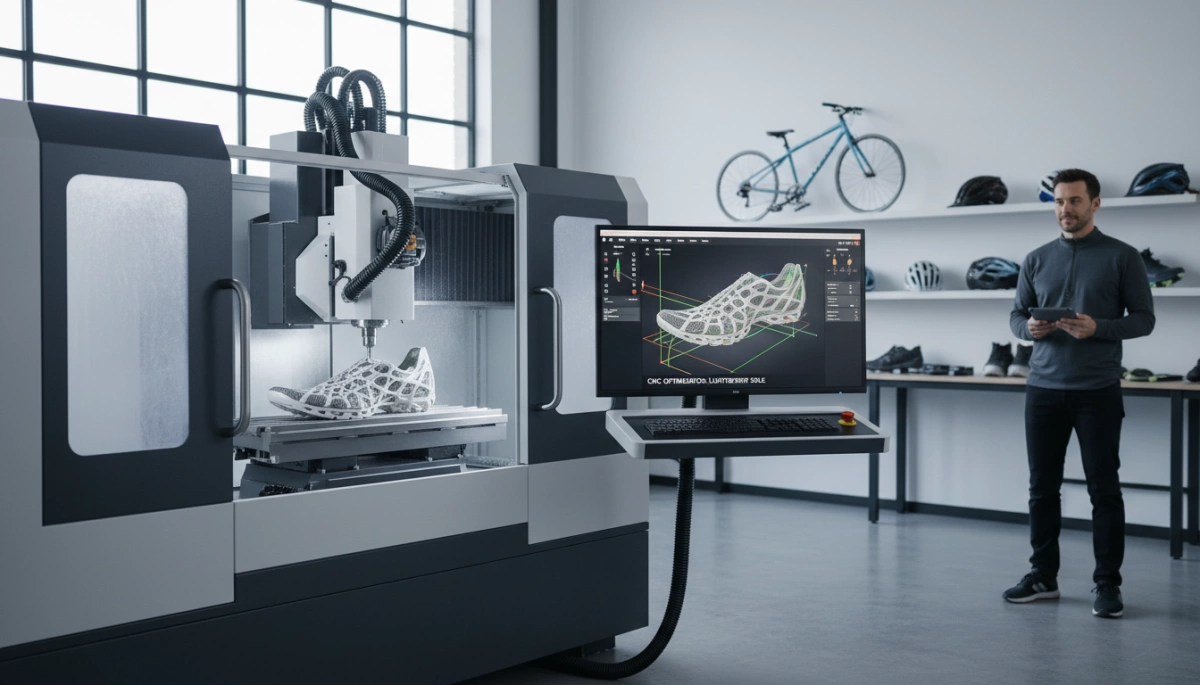
In high-performance engineering, the material is just as important as the geometry. When we execute Weight Reduction for Sports Equipment, we start by matching the mechanical requirements of the part with the specific properties of the alloy. Choosing the right substrate ensures that topology optimization results in a part that is light but remains stiff under load.
Aluminum 6061 and 7075: Cost-Effective Strength
Aluminum is the standard for most athletic hardware due to its excellent strength-to-weight ratio. We typically utilize two main grades:
- Aluminum 6061-T6: Ideal for general components like brackets and frames. Our expertise in aluminum 6061 machinability and DFM allows us to maximize material removal while keeping costs in check.
- Aluminum 7075-T6: Used for high-stress applications like mountain bike rocker arms. It offers higher yield strength, allowing for thinner walls and more aggressive weight-saving pockets.
Titanium Gr5 for Extreme Fatigue Life
For elite-level gear where failure isn't an option, Titanium Grade 5 (Ti-6Al-4V) is our preferred choice. It thrives in extreme environments and offers a fatigue life far superior to aluminum. Understanding how to select precise CNC machining materials is critical here, as titanium's toughness requires specialized tooling to maintain the integrity of complex lattice structures.
Precision Milling to Prevent Warping
Aggressive weight reduction often results in thin-walled sections that are susceptible to "springing" or warping due to internal material stresses. We counter this through:
- Stress Relieving: Utilizing heat treatment cycles to stabilize the material before final finishing.
- High-Speed Toolpaths: Reducing cutting forces to prevent deflection in delicate lattice webs.
- Symmetric Machining: Removing material evenly from both sides of the part to balance residual tension.
| Material | Strength-to-Weight | Fatigue Resistance | Typical Use Case |
|---|---|---|---|
| Aluminum 6061 | Good | Moderate | General sports brackets |
| Aluminum 7075 | Excellent | High | Racing pedal assemblies |
| Titanium Gr5 | Superior | Extreme | High-impact suspension components |
Our focus is on ensuring that every gram removed contributes to a faster, more agile product without sacrificing structural safety.
Is CNC Lattice Machining Viable for Weight Reduction?

When discussing Weight Reduction for Sports Equipment: CNC Lattice Machining & Topology Optimization, the ultimate question is always about the bottom line. Is the performance gain worth the engineering investment? In high-performance sports where every fraction of a second counts, the economic reality favors precision CNC over almost any other method.
Analyzing the Cost-Per-Gram Saved
We evaluate the viability of a project by looking at the cost-per-gram removed. While traditional milling might seem cheaper, an optimized part reduces wear on other components and improves athlete efficiency.
- Material Efficiency: By using Topology Optimization, we only keep the material that carries the load, reducing the raw weight of expensive alloys like Titanium.
- Structural Value: Unlike 3D printing, which can suffer from porosity, a CNC-machined lattice maintains the structural integrity of the original billet.
- Lower Finishing Costs: CNC produces a superior surface finish immediately, removing the need for expensive post-processing often required by additive manufacturing.
Rapid Prototyping: From CAD to 7-Day Delivery
In the R&D phase of sports gear, speed is everything. We’ve optimized our pipeline to ensure that complex, lattice-heavy designs don't stall your development cycle.
- Direct CAM Integration: Our advanced software converts your optimized CAD files into toolpaths with minimal manual intervention.
- Accelerated Timelines: We offer a 7-day delivery window for most optimized prototypes, allowing for rapid iterative testing.
- Global Reach: As a China custom CNC machining supplier for overseas buyers, we specialize in getting high-performance prototypes into the hands of international engineering teams quickly.
Scalability for Customization and Small Batches
CNC machining is the bridge between a one-off prototype and full-scale production. It offers a level of scalability that makes bespoke sports equipment accessible for pro teams and enthusiasts alike.
- Bespoke Customization: We can easily adjust lattice density or pocket depth to suit the specific weight and power output of an individual athlete.
- Small-Batch Economics: Our setup is designed to handle low-volume runs without the massive overhead of traditional die-casting or injection molding.
- Industrial Precision: We apply the same rigorous standards found in our custom CNC machining services for machinery and robotics parts to ensure every sports component meets safety and performance thresholds.
Why Partner with ZSCNC for Advanced Weight Reduction?

We understand that in high-performance sports, a few grams can be the difference between a podium finish and middle-of-the-pack results. At ZSCNC, we specialize in turning complex topology optimization data into physical reality. Our facility is built to handle the extreme demands of Weight Reduction for Sports Equipment: CNC Lattice Machining & Topology Optimization.
Our Precision and Technology Stack
Structural safety is non-negotiable. When we remove material to lighten a component, the remaining structure must be flawless. We utilize micron-level precision to ensure that every lattice strut and thinned wall meets your exact engineering specifications.
- Advanced Fleet: We operate 40+ CNC machines, including high-speed 3-axis and 4-axis units.
- 5-Axis Centers: Our dedicated 5-axis milling centers allow us to execute complex toolpaths for internal lattice pockets that traditional shops find "un-machinable."
- Expert Consulting: We help refine your design for 5-axis CNC machining to ensure the best high strength-to-weight ratio.
Speed and Scalability for R&D Cycles
We move as fast as the athletes who use our parts. Our workflow is optimized for rapid R&D and bespoke production:
| Feature | ZSCNC Advantage |
|---|---|
| Quoting Speed | Detailed quotes delivered within 24 hours. |
| Prototyping | Rapid CAD-to-Part transition for iterative testing. |
| Production | Scalable from one-off prototypes to small-batch racing series. |
| Quality Control | Comprehensive inspection to verify structural integrity. |
By choosing us as your manufacturing partner, you gain access to the precision engineering required for mass reduction strategies without the typical lead times of traditional aerospace shops. We bridge the gap between complex generative design and practical, durable sports hardware.
FAQ: Weight Reduction for Sports Equipment through CNC Lattice Machining
I get a lot of questions about how we actually pull off these complex builds. Here is the direct breakdown of what you need to know about Weight Reduction for Sports Equipment: CNC Lattice Machining & Topology Optimization.
How does CNC lattice machining compare to 3D printing for sports gear?
While 3D printing is great for purely visual prototypes, subtractive manufacturing via CNC is the gold standard for parts that actually take a beating. CNC-machined parts offer much higher structural integrity and better fatigue resistance because they are cut from a solid block of forged material. For high-performance gear, knowing when to switch from 3D printing to CNC machining is critical to ensuring the part survives real-world impact.
Can topology optimization be applied to existing sports equipment designs?
Absolutely. We take your current CAD files and run Finite Element Analysis (FEA) to find where the stress actually sits. By applying topology optimization to an existing design, we can strip away non-critical material and replace solid sections with high-performance lattice pockets. This often results in a 20-40% mass reduction without increasing deflection.
Is 5-axis milling necessary for all lattice structures?
In most cases, yes. To get a high strength-to-weight ratio in a complex component, we have to clear out material from angles that a standard 3-axis machine simply can't reach. Advanced 5-axis CNC milling allows us to tilt the part or the tool to prevent collisions and maintain a perfect surface finish inside the lattice pockets.
What are the typical lead times for an optimized prototype?
We understand that R&D moves fast.
- Quotes: Delivered within 24 hours.
- Prototyping: Generally 7 days from CAD approval to shipping.
- Small Batches: Scalable production usually takes 2-3 weeks depending on the complexity of the tool path optimization.
| Feature | CNC Lattice Machining | Standard 3D Printing (DMLS) |
|---|---|---|
| Material Density | 100% (Solid Stock) | 98-99% (Porous) |
| Fatigue Life | Exceptional | Moderate |
| Surface Finish | Ra 0.8 - 3.2 µm | Rough (Requires post-op) |
| Precision | Micron-Level | Variable |
 English
  German
  Dutch
Dutch  Russian
  Czech
Czech  French
  Korean
  Japanese
  Spanish
  Portuguese