

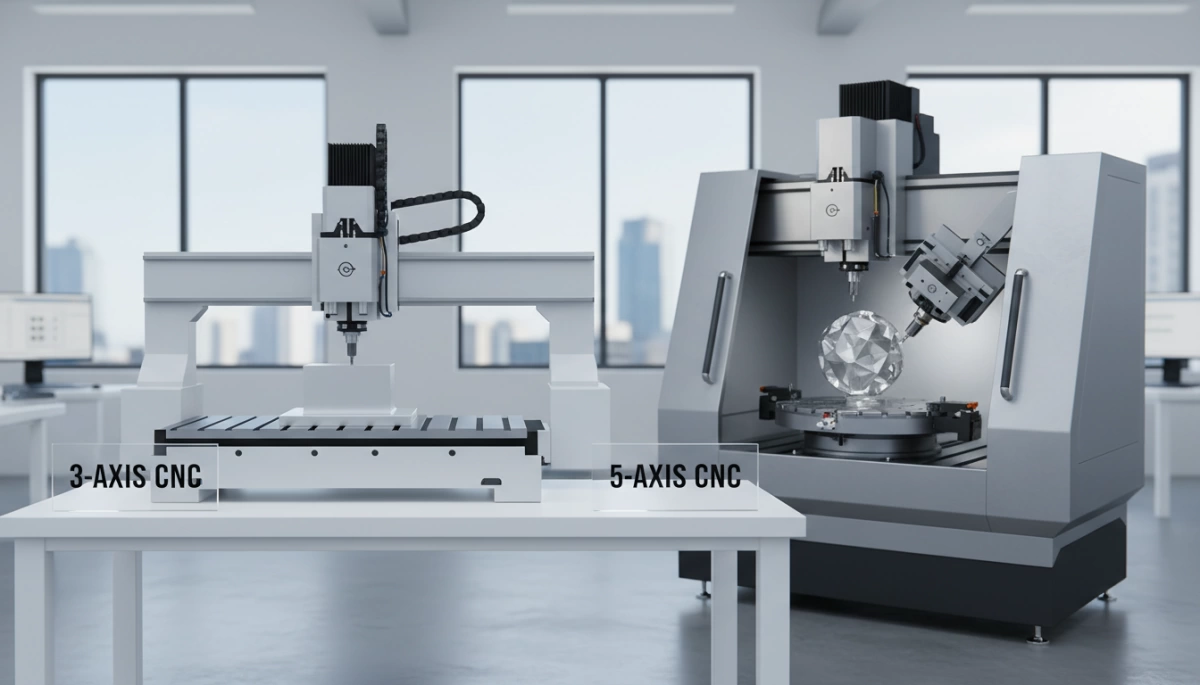
If you’re trying to decide between 5-axis CNC machining and 3-axis CNC machining, the wrong choice can quietly drain your budget, limit your part quality, and slow down your entire production line.
Both technologies look similar from the outside—a spindle, a table, cutting tools—but under the hood, they’re built for very different jobs. 3-axis CNC machining is ideal for simpler, prismatic parts and lower-cost setups. 5-axis CNC machining, with its extra rotational axes and simultaneous multi-axis linkage, is built to handle complex geometries, tighter accuracy, and better surface finish in fewer setups.
In this guide, you’ll see exactly how 3-axis vs. 5-axis compare in terms of movement, precision, setup time, cost, and real-world applications—and, most importantly, how to know which one actually makes sense for your parts and your budget.
What Is 3-Axis CNC Machining?
3-axis CNC machining is the most common and straightforward form of CNC milling. The cutting tool moves in three linear axes:
- X-axis: left and right
- Y-axis: front and back
- Z-axis: up and down
The workpiece stays fixed on the table (or in a simple vise/fixture), while the spindle and cutting tool move along these three directions. There is no rotational motion of the part or the tool head like you see in 5-axis CNC machining.
How the Tool Moves on X, Y, and Z
In a 3-axis CNC machine:
- The spindle (tool holder) travels in X, Y, and Z to reach any point within the machine’s work envelope.
- The tool always points in one direction—typically straight down (along the Z-axis).
- All features are cut from one primary tool orientation, so every surface you want to machine must be accessible from that direction.
This makes 3-axis ideal for flat parts, pockets, slots, holes, and simple 2.5D shapes where no complex tool tilting is required.
Common 3-Axis Configurations and Setups
Typical 3-axis CNC configurations include:
- Vertical machining centers (VMCs): The most widely used; spindle is vertical, workpiece sits on a horizontal table.
- Table + vise setups: Standard for plates, blocks, brackets, and general machining.
- Simple modular fixturing: Clamps, angle plates, and soft jaws to hold workpieces from one or more sides.
In most shops, a well-equipped 3-axis machine with smart fixturing can handle a large percentage of everyday machining work.
Typical 3-Axis CNC Workflow
For 3-axis CNC machining, the workflow is usually clear and efficient:
- Load the part into a vise or fixture and clamp securely.
- Locate the zero point (work offset) using an edge finder, probe, or reference surface.
- Load tools into the tool changer and set tool lengths.
- Run the CAM program, usually with 2D or 2.5D toolpaths (facing, pocketing, contouring, drilling).
- Flip or re-clamp the part for other faces if needed, then re-zero and machine the remaining surfaces.
Because all movement is limited to X, Y, and Z, programming, setup, and operation are simpler compared with multi-axis CNC machining, and this is exactly why many shops start with a 3-axis CNC machine before stepping up to 5-axis or other multi-axis CNC solutions.
What is 5-axis CNC machining?
5-axis CNC machining means the cutting tool can move in five directions at the same time: the standard linear axes X, Y, Z, plus two rotational axes (usually A, B, or C). Instead of only moving left–right, front–back, and up–down, the tool or the table can also tilt and rotate, so we can reach more faces of the part in a single setup.
X, Y, Z + A, B, C axes explained
- X, Y, Z – straight-line motion (left/right, forward/back, up/down)
- A axis – rotation around the X axis
- B axis – rotation around the Y axis
- C axis – rotation around the Z axis
A typical 5-axis CNC configuration is:
- XYZ + A + C (table rotates and tilts), or
- XYZ + B + C (head tilts and spindle rotates)
This extra rotational motion is what separates 5-axis vs 3-axis CNC machining and gives us better tool access on complex parts.
Simultaneous 5-axis vs indexed 3+2 machining
In multi-axis CNC machining, there are two main ways to use 5 axes:
- Simultaneous 5-axis machining
All five axes move together at once. This is ideal for:- Organic, freeform surfaces
- Turbine blades, impellers, medical implants
- High-end mold and die work
The tool can continuously change orientation, keeping the best cutting angle and chip load.
- Indexed 3+2 (positional) 5-axis machining
The two rotary axes position the part (or head) to an angle, then machining is done using 3-axis moves only.- Great for multi-side parts in one setup
- Simpler programming than full 5-axis
- Much less fixturing compared to 3-axis only
Both approaches massively improve workpiece accessibility and reduce setups, which is why we built our own 5-axis CNC machining services around this capability.
How rotational axes improve tool orientation and linkage
With 5-axis, I can:
- Tilt the tool away from vertical to maintain the ideal cutting angle
- Shorten tool overhang, reducing vibration and deflection
- Avoid collisions with clamps and part features
- Link multiple surfaces in a single smooth toolpath (multi-axis linkage) for better surface continuity
This tool orientation control in 5-axis is the core reason why 5-axis CNC machining achieves higher precision, better surface finish, and faster machining on complex geometries compared to traditional 3-axis CNC machining.
Core differences between 5-axis and 3-axis CNC machining
When people ask about 5-axis vs 3-axis CNC machining, they’re really asking about control, access, and cost. Here’s the core breakdown.
Axes and degrees of freedom
| Machine type | Linear axes | Rotational axes | Typical use name |
|---|---|---|---|
| 3-axis CNC machine | X, Y, Z | None | Standard CNC milling |
| 5-axis CNC machine | X, Y, Z | A, B or A, C | Multi‑axis / 5-axis CNC |
- 3-axis: Tool moves in straight lines only. The part stays fixed; we move X, Y, Z.
- 5-axis: Same X, Y, Z plus two rotary axes that tilt/rotate the part or the spindle, giving extra degrees of freedom for tool orientation.
Workpiece accessibility and reachable surfaces
- 3-axis CNC machining:
- Best for top-down and simple side features.
- Any hidden faces, deep pockets, or undercuts usually need extra setups, custom fixtures, or EDM.
- 5-axis CNC machining:
- We can tilt and rotate the part or spindle, so we reach multiple faces in one clamping.
- Much better workpiece accessibility for multi-side parts, deep cavities, and complex geometries.
Tool approach angles and orientation
- 3-axis:
- Tool always approaches perpendicular to one plane.
- Limited tool angle; hard to maintain consistent angles on organic or sculpted surfaces.
- 5-axis:
- We control tool orientation freely, keeping the cutter normal to the surface.
- This improves:
- Access to undercuts and complex contours
- Surface finish quality on 3D shapes
- Cutting efficiency with shorter tools and better chip evacuation
If you’re dealing with precision aluminum parts with multiple critical faces, this is exactly where a 5-axis setup shines, and it’s why we use it heavily on our custom CNC machined automotive parts.
Programming difficulty and operational complexity
| Aspect | 3-axis CNC machining | 5-axis CNC machining |
|---|---|---|
| CAM programming | Easier, standard 2D/2.5D/3D toolpaths | More complex, needs strong multi-axis CAM |
| G-code & post processor | Simple and widely available | Needs tuned post and machine-specific setup |
| Operator skill requirement | Suitable for junior–mid operators | Requires experienced programmers and machinists |
| Risk of collision | Lower, easier to visualize | Higher; you must manage tool, head, and fixture |
In short, 3-axis CNC wins on simplicity and cost, while 5-axis CNC machining wins on reach, angles, and control over complex parts.
Accuracy differences between 5-axis and 3-axis CNC machining
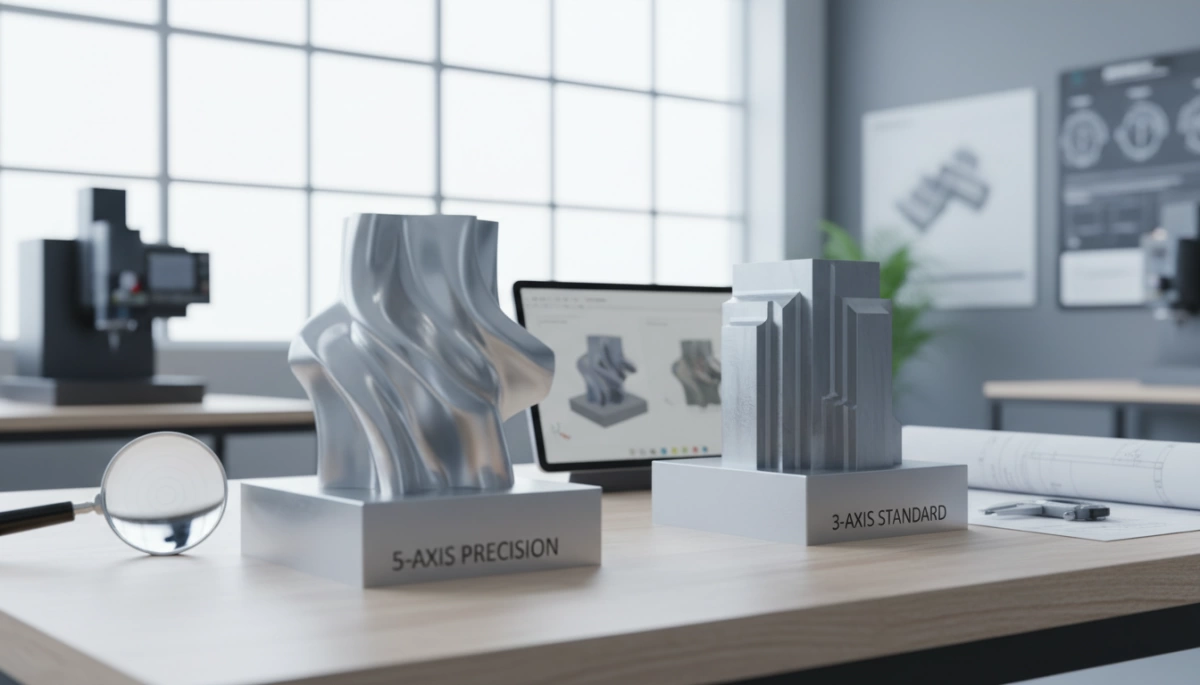
When we talk about 5-axis vs 3-axis CNC machining, the biggest real-world gap is accuracy and consistency on complex parts.
How setups and re-clamping hurt 3-axis accuracy
On a 3-axis CNC machine, every time you flip the part you risk:
- Small location errors from re-clamping
- Stack-up of fixture, probing, and operator errors
- Misalignment between faces, angles, and hole positions
For simple brackets or plates, this might be fine. But for tight-tolerance parts, multiple setups on 3-axis can easily add 0.02–0.05 mm of cumulative error, especially across 4–6 faces.
How 5-axis multi-axis linkage improves precision
With 5-axis CNC machining, we usually complete most faces in one setup using multi-axis linkage:
- The machine rotates the part instead of the operator
- Critical features stay in a single coordinate system
- Angles, hole patterns, and complex surfaces line up much better
By dynamically controlling tool orientation (A/B/C axes), 5-axis keeps the tool in the optimal posture, improving dimensional accuracy and positional repeatability, especially on freeform shapes and tilted surfaces.
Shorter tools, less vibration, higher accuracy
A huge advantage of 5-axis is using shorter cutting tools:
- Tool can “lean in” to deep pockets instead of reaching straight down
- Less overhang means less vibration, deflection, and chatter
- Better size control on small features and thin walls
On 3-axis, long tools are often needed to reach deep features, which increases bending and can easily cause tapered walls and size drift, especially in hard metals like machined aluminum parts.
Surface finish on complex 3D geometries
For complex 3D surfaces, 5-axis wins almost every time:
- Ability to keep the tool normal to the surface
- More consistent step-over and scallop height
- Less hand polishing and rework on molds, dies, and implants
3-axis can still achieve good finish, but only when surfaces are reachable from simple directions. Undercuts, steep walls, and deep cavities usually show visible tool marks and inconsistent finish.
Real-world accuracy: aerospace and medical
In real production, we see:
- Aerospace parts (turbine blades, blisks, structural brackets):
- Typical 5-axis tolerance bands: ±0.01–0.02 mm on critical features
- Geometry is smoother, with better airfoil shape control and tighter leading/trailing edge accuracy
- Medical implants (hip joints, spinal cages, trauma plates):
- 5-axis keeps complex organic surfaces and mating interfaces within micron-level repeatability
- Surface finish is good enough to minimize manual polishing, which protects dimensional accuracy
3-axis can hit tight tolerances on single-sided or simple 2.5D parts, but when you need multiple faces, blend-free 3D surfaces, and repeatability across large batches, 5-axis CNC machining delivers more stable accuracy and better surface quality at scale.
Pros and cons of 3-axis CNC machining
3-axis CNC machining is still the backbone of most shops, and for good reason. When you’re comparing 5-axis vs 3-axis CNC machining, here’s how 3-axis really stacks up.
Advantages of 3-axis CNC machining
1. Lower machine cost and simple operation
If you’re watching budget, a 3-axis CNC is the most cost-effective entry into multi-axis CNC machining.
- Lower purchase price than 5-axis
- Easier to install, maintain, and run
- Ideal for shops building up capacity step by step
2. Faster for simple and 2.5D work
For flat plates, prismatic parts, and basic 2.5D features (pockets, slots, holes), a 3-axis mill is often faster and cheaper per part:
- Shorter programming times
- Standard fixturing and tooling
- Great for brackets, covers, small housings, and general metal or plastic machining
3. Easier programming and training
CAM programming on a 3-axis is straightforward compared to simultaneous 5-axis machining:
- Short learning curve for new machinists
- Simple toolpaths and post-processors
- Less risk of collisions and programming errors
Limitations of 3-axis CNC machining
1. Struggles with complex geometries and undercuts
When parts have deep cavities, undercuts, or multiple critical angles, the difference between 3-axis and 5-axis CNC becomes obvious:
- Limited tool orientation control
- Harder to reach hidden or angled surfaces
- More manual finishing on complex 3D shapes
2. More setups and alignment risks
To machine multiple faces, you have to re-clamp and re-zero the part:
- Extra setups increase cycle time
- Each setup adds potential alignment error
- Tighter tolerances are harder to hold across several faces
For simple, flat, or moderately complex parts, 3-axis CNC machining is still the most cost-effective and user-friendly solution. Once you start chasing complex geometries, fewer setups, and tighter tolerances, that’s where 5-axis begins to pull ahead.
Pros and Cons of 5-Axis CNC Machining
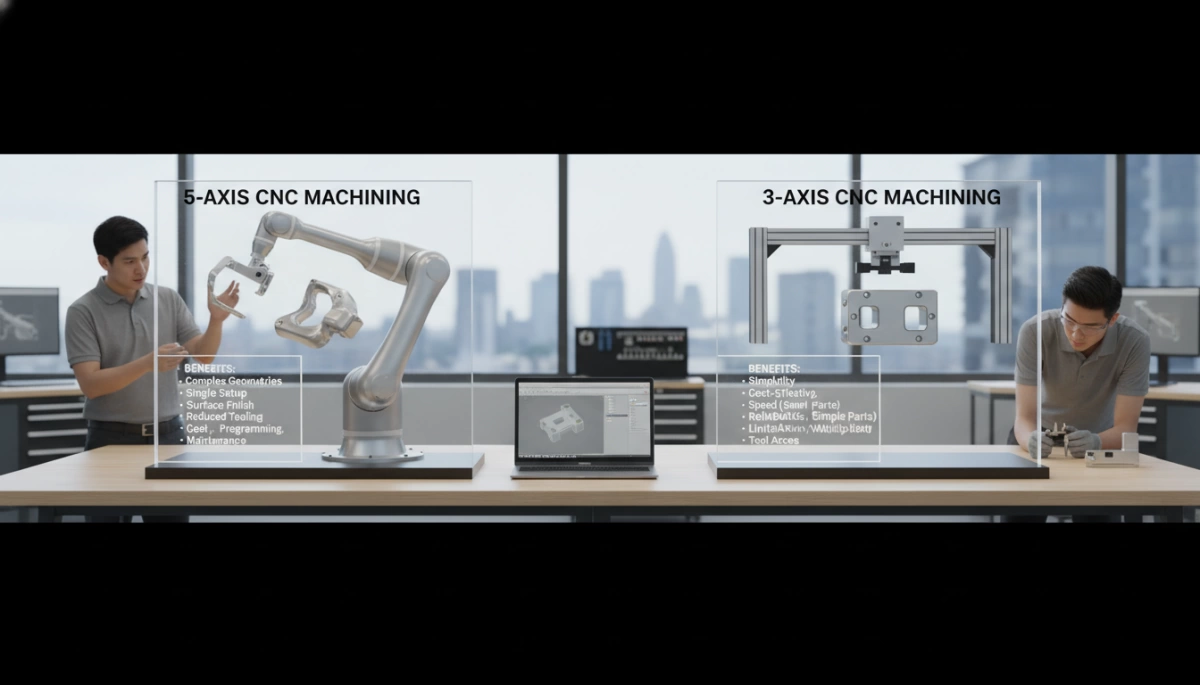
Key Advantages of 5-Axis CNC Machining
1. Machine complex shapes in one setup
With 5-axis CNC machining, I can tilt and rotate the part or the tool, so I reach multiple faces in a single clamping. That’s a huge win when you’re dealing with:
- Organic freeform surfaces
- Parts with deep pockets, undercuts, and tight corners
- Components like turbine blades, impellers, and complex molds
This multi-axis CNC machining approach cuts down on human error from multiple re-clamps and keeps all features aligned to the same datum.
2. Reduced fixturing and setup time
Because 5-axis gives better workpiece accessibility, I don’t need a complex stack of fixtures to reach each side. That means:
- Fewer custom fixtures and lower fixturing cost
- Faster changeovers between jobs
- Less setup time for multi-side parts
For many shops, this reduced setup time in 5-axis is what drives the strongest ROI, especially on repeat work and production runs.
3. Higher accuracy and better surface finish
By optimizing tool orientation control in 5-axis, I can:
- Use shorter, stiffer tools (less vibration and deflection)
- Keep the cutter in the ideal contact angle on freeform surfaces
- Maintain tighter CNC machining tolerances over multiple faces
The result is better CNC surface finish quality and fewer hand-polishing steps, which matters a lot for aerospace CNC machining parts, molds, and medical implant CNC machining. If you’re pairing 5-axis milling with the right materials and finishing options, a broad capability setup like our CNC machining and fabrication services can hit very demanding specs.
Key Drawbacks of 5-Axis CNC Machining
4. Higher machine and maintenance cost
5-axis CNC machines are more expensive than 3-axis, both to buy and maintain:
- Higher purchase price and longer payback period if volume is low
- More complex components (rotary tables, trunnions, swiveling heads) to service
- Tighter maintenance schedules to keep accuracy stable
You need to match this investment to the complexity and volume of your work, not just buy 5-axis because it sounds advanced.
5. Advanced CAM programming and skilled operators required
5-axis vs 3-axis CNC machining isn’t just hardware—programming and people matter:
- Toolpaths are more complex (simultaneous 5-axis machining and indexed 3+2 5-axis machining)
- Collision risk is higher, so simulation and verification are mandatory
- Operators and programmers need experience with multi-axis CNC machining and high-end CAM
If the team isn’t ready, the extra capability can slow you down instead of speeding you up.
Cost comparison of 3-axis vs 5-axis CNC machines
When you compare 5-axis vs 3-axis CNC machining, the biggest decision-maker is total cost, not just the sticker price.
Initial purchase cost: 3-axis vs 5-axis
- 3-axis CNC machines
- Lower upfront cost, ideal if you’re building up capacity step by step
- Good entry point for job shops, prototyping, and general manufacturing
- 5-axis CNC machines
- Significantly higher purchase price (machine, control, rotary axes, probing)
- Best for shops that already have a steady flow of complex geometries and high-value parts
If you’re planning a bigger investment or want to understand how different configurations fit your growth path, it’s worth looking at how brands like ZSCNC structure their machine portfolio and support model on their company resources and technical guides.
Maintenance and service costs
- 3-axis
- Fewer moving components and simpler kinematics
- Lower annual maintenance and easier access to local service
- 5-axis
- More complex drives, rotary tables, and trunnions = higher service cost
- Needs tighter calibration to maintain multi-axis CNC machining accuracy
Tooling and fixturing costs
- 3-axis CNC machining
- More custom fixtures and vises for multiple setups
- Cheaper per tool, but more tools and dedicated fixtures for each face
- 5-axis CNC machining
- You often spend more on premium tools and modular 5-axis workholding
- But you save on the number of fixtures, since one setup can reach more faces
Programming and labor cost impact
- 3-axis
- Easier CAM programming, shorter learning curve
- But more setups, more handling, and higher risk of human error
- 5-axis
- Higher CAM software cost and more advanced programming skills required
- Labor per part often drops thanks to reduced setup time in 5-axis, fewer re-clamps, and less manual deburring
How complexity and volume affect 5-axis ROI
5-axis only pays off if the work justifies it. In simple terms:
- Good fit for 5-axis investment
- Complex geometries, undercuts, deep cavities
- Tight tolerances across multiple faces
- Medium to high production volume of intricate components
- Better fit for 3-axis
- Flat plates, brackets, simple prismatic parts
- Low-volume or mixed one-off jobs
The ROI on a 5-axis CNC comes from fewer setups, higher precision, and better surface finish, especially in aerospace, medical, and high-end automotive work. If your parts are mostly simple and low volume, a solid 3-axis platform is still the smarter financial move.
Applications and industries for 3-axis and 5-axis CNC machining
Typical 3-axis CNC applications
3-axis CNC machining is still the workhorse for everyday parts. I use it when parts are mostly flat or prismatic and don’t need extreme angles. Common 3-axis jobs include:
- Flat plates and end plates with pockets, holes, and slots
- Enclosures and housings for electronics and machinery
- Brackets, bases, and simple fixtures
- Prototype parts where speed and low cost matter more than complex geometry
Most general manufacturing shops, prototyping labs, and job shops rely heavily on 3-axis because it’s cheaper to run and easy to staff and schedule.
Typical 5-axis CNC applications
5-axis CNC machining comes in when the geometry gets tricky or tolerances get tight across multiple faces. I use 5-axis for:
- Turbine blades, impellers, blisks, and pump wheels
- Complex molds and dies with freeform surfaces
- Medical implants and instruments (hips, knees, spine parts, surgical tools)
- Precision fixtures with multi-face datums and tight true position
If you’re in aerospace, medical, automotive, or energy, 5-axis quickly becomes less of a “nice to have” and more of a requirement. For example, our customers in aerospace machining and medical CNC manufacturing lean heavily on simultaneous 5-axis for consistent accuracy and surface quality.
5-axis in aerospace, automotive, and energy
5-axis CNC really shines in:
- Aerospace: structural components, brackets with multiple angles, engine parts, complex housings
- Automotive and motorsport: cylinder heads, intake and exhaust ports, mold tools, prototype performance parts
- Energy: turbine components, valve bodies, flow components for oil & gas and power generation
Here, you’re dealing with complex geometries, tight tolerances, and high-value materials—exactly where multi-axis CNC machining pays off.
3-axis in general manufacturing and prototyping
3-axis CNC remains ideal for:
- General industrial components (plates, spacers, machine parts)
- Low- to mid-volume prototypes and engineering validation parts
- Job shops doing mixed, cost-sensitive work
- Simple jigs and fixtures that don’t need multi-face machining in one setup
If parts can be done in one to three simple setups, 3-axis is usually the most cost-effective choice.
Matching geometry and tolerances to axis count
To decide between 5-axis vs 3-axis CNC machining, I always look at:
- Part geometry
- Mostly flat and prismatic → 3-axis
- Complex curves, undercuts, deep cavities, multi-angle features → 5-axis
- Tolerance and surface finish
- Standard tolerances and basic finishes → 3-axis is fine
- Tight tolerances across multiple faces or high-end surface finish → 5-axis gains an edge
- Access and tool reach
- Features reachable from top/side with standard tools → 3-axis
- Awkward angles, hard-to-reach areas, long slender tools → 5-axis with better tool orientation control
In short: simple shape + normal tolerance = 3-axis.
Complex geometry + tight tolerance + multiple faces = 5-axis.
When to choose 3-axis CNC machining
If you’re trying to decide between 5-axis vs 3-axis CNC machining, there are plenty of cases where a good 3-axis CNC is the smarter, more profitable choice.
Best fit for simple geometries
Choose 3-axis CNC machining when your parts are:
- Flat plates, enclosures, brackets, blocks, or simple pockets
- Mostly 2D or 2.5D features (holes, slots, steps, simple contours)
- Without deep undercuts, complex freeform surfaces, or tricky approach angles
In these cases, the difference between 3-axis and 5-axis CNC doesn’t bring real value—the extra axes simply won’t be used.
Ideal for low-volume and tight budgets
3-axis CNC machining makes sense when:
- You run low-volume or prototype jobs and don’t want high machine overhead
- Your budget is better spent on materials, inspection, or finishing instead of premium 5-axis equipment
- You need reliable, high precision CNC machining without paying for capabilities you don’t fully use
Machine cost, maintenance, and training are all lower on a 3-axis, which keeps total project cost under control.
Parts done in a few basic setups
If a part can be finished in one to three setups with simple workholding, 3-axis CNC milling is usually enough:
- Standard vises, clamps, or simple fixtures are all you need
- Setup time stays reasonable and repeatability is easy to control
- Tolerances and surface finish targets can be met without multi-axis linkage
The accuracy loss from extra setups is minimal on simple parts, especially if you have solid quality control processes in place, similar to what we use on our own precision stainless steel machining for medical equipment.
When 5-axis is overkill
Skip 5-axis CNC machining when:
- The part has no undercuts or hidden faces that require tilting
- Tolerances are tight but not ultra-critical across many complex surfaces
- Cycle time and surface finish are acceptable with standard 3-axis toolpaths
In these scenarios, a well-run 3-axis CNC delivers excellent results at a lower price point, with simpler programming, easier operator training, and a faster path to consistent production.
When to choose 5-axis CNC machining
Knowing when to go with 5-axis CNC machining instead of 3-axis can make a huge difference in cost, accuracy, and lead time. Here’s when I always recommend 5-axis:
Complex contours, undercuts, and deep cavities
If your parts have:
- Freeform 3D surfaces
- Undercuts, hidden features, or compound angles
- Deep cavities where long tools would chatter on a 3-axis
then 5-axis vs 3-axis CNC machining isn’t even a debate. With multi-axis CNC machining, I can tilt the tool and reach areas a 3-axis machine simply can’t without crazy fixturing.
High precision on multiple faces
When you need:
- Tight tolerances across several faces
- Precise feature-to-feature alignment (holes, pockets, profiles)
- Consistent accuracy across the whole part
5-axis wins. Fewer setups mean fewer chances for setup error and better CNC machining precision, especially for aerospace and medical parts.
Reduce setups and handling
If you’re tired of:
- Flipping parts 3–6 times on a 3-axis
- Spending more time on fixturing than machining
- Seeing variation because of re-clamping
5-axis lets me machine more sides in one setup, cutting:
- Setup time
- Handling risk
- Scrap and rework
This is where CNC machine ROI starts to make sense.
High-volume complex components
For high-volume production of intricate parts (aerospace brackets, turbine blades, automotive housings, medical implants), 5-axis CNC applications shine because:
- Cycle times drop
- Setup is standardized
- Consistency across batches is much higher
The higher the volume and complexity, the faster 5-axis CNC pays for itself.
Premium surface finish and minimal hand work
If you need:
- Premium surface finish on freeform 3D shapes
- Reduced hand polishing or blending
- Better finish on molds, dies, and implant surfaces
5-axis lets me keep:
- Shorter tools → less vibration and deflection
- Optimal tool orientation control in 5-axis
- Smoother toolpaths with simultaneous 5-axis machining
You end up with better CNC surface finish quality and less manual labor after machining.
In short, if your parts are complex, high-precision, multi-face, and high-value, choosing 5-axis CNC machining isn’t overkill—it’s the smart move.
How to pick the right CNC solution for your shop
Choosing between 5-axis vs 3-axis CNC machining comes down to matching real‑world work, not just chasing specs. Here’s how I look at it when we configure solutions at ZSCNC.
1. Compare part complexity, tolerance, and surface finish
Start from the parts, not the machine.
- Choose 3-axis CNC when:
- Parts are flat, prismatic, or simple 2.5D (plates, brackets, simple housings)
- Tolerances are moderate (e.g. ±0.05–0.1 mm) and mostly on a few key features
- Surface finish requirements are not ultra-critical or can be hand-finished
- Choose 5-axis CNC when:
- You have complex geometries, freeform surfaces, impellers, molds, undercuts, turbine blades, or medical implants
- Tight, high precision CNC machining is needed on multiple faces in one go
- You want premium CNC surface finish quality straight off the machine
If you regularly fight with reach, awkward angles, or multiple clamped sides, a 5-axis CNC machine is usually the right call.
2. Balance budget, timeline, and operator skill
Both 3-axis and 5-axis CNC have trade-offs:
- 3-axis CNC machining:
- Lower machine price and fixturing cost
- Easier to train new operators and programmers
- Good fit for shops with limited CNC experience
- 5-axis CNC machining:
- Higher purchase and maintenance cost
- Needs stronger CAM skills and process control
- Saves time on complex parts by cutting out extra setups
If your team is newer to CNC and your work is simple, I’d start with a solid 3-axis ZSCNC mill. If you already run CAM, chase complex RFQs, or serve aerospace/medical/global export customers, the jump to 5-axis pays back faster.
3. Consider production volume and future work mix
Think about today’s jobs and the next 3–5 years:
- Go 3-axis if:
- You’re a job shop or prototyping shop doing one-offs and small batches
- Your work is mostly general manufacturing, repair, or basic components
- You’re testing the market and want a lower-risk entry
- Go 5-axis if:
- You run high-volume production of intricate parts (aerospace, automotive, energy, medical)
- You want to win global customers who expect multi-axis capability
- You plan to expand into molds/dies, turbine parts, implants, or complex housings
When the part mix is clearly moving toward complex geometries CNC machining, investing in 5-axis early gives you a real edge.
4. Questions to ask CNC manufacturers (3-axis vs 5-axis)
When you compare brands, don’t just ask for a catalog. Ask:
- What positioning accuracy and repeatability can this 3-axis / 5-axis achieve?
- Is the 5-axis simultaneous or just indexed 3+2 5-axis machining?
- What post processors and CAM packages do you support for multi-axis CNC machining?
- How do you handle service, training, and remote support in my region?
- What does a typical CNC machine ROI analysis look like for my parts?
- Can you show similar customer projects (materials, tolerances, batch size)?
- What’s the real maintenance and service cost over 5 years?
The right supplier should talk in parts, hours, and cost per piece, not only in axis count.
5. How ZSCNC positions 3-axis and 5-axis options
At ZSCNC, we design both 3-axis CNC machines and 5-axis CNC machining centers with a clear split:
- ZSCNC 3-axis line:
- For shops that need reliable, cost-effective general manufacturing CNC and CNC prototyping on 3-axis
- Focus on stable structure, easy operation, and low learning curve
- Ideal for plates, enclosures, fixtures, brackets, and standard mechanical parts
- ZSCNC 5-axis line:
- For customers growing into aerospace CNC machining parts, automotive precision components, molds and dies, and medical implant CNC machining
- Optimized for tool orientation control in 5-axis, reduced setups, and better accuracy on complex shapes
- Built for shops that want to move up the value chain and serve global, high-spec markets
If you share a few sample drawings, tolerances, and target cycle times, we can usually tell you in one conversation whether a 3-axis or 5-axis ZSCNC is the smarter investment for your shop.
FAQs on 3-axis vs 5-axis CNC machining
What is the main functional difference between 3-axis and 5-axis CNC machines?
The core difference between 3-axis and 5-axis CNC machining is how many directions the tool can move and tilt:
- 3-axis CNC machining
- Moves in X, Y, Z only (linear motion)
- Tool stays vertically oriented
- Great for flat parts, 2.5D features, simple pockets, and holes
- 5-axis CNC machining
- Moves in X, Y, Z + 2 rotational axes (A, B or A, C)
- Tool can tilt and rotate, not just move up/down/left/right
- Ideal for complex geometries, undercuts, deep cavities, and multi-face parts in one setup
In short: 3-axis = straight cuts from one direction, 5-axis = controlled tool orientation and multi-axis linkage for far better access to complex surfaces.
Does 5-axis CNC always give better accuracy than 3-axis?
No, not always. 5-axis vs 3-axis CNC machining accuracy depends on:
- Part design and setup
- If the part is simple and can be done in one or two setups on a 3-axis, accuracy can be just as good.
- When a part needs many re-clamps on a 3-axis, each setup adds alignment error.
- Where 5-axis wins
- Fewer setups and less handling → less cumulative error
- Better tool posture (shorter tools, tilted correctly) → less deflection and vibration
- More consistent accuracy on multi-face and 3D freeform parts
So, 5-axis doesn’t magically beat 3-axis on every job, but for complex parts, tight tolerances across multiple faces, and demanding surface finish, 5-axis machining normally delivers higher and more stable accuracy.
When is 5-axis CNC machining worth the extra investment?
5-axis CNC is worth it when:
- You’re machining:
- Turbine blades, impellers, blisks
- Medical implants, bone plates, dental parts
- Molds and dies, complex automotive or consumer product surfaces
- Aerospace brackets and structural parts with features on multiple sides
- You need:
- High precision across several faces in one clamping
- Reduced setup time and less manual handling
- Premium surface finish that minimizes hand polishing
- High-volume production of complex parts where every saved minute matters
If you run mostly simple plates, brackets, and 2.5D parts, 5-axis is often overkill. If your work is trending toward complex, high-value parts with tight deadlines, 5-axis pays for itself in throughput, accuracy, and reduced rework.
Can I upgrade a 3-axis machine to 5-axis capability?
Yes, but with limits:
- Add-on 4th / 5th axis tables
- You can add a rotary or trunnion table to some 3-axis machines
- This gives indexed 3+2 5-axis machining (tilt and lock, then cut with 3 axes)
- Great for multi-side machining with fewer setups
- Limitations
- Not true simultaneous 5-axis unless both machine and controller fully support it
- May be less rigid and less accurate than a purpose-built 5-axis machining center
- Work envelope shrinks because the rotary table eats up space and Z-height
If you’re testing the waters, a 3-axis with a 4th/5th axis add-on can be a smart step. For heavy multi-axis CNC machining and serious complex parts, a dedicated 5-axis is the right long-term move.
Which industries benefit most from adopting 5-axis machining?
Industries that deal with complex geometries and tight tolerances gain the most from 5-axis CNC machining:
- Aerospace – turbine blades, blisks, structural components, engine parts
- Medical – joint replacements, trauma plates, spinal implants, dental components
- Automotive & motorsport – performance parts, molds, dies, cylinder heads, prototypes
- Energy – impellers, pump housings, turbine components
- High-end consumer & electronics – complex housings, precision molds, design-driven parts
For general manufacturing, prototyping, and job shops, 3-axis CNC machining still covers a huge amount of everyday work, especially plates, fixtures, enclosures, and brackets. Once your part mix shifts toward 3D freeform surfaces and multi-face features, that’s when 5-axis vs 3-axis CNC machining becomes a real strategic decision.
 English
  German
  Dutch
Dutch  Russian
  Czech
Czech  French
  Japanese
  Spanish
  Portuguese
  Korean