
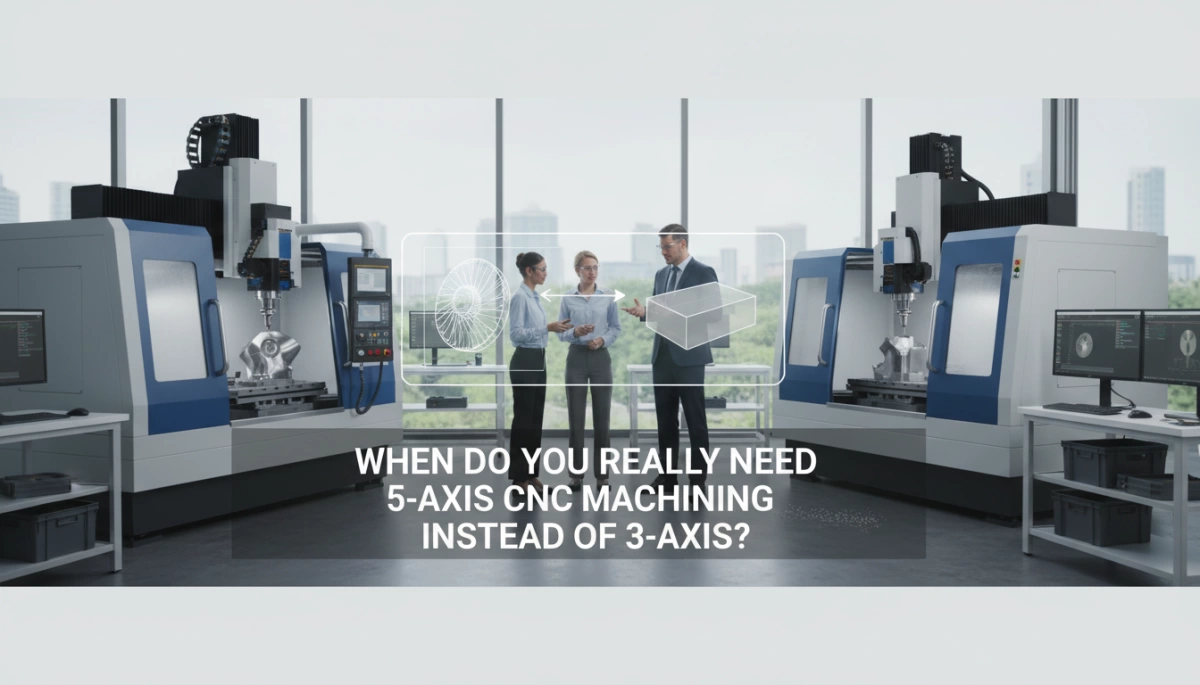
Basics of 3-Axis vs 5-Axis CNC Machining
Engineers and buyers usually ask one thing first: “Do I really need 5-axis, or is 3-axis enough?” To answer that, you need a clear picture of what each machine actually does in real production.
What Is 3-Axis CNC Machining?
A 3-axis CNC machine moves the cutting tool along X, Y, and Z only:
- The part stays fixed in one orientation.
- The tool can move left–right (X), front–back (Y), and up–down (Z).
- It’s ideal for flat faces, simple pockets, slots, and hole patterns.
Use 3-axis when:
- You’re machining simple prismatic parts.
- Most features are accessible from one or two sides.
- You care about low cost, straightforward setups, and fast turnaround.
What Is 5-Axis CNC Machining?
A 5-axis CNC machine adds two rotary axes (usually A, B, or C) to the three linear axes:
- You still have X, Y, Z, but the table or head also tilts and rotates.
- The tool can approach the part from almost any angle.
- This is key for complex geometry machining, curved surfaces, and multi-sided parts.
Use 5-axis when:
- You need multi-sided part machining in one setup.
- You have compound angles, undercuts, or deep cavities.
- Surface continuity and high-precision CNC tolerances matter across multiple faces.
3+2 (Indexed) vs Full Simultaneous 5-Axis
Not all 5-axis machines run the same way:
- 3+2 (Indexed 5-axis machining)
- The rotary axes move to a fixed angle, then lock.
- The cut happens using 3-axis moves at that orientation.
- Perfect for multi-sided parts, tight tolerances between faces, and reducing setups without full 5-axis complexity.
- Full simultaneous 5-axis machining
- All five axes move at the same time.
- Required for parts like turbine blades, impellers, blisks, and organic freeform surfaces.
- Critical for high-end aerospace CNC parts, advanced robotics, and medical implant machining.
Typical Parts for 3-Axis vs 5-Axis
Best suited for 3-axis CNC machining:
- Flat plates with pockets and holes
- Basic brackets, blocks
Core Advantages of 5-Axis CNC Over 3-Axis
5-axis CNC machining isn’t just “more axes” – it changes how I can approach a part and what kind of cost and quality I can deliver.
Fewer setups, less manual intervention
With 5-axis, I can hit multiple faces in one clamping. That means:
- Far fewer setups compared to 3-axis
- Less manual handling, fewer chances to bump or misalign the part
On complex jobs, this alone can cut hours of setup time and reduce mistakes.
Higher accuracy from fewer repositioning errors
Every time you re-clamp a part on a 3-axis machine, you risk stack-up error.
5-axis CNC keeps the part in one setup and rotates the tool around it, which:
- Improves overall accuracy and repeatability
- Keeps tight tolerances consistent across multiple faces and angles
Better surface finish on complex 3D surfaces
Simultaneous 5-axis machining lets me keep the tool at a constant, optimized angle on curved and freeform surfaces. The result:
- Smoother surface finish on organic shapes, molds, and aero profiles
- Less polishing and hand finishing afterwards
Longer tool life with optimal angles and shorter tools
Because I can tilt the tool:
- I avoid rubbing and
When 3-Axis CNC Is All You Really Need
Most shops don’t need 5-axis for everyday work. A well-set-up 3-axis CNC still covers a huge chunk of real-world parts and can do it fast, repeatably, and cheaply.
Ideal part shapes for 3-axis machining
3-axis CNC machining is usually enough when your parts are:
- Flat or prismatic: plates, brackets, blocks, flanges
- Simple 2.5D geometries: pockets, bosses, steps, chamfers
- Straightforward drilling patterns: hole grids, tapped holes, countersinks on one or two faces
If you can reach every feature from the top (or a few simple re-clamps), 3-axis is the right tool.
Flat parts, simple pockets, and drilled holes
For parts like:
- Mounting plates, covers, base plates
- Simple housings with shallow pockets
- Manifolds and fixtures with straight-through holes
3-axis milling handles it all day with short cycle times and simple programs. For example, many aluminum automotive brackets and housing components can be produced efficiently on 3-axis machines, similar to how we run our own custom aluminum CNC machining parts in volume.
High-volume basic components
If you’re pushing high-volume, repeatable parts with stable designs, 3-axis wins on:
- Lower machine hourly rate
- Faster setup for each repeat order
- Simpler workholding and fewer special fixtures
Think spacers, blocks, covers, simple packaging machinery parts, or standard automotive aluminum parts like those we produce as a CNC machining supplier for automotive aluminum components.
When budget and simplicity matter more
Choose 3-axis machining when:
- You’re launching a new product and cash flow matters
- You want straightforward programming and easier operator training
- Your geometry doesn’t truly need multi-axis moves
You get predictable costs and faster onboarding for new staff, without overcomplicating the process.
Common parts made on 3-axis machines
Typical 3-axis CNC parts include:
- Brackets, clamps, and supports
- Pump and motor plates
- Simple molds, trim tools, and jigs
- Packaging machinery components and covers
These don’t require complex orientation, compound angles, or sculpted surfaces.
Risks of over-specifying 5-axis for simple work
Pushing a basic part onto a 5-axis machine just because it “sounds better” is a waste. You risk:
- Higher machining rates with no real gain in quality
- Longer programming times for simple geometry
- More complex setups that don’t add value
If the part is mostly flat, has simple pockets and drilled holes, and doesn’t demand multi-sided machining in one clamping, 3-axis CNC machining is all you really need—and it will almost always be the most cost-effective choice.
When You Actually Need 5-Axis Machining Instead of 3-Axis
You really need 5-axis CNC machining instead of 3-axis when the part geometry or quality requirements start fighting you at every step. If you’re stacking fixtures, chasing tolerances across faces, or spending hours on hand finishing, that’s your signal.
Complex geometries beyond 3-axis limits
3-axis works fine as long as you can hit most features from the top with maybe a couple of re-clamps. You move into 5-axis territory when:
- Critical features sit on multiple angled faces.
- You can’t reach key areas without awkward long tools.
- Every new revision forces another custom fixture.
If the CAM setup for a “simple” part starts looking like a puzzle, 5-axis will usually clean that up fast.
Multi-sided machining in a single setup
5-axis really shines when you need true multi-sided machining in one clamp:
- Parts with 3–5 critical faces that must relate tightly to each other.
- Housings, brackets, and manifolds with ports and features on all sides.
- Low-volume, high-mix jobs where you can’t afford 5 different fixtures.
Being able to tilt and rotate the part instead of constantly unbolting it is where 5-axis vs 3-axis becomes a clear win in both accuracy and time.
Tight tolerances across multiple faces and angles
If you’ve got GD&T callouts tying faces together at odd angles, 5-axis starts to look less like a “nice to have” and more like a requirement:
- True position and perpendicularity across several planes.
- Angle-critical features like chamfers, bores, or sealing surfaces.
- Precision mating parts where every re-clamp multiplies error.
Because 5-axis reduces re-fixturing, you get much better accuracy and repeatability across the whole part, not just one side.
Organic curves and freeform surfaces
If the part looks more like a sculpture than a block, you’re in 5-axis machining territory:
- Organic curves and freeform shapes (robotics, medical implants).
- Sculpted surfaces that must blend smoothly.
- Flow path parts (impellers, blisks, turbines) with twisted blades.
Simultaneous 5-axis lets you keep the tool normal to the surface, giving you better surface finish and more consistent scallops without endless polishing.
Undercuts, steep walls, and deep pockets
You’ll quickly feel the 3-axis limits when the geometry gets “awkward”:
- Undercuts that are impossible to reach from straight above.
- Steep walls (over ~45–60°) where long tools chatter and deflect.
- Deep, narrow pockets where clearance is a nightmare.
With 5-axis, you can tilt the part or the tool to shorten stick-out, avoid collisions, and cut those problem areas cleanly instead of compromising on design.
Signs your 3-axis process is stretched too far
You may not need a 5-axis machine for every part, but you should consider it when you see this pattern:
- Too many setups and re-clamps for one part.
- Complex, expensive fixtures just to hit a weird angle.
- High scrap rate from misalignment between operations.
- Hours of hand deburring and polishing 3D surfaces.
- Long cycle times because every feature needs its own setup.
At that point, 5-axis machining usually reduces setups, improves accuracy, and cuts total cost per part, even if the machine itself costs more per hour. If your parts also demand tight tolerances and wear-resistant materials, pairing 5-axis milling with high-precision material selection (see our guide on selecting precise CNC machining materials) gives you a much more reliable process end to end.
Real-World Parts and Industries That Depend on 5-Axis CNC
When you compare 5-axis vs 3-axis CNC, the real difference shows up in the parts and industries that simply can’t function without multi-axis CNC machining.
Aerospace parts that require 5-axis machining
In aerospace, weight, strength, and precision matter more than anything. Parts often need multi-sided machining in a single setup and tight tolerances over complex surfaces.
Typical aerospace parts that demand 5-axis machining benefits:
- Turbine blades and blisks with twisted, freeform airfoil profiles
- Structural brackets with compound angles and pocketing on multiple faces
- Engine components with complex geometry machining and hard-to-reach features
These parts are not just “nicer” on 5-axis – they’re often not realistic on standard 3-axis without insane fixturing, re-clamping, and hand finishing.
Turbine blades, blisks, impellers, and structural components
Parts like impellers, blisks, and turbine blades are classic simultaneous 5-axis machining jobs:
- Blades need smooth, continuous toolpaths to maintain airflow and strength
- Impellers require access around deep curved vanes and tight hubs
- Structural aerospace parts often mix pockets, ribs, and bosses at multiple angles
Trying to do these on 3-axis usually means:
- Many setups
- Lots of custom fixtures
- Inconsistent surface finish and higher risk of scrap
Medical implants and surgical tools with organic shapes
Medical implant machining is another area where 5-axis is almost mandatory. Think:
- Hip and knee implants with organic, anatomical curves
- Spinal cages with internal lattices and complex internal paths
- Surgical tools with rounded handles and angled cutting tips
Here, surface finish in CNC milling and repeatable accuracy are non-negotiable. 5-axis CNC machining lets us blend surfaces smoothly and hold tight tolerances over weird, freeform shapes that are hard to even dimension on paper.
Energy and automotive parts with complex internal paths
Energy and automotive parts are getting more compact and more complex every year. For example, our work in energy component machining and automotive CNC machining often needs:
- Pump bodies and valves with angled ports and intersecting channels
- Turbocharger housings and rotors with compound angle machining
- EV and powertrain components with deep cavities and precise sealing faces
5-axis here means:
- Fewer setups
- Better alignment between faces and holes
- Smaller, more efficient designs that wouldn’t be economical with 3-axis only
Molds, dies, and tooling with deep cores and tricky draft angles
Mold and die work is a perfect match for multi-axis CNC machining:
- Deep cores and cavities that need short, rigid tools
- Tricky draft angles and undercuts that a 3-axis spindle can’t reach directly
- Freeform 3D surfaces that need consistent, high-end surface finish
With 5-axis, we tilt the tool into optimal angles, cut closer with shorter tools, and dramatically reduce polishing and manual rework.
Mini case studies: 3-axis vs 5-axis for the same part
Case 1 – Small impeller:
- On 3-axis:
- 6+ setups, custom fixtures, long reach tools, heavy deburring
- Higher risk of mismatch between sides and poor surface finish
- On 5-axis:
- 1–2 setups, simultaneous 5-axis toolpaths
- Better balance, tighter tolerances, smoother surfaces
Case 2 – Multi-sided bracket with compound angles:
- On 3-axis:
- Rotate and re-clamp for each face, locate and re-probe, more chance of error
- On 5-axis (or 3+2 indexed 5-axis):
- One setup, automatic indexing to each face
- Faster, more accurate, less fixture cost
If your parts look anything like these – lots of angled faces, organic curves, deep pockets, or internal flow paths – that’s the point where 5-axis CNC machining stops being “nice to have” and becomes the only practical way to hit cost, quality, and lead time targets.
Cost and Efficiency: When 5-Axis Actually Saves You Money
When you compare 5-axis vs 3-axis CNC, the machine sticker price is only part of the story. What really matters is total part cost over time.
5-Axis CNC Costs More Up Front
- 5-axis machines and simultaneous 5-axis controls are more expensive than standard 3-axis milling centers.
- You’ll usually pay more for:
- The machine itself
- Probing, rotary tables, and automation options
- Advanced 5-axis CAM software and post processors
But that extra investment is designed to pay off on the right kind of work.
Where 5-Axis Savings Come From
Most savings come from process efficiency, not cutting corners on quality:
- Fewer setups: One 5-axis setup can replace 3–6 setups on a 3-axis, especially for multi-sided parts.
- Shorter cycle times: Toolpaths are more efficient, and you’re not wasting time reclamping and re-zeroing.
- Less fixture work: You spend less time and money on complex custom fixtures and jigs because the machine handles the orientation.
If you’re running a mix of complex parts, this is where a good 5-axis cell starts beating a shop full of basic 3-axis machines.
Less Scrap From Handling and Alignment Errors
Every time you unclamp and reclamp a part on a 3-axis, you risk:
- Misalignment between faces
- Tolerance stack-up across multiple sides
- Operator errors and damaged parts
With 5-axis, more work is done in a single clamping, which means:
- Fewer scrap parts
- More consistent accuracy and repeatability
- Less time spent reworking bad parts
On high-value parts like aerospace components or medical implants, reducing scrap alone can justify 5-axis. If you’re machining that kind of work, it’s worth exploring a specialist CNC machining service rather than forcing it on 3-axis.
Programming Time, CAM, and Skill Level
Yes, 5-axis programming is more demanding:
- You’ll need 5-axis capable CAM and a solid post.
- Programmers must understand tool orientation, collision checks, and multi-axis strategies.
- Setup staff and operators need training on probing, work offsets, and safe machine moves.
But once the workflow is dialed in, especially for repeat orders, the time savings on the machine more than offset the extra programming effort—particularly for complex geometry machining, impellers, molds, and multi-sided housings.
You can also start with 3+2 (indexed 5-axis) to keep programming simpler, and move to full simultaneous 5-axis only when needed.
Hourly Rate vs Total Part Cost
A common trap: looking only at machine hourly rate.
- 5-axis machine rate: higher per hour
- 3-axis machine rate: lower per hour
But what matters is:
Total cost per part = (Machine time + Setup time + Programming + Fixtures + Scrap) / Parts produced
5-axis often wins when:
- Setup time is slashed from hours to minutes
- Multiple fixtures are replaced by one smart setup
- Scrap and rework are cut to almost zero
- You can run unattended or lightly attended shifts
When 5-Axis Becomes Cheaper Than 3-Axis
5-axis CNC usually becomes cheaper than 3-axis when:
- Parts need 3+ setups on a 3-axis to finish
- You’re chasing tight tolerances over several faces and angles
- There are undercuts, deep cavities, complex curves, or compound angles
- You run repeat batches of the same complex parts
- Fixtures and manual deburring/hand finishing are eating profit
As a rule of thumb:
- Simple, flat, prismatic parts → Stay on 3-axis.
- Complex, multi-sided, or highly contoured parts → 5-axis often gives a lower real cost per part, even with a higher machine rate.
If you’re unsure, I usually run both scenarios: quote the part as 3-axis (multiple setups, fixtures, and hand finishing) and as 5-axis (fewer setups, better tool access). The numbers make the answer very clear, especially for low-volume high-mix work and industries like robotics, aerospace, and precision tooling. For more detailed breakdowns and examples, I share real shop scenarios on our CNC machining blog.
Practical checklist: 3-axis vs 5-axis CNC machining
Use this quick checklist to decide if you really need 5-axis CNC machining or if 3-axis will do the job.
1. Part geometry & features
Ask yourself:
- Do I need to machine more than 3–4 sides in one go?
- Are there compound angles, chamfers, or holes not normal to a flat face?
- Any undercuts, deep cavities, or sculpted 3D surfaces?
- Can all features be reached with the tool pointing straight down (Z-axis only)?
If everything is reachable from the top or with simple flips → 3-axis is usually enough.
If you need multiple angles and faces in one setup → you’re in 5-axis territory.
2. Tolerances, surface finish, quality
Define what you actually need:
- Tolerances across multiple faces
- Loose: ±0.1 mm (±0.004") → 3-axis + extra setups often OK
- Tight across several angles/faces: ±0.01–0.02 mm → 5-axis helps a lot
- Surface finish on 3D shapes
- Flat and simple pockets → 3-axis
- Smooth organic curves, turbine-like shapes, molds → 5-axis for better scallops & flow
If you’re machining demanding plastics like PTFE or PEEK, consistent orientation and fewer setups on a 5-axis can help stabilize accuracy and finish. That’s exactly how we approach high-precision parts in materials like PTFE and PEEK.
3. Volume, repeat orders, and schedule
Think in terms of total cost, not just machine rate:
- Low volume / prototypes
- Simple parts → 3-axis is more than enough
- Complex multi-angle parts → 5-axis saves setup time, even at low qty
- High volume / repeat orders
- If you’re doing the same complex part again and again, 5-axis can:
- Cut setups
- Reduce handling errors
- Slash total cost per part over time
- If you’re doing the same complex part again and again, 5-axis can:
If setups, inspections, and fixtures are killing your lead time, 5-axis starts to make financial sense.
4. Material & machinability
Ask:
- Is the material hard, gummy, or expensive (e.g., titanium, Inconel, PEEK, specialty alloys)?
- Do you need short, rigid tools to avoid chatter?
- Do you need to keep heat and tool wear under control with better tool angles?
5-axis lets you:
- Keep tools short and rigid
- Tilt the tool to optimize cutting angle
This is a big win on tough metals and high-end plastics where scrap is costly.
5. Try 3+2 (indexed 5-axis) as a middle ground
3+2 machining (indexed 5-axis) = the rotary axes position the part, then you cut using 3-axis moves.
Perfect when:
- You need multi-sided machining in fewer setups
- But you don’t need full simultaneous 5-axis motions on sculpted surfaces
Use 3+2 when:
- Your part has several angled faces or hole patterns
- You want accuracy between faces without endless re-clamping
- You’re bridging from 3-axis into more advanced multi-axis work
6. Rotary table vs full 5-axis
Add a rotary table to 3-axis when:
- Parts are mainly prismatic (blocks, shafts, brackets)
- You just need 4th-axis indexing for extra faces
- Budget is tight, and full 5-axis is overkill
Jump to full 5-axis when:
- True 3D surfaces, blades, impellers, or molds are involved
- You need continuous tool orientation changes during cutting
- You’re chasing serious efficiency and precision on complex geometry
7. How to talk with your CNC supplier or shop
When you send parts out, share:
- 3D model + 2D drawing with:
- Tolerances (especially across multiple faces)
- Critical surfaces & finishes
- Expected volume and repeat frequency
- Material and any special requirements (e.g., medical, aerospace, food-grade)
- Where you’re currently struggling:
- Too many setups?
- Alignment errors?
- Too much hand deburring/polishing?
Tell the shop openly:
“I want to know if this is better on 3-axis, 3+2, or full 5-axis, and why.”
A good partner will walk you through options and help you avoid overpaying for 5-axis when 3-axis will do—or under-spec’ing when your geometry clearly needs multi-axis CNC machining.
Common Concerns and FAQs About Moving to 5-Axis CNC
Can a 3-axis CNC handle most everyday jobs?
Yes. For most flat parts, simple 2.5D pockets, drilled hole patterns, and basic brackets, 3-axis CNC machining is more than enough. If your parts are mostly prismatic, have features on one or two faces, and don’t need tricky angles, staying with 3-axis keeps cost and programming simple. Many shops run 80%+ of their work on standard 3-axis milling machines without any problem.
Is 5-axis machining worth it for my kind of parts?
It’s worth it when:
- You’re fighting multiple setups to hit all sides.
- You need tight tolerances across several faces and angles.
- You care a lot about surface finish on 3D or sculpted surfaces.
- You’re wasting hours on custom fixtures and hand finishing.
If that sounds like your reality, 5-axis machining often lowers total part cost, even though the hourly rate is higher. For high-mix, complex work (common in aerospace, robotics, medical, and tooling), 5-axis usually wins on flexibility and consistency.
What parts basically demand 5-axis from day one?
You’re in true 5-axis territory when parts look like this:
- Turbine blades, blisks, impellers, or complex pump wheels.
- Orthopedic implants, surgical tools, and organic freeform shapes.
- Molds, dies, and deep cavities with compound draft angles.
- Multi-sided housings with ports, bosses, and hole patterns at angles.
If you see undercuts, steep walls, and features on 3–5 faces that need to line up perfectly, you’re in multi-axis CNC machining land.
How steep is the 5-axis programming learning curve?
It’s real, but manageable with the right tools:
- Modern CAM makes 5-axis programming far easier than it used to be.
- The main jump is understanding tool tilting, collision avoidance, and safe retracts.
- If you already program 3-axis with good CAM habits, you’re not starting from zero.
Plan on:
- Extra time for post-processor tuning.
- Test cuts on simpler parts before pushing full simultaneous 5-axis.
 English
  German
  Dutch
Dutch  Russian
  Czech
Czech  French
  Korean
  Japanese
  Spanish
  Portuguese