

Critical Material Selection for Robotics & Automation
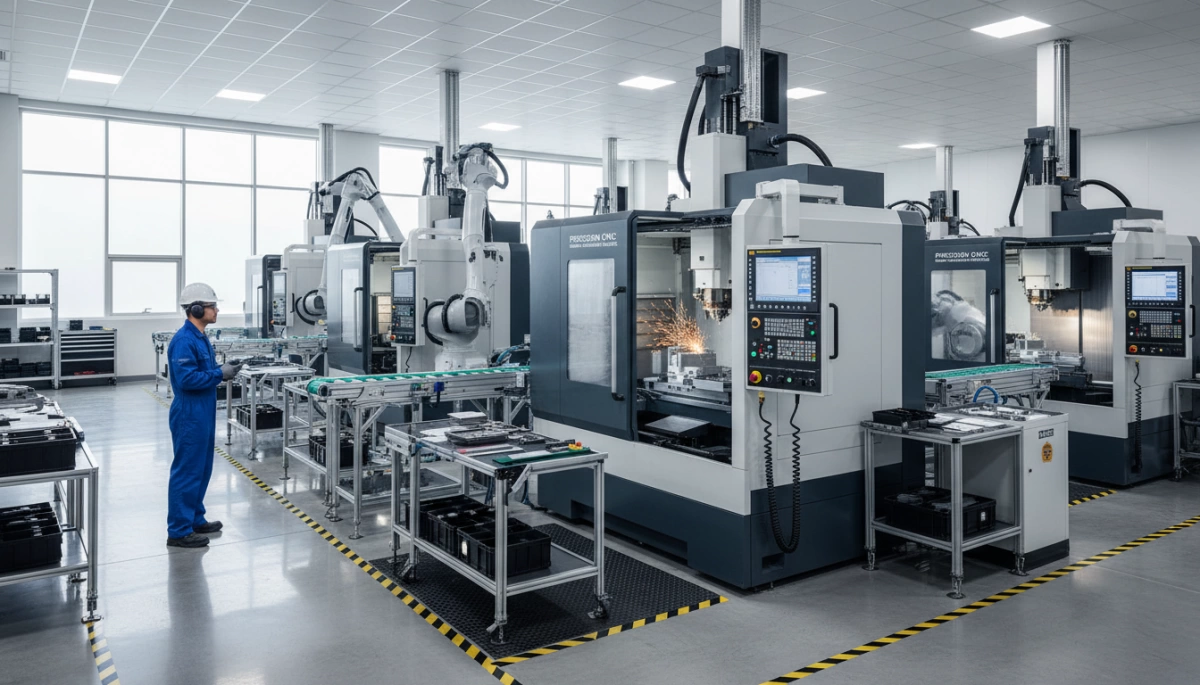
Selecting the right material is the foundation of successful precision CNC machining for automation and robotics. In our experience at ZS Precision, balancing weight, strength, and environmental resistance is crucial for system performance. We guide our clients through selecting materials that optimize speed and payload capacity without compromising structural integrity.
Structural Components: Aluminum 6061 & 7075 for Strength-to-Weight Ratio
For robotic arms and chassis fabrication, weight is the enemy of speed and battery life. Aluminum is the standard for achieving an optimal strength-to-weight ratio.
- Aluminum 6061: The workhorse of the industry. It offers excellent machinability and corrosion resistance, making it perfect for base plates, brackets, and general structural frames.
- Aluminum 7075: When standard aluminum isn't enough, we recommend 7075. It delivers strength comparable to some steels but maintains the lightweight properties of aluminum, essential for high-stress joints and heavy-lift robotic arms.
Gears, Drives, and Actuators: Stainless Steel & Alloy Steel Durability
Transmission components require materials that can withstand high torque and repetitive stress cycles. We utilize advanced CNC turning and milling to produce durable drive components.
- Stainless Steel (303, 304, 316): Ideal for automation in medical or food processing environments where corrosion resistance is non-negotiable.
- Alloy Steel: For high-torque gear machining and actuator shafts, hardened alloy steels provide the necessary fatigue resistance to prevent failure under heavy loads.
End-Effectors and Bushings: Low-Friction Engineering Plastics (Delrin/POM, PEEK)
End-of-arm tooling (EOAT) and sliding mechanisms often require non-metallic solutions to prevent wear on mating parts and reduce inertia.
- Delrin (POM): Our go-to for low-friction plastics. It is dimensionally stable and excellent for bushings, bearings, and sliding guides.
- PEEK: For extreme environments requiring high thermal stability and chemical resistance, PEEK offers superior performance for complex sensor housings and grippers.
Design for Manufacturability (DFM) Tips for Robotics
Designing for automation requires balancing mechanical performance with manufacturing efficiency. At ZS CNC, we review CAD files daily to ensure robotic chassis fabrication and arm components are optimized for our 3, 4, and 5-axis CNC machines. Implementing specific DfM strategies early in the design phase ensures parts are produced faster and more reliably.
Lightweighting Strategies: Pocketing and Inertia Reduction
In robotics, mass equals inertia. Heavy end-effectors and arms require larger motors, reduce payload capacity, and consume more power. We recommend aggressive lightweighting techniques like pocketing—removing excess material from non-structural areas without compromising stiffness. This is particularly effective with Aluminum 6061 design optimization, where we can maintain structural rigidity while significantly dropping weight to improve acceleration and cycle times.
Managing Tolerance Stacking to Reduce Costs
While our equipment achieves high-precision ±0.005mm tolerances, applying this tightness to every feature is unnecessary and costly. In multi-part assemblies, tolerance stacking can cause fitment issues if not calculated correctly.
- Critical Features: Apply tight tolerances only to bearing bores, gear mountings, and sensor housings.
- Non-Critical Features: Open up tolerances on clearance holes and outer profiles to reduce machining time and cost.
Corner Radii & Tool Access Optimization for Speed
CNC milling tools are round and cannot cut perfectly square internal corners. Designing with specific corner radii allows us to use larger, sturdier tools, removing material faster. To speed up CNC lead times, ensure internal radii are slightly larger than the standard cutter radius (e.g., use a 6.5mm radius for a 12mm tool). This prevents tool chatter, reduces dwell marks, and allows the cutter to turn corners smoothly without stopping.
Surface Finishes for Function and Longevity
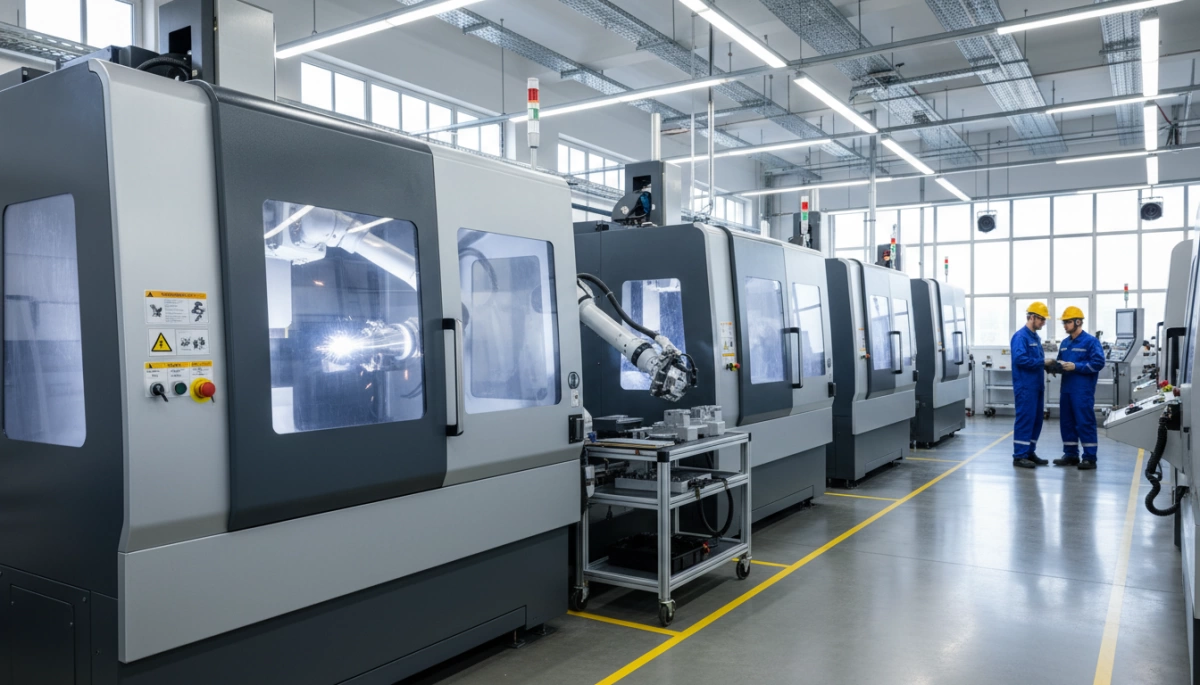
The right surface treatment transforms a raw machined part into a durable component ready for rigorous industrial environments. In precision CNC machining for automation and robotics, the finish dictates how parts interact with their surroundings, directly affecting friction, corrosion resistance, and sensor accuracy. We treat finishing as a critical engineering step, not just an aesthetic afterthought.
Anodizing (Type II & III) for Wear Resistance and Aesthetics
For aluminum robotic arms and chassis components, anodizing is the industry standard. We provide both Type II (standard) for corrosion protection and color coding, and Hard Anodizing (Type III) for superior wear resistance. Type III creates a hardened surface layer essential for sliding mechanisms, rails, and gears that face constant friction, significantly extending the lifespan of the equipment without altering the core material properties.
Passivation & Electropolishing for Medical and Food Automation
When manufacturing for sterile environments, surface purity is non-negotiable. We utilize passivation and electropolishing for stainless steel components used in medical robotics and food processing automation. These processes remove surface contaminants and smooth out microscopic peaks to prevent bacterial growth. Understanding the influence of surface roughness (Ra) on part performance is critical here, as a smoother finish ensures the strict hygiene standards required for regulatory compliance are met.
Bead Blasting to Reduce Glare for Vision Systems
Automated systems relying on machine vision cameras often fail when facing highly reflective surfaces. We use bead blasting to create a uniform matte texture on metal parts. This diffusion of light prevents glare that can confuse optical sensors, ensuring high reliability in pick-and-place robots and automated inspection units where lighting conditions vary.
Why Precision CNC is Superior to 3D Printing for End-Use Robots
While additive manufacturing has its place in rapid prototyping, precision CNC machining for automation and robotics remains the gold standard for final production parts. When we build robots meant to operate on a factory floor for years, we cannot compromise on structural integrity or surface finish. Here is why machining consistently outperforms 3D printing for end-use applications.
Isotropic Strength vs. Z-Axis Weakness
The biggest limitation of 3D printing is anisotropy. Because printers build parts layer by layer, the bonds between those layers (the Z-axis) are significantly weaker than the material within the layer itself. Under stress, printed parts are prone to delamination or snapping.
In contrast, CNC machining cuts parts from a solid billet of material. This preserves the material's isotropic strength, meaning the part is equally strong in all directions. For critical components like robotic chassis fabrication or load-bearing arms, this structural consistency is non-negotiable to prevent catastrophic failure under load.
Achieving Superior Surface Quality for Sensor Mounting
Modern automation relies heavily on vision systems, LiDAR, and precision sensors. These components require mounting surfaces that are perfectly flat and perpendicular to function correctly.
- 3D Printing: Often leaves "stair-step" layer lines and rough surfaces that require manual sanding or machining to fix.
- CNC Machining: Delivers machine-finished surfaces with extremely tight flatness and parallelism tolerances right off the machine.
For complex robotic components requiring tight tolerances, our 5-axis CNC machining services ensure the geometric accuracy and surface finish that 3D printing simply cannot match without extensive post-processing.
Material Density and Fatigue Resistance
Robots in automation lines often run 24/7, subjecting parts to millions of cycles of vibration and stress. Metal 3D printing (DMLS/SLM) can introduce microscopic porosity, which becomes the starting point for fatigue cracks. CNC machined parts retain 100% material density. This superior density translates to better fatigue resistance, ensuring that heavy duty cycles don't lead to premature part failure. When durability is the goal, a solid block of aluminum or steel is always the safer bet.
The ZSCNC Advantage in Automation Manufacturing
At ZSCNC, we understand that the robotics industry demands more than just standard machining; it requires a partner who understands the engineering behind the movement. We combine over 15 years of experience with a fleet of 100+ CNC machines to deliver precision CNC machining for automation and robotics that meets global standards.
Here is how we support your engineering goals:
- Speed for R&D: Time-to-market is critical in automation development. We offer dedicated rapid prototyping services with a turnaround of just 3-7 days. This speed allows your team to test fit, function, and iterate designs quickly before committing to mass production.
- Complex Geometry Handling: Robotic arms and joints often feature complex, organic shapes that are difficult to machine. We utilize advanced 5-axis CNC milling to produce these intricate geometries in a single setup. This approach significantly improves accuracy by reducing the need for multiple fixture changes.
- Quality Assurance: Reliability is non-negotiable in industrial automation. As an ISO 9001:2015 certified machining provider, we implement rigorous quality controls. We verify critical dimensions using CMM (Coordinate Measuring Machines) and OMM to ensure every part meets your specifications, with capabilities to hold tolerances as tight as ±0.005mm.
- Scalability: Whether you need a single custom end-effector or thousands of gear housings, our CNC milling capabilities scale effortlessly from prototype to high-volume production.
Frequently Asked Questions About CNC for Robotics
What is the best material for lightweight robotic arms?
For robotic arms where speed and efficiency depend on a high strength-to-weight ratio, Aluminum 7075 is often the superior choice. It offers strength comparable to some steels but at a fraction of the weight, significantly reducing inertia during movement.
- Aluminum 6061: Excellent for general structural frames and brackets.
- Aluminum 7075: Best for high-stress components requiring maximum durability.
- Delrin (POM) / PEEK: Ideal for end-of-arm tooling (EOAT) and grippers that need to be lightweight and non-conductive.
How does CNC machining compare to 3D printing for robotics?
While 3D printing is useful for visual models, CNC machining remains the standard for functional, end-use parts. Machined components provide isotropic strength, meaning they are equally strong in all directions, unlike printed parts which often have weak points along the Z-axis layers. For robotic chassis fabrication and heavy-duty cycles, CNC ensures the material density and fatigue resistance necessary for long-term reliability.
What tolerances are required for high-precision automation parts?
Automation systems rely on precise fits to prevent backlash and ensure accurate positioning. Standard commercial tolerances usually sit around ±0.01mm. However, for critical applications like gearbox internals or sensor mounts, we adhere to industrial-grade accuracy standards down to ±0.005mm. This level of precision is vital for maintaining the repeatability and longevity of automated assembly lines.
 English
  German
  Dutch
Dutch  Russian
  Czech
Czech  French
  Japanese
  Spanish
  Portuguese
  Korean