
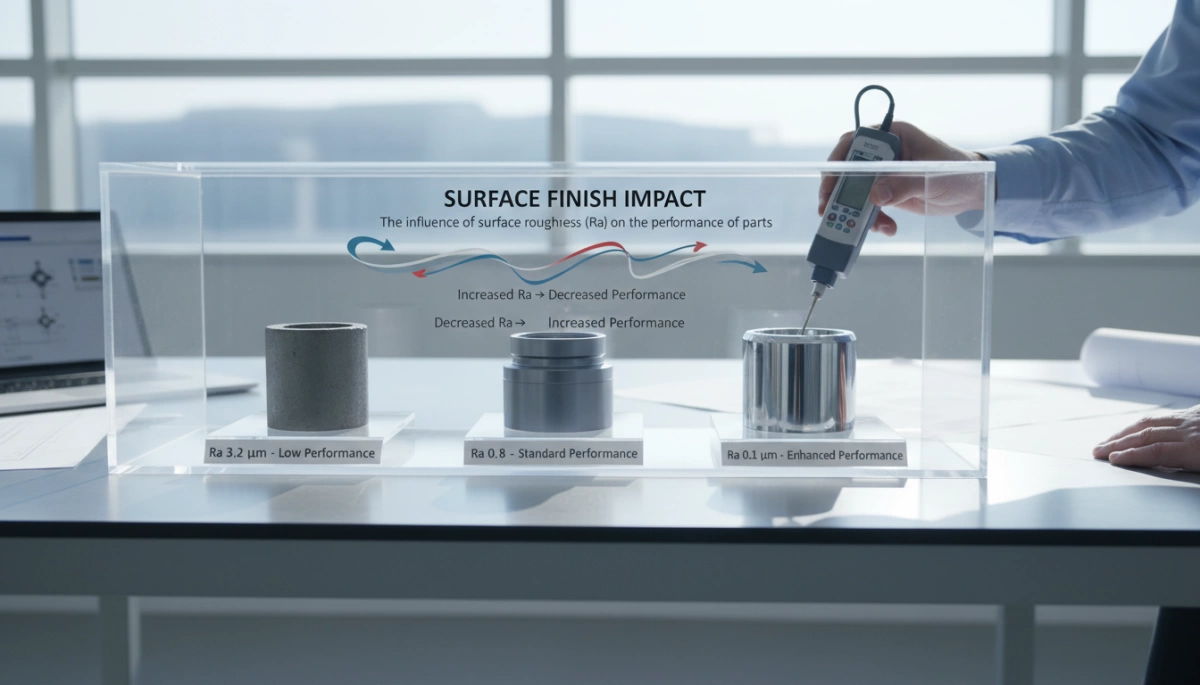
You might already know that surface roughness Ra affects how a part looks…
But do you know exactly how it dictates how a part functions?
The truth is, the influence of surface roughness (Ra) on the performance of parts is often the hidden variable behind friction, wear resistance, and catastrophic fatigue failure.
Select the wrong finish, and your mechanism seizes; over-specify it, and your manufacturing costs skyrocket.
In this post, I’m going to break down the critical surface finish parameters and show you the direct link between Ra values and engineering performance.
From interpreting a Ra value chart to mastering CNC machining surface finish for optimal sealing and durability, this is the practical guide you’ve been looking for.
Let’s dive right in.
Understanding Surface Roughness Parameters
At ZSCNC, we view surface finish as a critical engineering specification, not just an aesthetic choice. When you upload a .STEP file for an instant quote, understanding the specific surface finish parameters ensures the final component meets your functional requirements, whether it's for an aerospace assembly or a medical device.
Core Parameters: Ra, Rz, and Rq
While surface roughness Ra is the most common standard we see in technical drawings, it isn't the only metric that matters. Different applications require different ways of measuring the peaks and valleys left by our CNC milling or turning processes.
| Parameter | Name | Definition | Best Use Case |
|---|---|---|---|
| Ra | Roughness Average | The arithmetic average of profile height deviations from the mean line. | General QC for CNC machining surface finish; standard for most machined parts. |
| Rz | Mean Roughness Depth | The average of the highest peaks and lowest valleys over five sampling lengths. | Critical for sealing surfaces and interference fits where a single high peak could cause failure. |
| Rq | Root Mean Square | The RMS value of the profile heights. | Used in optical and electronic applications where statistical precision is key. |
2D Profile vs. 3D Areal Measurements
Most traditional quality control relies on 2D profile measurements (stylus profilometers), which drag a probe across a single line on the part. However, this can miss defects that don't fall directly on that line.
For complex geometries processed on our 5-axis centers, 3D areal measurements (Sa, Sz) provide a topographical map of the surface. This is vital when the surface texture lay direction—the pattern left by the cutting tool—varies across the part.
The Role of Secondary Parameters
Beyond the basics, secondary parameters dictate how a part interacts with its environment:
- Rsk (Skewness) & Rku (Kurtosis): These measure the symmetry and sharpness of the profile. A negative Rsk indicates a surface with deep valleys and flat plateaus (like a plateau honed surface), which is ideal for retaining lubricant in automotive engines.
- Bearing Ratio (Rmr): This indicates the percentage of material contact area at a specific depth, crucial for predicting wear in moving assemblies.
- Lay Direction: In processes like CNC turning or surface grinding, the direction of the tool marks affects fluid flow and seal performance.
Industry Standards: ISO 4287 and ASME B46.1
To ensure global compatibility, we strictly adhere to major international standards. ISO 4287 is the primary standard for geometrical product specifications (GPS) regarding surface texture, while ASME B46.1 is the dominant standard in the US market. Both define how surface roughness measurement must be conducted, ensuring that an Ra value of 1.6 µm specified in a design file translates exactly to the physical part we manufacture.
Primary Functional Impacts of Surface Roughness on Part Performance
At Baetro, we treat surface finish as a critical engineering specification, not just an aesthetic choice. The surface roughness Ra directly dictates how a component interacts with its environment and other parts in an assembly. Getting the Ra value wrong can lead to premature failure, regardless of how precise the dimensional tolerances are.
Friction and Lubrication Dynamics
The impact of Ra on friction is the first thing we consider for moving assemblies. A rough surface increases the coefficient of friction, generating excess heat and drag. However, smoother isn't always better.
- Oil Retention: Extremely smooth surfaces (mirror finishes) may wipe away lubrication too effectively, leading to seizure.
- Plateau Honed Surface: We often aim for a specific texture where deep valleys retain oil while flattened peaks support the load, balancing lubrication with low friction.
Wear Resistance Mechanisms
Surface roughness wear resistance determines the lifespan of your parts. When two surfaces slide against each other, the microscopic peaks (asperities) on a rough surface carry the entire load.
- Abrasive Wear: These peaks can break off, turning into abrasive particles that grind down the system.
- Adhesive Wear: Under high pressure, rough peaks can micro-weld and tear, causing rapid degradation.
Fatigue Strength and Crack Initiation
For components under cyclic loading, the Ra effect on fatigue life is massive. Surface irregularities act as stress concentrators. Deep valleys in a rough surface are essentially pre-existing cracks. In high-stress applications, such as aerospace turning parts, we utilize precision grinding and polishing to minimize these stress risers, significantly extending the fatigue life of the component.
Sealing and Leak Prevention
Achieving the optimal Ra for sealing is a precise science in hydraulic and pneumatic systems.
- Static Seals: Require a rougher finish to "bite" into the gasket.
- Dynamic Seals: Need a smoother finish (typically Ra 0.2–0.4 µm) to prevent wearing down the O-ring while still retaining enough lubricant to prevent stick-slip.
Corrosion and Environmental Resistance
Surface roughness corrosion resistance is vital for parts exposed to harsh environments. Rough surfaces have more surface area and deep crevices that trap moisture, salts, and chemicals, accelerating pitting and crevice corrosion. This is particularly critical when we adhere to the strict requirements for CNC machining medical device components, where a smooth, passivated surface is required to prevent bacterial growth and corrosion.
Other Functional Effects
- Coating Adhesion: Paints and platings bond better to slightly rougher surfaces (mechanical keying).
- Conductivity: For electrical contacts, a lower Ra ensures better contact area and lower resistance.
- Aerodynamics: In fluid or airflow applications, smoother surfaces reduce drag and turbulence.
Typical Ra Values by Application and Industry
Selecting the right surface roughness Ra isn't just about aesthetics; it is about matching the finish to the function. At ZSCNC, we see a wide variance in requirements depending on whether a part is a simple bracket or a critical aerospace component. Over-specifying a finish drives up costs unnecessarily, while under-specifying leads to premature failure.
Ra Ranges: General vs. Precision Components
For general industrial applications where parts are stationary or non-mating, a standard "as-machined" finish is usually sufficient.
- Rough Milling (Ra 6.3–12.5 µm): Acceptable for heavy cuts, weldments, or surfaces that will be painted or cast.
- Standard Machining (Ra 3.2 µm): The default finish for most CNC milled parts. It shows visible tool marks but is smooth to the touch.
- Precision Finishing (Ra 0.8–1.6 µm): Required for accurate fits, bearing surfaces, and high-load applications. This often requires slower finishing passes or high-speed machining strategies.
Industry-Specific Requirements
Different verticals demand specific surface textures to ensure safety and performance. When dealing with FAQ CNC machining for aluminum automotive medical and packaging parts, understanding these specific finish requirements is crucial for regulatory compliance and functionality.
- Hydraulics & Automotive: Engine cylinders and hydraulic rods often require a plateau honed surface (Ra 0.2–0.8 µm). This texture retains oil for lubrication while providing a smooth bearing area for seals and rings.
- Aerospace: Turbine blades and structural components demand very low Ra values (often < 0.4 µm) to minimize aerodynamic drag and eliminate stress risers that could lead to fatigue cracks.
- Medical: Implants and surgical instruments require extremely smooth finishes (Ra < 0.4 µm), often achieved via electropolishing, to prevent bacterial growth and ensure biocompatibility.
The Trade-off: Surface Finish Cost vs. Performance
Achieving a lower Ra value exponentially increases manufacturing time. Moving from a standard Ra 3.2 µm to a fine Ra 0.4 µm might require specialized tooling, slower feed rates, or secondary processes like surface grinding and polishing.
We often advise clients on how to reduce machining cost for low volume automotive CNC parts by only specifying tight surface tolerances on critical mating surfaces. Leaving non-critical areas with a standard finish allows us to utilize our high-speed machining capabilities efficiently, balancing precision components quality with production speed.
How CNC Machining Processes Influence Surface Roughness
Achieving a specific surface roughness Ra is not accidental; it is a calculated result of precise engineering controls. At ZSCNC, we view every cut as a balance between speed and finish quality. The primary drivers defining the final texture include feed rate, cutting speed, and tool geometry. A higher feed rate generally increases productivity but results in a rougher surface due to the "scallop" height left by the tool. Conversely, optimizing the cutting speed and ensuring rigid machine stability minimizes vibration (chatter), which is the main cause of poor surface quality.
Process Comparison: Milling, Turning, and Grinding
Different manufacturing methods yield distinct baseline finishes. While our 5-axis CNC machining services allow for complex geometries with superior surface continuity, specific processes are better suited for different Ra targets.
| Process | Typical Ra Range (µm) | Characteristics |
|---|---|---|
| CNC Turning | 0.4 – 3.2 | Ideal for cylindrical parts; produces a consistent, directional lay pattern. |
| CNC Milling | 0.8 – 6.3 | Dependent on tool path (climb vs. conventional); 5-axis reduces tool deflection for smoother finishes. |
| Surface Grinding | 0.1 – 0.8 | Used for high-precision, flat surfaces requiring tight tolerances and low friction. |
Post-Processing: Bead Blast vs Polish
For many applications, the "as-machined" finish is just the starting point. We offer a range of secondary operations to adjust the CNC machining surface finish for function or aesthetics.
- Bead Blasting: Creates a uniform matte texture that hides tool marks and removes minor imperfections. This increases the Ra slightly but improves grip and paint adhesion.
- Polishing: Reduces Ra significantly (often below 0.1 µm) to create a mirror-like finish, essential for sealing surfaces or reducing friction.
- Anodizing: Adds a protective oxide layer. While it follows the existing surface texture, the pre-treatment (etching) can slightly alter the final roughness.
Achieving Consistency in Production
Consistency is key when scaling from a prototype to thousands of units. With access to over 1,000 modern machines, we standardize tool paths and cutting parameters across our network. This ensures that the Ra values defined in your design files are met reliably, whether we are machining soft aluminum or utilizing our titanium 5-axis CNC machining services for aerospace components where surface integrity is critical for fatigue resistance.
Measurement Techniques and Best Practices
Getting the surface finish right is half the battle; proving it is the other half. Accurate surface roughness measurement is non-negotiable in our quality control process. If you cannot measure the texture reliably, you cannot guarantee the part's performance. We generally choose between two main technologies depending on the material softness and geometry.
Stylus Profilometers vs. Optical Methods
- Contact Stylus Profilometers: These are the industry workhorses. A diamond-tipped probe physically drags across the surface to record peaks and valleys. They are robust and compliant with most ISO standards, making them perfect for checking hard metals. However, on softer alloys, the stylus pressure must be managed to avoid scratching the part.
- Optical Non-Contact Methods: Using white light interferometry or laser confocal microscopy, these tools capture surface texture data without touching the component. This is the preferred method for delicate precision parts or when we need 3D areal data rather than a simple 2D line profile.
Sampling Length and Evaluation
Data is only as good as the setup. We adhere to strict standards regarding sampling length and cut-off wavelengths. The cut-off filter is critical because it separates actual roughness (short wavelength) from waviness or form error (long wavelength). If the cut-off isn't set correctly based on the expected Ra range, the reading will be inaccurate. This rigorous verification is standard when we verify specs for [custom CNC machining services for machinery and robotics parts], ensuring every micron aligns with the engineering print.
Common Measurement Pitfalls
Even with high-end equipment, technique matters. We watch out for three specific issues to ensure data integrity:
- Directionality: Always measure perpendicular to the lay (the direction of the tool marks). Measuring parallel to the cut will yield a falsely smooth Ra value that doesn't represent the true surface.
- Outliers: A single scratch, burr, or dust particle can spike the average. We focus on representative sampling across multiple spots on the surface rather than relying on a single pass.
- Geometry Limits: Stylus tips have a radius. If the surface features are smaller than the tip radius, the machine physically cannot measure the bottom of the valley, leading to distorted data.
Frequently Asked Questions About Surface Roughness Ra
Does a lower Ra value always indicate better performance?
Not necessarily. While we pride ourselves on achieving high-end finishes, "smoother" isn't always the goal. Some applications, like cylinder liners, need a specific surface texture lay direction to retain oil for lubrication. If the surface is too smooth, the oil film breaks, leading to seizure. Other parts need a rougher profile for paint or coating adhesion. It is about hitting the optimal spec for the function, not just the lowest number.
What is the difference between Ra and RMS?
Ra (Roughness Average) is the arithmetic mean of the surface profile, while RMS (Root Mean Square) calculates the square root of the average of squared deviations. In practical terms, RMS values are typically about 11% higher than Ra values for the same surface. We primarily use Ra as it is the global standard for CNC machining surface finish, ensuring our quality control protocols align with international ISO standards.
How does surface finish affect manufacturing costs?
There is a direct link between surface finish cost vs performance. Demanding a lower Ra (smoother surface) increases machine cycle time significantly because we have to slow down feed rates or use specialized tooling.
- Standard Finish (3.2–6.3 µm): Fast, cost-effective, "as-machined."
- Fine Finish (0.8–1.6 µm): Requires slower cutting speeds and finer step-overs.
- Precision Finish (<0.4 µm): Often needs secondary operations like grinding or polishing.
We recommend validating if tight tolerances are strictly necessary to avoid unnecessary costs.
Can you measure Ra without specialized equipment?
For a quick check, you can use a Ra value chart or surface finish comparator plates to visually and tactually compare the part against a standard sample. However, this is subjective. For verifiable results, especially for aerospace or medical parts, we rely on calibrated stylus profilometers to measure the exact surface roughness Ra.
 English
  German
  Dutch
Dutch  Russian
  Czech
Czech  French
  Korean
  Japanese
  Spanish
  Portuguese