


Aerospace Turning Parts Product Overview
How aerospace machined parts relate to CNC turning
Aerospace machined parts include both rotational components and milled shapes. Turning is typically used for shafts, pins, bushings, sleeves and spacers; brackets and housings may require milling. For aluminum components with milled features, see our aerospace aluminum CNC machining page. Process selection and suitability depend on the drawing and required approvals.
For a quotation review, send a PDF drawing and STEP model, alloy and condition, quantity, critical fits, surface finish, required documentation and delivery destination. Request a quote for aerospace machined parts.
What Are Aerospace Turning Parts?
Aerospace turning parts are precision rotational components produced on CNC lathes, Swiss machines, and mill‑turn centers. These include aerospace shafts and pins, bushings, fasteners, fittings, and custom CNC turned aerospace components that must meet tight tolerances and aerospace standards for flight‑critical use.
ZSCNC can review enquiries for custom aerospace turning parts against the specified alloy, condition, geometry, inspection and required approvals. Material availability and the proposed process route must be confirmed for the individual project.
How CNC Turning and Mill‑Turn Shape Aerospace Components
We use multi‑axis CNC turning and CNC mill‑turn aerospace processes to create complex geometries in a single setup:
- CNC turning for accurate OD/ID, faces, grooves, and threads
- Mill‑turn machining for flats, slots, cross‑holes, ports, and complex profiles
- Swiss turning aerospace components for small, slender, or tight‑tolerance parts
This setup delivers tight tolerance aerospace parts with high repeatability, excellent surface finish, and reduced cycle time.
Where Turned Parts Are Used in Aircraft and Engines
Examples of assemblies that can contain precision aerospace turning parts include:
- Aircraft engines – shafts, spacers, sleeves, Inconel turned rings, and engine fittings
- Landing gear – turned landing gear parts including axles, pins, bushes, and pistons
- Structures & interiors – aircraft structural turned parts, seat hardware, and cabin mounts
- Hydraulic and fuel systems – precision turned aerospace fittings and connectors
These aerospace rotational parts are designed for high load, vibration, and harsh environments.
Who Needs Custom Aerospace Turning Parts?
We support global aerospace companies that require custom aerospace hardware turning and repeat production:
- Design and manufacturing engineers needing engineered aerospace turning solutions
- Buyers and supply chain managers sourcing a reliable aerospace lathe parts supplier
- OEMs and Tier 1/Tier 2 suppliers evaluating aerospace CNC machining services against their qualification requirements
We work to your drawings, models, and specs, aligning with your internal and customer requirements.
How ZSCNC Supports Prototyping and Production Runs
ZSCNC is set up for both aerospace component prototyping and volume production:
- Rapid prototype turning for design validation and testing
- Flexible small‑batch builds for pre‑production and spares
- Scalable high‑volume production with process control and material traceability
Our goal is to provide consistent, cost‑effective precision aerospace turning parts with the quality, documentation, and delivery performance aerospace programs demand.
Key Features & Benefits of Aerospace Turning Parts
For aerospace turning parts, compare drawing requirements, material condition, measurement methods and supplier qualifications before placing an order. The following features are engineering considerations for evaluating a proposed process.
Tight tolerances & high precision
For precision aerospace turning parts, define the critical features and acceptance criteria on the drawing:
- Stable process for microns‑level control on diameters, bores, and shoulders
- Perfect fit for aerospace shafts and pins, bushings, and precision fasteners
- Reliable performance in engine, landing gear, and hydraulic systems
Consistent repeatability
For OEMs and Tier 1 suppliers, repeatability is everything:
- Controlled CNC programs and tooling libraries for repeatable aerospace lathe parts
- Consistent dimensions across batches and long‑term programs
- SPC and in‑process checks to keep every lot in spec
Clean surface finish & concentricity
Smooth motion and sealing depend on finish and runout:
- Low Ra finishes for precision turned aerospace fittings and sealing surfaces
- Tight concentricity between IDs/ODs for bearings, shafts, and rotating assemblies
- Ideal for aerospace hydraulic fittings turning and fuel system components
Weight reduction with optimized geometries
We use CNC turning and mill‑turn to cut weight without sacrificing strength:
- Thin walls, relief grooves, and optimized profiles for aerospace rotational parts
- Smart design support to remove non‑functional material and reduce mass
- Strong fit for aircraft structural turned parts in aluminum and titanium
For example, our experience with aluminum aerospace CNC parts helps your team balance stiffness, weight, and cost.
Durability in harsh aerospace environments
We machine materials and features that stand up to heat, load, and corrosion:
- Titanium, stainless, and superalloys for high‑stress aerospace turned components
- Suitable for hot engine zones, landing gear, and aggressive fluids
- Clean machining processes that protect fatigue life and surface integrity
Our high‑precision turning of 304 stainless steel parts is a good reference for corrosion‑resistant aerospace fasteners and fittings.
Shorter lead times with multi‑axis turning
We use multi‑axis CNC and live tooling to cut setups and lead time:
- CNC mill‑turn aerospace parts with turning, drilling, and milling in one hit
- Fewer operations, faster changeovers, and quicker response on urgent orders
- Strong support for aerospace component prototyping and PPAP / first article builds
Cost‑effective for complex rotational parts
You get both precision and value:
- Efficient cycle times for custom CNC turned aerospace components
- Reduced tooling and handling cost for complex parts with cross‑holes, flats, and slots
- Scalable from prototype to production for engineered aerospace turning solutions
If you need tight tolerance aerospace bushings and fasteners, hydraulic fittings, or turned landing gear parts, we build them to spec and price them to work for real‑world programs.
Materials for aerospace turning parts
Titanium aerospace turning parts (Ti‑6Al‑4V and others)
For critical, high‑load locations, I usually recommend titanium aerospace turning parts, especially Ti‑6Al‑4V and similar grades. They deliver:
- High strength‑to‑weight ratio for shafts, pins, and structural lugs
- Excellent corrosion resistance in harsh flight environments
- Good fatigue performance for long‑life, safety‑critical components
Typical titanium turned parts include landing gear pins, engine mounts, and structural aerospace shafts where every gram matters.
Aluminum alloy turned parts for aircraft structures
For lighter duty or larger structural features, aluminum alloy turned parts are the go‑to choice:
- Very low weight for aircraft structural turned parts and housings
- Good machinability for cost‑effective CNC turning of complex features
- Solid strength and stiffness in common aerospace grades (e.g., 6061, 7075)
We use aluminum turning a lot for aircraft fittings, bushings, spacers, and interior / avionics hardware where high volume and tight tolerance meet cost pressure.
Inconel and superalloy turning for hot‑section parts
When you’re near the engine hot section, you’re in Inconel and nickel superalloy territory. These precision aerospace turning parts are designed for:
- Extreme temperature resistance in turbine and exhaust areas
- High strength under continuous thermal stress
- Resistance to oxidation and creep
Inconel turned aerospace components are ideal for engine shafts, high‑temp fittings, rings, and couplings that run close to the flame.
Stainless steel turned fasteners and high‑stress components
Stainless steel remains a staple for aerospace bushings and fasteners, as well as hydraulic and structural interfaces. It offers:
- High tensile strength and toughness
- Good corrosion resistance for exposed hardware
- Stable, predictable machinability for repeatable high‑precision turning
For more detail on stainless grades we use, you can check our stainless steel machining materials overview.
Material traceability, test reports, and certifications
Specify the alloy, condition, material standard and documentation requirements on your RFQ. Supplier material certificates can be reviewed with the order; original mill certificates or EN 10204 3.1 documents are not standard inclusions. Heat and lot records, additional testing and any first article report format must be agreed before production.
How to choose the right material for your aerospace turning parts
When I help customers pick materials for precision aerospace turning parts, we usually balance:
- Environment: temperature, fluids, corrosion, vibration
- Load case: static vs. fatigue, peak loads, safety factors
- Weight targets: titanium or aluminum vs. steel and superalloys
- Cost and manufacturability: cycle time, tool wear, material price
- Certification needs: existing approvals, fleet commonality, qualification effort
If you’re unsure, send us your 3D model, 2D drawing, and operating conditions and we’ll recommend a material and machining route that hits your performance targets without blowing up cost.
CNC turning capabilities and specifications
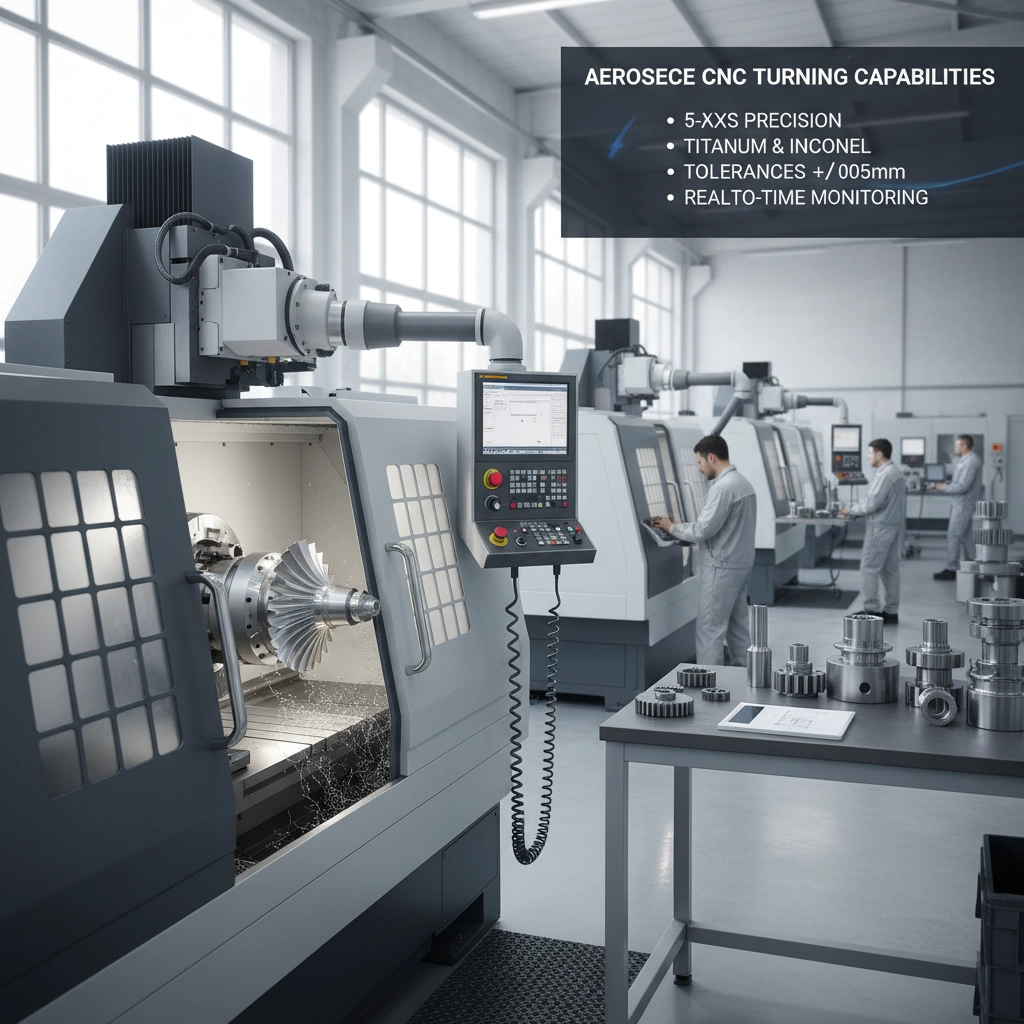
When it comes to aerospace turning parts, capability and consistency matter more than anything. We’ve built our setup around high‑precision, production‑ready turning for global aerospace programs.
Max turning diameter and length for aerospace parts
Send the maximum outside diameter, overall length, bore depth, wall thickness and stock form. Workholding, tool access and inspection can limit feasibility even when a part fits within a nominal machine envelope. The working range must be confirmed for the individual drawing and process route. Our CNC machining services provide general process context.
Achievable tolerances for critical turned features
For tight‑tolerance aerospace turning parts, we design the process to hold:
- Typical turned features: ±0.01 mm (±0.0004 in)
- Critical diameters / fits: down to ±0.005 mm or better with process control
- Runout / concentricity: tightly controlled on bearing seats, sealing diameters, and spline locations
We match tolerance strategy to function: press fits, bearing fits, hydraulic sealing, and flight‑critical locations.
CNC turning, Swiss turning, and mill‑turn options
We combine different technologies to cover the full range of custom CNC turned aerospace components:
- CNC turning centers: ideal for medium–large aerospace rotational parts
- Swiss turning aerospace components: perfect for small diameters, long slender parts, and precision pins
- CNC mill‑turn aerospace parts: for parts that blend turned features with milled flats, ports, and complex forms in one setup
This mix keeps your parts accurate, stable, and cost‑effective.
Live tooling and complex feature machining
With live tooling and multi‑axis turning, we can machine more in a single clamp:
- Cross‑holes, radial ports, keyways, and slots
- Milled pads, mounting features, and complex faces
- Integrated hex, wrench flats, and custom drive features
This is a big win for precision turned aerospace fittings, hydraulic connectors, and compact engine components.
Secondary operations and finishing
We don’t stop at the lathe. For aerospace rotational parts machining, we support complete processing:
- Threading: metric, UN, UNJ, NPT, custom threads
- Grinding: OD/ID grinding for ultra‑tight fits and surface quality
- Coatings and treatments: anodizing, passivation, nitriding, plating, dry film lube, and more
- Deburring and edge control tuned for aerospace assembly and safety
Material and process records must be reviewed against the specific customer requirements before order acceptance.
From prototype to high‑volume production
We support you from first article to stable long‑term supply:
- Prototypes and pre‑production runs: fast feedback, DFM support, and quick changes
- Low to medium volume: ideal for custom aerospace hardware turning and special programs
- Higher volume production: stable processes, documented setups, and repeatable quality across batches
Whether you’re validating a new design or locking in a long‑term supplier for tight tolerance aerospace parts, we scale the same rigorous process to your order size.
Applications of Aerospace Turning Parts
The following are examples of where rotational components may appear in aerospace engineering. They are application descriptions rather than a list of ZSCNC customer programs. Machining feasibility, material requirements, special processes and supplier approvals must be assessed for each drawing.
Turned components for aircraft engines
Shafts, spacer rings, sleeves and fittings can involve elevated temperature, vibration and demanding surface-integrity requirements. Specify alloy condition, critical characteristics, required testing and approved process routes. Suitability for an engine application cannot be established from dimensional machining alone.
Landing gear shafts, bushings, pins, and axles
These component types may require controlled fits, heat treatment, fatigue-related requirements and traceable processing. Provide the complete drawing and applicable program specifications for review; the application name does not confirm that a particular order can be accepted.
Structural assemblies and precision fasteners
Spacers, standoffs, inserts and special fasteners require clear material, thread, fit and finish specifications. Define load-related acceptance criteria and any supplier qualification requirements before quotation.
Hydraulic and fuel system turned fittings
Fittings, adapters and union nuts can depend on thread geometry, sealing faces, cleanliness and material compatibility. Specify inspection, pressure or leak-testing requirements separately from dimensional machining. For general material considerations, see our guide to selecting precise CNC machining materials.
Avionics and interior hardware applications
Spacers, standoffs, connector features and interior hardware may combine small dimensions with finish, electrical or fire-performance requirements. State the relevant customer specifications and required evidence in the RFQ.
Custom rotational parts for special programs
For development, tooling or replacement-part enquiries, identify intended use, drawing revision, quantity, approved material alternatives and acceptance criteria. Commercial feasibility and delivery are confirmed after review; prototype manufacture is not automatic approval for operational use.
Quality control for aerospace turning parts

The inspection scope for aerospace machined parts must follow the drawing revision, critical characteristics and customer acceptance criteria. Machining a component does not by itself establish airworthiness or approval for flight use.
Drawing review and inspection planning
Identify critical diameters, datum references, runout, threads and surface finish requirements before quotation. Measurement methods, sampling and reporting should be agreed for the specific geometry and order. See our quality control overview for further context.
Material certificates and first article requirements
Supplier material certificates are available for order review. Original mill certificates, EN 10204 3.1 documentation, additional testing and AS9102 first article reporting require separate feasibility review and written agreement; they are not included automatically.
Customer approvals and special processes
If your drawing or purchase specification requires AS9100 certification, NADCAP-accredited processing, an approved supplier, export-controlled handling or another program-specific qualification, state it before sharing restricted files or placing an order. Availability and acceptance must be verified for the specific project; this page is not evidence of those approvals.
Finishing and inspection records
Specify coating thickness, masking, post-finish dimensions and required reports. Heat treatment is arranged through external suppliers; available hardness evidence and any independent test requirements should be confirmed in advance. Passivation does not include an independent test report as standard. Agree the required inspection records and release criteria before production.
Why choose ZSCNC for aerospace turning parts
Project review for precision aerospace turning
ZSCNC reviews custom turned components against customer drawings, material specifications, critical characteristics and documentation requirements. Application examples on this page describe component types and engineering considerations; they do not establish completed supply to an aircraft or engine program. Any required project references or supplier qualifications should be verified before order acceptance.
Equipment for complex aerospace geometries
We use multi‑axis CNC lathes, CNC mill‑turn centers, and Swiss turning for small, critical parts. This lets us machine complex aerospace geometries, deep bores, thin‑wall features, and multiple operations in a single setup. You get better accuracy, fewer setups, and lower risk. You can see more on our broader CNC machining capabilities on our CNC machining services page.
Engineering support and DFM
I don’t just “take a print and cut metal.” We review your models and drawings for manufacturability, tolerance stack‑ups, tool access, and material choice. Our engineering and DFM support helps you:
- Tighten tolerances only where they matter
- Simplify features to cut cost and lead time
- Choose the right titanium, aluminum, Inconel, or stainless grade for each aerospace location
Program management and supply chain coordination
For global aerospace customers, we manage full programs, not just single parts:
- Multi‑part families and kitted hardware
- Forecast and blanket orders
- Coordination with coaters, heat treaters, and testers
This keeps your aerospace turning parts flowing with less admin on your side.
Pricing, lead times, and delivery
We balance cost with risk and performance:
- Competitive pricing for complex CNC turned aerospace components
- Fast response on RFQs and realistic, reliable lead times
- Production and shipping schedules confirmed after drawing, material and inspection review
Long‑term partnership mindset
I build long‑term relationships with engineers, buyers, and OEM teams. We keep your process data, tooling strategies, and material history, so repeat orders and new variants are faster, more consistent, and easier to qualify. ZSCNC is set up to be your long‑term aerospace lathe parts supplier, not a one‑off job shop.
Technical resources for aerospace turning projects
Information to confirm before requesting a quote
Use the following checklist to define the machining review. Dimensions, materials, processes and reporting must be confirmed for the specific drawing rather than inferred from a general capability description.
| Review item | Information to provide |
|---|---|
| Part envelope | Maximum diameter, overall length, stock form and internal features |
| Critical features | Datums, fits, threads, runout, surface roughness and inspection method |
| Material and finishing | Alloy, condition, specification, coating thickness, masking and post-finish dimensions |
| Order and documentation | Quantity per part, drawing revision, required approvals, reports and target delivery date |
Our manufacturing process overview gives general context. Submit drawings for an aerospace turning feasibility review.
Project evidence for supplier evaluation
For a supplier comparison, identify the evidence your team needs: relevant part geometry, material records, critical-dimension inspection, finishing requirements and customer acceptance criteria. Any project reference should identify its verified scope and respect confidentiality. Examples of part types alone do not demonstrate program approval, flight suitability or delivery performance.
Material and process selection tips
We help you match material and process to the real job:
- Titanium (Ti‑6Al‑4V): High strength, weight reduction, flight‑critical parts
- Inconel/superalloys: Hot‑section and engine turned components
- Aluminum alloys: Structural and interior aircraft parts
- Stainless steel: High‑load fasteners, shafts, hydraulic fittings
Quick rules we share:
| Requirement | Recommended direction |
|---|---|
| High temp + corrosion | Inconel / nickel superalloy turning |
| Strength + weight saving | Titanium turning for aerospace shafts |
| Cost‑sensitive structures | Aluminum alloy turned parts |
| Wear + fatigue resistance | Stainless aerospace fasteners and pins |
Design guidelines for machinability and cost
The following DFM checks can help a drawing review for custom CNC turned aerospace components:
- Keep standard thread sizes and pitches where possible
- Avoid unnecessary long, thin sections that chatter or deflect
- Use consistent radii instead of sharp corners where allowed
- Relax tolerances on non‑critical features
Goal: same function, lower cycle time, and more consistent repeatability.
How to prepare drawings and models for RFQs
To quote aerospace rotational parts machining accurately and fast, we typically need:
- 3D model: STEP, X_T, or similar
- 2D drawing: Fully dimensioned with tolerances and GD&T
- Material spec: Grade, condition, and any alternates allowed
- Finish and treatments: Coating, passivation, NDT, plating
- Quantity and schedule: Prototype, bridge build, or production
You can also check our online RFQ and FAQ guidelines to see what info helps us lock in pricing and lead time for your aerospace CNC turning services.
FAQ on aerospace turning parts
What tolerances can you expect on aerospace turning parts?
For precision aerospace turning parts, we usually work to:
- ±0.005 mm–±0.01 mm (±0.0002″–±0.0004″) on critical diameters and fit features
- ±0.01 mm–±0.02 mm (±0.0004″–±0.0008″) on secondary features
- True position and runout controlled per drawing and GD&T
Actual tolerances depend on material, part size, geometry, and inspection requirements. Send us your model and print, and we’ll confirm what’s achievable before we quote.
Best materials for high‑temperature or high‑load locations
For custom CNC turned aerospace components in demanding spots, we typically recommend:
- Inconel and nickel superalloys – for engine, hot‑section, and exhaust turning
- Titanium (Ti‑6Al‑4V and similar) – high strength‑to‑weight for shafts, pins, and lugs
- High‑strength stainless steels (17‑4PH, 15‑5PH, 13‑8Mo) – for aerospace shafts and fasteners under heavy load
- High‑strength aluminum – for aircraft structural turned parts where weight is critical but temps are moderate
If you’re unsure, we help you pick the best alloy for your environment, load, and certification needs.
Do you support prototypes and low-volume custom turning?
Prototype and small-batch turning enquiries can be reviewed against the drawing, material, quantity and inspection requirements. Minimum practical quantity, price and production schedule depend on the individual part.
How are aerospace standards and approvals confirmed?
Provide the applicable specifications and required supplier approvals with your RFQ. We must confirm which machining, material documents, special processes and inspection requirements can be supported before accepting the order. Flight-critical suitability and customer qualification require explicit project review.
What affects delivery for aerospace turned components?
Material availability, geometry, finishing, inspection and external processing affect delivery. Send your target date and batch quantities; a production and shipping schedule can be confirmed after technical review.
File formats and information needed to quote your parts
To quote custom aerospace turning parts quickly and accurately, we need:
- 3D CAD models: STEP, IGES, or native formats (e.g. Parasolid)
- 2D drawings: PDF with full dimensions, GD&T, tolerances, and notes
- Material spec: alloy, temper, and any certification requirements
- Quantity and delivery expectations
- Special processes: coatings, treatments, testing, and reporting
You can upload your files directly through our online RFQ form on the ZSCNC request‑quote page.
Related aerospace machining solutions
Beyond aerospace turning parts, I also support full programs that need multiple machining processes and complete hardware delivery.
Aerospace milling parts and prismatic components
For non-rotational components, I machine high-precision aerospace milling parts and prismatic components from aluminum, titanium, stainless steel, and superalloys. Tight-tolerance brackets, housings, and structural blocks are produced with 3–5 axis CNC milling, always backed by controlled material sourcing through our dedicated metal material supply chain.
Swiss turned aerospace components and micro parts
When you need small, tight-tolerance aerospace shafts, pins, bushings, and micro fasteners, I run Swiss turning for aerospace components with extreme accuracy and excellent surface finish. This is ideal for avionics, fuel systems, and precision hydraulic fittings where consistent size and concentricity are critical.
Complete assemblies and kitted hardware for aerospace
I don’t just ship individual parts. I can deliver complete assemblies and kitted aerospace hardware—turned parts, milled components, and standard items packed and labeled by project, station, or aircraft tail number. That cuts your internal handling time and simplifies your supply chain.
Combined turning and milling for complex parts
For complex aerospace rotational parts with milled features—ports, flats, slots, gear forms—I use integrated CNC mill-turn equipment. Turning and milling in a single setup means better accuracy, fewer fixtures, and lower cost for engine components, landing gear parts, and custom CNC turned aerospace components.
 English
 German
 Dutch
 Russian
 Czech
 French
 Japanese
 Spanish
 Portuguese
 Korean
Reviews
There are no reviews yet.