

The Economics of CNC Machining in 2026
Manufacturing in 2026 demands a smarter approach to budgeting. We are witnessing global shifts where fluctuating raw material prices and rising energy costs directly impact the final invoice. To maintain healthy margins, engineers and procurement teams must look beyond the drawing board and analyze the entire supply chain structure.
Factory Direct CNC Pricing vs. Broker Markups
The fastest way to lower expenses is cutting out the middleman. Many online platforms function merely as digital brokers, adding a significant markup to your parts without adding value. At ZSCNC, we operate as a factory direct partner. This means you communicate directly with the machinists and engineers manufacturing your components, eliminating hidden broker fees while ensuring ISO 9001 certified machine shop quality control.
Identifying Cost-Drivers Early
Real savings happen before production begins. We encourage clients to analyze these primary cost-drivers during the initial design phase:
- Machine Run Time: Complex geometry requires longer cycle times, directly increasing the hourly rate.
- Material Utilization: Excessive waste from poor stock size selection drives up raw material expenses.
- Setup Frequency: Parts requiring multiple flips (re-fixturing) significantly increase labor and NRE (Non-Recurring Engineering) costs.
Balancing design optimization with strategic sourcing is the key. By understanding these economic factors and leveraging proven CNC cost reduction strategies, you can navigate the 2026 market without sacrificing precision.
Master Design for Manufacturability (DFM)
The most effective way to lower CNC milling services costs is optimizing your CAD file optimization before it ever hits the shop floor. We see countless designs that require expensive tooling simply because the geometry wasn’t adapted for the machining process. By applying smart Design for Manufacturability (DFM) principles, you can slash machining time and material waste without changing the part’s functionality.
Optimizing Internal Corner Radii
CNC tools are round and rotate, meaning they cannot cut a perfectly sharp internal corner. When you design sharp 90-degree internal angles, we have to use expensive EDM (Electrical Discharge Machining) or incredibly small end-mills to approximate it.
- The Fix: Add a radius to all internal vertical edges. Ideally, the radius should be slightly larger than the radius of the standard end-mill used to cut it. This prevents the tool from stopping and rubbing in the corner.
Managing Wall Thickness
Thin walls are a nightmare for stability. During high-speed machining, thin structures tend to vibrate, causing “chatter” marks on the surface. To avoid this, machinists must slow the feed rates drastically, which increases machine time and cost.
- Guideline: Keep metal wall thickness above 0.8mm and plastics above 1.5mm. Thicker walls allow for aggressive cutting speeds.
Limiting Cavity Depth
Deep pockets require long tools, which are prone to deflection (bending) and breakage. To maintain accuracy in deep cavities, we have to step down slowly, extending the cycle time.
- Ratio Rule: Keep the depth-to-diameter ratio under 4:1. If a deeper cavity is necessary, consider if the part can be split or if design tips for 5-axis parts can be applied to approach the feature from a better angle.
Standardizing Holes and Threads
Avoid arbitrary hole sizes like 5.13mm if a standard 5.0mm or 5.5mm works. Custom hole sizes require custom-ground tools, adding unnecessary setup fees. Sticking to standard metric or imperial drill sizes ensures we can use off-the-shelf tooling. You can learn more about how aluminum 6061 machinability and DFM impact your bottom line by reviewing material-specific guidelines.
Smart Material Selection Strategies
Choosing the right material is often the fastest way to lower your quote without compromising functionality. We frequently see over-engineered parts where a standard, easier-to-machine material would perform perfectly well. The goal is to balance mechanical requirements with the cost of raw stock and the time it takes to cut it.
Balancing Machinability and Performance
Machinability ratings directly impact production speed. Materials that are harder to cut increase machine time and tool wear, driving up costs.
- Aluminum 6061: This is the industry standard for a reason. It offers excellent Aluminum 6061 machinability, good strength-to-weight ratio, and low cost. It is ideal for most structural components.
- Aluminum 7075: Only upgrade to 7075 if you specifically need high fatigue strength comparable to some steels. It costs more and is harder to process.
- Stainless Steel: While durable, stainless steel machining is significantly slower than aluminum. Specify grades like 304 or 316 Stainless Steel only when corrosion resistance or medical-grade hygiene is non-negotiable.
Plastics: Standard vs. High-Performance
For non-metal components, the price gap between standard and engineering plastics is massive.
- POM (Acetal/Delrin): This is our go-to for precision plastic parts. It is highly stable, easy to machine, and affordable.
- PEEK: This is a high-performance thermoplastic with exceptional heat and chemical resistance. However, machining PEEK is expensive due to high raw material costs. Reserve it for extreme environments where standard plastics fail.
Minimizing Waste with Stock Size Optimization
Raw materials come in standard bar and sheet sizes (e.g., 10mm, 25mm, 50mm). If you design a part to be 26mm wide, we must machine it down from 30mm or 32mm stock. This increases material waste reduction challenges and machining time. Designing your part dimensions to fit slightly within standard stock sizes (e.g., 24mm wide for 25mm stock) eliminates unnecessary facing operations and reduces material costs.
Navigating Tolerances and Precision
One of the fastest ways to inflate a budget is over-specifying tolerances. In our experience as an ISO 9001 certified machine shop, there is an exponential relationship between precision and price. As tolerances tighten, machining time increases, tooling wears out faster, and inspection requirements become more rigorous. Understanding this cost curve is vital for keeping your CNC cost reduction strategies on track.
To optimize spending without risking part failure, we recommend the following approach:
- Stick to Standards: For features that do not interact with other parts, utilize standard machining tolerances (typically DIN-2768-1 Medium or ±0.1mm). This avoids unnecessary scrap and setup time.
- Target Critical Areas: Reserve high precision machining tolerances (like ±0.01mm) strictly for mating surfaces, bearing fits, or sealing interfaces.
- Use GD&T Wisely: Applying Geometric Dimensioning and Tolerancing correctly communicates the functional requirements of a part without forcing tight linear tolerances everywhere.
For complex assemblies, such as those found in industrial equipment, understanding specific aluminum CNC machining tolerances is crucial to balancing performance with manufacturability. By defining “critical-to-quality” features clearly in your CAD file, you allow us to focus our advanced equipment on the features that matter, reducing the overall cost per unit without compromising functionality.
Surface Finishes: Aesthetic vs. Functional
One of the easiest ways to inflate your manufacturing bill is by applying unnecessary cosmetic treatments to every single part. At ZS CNC, we often see designs requesting mirror polishes or specific color anodizing for components that will never be seen by the end-user. To keep CNC cost reduction strategies on track, you must distinguish between functional requirements and aesthetic preferences.
Leveraging “As-Machined” Finishes
The most cost-effective option is always the standard “as-machined” finish (typically Ra 3.2μm). This leaves visible tool marks but requires no post-processing labor. For internal brackets, mounting plates, or non-visible structural components, an as-machined surface is perfectly adequate. Understanding how surface roughness Ra impacts part performance helps you decide when a smoother finish is actually necessary for mating parts versus when the standard finish suffices.
Evaluating Cost Impacts of Secondary Processes
While we offer a full range of finishes—including anodizing, bead blasting, powder coating, and plating—each step adds lead time and cost.
- Bead Blasting: Removes tool marks and provides a uniform matte texture. It is relatively affordable but still adds a manual processing step.
- Anodizing (Type II & III): Excellent for corrosion resistance and color, but requires racking and chemical processing.
- Polishing: The most expensive option. It is labor-intensive and often requires manual work to achieve high gloss.
Pro Tip: Avoid specifying expensive polishing or cosmetic bead blasting for hidden parts. Reserve high-end finishes strictly for external enclosures or user-facing surfaces to maintain a competitive unit price without compromising the product’s perceived quality.
Production Strategy: Volume and Equipment
One of the most effective levers we have to pull for cost reduction isn’t just in the design geometry, but in how we plan the production run. The economics of CNC machining are heavily driven by setup time. Every time we load a new job, there are fixed costs: CAM programming, tooling setup, and machine calibration. If you order a single prototype, that one part bears the entire burden of those setup costs.
Amortizing Setup Costs Through Economies of Scale
The “Golden Rule” of machining economics is simple: increase the quantity to decrease the unit price. When we increase the batch production volume, we amortize those one-time setup costs across hundreds or thousands of parts.
- Prototype (1 unit): High unit cost (100% setup cost absorption).
- Low-Volume (50-100 units): Drastic price drop as setup is split.
- Production (1000+ units): Lowest price, approaching raw material + run time costs.
Comparing 3-Axis vs. 5-Axis Machining Costs
Choosing the right machine for the job is critical. While 5-axis machines are incredible for complex geometries, their hourly rate is significantly higher than standard 3-axis mills.
- 3-Axis Machining: Best for simple parts where features are accessible from one or two sides. It is the most cost-effective option for standard custom aluminum CNC machining parts.
- 5-Axis Machining: Necessary for complex contours or parts that would otherwise require multiple manual re-orientations (refixturing).
- Turn-Mill Compound Machining: Ideal for cylindrical parts with complex milled features, allowing us to finish the part in one go.
Designing for Single-Setup Manufacturing
Labor is expensive. If a design requires an operator to manually flip the part five times on a 3-axis machine, the labor costs will eat up any savings you thought you were making. We always advise designing parts that can be machined in a single setup—or as few as possible. This strategy is particularly effective when producing CNC machining for packaging machinery parts, where components are often complex but need to remain cost-competitive.
Transitioning from Rapid Prototyping to Low-Volume Production
When you move from the R&D phase to low-volume manufacturing, the strategy changes. During prototyping, we prioritize speed. In production, we prioritize cycle time reduction. By consulting with us early, we can optimize the CAD file to ensure that when you are ready to scale, the transition is seamless and the rapid prototyping costs don’t follow you into production.
The ZSCNC Factory-Direct Advantage
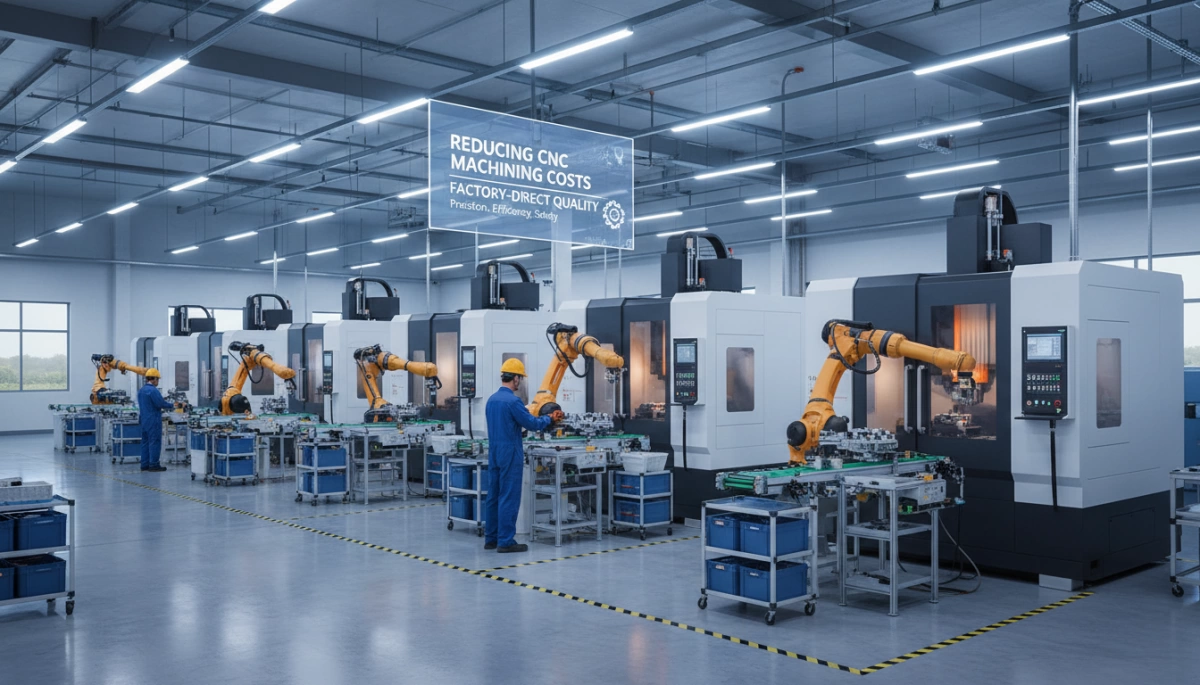
When you look at the bottom line in 2026, supply chain layers add unnecessary expense. We built ZSCNC to cut out the middleman completely. By eliminating broker markups, we offer factory direct CNC pricing that reflects the actual cost of manufacturing, not administrative fees. You aren’t just buying parts; you are partnering directly with the shop floor that makes them.
Why partnering directly with us makes sense:
- No Hidden Fees: You avoid the extra percentage that trading companies and brokers charge.
- Certified Reliability: Low cost is useless without quality. As an ISO 9001 certified machine shop, we maintain rigorous quality control systems. This ensures that whether we are producing high-volume runs or specific custom aluminum CNC machined parts, the precision matches your technical drawings every time.
- Instant Budget Checks: We leverage instant CNC quote technology to give you immediate pricing feedback. You can upload your files and see how design changes impact the price in real-time, making CNC machining quotes transparent and fast.
- Reduced Lead Times: Direct communication means faster results. We significantly reduce lead times for both prototypes and production runs because there is no third party relaying messages, helping you transition from design to finished product faster.
FAQ: Common CNC Cost Reduction Questions
Navigating the pricing structure of custom manufacturing can be complex. Below, we address the most frequent questions we receive from clients looking to optimize their CNC cost reduction strategies without compromising on part quality.
How much does anodizing add to the final part cost?
Surface finishing is a variable cost that depends on the type and color. Standard Type II anodizing (Clear or Black) is generally the most cost-effective option because we can batch multiple parts together. However, requesting custom color matching or Type III hard anodizing will increase costs due to the specialized setup required for smaller batches. To keep prices low, we recommend sticking to standard finishes unless the application strictly demands otherwise.
Can ZSCNC engineers suggest design changes to save money?
Yes. Design for Manufacturability (DFM) is a core part of our service. When you submit a CAD file, our engineering team reviews it to identify features that drive up costs unnecessarily, such as deep cavities, sharp internal corners requiring EDM, or non-standard hole sizes. We often suggest minor geometry adjustments that significantly reduce machining time while maintaining the part’s functionality.
Is it cheaper to machine or 3D print a prototype?
This depends entirely on the geometry and quantity. For a single unit with complex, organic geometries, 3D printing (SLA or SLS) is typically cheaper because it requires no tooling or setup. However, for functional testing where material strength is critical, deciding when to switch from 3D printing to CNC machining is vital. If your prototype requires the mechanical properties of Aluminum 6061 or Stainless Steel, CNC machining is the superior choice, even for a quantity of one.
How do batch sizes affect the price per unit?
Batch production volume is the single biggest factor in unit pricing. Every CNC job involves a fixed setup cost—programming, tooling preparation, and fixture alignment.
- 1 Part: You pay the entire setup cost for that single item.
- 100 Parts: The setup cost is amortized across all 100 units, drastically lowering the price per part.
While ZSCNC offers a no MOQ policy to support R&D, increasing your order size from a single prototype to a low-volume run is the fastest way to reduce the cost per unit.

 English
  German
  Dutch
Dutch  Russian
  Czech
Czech  French
  Korean
  Japanese
  Spanish
  Portuguese
Reviews
There are no reviews yet.