
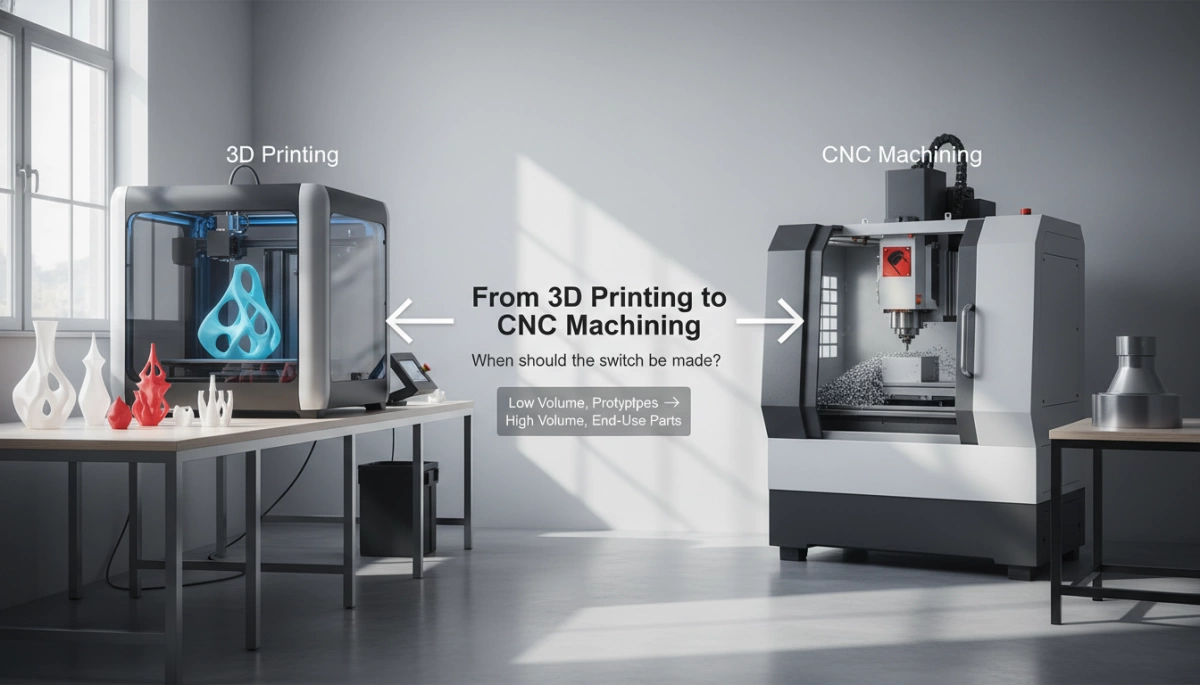
Understanding the Core Differences: Additive vs. Subtractive Manufacturing
At ZSCNC, we manage thousands of projects ranging from rapid prototyping to full-scale production, and the fundamental choice often starts here: how the part is physically created. Additive manufacturing (3D printing) builds parts layer-by-layer, fusing material to create complex geometries that might be impossible otherwise. Conversely, CNC machining is subtractive manufacturing; we start with a solid block of material and use high-precision tools to remove what isn't needed, carving out the final component.
While 3D printing offers speed for early concepts, CNC machining provides the structural integrity required for final functional parts. Here is a quick breakdown of how these technologies compare on our platform:
| Feature | 3D Printing (Additive) | CNC Machining (Subtractive) |
|---|---|---|
| Process | Builds layer-by-layer | Removes material from solid stock |
| Speed | Extremely fast (Parts in as little as 3 days) | Fast (Parts in as little as 5 days) |
| Geometry Freedom | High (Complex internals, hollows) | Moderate (Limited by tool access) |
| Material Properties | Anisotropic (Strength varies by direction) | Isotropic (Uniform strength) |
| Material Options | 70+ Materials (Plastics, Resins, Metals) | 120+ Materials (Metals, Plastics) |
| Waste | Low (Material efficient) | High (Chips/swarf generated) |
| Scalability | Best for 1-50 units | Best for 1-1,000+ units |
Real-World Implications: Isotropic vs. Anisotropic Parts
The manufacturing method directly dictates part performance. Because 3D printing fuses layers, parts are generally anisotropic, meaning they may be weaker along the Z-axis (where layers bond). If a part needs to withstand multi-directional stress, this can be a failure point.
In contrast, CNC machined parts are isotropic. Since we machine them from a solid, extruded, or cast block of material, they retain the native mechanical properties of the raw stock—whether that’s Aluminum 6061 or Delrin. For engineers requiring consistent tensile strength and thermal stability across the entire component, subtractive manufacturing is often the necessary choice.
Key Triggers: When 3D Printing Reaches Its Limits
While additive manufacturing is unbeatable for speed—delivering parts in as little as 3 days—there comes a specific point where it holds your project back. Recognizing these triggers early prevents wasted budget on prototypes that cannot perform in real-world conditions.
Design Maturity and DFM Readiness
The first signal to switch is often design maturity. If your geometry is stabilized and you have already incorporated automated design for manufacturability DFM feedback, continuing with print iterations is unnecessary. Once the design is locked, the cost-per-part efficiency of 3D printing diminishes rapidly compared to CNC, especially when scaling beyond a handful of units.
Functional Testing Failures
Physical performance is the ultimate deciding factor. Functional prototyping with 3D prints often reveals limitations in layer adhesion; if your parts are snapping under load, failing fatigue tests, or exhibiting poor environmental resistance, you need the isotropic strength of machined solid stock. Many teams overlook this, which is one of the top mistakes engineers make when ordering custom CNC parts—relying on printed approximations for structural validation when only a machined part can provide accurate data.
Tolerance and Surface Quality Demands
Precision is the hard line for most engineers. Standard 3D printing rarely holds reliable tolerances tighter than ±0.1mm without extensive post-processing.
- Tight Tolerances: When your assembly requires tight tolerances CNC machining—down to ±0.001mm for precise mating surfaces, bearing fits, or fine threads—the switch is mandatory.
- Surface Finish: If visible layer lines interfere with the part's operation (e.g., sealing surfaces) or aesthetics, a surface finish Ra comparison heavily favors CNC. Machining delivers superior surface quality (Ra 0.8µm or better) straight off the machine, whereas finishing a print to that standard is often cost-prohibitive.
Material and Mechanical Performance: The Deciding Factor
When moving from a visual model to a functional component, the physical integrity of your material is the ultimate dealbreaker. The fundamental difference lies in structure. 3D printing fuses material layer by layer, creating anisotropic parts. This means a printed bracket might be strong horizontally but prone to snapping along the vertical layer lines (Z-axis) under stress.
In contrast, CNC machining material strength is isotropic. Because we carve parts from a solid, extruded block of stock, the material possesses uniform strength in every direction. You get the full, native properties of the material—tensile strength, fatigue resistance, and thermal stability—without the internal porosity often found in additive processes.
Comparison: Printed vs. Machined Properties
| Feature | 3D Printing (Additive) | CNC Machining (Subtractive) |
|---|---|---|
| Structure | Anisotropic (Weak Z-axis) | Isotropic (Uniform Strength) |
| Thermal Stability | Lower (Prone to warping) | High (Native material limits) |
| Fatigue Resistance | Low to Medium | High (Ideal for cyclic loads) |
| Watertightness | Porous (Requires sealing) | 100% Solid |
When "Like" Materials Aren't Enough
Simulated materials in 3D printing often mimic the name but not the performance of their industrial counterparts. A "Nylon-like" resin print lacks the elongation at break and impact resistance of real Nylon plastic machined from solid stock. This distinction is even more critical with metals. While DMLS (metal printing) is advancing, it cannot yet match the cost-efficiency and structural predictability of aluminum materials used in precision machining. If your part must withstand high RPMs, pressure, or extreme heat, switching to CNC ensures the mechanical properties matches your engineering simulations exactly.
Volume and Cost Crossover: The Economic Tipping Point
Determining the right manufacturing process often comes down to a simple calculation of unit economics. While additive manufacturing is unbeatable for single prototypes due to zero tooling costs, the CNC vs 3D printing cost per part dynamic shifts rapidly as quantities increase. We typically see the "tipping point" occur between 10 and 50 units. At this volume, the efficiency of subtractive manufacturing begins to outweigh the setup-free convenience of printing.
Analyzing the Hidden Costs
To make an informed decision, you need to look at where the money actually goes in each process:
- 3D Printing (Linear Scaling): The cost is driven by machine time and material. Printing 50 parts takes roughly 50 times as long as printing one. There are no economies of scale here; the machine builds slowly, layer by layer, regardless of volume.
- CNC Machining (Front-Loaded Cost): The primary cost is the initial setup—CAM programming and fixturing. However, once the machine is running, material removal is incredibly fast. For low volume production CNC, that initial setup fee is amortized across the entire batch, causing the price per unit to drop drastically as you order more.
Bridge Production Strategies
This cost structure makes CNC the perfect solution for "bridge production." Before committing to the high capital investment of injection molding tools (which often require minimums of 1,000+ units), running 50 to 500 units via CNC allows you to validate the market and supply chain. This approach is particularly effective when you need to reduce machining cost for low-volume automotive CNC parts while maintaining production-grade material properties that 3D printing simply cannot match. It bridges the gap, ensuring you aren't stuck with weak prototypes or expensive, unverified tooling.
Hybrid Workflows: The Best of Both Worlds in 2026
We are moving beyond the binary choice of additive vs subtractive manufacturing. In 2026, the most efficient supply chains are adopting hybrid strategies that leverage the strengths of both technologies. The process involves 3D printing a "near-net shape"—getting the part 90% complete with internal complexity—and then using CNC machining to finish critical features like bores, threads, and mating surfaces to tight tolerances.
This approach solves the limitations of each standalone process. You get the geometric freedom of printing (like internal cooling channels) combined with the precision of machining. For instance, we often use 5-axis CNC machining services for complex aluminum parts to refine metal 3D prints (DMLS/SLM), ensuring that sealing surfaces meet strict flatness requirements while keeping material waste low.
Why Switch to a Hybrid Strategy?
| Feature | Pure 3D Printing | Pure CNC Machining | Hybrid Workflow |
|---|---|---|---|
| Geometry | High complexity (internal structures) | Limited by tool access | Complex internals + Precision externals |
| Tolerance | Standard (±0.1mm - ±0.2mm) | High Precision (±0.001mm) | High Precision on critical features |
| Material Waste | Low | High (Subtractive) | Optimized (Add material only where needed) |
| Lead Time | Fast (3 days) | Medium (5+ days) | Accelerated for complex metal parts |
Real-World Applications
- Aerospace: Printing lightweight brackets with honeycomb interiors, then machining the mounting points for perfect alignment.
- Automotive: Creating custom fluid manifolds where internal flow paths are printed, but port threads are machined for high-pressure seals.
- Consumer Hardware: Rapidly iterating housing designs with 3D printing while CNC machining the interface points to validate fit with existing assemblies.
By integrating these methods, we help engineers achieve tight tolerances without sacrificing the design innovation offered by additive manufacturing.
Practical Decision Framework: Step-by-Step Guide
Navigating the shift from additive vs subtractive manufacturing doesn't have to be a guessing game. We use a logical progression to determine the exact moment a project should graduate from the print bed to the machine shop. This framework ensures you aren't overspending on prototypes or under-delivering on material performance during the prototype to production transition.
The Decision Flowchart
- Phase 1: Concept & Form
- Is the design still changing daily?
- Is the part purely for visual representation?
- Verdict: Stick with Rapid prototyping additive methods like FDM or SLA. Speed and low cost are your priorities here.
- Phase 2: Fit & Function
- Does the part need to mate with other components?
- Are there specific tight tolerances (e.g., ±0.05mm) required for assembly?
- Verdict: If standard 3D printing tolerances (typically ±0.2mm) aren't cutting it, it’s time to look at machining. For a deeper dive into these requirements, our CNC machining 101 guide explains how precision impacts functionality.
- Phase 3: Stress & Environment
- Will the part be under load, heat, or pressure?
- Do you need isotropic strength (equal strength in all directions)?
- Verdict: Functional prototyping requires the native material properties of CNC machining material strength. Printed parts often fail here due to layer adhesion issues.
Real-World Application Scenarios
| Stage | Scenario | Recommended Method | Why? |
|---|---|---|---|
| Early Concept | Visualizing a new drone housing design. | 3D Printing | Fast iteration (3 days), low cost, geometry freedom. |
| Functional Validation | Testing a suspension arm under load. | CNC Machining | Needs isotropic metal strength and fatigue resistance. |
| Scaled Prototypes | 50 units of a complex manifold. | Hybrid / CNC | Low volume production CNC becomes cost-effective and ensures consistency. |
Quick-Reference Matrix: When to Switch
Use this table to make instant decisions based on your project's critical constraints.
- Choose 3D Printing If:
- Quantity is 1-10 units.
- Geometry is impossible to machine (internal lattices).
- Surface finish isn't critical (visible layers are acceptable).
- You need parts in hand within 24-72 hours.
- Choose CNC Machining If:
- Quantity is 10-500+ units.
- You need Surface finish Ra comparison values better than 0.8µm.
- The part requires threads, tight bores, or flat sealing surfaces.
- Material properties must match the final production part (e.g., Aluminum 6061, Stainless Steel).
- Consider Hybrid Manufacturing If:
- The part is large and expensive to machine from solid block.
- You need complex internal channels (printed) combined with precision mating surfaces (machined).
- You are balancing high-performance needs with material conservation.
Many industries, particularly in MedTech, face strict regulatory hurdles where material certification is non-negotiable. In these cases, understanding why many medical device startups choose CNC machining for prototypes can save significant time during the validation phase. Making the switch at the right time prevents costly re-designs later.
How ZSCNC Supports Your Transition
Making the leap from rapid prototyping to full-scale production requires a partner who understands the nuances of both additive and subtractive manufacturing. At ZSCNC, we specialize in bridging this gap, offering high-precision CNC milling and turning services that turn your finalized designs into robust, production-grade reality. We don't just cut material; we ensure your move from 3D printing to CNC is seamless and cost-effective.
Precision and Material Versatility
When your project outgrows the material limitations of 3D printing, we provide access to over 120 metals and plastics. Our facility is equipped to handle complex geometries with strict requirements, ensuring that functional parts meet the necessary mechanical properties for end-use applications.
- Tight Tolerances: We deliver components with exceptional precision, capable of meeting industrial-grade CNC machining accuracy standards down to ±0.005mm for critical mating surfaces.
- Surface Finish: Achieve superior Ra values and cosmetic finishes that 3D printing cannot match without extensive post-processing.
- Scalability: Efficiently transition from "one-off" prototypes to low-volume production runs.
Seamless Integration and DFM
We streamline the procurement process to keep your engineering timeline on track. By uploading your CAD files (STEP, STL, IGS) to our platform, you receive automated Design for Manufacturability (DFM) feedback. This identifies potential machining issues early, allowing you to optimize designs that were originally intended for 3D printing.
- Instant Quoting: Compare costs immediately to identify the economic tipping point for your specific project.
- Fast Lead Times: Get CNC machined parts delivered in as little as 5 days.
- Hybrid Strategy Support: We assist in workflows that utilize 3D printing for complex internal geometries while using CNC for precision external features.
 English
  German
  Dutch
Dutch  Russian
  Czech
Czech  French
  Korean
  Japanese
  Spanish
  Portuguese