
Material Selection: The Backbone of Reliable Change Parts
In the high-stakes environment of packaging, the material chosen for change parts dictates the line's overall efficiency (OEE). We don't just pick plastic off a shelf; we engineer solutions that strike a critical balance between low friction and extreme durability. If a material is too soft, it wears out prematurely; if it is too hard, it scuffs premium PET or glass containers.
Why UHMW-PE (PE1000) is the Gold Standard
For components in direct contact with moving containers—specifically starwheels and timing screws—UHMW-PE wear strips are our go-to solution. Its self-lubricating properties drastically reduce noise and friction, ensuring smooth bottle handling without the need for external lubricants.
- Impact Strength: Absorbs shock from high-speed container collisions.
- Surface Protection: Prevents cosmetic damage to labels and bottle walls.
- Noise Reduction: Significantly dampens vibration on high-speed bottling lines.
Structural Rigidity with POM (Delrin)
When we design parts requiring tighter tolerances and higher mechanical strength, such as Delrin guide rails or complex gripper components, Acetal (POM) is the superior choice. Unlike softer polyethylene, Delrin holds its dimensions under load, ensuring precise alignment and stability during format changeovers.
Stainless Steel for Washdown Environments
For pharmaceutical and beverage lines subject to aggressive CIP (Clean-in-Place) and SIP (Sterilization-in-Place) protocols, standard plastics may degrade. We utilize Stainless Steel (304/316) for base plates and structural interfaces to withstand caustic chemicals and high-pressure washdowns without corroding.
Ensuring Safety and Compliance:
- FDA-Compliant Materials: All food-contact surfaces are machined from certified food-grade plastics meeting FDA and EU standards.
- Chemical Resistance: We select materials specifically to survive daily exposure to harsh sanitizing agents.
- Hygiene: Our materials feature near-zero moisture absorption to prevent swelling and bacterial growth.
Engineering Drop-In Reliability: Design Best Practices
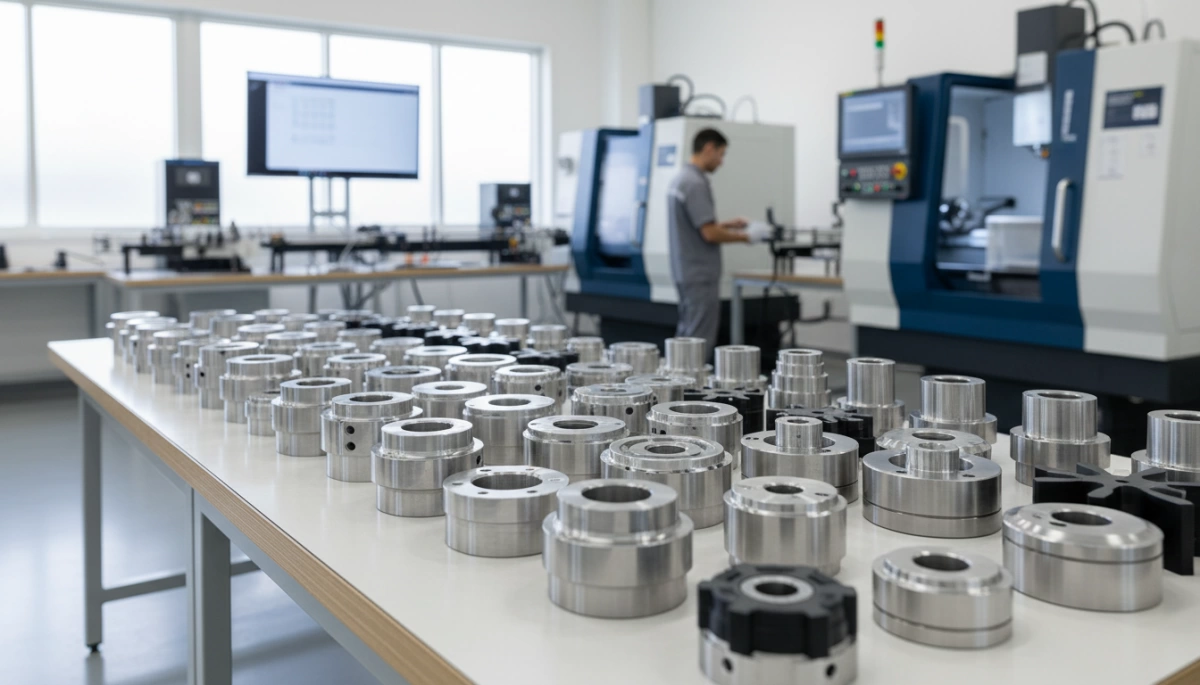
When we approach CNC machining for packaging lines, the goal is simple: the operator should never need a file or a hammer to install a part. "Drop-in" means the component fits perfectly immediately, drastically reducing downtime during format changes. This reliability starts with the engineering phase, where we focus on the interaction between the machine and the container.
Mastering the 'Handshake' and Tolerances
The most critical moment in any packaging line is the "handshake"—the split second a bottle transfers from the timing screw to the infeed starwheel. We engineer precise bottle handling geometry to ensure this transition is seamless. If the geometry is off, bottles will tip, jam, or break. To prevent this, we rigorously manage tolerance stack-up. In high-speed bottling, a variance of just a few microns can cause chaos. We adhere to strict standard tolerances for 5-axis parts, typically holding dimensions within 0.02mm to 0.05mm. This precision ensures that starwheel pocket tolerance is tight enough to grip the bottle securely but loose enough to allow smooth entry and exit.
Timing Screw Dynamics and Container Safety
Timing screw design is about more than just cutting a spiral groove. For high-speed lines, we design screws with variable pitch and acceleration. This geometry gently grabs a container from a slow conveyor and accelerates it to match the machine's pitch, ensuring total container stabilization before it enters the main turret.
To ensure the safety of the product, we focus on these specific design details:
- Matching Root Diameters: We profile the root diameter of the screw to match the exact contour of the container, providing full surface contact rather than pressure points.
- Chamfered Edges: Freshly machined plastic can be razor-sharp. We chamfer every edge on starwheels and guides to eliminate product damage, preventing scratched labels or punctured PET walls.
Optimizing for SMED: Designing for Quick Changeovers
Minimizing downtime during format changes is just as critical as the running speed of the line. We engineer our change parts specifically to support SMED (Single-Minute Exchange of Die) methodologies, directly contributing to significant OEE improvement. By moving away from standard OEM designs that require wrenches and extensive manual adjustment, we focus on tool-less changeover solutions that get your packaging line back up and running in minutes, not hours.
To achieve this, we implement specific design features during the CNC machining process:
- Tool-less Assembly: We integrate quick-release knobs, magnets, and cam levers directly into the component design. Operators can swap starwheels and guides by hand, completely eliminating the need for tools on the production floor.
- Lightweighting via CNC Pocketing: Heavy change parts fatigue operators and slow down the process. We utilize advanced milling strategies to remove excess material without compromising structural integrity. You can review our design tips for complex 5-axis parts to understand how we optimize geometry for weight reduction while maintaining durability.
- Poka-Yoke Strategies: We design "mistake-proofing" features like asymmetric mounting pins or unique keyways. This ensures parts can only be installed in the correct orientation, preventing jams and damage during startup.
- Visual Management: We use color-coded materials (e.g., Blue UHMW for 500ml, Green for 1L) to make size identification instant. This simplifies inventory management and ensures the correct precise CNC machining materials are selected for the specific run.
The Manufacturing Workflow: Reverse Engineering to 5-Axis
Solving the 'No Drawing' Problem with 3D Scanning
Running legacy equipment often means dealing with missing blueprints. We solve this common headache by using advanced 3D scanning technology to capture the exact geometry of your existing components. Whether it is a worn starwheel or a broken guide rail, we can take the physical part and generate a precise digital twin. This process allows us to reverse engineer change parts without needing original CAD files from the OEM, ensuring you get a replacement that fits perfectly the first time.
From Worn Sample to Optimized CAD Model
Simply copying a used part isn't enough because you don't want to replicate the wear patterns. Our engineering team analyzes the scan data to restore critical dimensions to their original tolerances. We transform the data from a worn sample into an optimized CAD model, correcting any deformities caused by years of production. This digital restoration ensures that the new CNC machined components provide better stability and longevity than the part being replaced.
Why 5-Axis CNC Milling is Non-Negotiable for Scrolls
For complex geometries like timing screws and feed scrolls, standard 3-axis machining cannot achieve the necessary fluidity. We utilize precision CNC milling services with full 5-axis capabilities to handle these intricate shapes. A 5-axis CNC milling setup allows the cutting tool to follow the variable pitch and acceleration curves of a screw continuously. This results in a seamless bottle path that eliminates the "stuttering" or vibration often seen with inferior machined parts, protecting your glass or PET containers from damage.
Achieving Sanitary Surface Finishes
In the food and beverage industry, surface roughness is a breeding ground for bacteria. We prioritize achieving sanitary surface finishes directly from the machine. By using high-speed machining strategies and sharp tooling, we minimize microscopic peaks and valleys where product residue can accumulate. This attention to detail ensures your change parts are easy to clean during washdowns and remain compliant with strict hygiene standards.
FAQs: Common Questions About Custom Change Parts
Can you reverse engineer parts without original CAD files?
Absolutely. We specialize in reverse engineering change parts using advanced 3D scanning technology. You do not need the original OEM blueprints. Whether you have a worn-out sample, a broken component, or just the machine interface details, we capture the exact geometry to create a precise CAD model. This ensures a "first-time right" fit for complex shapes like feed scrolls and grippers.
How does CNC machining improve OEE compared to OEM parts?
Precision is the main driver of efficiency. Our CNC machining for packaging lines ensures tighter tolerances than standard mass-produced parts, which leads to smoother packaging line synchronization and fewer jams. By tailoring the design to your specific production speed rather than a generic standard, our custom CNC machining services for machinery help minimize micro-stops and reduce noise. This direct focus on stability results in measurable OEE improvement.
What is the typical lead time for custom starwheels?
Speed is our major advantage over large OEMs. While original manufacturers often quote lead times of several months, our standard turnaround is typically 2–3 weeks. We understand that line stoppages are expensive, so we prioritize rapid production for critical components like custom starwheels and timing screws to get your line back up and running fast.
Do you provide material certifications for FDA audits?
Yes. Compliance is non-negotiable in the food and beverage sector. We strictly use FDA-compliant materials such as virgin UHMW-PE, Delrin (POM), and Stainless Steel 316. We provide full material certifications and traceability documentation with your order, ensuring you have everything needed to pass safety audits and washdown inspections without issues.
 English
  German
  Dutch
Dutch  Russian
  Czech
Czech  French
  Korean
  Japanese
  Spanish
  Portuguese