

You might already know that the secret to crafting a world-class horn isn't just the design—it's the exact manufacturing process behind it.
But how do you perfect CNC machining brass for musical instruments to achieve a truly flawless, resonant sound?
Well, you're in for a treat because I've put together a complete guide to mastering this exact craft.
It takes a lot more than just cutting metal. It requires achieving the ultimate precision for perfect harmonics, optimizing the surface finish to prevent vibration damping, and unlocking the absolute best acoustic properties from your chosen brass alloys.
In this post, you're going to learn exactly how to navigate these technical challenges step by step to produce instruments of unmatched quality.
Let's dive right in.
The Transition from Manual Crafting to Precision CNC
For centuries, brass musical instruments were defined entirely by the hands of master artisans. While traditional manual crafting established the foundation of acoustic design, it inherently struggled to meet the rigorous scalability and consistency demands of the modern global market. Today, the shift toward CNC machining brass for musical instruments marks a critical evolution in production.
By transitioning from conventional hand-tooling to advanced subtractive manufacturing, we bridge the gap between historic artistry and modern engineering. The implementation of computer-controlled machine tools guarantees exceptional dimensional stability, ensuring that every complex structure and custom musical instrument part is replicated with absolute fidelity. This is not merely an upgrade in speed; it is a fundamental transformation in how structural integrity and acoustic reliability are achieved.
How CNC Technology Enhances Instrument Quality
The integration of precision manufacturing into instrument production directly dictates the final sound. CNC technology elevates instrument quality from the inside out, aligning optimal surface finishes with engineered acoustic properties.
Here is exactly how automated processes enhance overall instrument quality:
- Micron-Level Precision: Automated CNC processes eliminate human error. Critical components, such as valve casings and mouthpieces, are machined to exact geometric tolerances to prevent air leakage and mechanical friction.
- Superior Surface Finish: The high machinability of brass allows CNC equipment to produce exceptionally smooth, aesthetically pleasing surfaces right off the machine. This internal smoothness reduces turbulence, allowing for unhindered sound wave conduction.
- Optimized Acoustic Performance: By maintaining strict control over material wall thickness and chamber dimensions, CNC machining ensures consistent resonance, flawless intonation, and predictable vibration control across every production batch.
- Complex Structure Molding: Advanced multi-axis CNC machines easily carve out intricate internal geometries that are either too difficult or completely impossible to achieve through manual casting and traditional tooling.
Why Brass is the Ideal Material for Acoustic Excellence
When crafting custom musical instrument parts, the material dictates the final sound. We rely on brass because it delivers the perfect balance: it is easy to cut, resonates brilliantly, and lasts for generations. CNC machining brass for musical instruments is the proven standard for achieving elite acoustic performance.
Exceptional Machinability for Complex Structures
Brass is remarkably forgiving during subtractive manufacturing. Its high machinability allows our computer-controlled machine tools to carve out intricate designs without ruining the cutting tools.
- Faster production: Smooth material removal keeps our manufacturing times efficient and predictable.
- Complex structure molding: We can easily shape the tight curves, valve casings, and exact internal geometries required for proper airflow.
- Dimensional stability: Brass holds exceptionally tight tolerances, ensuring every moving piece fits together flawlessly.
Inherent Acoustic Properties and Resonance
The real advantage of brass is its voice. The metal's natural density provides a highly responsive acoustic performance. As air moves through the machined chambers, the brass resonates, amplifying rich harmonics while maintaining a focused, stable sound. This specific blend of mechanical properties is what gives horns and woodwinds their signature warmth and bright projection.
Corrosion Resistance for Instrument Longevity
Instruments face constant moisture from a player's breath, so the metal must fight off degradation. Brass naturally offers excellent corrosion resistance, preventing internal pitting that can disrupt airflow and ruin an instrument's tone. By selecting the right brass grades, we ensure the finish quality and structural integrity hold up over decades of heavy use. For specialized, high-wear components that demand even tougher moisture defense, we utilize durable alloys like C46400 naval brass to guarantee long-lasting performance without compromising the acoustics.
How Machining Precision Impacts Sound Quality
In CNC machining brass for musical instruments, precision, surface finish and acoustic properties dictate the final sound. A fraction of a millimeter off, and the instrument loses its voice. We rely on precision manufacturing to ensure every single cut directly enhances the overall acoustic performance of the piece.
Geometric Tolerances and Sound Wave Conduction
Sound waves require a flawless path to travel. If the internal dimensions of a mouthpiece or a valve casing aren't perfect, the air becomes turbulent, and the note falls flat or feels stuffy.
- Micron-level precision: We machine brass components to exact specifications so the air column flows without any interruption.
- Dimensional stability: The brass holds its precise shape over time, keeping the sound wave conduction consistent and reliable.
- Design optimization: Exacting geometries mean better resonance and projection. Selecting the right machining materials ensures the brass maintains these tight geometric tolerances under pressure.
Assembly Accuracy for Optimal Harmonics
Even the best individual components won't sound right if they don't fit together flawlessly. Assembly accuracy is what brings the instrument's true voice to life.
- Seamless connections: When custom musical instrument parts like valves, tuning slides, and bells connect without gaps, you completely eliminate air leaks.
- Vibration transfer: A tight, accurate assembly ensures acoustic vibrations pass cleanly through the entire body of the instrument, producing rich, full harmonics.
- Subtractive manufacturing: By cutting away exactly what is not needed, we create complex structures that lock together perfectly, securing the instrument's tonal integrity from the mouthpiece to the bell.
Selecting the Right Brass Alloys for Instrument Parts
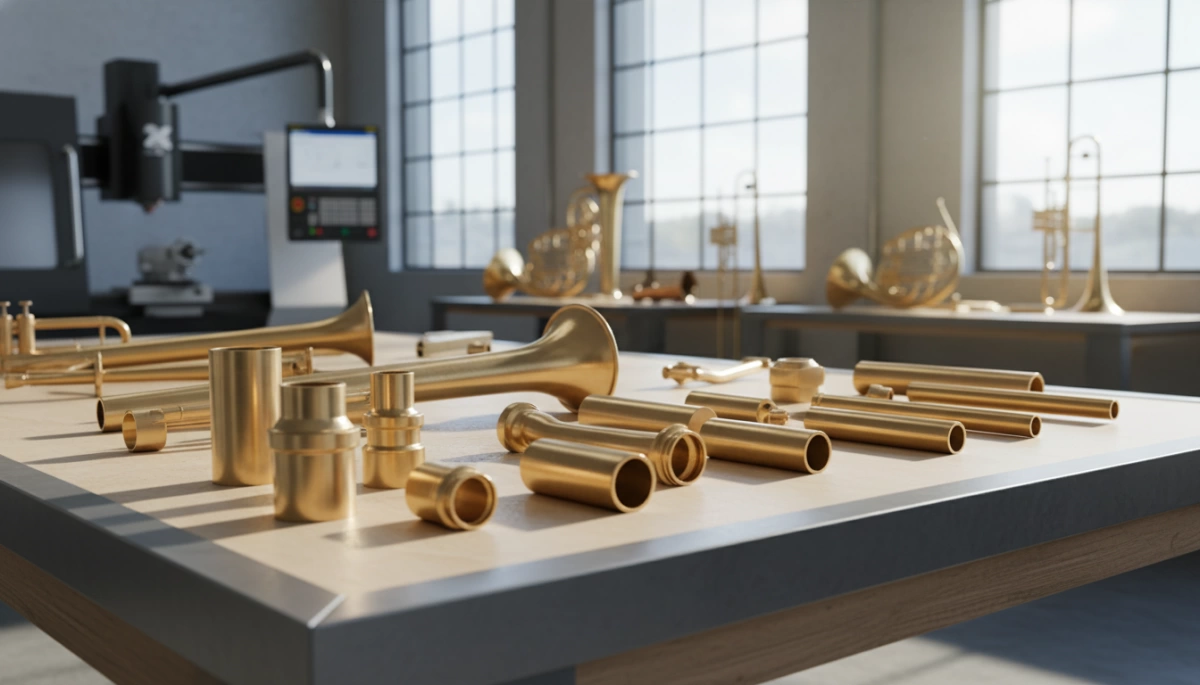
When dealing with CNC machining brass for musical instruments: precision, surface finish and acoustic properties, the exact material choice makes all the difference. Understanding how to select precise CNC machining materials dictates whether an instrument sings or falls flat. I always match specific brass grades to the exact function of the part to guarantee top-tier acoustic performance.
C360 Free-Cutting Brass for Precision Valves and Mouthpieces
For the most intricate and fast-moving components, I rely strictly on C36000 free-cutting brass.
- High machinability: It chips cleanly, preventing tool drag during high-speed precision manufacturing.
- Complex structure molding: Perfect for achieving micron-level precision in mouthpieces.
- Dimensional stability: Ensures completely airtight seals in piston and rotary valves.
C260 Cartridge Brass for Resonant Acoustic Chambers
Acoustic chambers and bells require a completely different approach. Cartridge brass (C260) is my undisputed choice here.
- Superior resonance: It delivers the warm, ringing, and expansive acoustic qualities players demand.
- Ideal mechanical properties: It offers outstanding formability, allowing us to shape large, sweeping instrument bodies without risking material fatigue or cracking.
Lead-Free Brass Options for Modern Compliance
Modern manufacturing means staying ahead of global safety standards. We are actively integrating lead-free brass alloys into our production lines for modern compliance.
- Regulatory safety: Meets strict health and environmental regulations for skin-contact parts.
- Uncompromised quality: Maintains the same rich sound profile and corrosion resistance as traditional leaded options.
Brass Grade Application Quick Reference
| Brass Grade | Primary Application | Key Manufacturing Advantage |
|---|---|---|
| C360 (Free-Cutting) | Valves, Mouthpieces, Trim | Ultimate precision and high machinability |
| C260 (Cartridge) | Bells, Acoustic Chambers, Tubing | Exceptional resonance and structural forming |
| Lead-Free Alloys | Direct skin-contact components | Complete regulatory compliance without acoustic loss |
Optimizing Surface Finish for Aesthetics and Vibration
When dealing with CNC machining brass for musical instruments: precision, surface finish and acoustic properties are deeply connected. We understand that a flawless exterior is not just for visual appeal. The overall finish quality directly dictates how sound waves and air travel through the instrument. Crafting aesthetically pleasing surfaces is only the baseline; optimizing the metal for peak acoustic performance is our primary goal.
The Effect of Surface Quality on Vibration Damping
Every microscopic flaw on a machined brass part can alter its musical profile. A rough internal or external surface acts as a barrier, causing unwanted vibration damping and deadening the tone.
- Smooth surfaces: Promote natural resonance, allowing sound waves to travel freely.
- Rough textures: Increase acoustic friction, dampening the instrument's sustain.
- Micron-level precision: Guarantees the brass vibrates exactly as the designer intended, maintaining pitch clarity.
Polishing and Buffing Techniques for Brass Instruments
Achieving a mirror-like shine requires targeted surface treatments. We utilize reliable, automated processes to guarantee consistency across every production run. Whether you assemble locally or scale operations overseas, knowing how to manage cost, quality, and supplier selection is vital to securing these premium finishes consistently.
| Technique | Best For | Primary Benefit |
|---|---|---|
| Mechanical Polishing | Mouthpieces and valve blocks | Deep, high-gloss shine and smooth tactile feel |
| Buffing | Bells and large exterior curves | Efficiently removes fine machining marks |
| Electrochemical Polishing | Complex internal geometries | Uniform finish quality, drastically improving airflow |
Electroplating and Protective Coating Options
Raw brass oxidizes quickly when exposed to air and moisture. To preserve the instrument's look and extend its lifespan, we apply specialized protective layers. The challenge is maximizing corrosion resistance and long-term wear performance without adding excessive mass, which can choke the instrument's natural vibration.
- Clear Lacquer: A lightweight, durable coating that maintains the raw brass aesthetic and protects against tarnishing without restricting resonance.
- Silver Plating: Delivers a distinctly bright sound profile alongside excellent wear resistance.
- Gold Plating: Offers a premium, warm tonal quality and provides the absolute highest level of corrosion resistance for high-end custom parts.
Technical Challenges in Brass Instrument Manufacturing
Even with the high machinability of brass, precision manufacturing for acoustic equipment presents unique hurdles. We must constantly balance mechanical properties with acoustic performance to deliver flawless custom musical instrument parts.
Managing Heat Generation and Tool Wear
Friction during subtractive manufacturing generates significant heat. While brass boasts excellent thermal conductivity, excessive temperatures can still warp thin-walled instrument components.
- Heat Control: We use optimized coolant flows and automated processes to keep temperatures stable.
- Tool Wear: Keeping computer-controlled machine tools razor-sharp prevents surface burrs and maintains dimensional stability.
- Material Dynamics: Unlike the rigorous tool-wear and heat challenges seen when managing stainless steel density and properties, brass allows for faster cutting speeds. However, thermal buildup must still be tightly controlled to prevent warping in delicate acoustic chambers.
Microstructure Acoustic Optimization During Machining
Cutting metal inherently alters its internal stresses. If we remove material too aggressively, we risk deadening the instrument's natural sound.
- Stress Relief: We program precise tool paths that minimize aggressive localized heating and preserve the metal's integrity.
- Resonance Preservation: Micron-level precision ensures different brass grades retain their intended vibrational qualities.
- Acoustic Tuning: Design optimization is applied directly at the machining stage to lock in superior acoustic performance and an aesthetically pleasing surface.
Ensuring Consistency in High-Volume Production
Achieving a perfect finish quality on a single valve is simple; doing it for ten thousand units requires rigorous automated control.
- Complex Geometries: Complex structure molding and intricate valve designs require high-end multi-axis setups. Leveraging advanced techniques, similar to the precision needed in 5-axis CNC gear machining services, guarantees that complex internal curves are cut flawlessly every time.
- Repeatability: We lock down every manufacturing variable—from tool feed rates to ambient shop temperature—to ensure absolute consistency and wear performance across all production batches.
Manufacturing Challenges & Solutions
| Challenge | Impact on Instrument | Our CNC Solution |
|---|---|---|
| Excessive Heat | Loss of dimensional stability | Automated cooling & optimized feed rates |
| Microstructure Stress | Poor acoustic performance | Precision-programmed subtractive tool paths |
| Volume Consistency | Variations in finish quality | Multi-axis computer-controlled machine tools |
 English
  German
  Dutch
Dutch  Russian
  Czech
Czech  French
  Japanese
  Spanish
  Portuguese
  Korean