
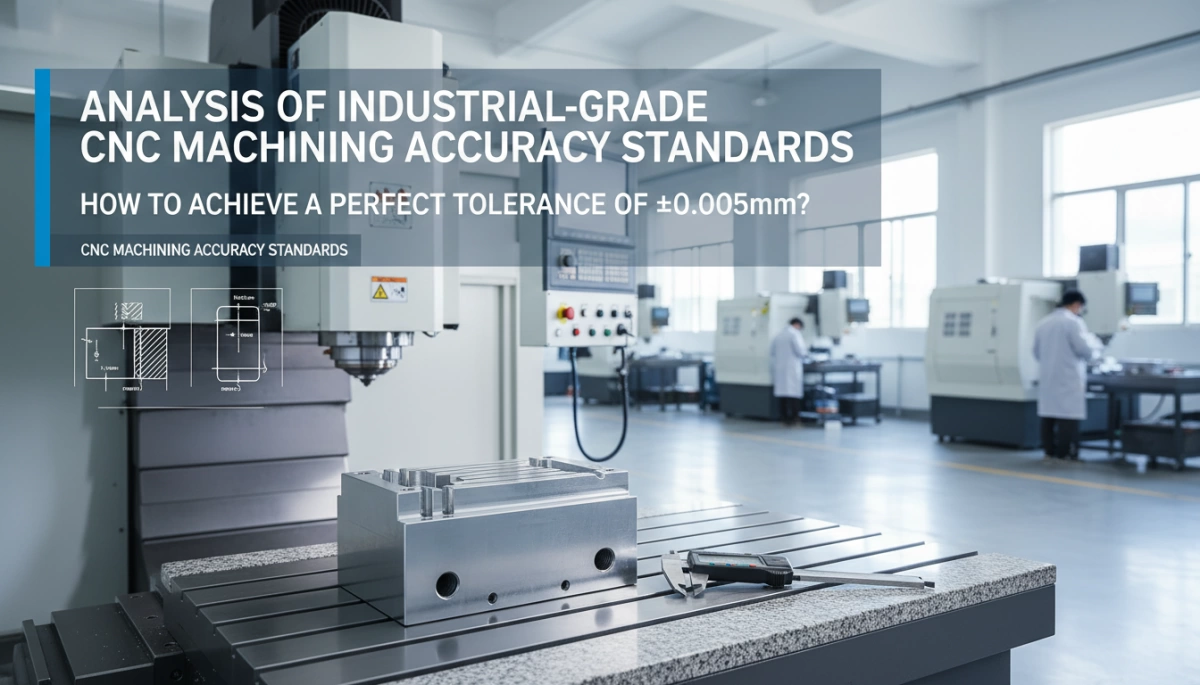
Understanding CNC Machining Accuracy Standards in Industrial Applications
When you’re sourcing critical parts, “high-precision CNC” isn’t enough. You need to know exactly what level of CNC machining accuracy you’re paying for, how it’s defined, and whether a supplier can truly hold a ±0.005mm tolerance in real production, not just on a brochure.

CNC Machining Accuracy vs Precision vs Tolerance
These three terms get mixed up, but they mean different things:
- Accuracy – How close the machined dimension is to the true or nominal value.
- Example: Target Ø10.000mm, actual Ø10.004mm → high accuracy.
- Precision (repeatability) – How consistent results are over many parts or cycles, regardless of how close they are to nominal.
- Example: Ten parts at Ø10.020mm ±0.001mm → high precision, low accuracy.
- Tolerance – The allowable deviation from nominal defined on the print.
- Example: Ø10.000mm ±0.005mm means any size between Ø9.995mm and Ø10.005mm is acceptable.
In industrial CNC machining, accuracy standards, precision, and tolerance must align. If a shop claims ±0.005mm capability but can’t repeat it across a lot of 500 parts, it fails industrial-grade expectations.
Why Tight Tolerances Matter in Critical Industries
Not every part needs micron-level accuracy, but in some sectors tight CNC tolerance standards are non‑negotiable:
- Aerospace machining tolerances
- Bearing bores, turbine components, actuators
- Tight fits control vibration, fatigue, and safety margins
- Medical device machining accuracy
- Implants, surgical instruments, housings
- Micron-level consistency affects biocompatibility, motion, and patient safety
- Automotive precision machining
- Engine components, transmission parts, fuel systems
- Accurate fits impact efficiency, noise, wear, and emissions
- Optical component machining
- Housings, mounts, lens barrels, stages
- High-precision tolerances control alignment, focus, and optical performance
In these fields, tight tolerance machining is about function, lifetime, and regulatory compliance, not just aesthetics.
Industrial Demand for Micron-Level Accuracy (±0.005mm)
Today’s industrial CNC accuracy expectations are moving into the micron-level range:
- ±0.01mm (±10µm) – Common for high-precision mechanical parts
- ±0.005mm (±5µm) – Required for critical fits, sealing surfaces, precision bores, and motion interfaces
- Below ±0.003mm (±3µm) – Specialized micron-precision parts, matched sets, optical and metrology components
Our own high-precision lines are built to deliver industrial-grade CNC machining in the ±0.005mm range on defined features, with validated process capability, not just one-off lab results.
Standard Tolerances vs High-Precision Requirements
Most drawings do not start at ±0.005mm. Typical CNC machining accuracy standards look like:
- Standard CNC machining tolerance
- General: ±0.05mm to ±0.1mm
- Non-critical bores and lengths: H7 / H8 holes, IT9–IT10 class fits
- Precision CNC machining
- Critical diameters, bearing seats: ±0.01–0.02mm
- Controlled geometry with GD&T (position, flatness, parallelism)
- High-precision tolerances
- Locating bores, sealing interfaces, precision slides: ±0.005mm or better
- Often combined with profile tolerances, cylindricity, and strict surface finish requirements
The step from standard to high-precision brings steep increases in cost, process complexity, metrology, and lead time. That’s why defining the correct tolerance level is a strategic decision, not just a design habit.
How Industrial Buyers Evaluate CNC Machining Accuracy Standards
Professional buyers and engineers don’t rely on claims; they verify CNC machining accuracy standards using hard data and process transparency. Here’s what they look for:
- Documented tolerance capability
- Sample machining tolerance charts and capability reports
- Evidence of holding ±0.005mm tolerance on similar materials, sizes, and geometries
- Machine and process capability
- High-precision 3-, 4-, and 5-axis CNC machines with known repeatability and repeat positioning accuracy
- Stable processes with proven Cpk/Ppk for critical features
- Metrology and quality control
- In-house CMM inspection, optical measurement, and calibrated gauges
- Formal inspection plans, PPAP or FAIRs for aerospace/automotive/medical
- Standards alignment
- Work aligned with ISO 2768, ASME Y14.5, and industry-specific norms
- Clear understanding of GD&T in machining and how it translates to real process controls
As a global supplier, we position our CNC services around this exact decision-making process: clear tolerance standards, transparent capability data, and a proven track record on industrial-grade ±0.005mm CNC machined parts.
Key CNC machining accuracy standards
If you want reliable industrial‑grade CNC machining accuracy, you have to design and buy parts around clear, recognized CNC machining accuracy standards—not guesswork.
Overview of common CNC tolerance standards
In most industrial shops, CNC tolerance standards are built around three pillars:
- General dimensional tolerances (ISO 2768, company standards)
- Geometric tolerances (ASME Y14.5 / GD&T)
- Machine capability (repeatability, process capability, SPC)
This combo defines what “standard CNC machining tolerance” means in real production, and when we step up into tight tolerance machining like ±0.005 mm.
ISO 2768 tolerance classes and when to use them
ISO 2768 is the main global reference for general tolerances on machined parts when no specific tolerance is called out.
- ISO 2768‑m / ISO 2768‑k
Used for standard industrial tolerances on non‑critical dimensions. - ISO 2768‑f / ISO 2768‑h
Used when you need higher precision but not extreme micron‑level accuracy.
Typical use:
- Brackets, housings, covers: ISO 2768‑m or k
- Mating mechanical features: ISO 2768‑f or h
- Truly critical fits (bearing bores, sealing lands, optical features): explicit tolerances like ±0.01 mm or ±0.005 mm instead of just ISO 2768.
ASME Y14.5 and GD&T basics for CNC parts
ASME Y14.5 defines GD&T (Geometric Dimensioning and Tolerancing), which is how we control:
- Form – straightness, flatness, circularity
- Orientation – perpendicularity, parallelism, angularity
- Location – position, concentricity, symmetry
- Profile – profile of a line/surface (key in profile tolerance machining)
- Runout – circular runout, total runout
For high‑precision CNC machining, GD&T lets us:
- Put tight control where it really affects function (e.g., bearing seats, alignment features)
- Relax non‑critical geometry to avoid over‑tolerancing and cost spikes
- Define flatness and parallelism tolerances and surface finish and accuracy in a clear, measurable way
Standard industrial tolerances vs precision tolerances
In industrial CNC, the gap between “normal” and “micron‑precision” is huge:
- Standard CNC machining tolerance:
About ±0.05–±0.1 mm on general dimensions for most materials/part sizes. - Precision tolerances:
Around ±0.01–±0.02 mm on critical fits with tighter process control. - High‑precision tolerances / micron‑level accuracy:
±0.005 mm or better, limited features, strict process, often 5‑axis and CMM‑verified.
Knowing where your part sits on this spectrum lets us choose the right CNC tolerance standards and quote honestly on cost and lead time. For typical 5‑axis parts, I recommend checking this quick guide to standard tolerances for 5‑axis machining before locking in your drawing.
Repeatability, repeat positioning accuracy, and stability
You can’t hold ±0.005 mm tolerance if your machine can’t land in the same spot every time.
Key machine metrics:
- Positioning accuracy – how close the axis moves to the commanded location on the first move.
- Repeatability / repeat positioning accuracy – how close multiple moves to the same position match each other.
- Stability – how those values drift with temperature, time, and load.
For industrial CNC accuracy, I look for:
- Linear axis repeatability ≤ ±0.002–0.003 mm
- High‑quality scales / encoders
- Proven CNC calibration and maintenance logs
This is the foundation for any promise of micron‑precision parts.
How to read a machining tolerance chart correctly
A machining tolerance chart (or capability chart) tells you:
- What range of tolerances is realistic for a given:
- Material
- Feature size
- Machine type (3‑axis vs five‑axis CNC precision)
- Whether the process is capable:
We often check Cp/Cpk ≥ 1.33 (or 1.67 for critical safety parts).
When you see a chart:
- Match your tightest tolerance (e.g., ±0.005 mm) against:
- Feature size
- Batch size
- Measurement method
- Confirm there’s data to back it: SPC, capability runs, CMM reports.
How standards guide design for manufacturability
Good use of CNC machining accuracy standards makes your part cheaper and more reliable:
- Use ISO 2768 for non‑critical dimensions instead of filling the drawing with tight numbers.
- Use ASME Y14.5 / GD&T to focus tight control on:
- Datums and assembly features
- Bearing bores, sealing faces, locating pins
- Critical alignment surfaces in aerospace, medical, and optics
- Avoid blanket tight tolerances (e.g., “all dimensions ±0.01”) that:
- Kill design for manufacturability tolerances
- Drive up cycle time, scrap, and inspection costs.
When we quote industrial‑grade CNC projects, we always align your drawing with practical CNC machining best practices and actual process capability. If you’re just starting with tolerance strategy, this broader CNC machining 101 guide is a good baseline before you jump into ±0.005 mm discussions.
What ±0.005mm CNC Tolerance Really Means
When we talk about ±0.005mm CNC tolerance, we’re in true micron-level territory. You’re allowing the size to vary by just five microns either side of nominal – that’s 0.01mm total, or about 1/10 the thickness of a human hair. At this level, every detail in design, machining, and inspection has to be controlled.
Bilateral, unilateral, and limit tolerances
In CNC machining accuracy standards, that ±0.005mm can be called out in a few ways:
- Bilateral tolerance
- Example: 10.000 ±0.005 mm
- Actual size can be: 9.995–10.005 mm
- Common for general fits and when deviation both ways is acceptable.
- Unilateral tolerance
- Example: 10.000 +0.000 / –0.010 mm
- Size can’t go over 10.000 mm, only smaller.
- Used where interference or jamming is critical (shafts, press fits).
- Limit dimensions
- Example: 9.995 / 10.005 mm
- Directly states min/max; no “±” symbol.
- Often used on drawings aligned with ASME Y14.5 or ISO 2768 practices.
Knowing which style is used changes how we program the job, set tool offsets, and check repeat positioning accuracy.
How ±0.005mm affects fit, function, and performance
With micron-level accuracy:
- Fits
- Sliding fits feel smoother and more consistent.
- Interference fits (e.g. bearings, bushings, pins) become highly predictable.
- Less variation = fewer surprises in assembly.
- Function & performance
- Lower noise and vibration in rotating parts.
- Better sealing, less leakage in hydraulic/pneumatic systems.
- More stable optical alignment and sensor accuracy.
- Reduced wear and longer service life.
On critical assemblies, this kind of industrial CNC accuracy directly cuts warranty issues and performance drift.
Micron-level accuracy in real industrial parts
We typically hold ±0.005mm tolerance on:
- Precision bores and bearing seats
- Locating features for optical or sensor mounts
- High-speed spindle/rotor interfaces
- Reference faces used for downstream assembly datums
To hit this reliably, we pair stable five-axis CNC machining, thermal compensation, and in-process probing with strict metrology (CMM, air gauges, optical measurement).
Industries that truly need ±0.005mm CNC machining
Not every industry needs it, but some absolutely do:
- Aerospace – fuel system components, turbine interfaces, precision housings, critical alignment features. Tight tolerance machining here is often mandatory; you can see how we apply it in our aerospace CNC machining services.
- Medical devices – surgical tools, implant interfaces, precision pump components, dental tooling.
- Automotive & EV – injection system parts, transmission valves, motor shafts, precision bushings.
- Optics & photonics – lens mounts, alignment blocks, sensor frames, where micron-level misalignment kills performance.
- High-end industrial equipment – precision stages, metrology tools, fluid control components.
In these areas, high-precision tolerances are not a “nice to have” – they’re a design requirement.
Trade-offs: cost, lead time, scrap, and risk
Pushing to ±0.005mm has real consequences:
- Cost goes up
- Slower feeds/speeds
- More finishing passes
- More expensive cutting tools and holders
- Extra inspection time (CMM, gauges, SPC)
- Lead time extends
- More process steps
- Extra setups, fine-tuning, and sometimes process trials.
- Scrap & risk increase
- A tiny drift in temperature, tool wear, or fixture stability can push a part out of spec.
- We mitigate this with in-process probing, tool wear compensation, and controlled environments.
So yes, industrial-grade CNC machining to ±0.005mm is possible and repeatable – but it must be justified by the function and lifecycle of the part.
When ±0.005mm is overkill (and what to use instead)
In a lot of cases, ±0.02–0.05mm or even ISO 2768-m (medium) tolerances are more than enough. Over-tolerancing:
- Drives up cost for no functional benefit
- Makes suppliers reluctant or pushes them to pad quotes
- Increases quality paperwork, inspection time, and delays
As a rule of thumb:
- Structural brackets, covers, non-critical spacers
→ Use standard CNC machining tolerance (±0.1–0.05mm or ISO 2768-m/k). - General precision fits and mating features
→ ±0.02mm–±0.01mm is usually realistic and cost-effective. - Only call ±0.005mm where:
- There’s a clear functional reason (fit, sealing, alignment, performance), and
- The whole chain (material, geometry, environment, measurement) can support it.
If you’re unsure what tolerance is realistic for your geometry and material (for example, titanium parts for aerospace or medical), I’d rather help you optimize the drawing than quote blindly. For demanding alloys, we lean on our experience with titanium CNC machining and similar materials: high-precision titanium machining capability.
Used in the right places, ±0.005mm tolerance is a powerful tool. Used everywhere, it’s an expensive problem.
Key Factors That Influence CNC Machining Accuracy
Hitting industrial-grade CNC machining accuracy standards—especially tight tolerance machining at ±0.005mm—depends on the whole system working together, not just a “good machine.”
Machine rigidity, spindle, and calibration
- Rigid machine structure (casting, guideways, bearings) cuts vibration and flex, which is critical for micron-level accuracy.
- A high-quality spindle with low runout keeps the tool path stable and protects surface finish.
- Regular laser calibration and ballbar tests keep positioning and geometric errors under control, so the machine actually delivers the tolerance you program.
Axis positioning, backlash, and servo control
- Backlash in ballscrews or worn guides instantly kills repeat positioning accuracy.
- Modern servo control with high-resolution encoders and closed-loop feedback is key to hitting ±0.005mm on complex moves.
- Properly tuned acceleration, deceleration, and jerk settings reduce overshoot on tight features.
Tool selection, wear, and deflection
- The right tool material, coating, and geometry must match the material and required surface finish.
- Tool wear compensation and short tool overhang reduce deflection, so diameters and profiles stay in spec.
- For high-precision tolerances, I always plan a finishing tool dedicated only to light, stable cuts.
Material properties and thermal expansion
- Aluminum, brass, steels, and plastics all move differently with temperature and stress.
- Harder materials may need slower cuts but hold geometry better once finished.
- For parts in materials like aluminum or brass, using stable, known grades and controlled stock from reliable sources is essential to keep micron-level accuracy realistic.
Coolant, chip evacuation, and surface finish
- A good coolant strategy (through-spindle coolant, mist, or flood) keeps the cut cool and predictable.
- Clean chip evacuation prevents recutting and tool deflection, improving dimensional accuracy and surface quality.
- On tight tolerance bores or profiles, I always pair coolant with light finishing passes for consistency.
Shop environment and stability
- A stable 20°C-class environment with low temperature swings is non‑negotiable for micron-level accuracy.
- Floor vibration, dirty guideways, and poor housekeeping all add random errors.
- Clean, controlled shops simply hold industrial CNC accuracy better over long runs.
Programming, CAM, and post processor
- Smart CAM strategies (climb milling, constant engagement toolpaths, optimized stepovers) reduce tool load variation.
- A well‑tuned post processor ensures that what you simulate is what the machine really does.
- Proper tolerances in the CAM output (chordal deviation, filter settings) avoid faceting and geometric drift on 3D surfaces.
Operator skill and process discipline
- Even the best 5‑axis machine fails without disciplined setup, probing, and offset control.
- Clear work instructions, tool lists, and inspection plans keep results consistent across shifts.
- Skilled operators know when to adjust offsets, change tools early, and stop a job before scrap multiplies.
Five-axis CNC precision advantages
- Five-axis CNC precision control cuts setups, reduces stack-up errors, and keeps the cutter normal to complex surfaces.
- Shorter tools, fewer clamps, and continuous toolpaths boost both repeatability and surface finish on tight-tolerance profiles.
- On complex aerospace or medical components where multiple faces need ±0.005mm relative accuracy, a calibrated 5‑axis cell is often the only practical solution.
If you combine rigid, calibrated equipment with disciplined process control and smart CAM, hitting industrial-grade micron-level accuracy becomes a repeatable process, not a lucky exception.
Process strategies to achieve ±0.005mm CNC tolerances
Hitting a true ±0.005mm tolerance isn’t about “one magic machine”; it’s about stacking the right process decisions from start to finish. Here’s how I set up a machining process when a customer asks for real micron‑level accuracy.
Choosing the right CNC machine and configuration
For ±0.005mm tolerance, I only trust:
- High‑end 3+2 or 5‑axis CNC machining centers with thermal‑stable frames
- Linear scales on axes and a proven repeat positioning accuracy in the micron range
- Regular CNC calibration and ball-bar tests to verify industrial CNC accuracy
On small detailed parts, five‑axis linkage precision control helps keep the tool normal to the surface and reduces repositioning errors that would blow the tolerance.
Fixture stability and workholding
With tight tolerance machining, the part must not move—at all:
- Use rigid modular fixtures, double‑station vises, or vacuum + mechanical clamps
- Support thin walls and long parts with soft jaws, supports, or glue fixtures
- Clamp close to the cutting zone to reduce vibration and bending
Good fixture design is often the difference between “barely OK” and repeatable micron‑level accuracy.
Finishing passes and step-down strategy
Rough to remove stock, finish to hit tolerance:
- Leave 0.1–0.3 mm for finishing on critical faces
- Use multiple light finishing passes instead of one heavy pass
- Use climb milling and consistent tool engagement for smoother surface and better size control
The goal is to remove cutting forces and stress from the final pass so the part cuts “clean” into the tolerance band.
Balancing feeds, speeds, and depth of cut
To hold high‑precision tolerances, I will:
- Run slightly lower feed on finishing cuts to reduce tool deflection
- Use shallower radial and axial depths on critical features
- Tune spindle speed to avoid chatter windows
We’re not chasing material removal rate here. We’re chasing dimensional stability.
Thermal management and compensation
Thermal expansion will easily destroy ±0.005mm if you ignore it:
- Keep shop and machine at stable temperature (ideally 20 ±1°C)
- Let machine, tools, and workpiece reach thermal equilibrium before fine cuts
- Use machines with thermal compensation for ballscrews and spindle
- Control coolant temperature for stable part size
On some jobs, we even time critical finishing passes for when the machine is most thermally stable.
Tool length, holders, and runout control
Tooling setup is key for precision CNC machining:
- Use the shortest possible tool length to reduce bending
- Use high‑precision shrink-fit or collet chucks with <3µm runout
- Measure tool length and diameter with a presetter or in-machine probe
Low runout not only improves surface finish and accuracy, it keeps tolerance consistent across the whole batch.
In‑process probing and real-time error correction
For industrial‑grade CNC machining at this level, in‑process probing is non‑negotiable:
- Probe work offsets and key datums after roughing
- Use in‑cycle probing to update tool wear offsets on critical diameters
- Detect and correct small position shifts before they scrap the part
On complex parts or 5 axis machining tolerance jobs, real‑time error correction is the only way to keep everything inside a ±0.005mm window.
Tool wear compensation and offset management
At micron level, tool wear shows up fast:
- Short tool life rules for finishing tools on tight profiles
- Automatic increment of wear offsets based on probe measurements
- Use separate dedicated finishing tools kept only for tight tolerance features
We treat finishing tools like metrology instruments, not consumables.
Stress relief and dimensional stabilization
Some materials move after machining:
- Rough machine → stress relieve (heat treatment or aging) → finish machine
- Leave stock on critical features until after stress relief
- For plastics and thin parts, allow time for dimensional stabilization before final inspection
If you’re working with engineering plastics, it helps to match machining strategy to the specific material; for example, our ABS CNC machining material guide shows how we handle heat and movement on tight parts.
Real examples of ±0.005mm in production
We routinely see ±0.005mm requirements on:
- Aerospace hydraulic sleeves and valve components – tight bores and land widths
- Medical implant tooling and surgical guides – mating tapers and location bores
- Optical and sensor housings – flatness and parallelism for lens stacks
On those jobs, we combine everything above into a locked‑down process, then validate capability (Cp/Cpk) before mass production. If you need this kind of industrial CNC accuracy, send the drawing and tolerance scheme with your RFQ so we can build the right process from day one; you can use our online request quote form to share details securely: CNC machining quote request.
Quality Control and Measurement for Micron-Level Accuracy
When we talk about industrial-grade CNC machining accuracy standards at ±0.005mm, quality control and metrology are just as important as the machines themselves. If you can’t measure it, you can’t guarantee it.
Key Metrology Tools for CNC Inspection
For micron-level accuracy, we rely on a mix of high-end inspection tools, not just calipers:
- CMM (Coordinate Measuring Machine) – The backbone of precision CNC inspection. Ideal for:
- Complex GD&T features (position, profile, flatness, parallelism)
- Multi-point inspection with automated programs
- Optical measuring systems – Vision systems and microscopes for:
- Tiny features, micro-holes, slots, optics-related parts
- Non-contact measurement on soft or polished surfaces
- Air gauges / bore gauges / plug gauges – For very tight bores and critical diameters
- Surface roughness tester – When surface finish ties directly to function (sealing, sliding, optics)
We integrate these tools directly into our manufacturing process and inspection workflow so tolerance control is built-in, not bolted on.
How to Measure ±0.005mm Reliably
Holding ±0.005mm is one thing. Proving it is another. To measure this tolerance with confidence, we:
- Use calibrated equipment with traceability (ISO/ASTM, national labs)
- Match instrument resolution to the tolerance (minimum 10:1 rule – 0.0005mm or better for ±0.005mm)
- Inspect in a controlled environment (typically 20°C, low vibration, clean surfaces)
- Standardize measurement setups (same fixturing, probing strategy, and contact pressure)
Repeatability is key: same result, same part, same method, no surprises.
Inspection Plans for Tight Tolerance Parts
For tight tolerance machining, inspection is a process, not a spot check. A solid inspection plan usually includes:
- Critical-to-quality (CTQ) list – Only the features that truly need micron-level accuracy
- Sampling strategy – 100% inspection for safety/medical/aerospace features; smart sampling for the rest
- Inspection sequence – Datum features first, then dependent dimensions and GD&T
- Defined methods – Clear instructions: tool, fixture, temperature, alignment, probe path
We document all of this in control plans and job travelers, so operators and QA are aligned on what “pass” and “fail” actually mean.
Controlling Measurement Uncertainty at Micron Level
The smaller the tolerance, the bigger the impact of uncertainty. To keep measurement uncertainty under control, we:
- Stabilize temperature for both parts and instruments
- Allow parts to soak to room temperature after machining (no hot-part measuring)
- Use short, stable setups and minimize fixturing distortion
- Regularly calibrate probes, styli, and reference artifacts
- Validate methods with Gage R&R (repeatability & reproducibility)
The goal: measurement uncertainty should be a small fraction of the tolerance band—ideally under 10–20% of ±0.005mm.
SPC
Benefits and Limits of High-Precision CNC Machining
Performance benefits of tight CNC tolerances
When we talk about CNC machining accuracy standards at ±0.005mm, we’re talking about performance, stability, and consistency:
- Better assembly fit – Less play, cleaner mating surfaces, more repeatable positioning.
- Lower noise & vibration – Critical for automotive powertrain parts and robotics joints.
- Reduced wear – Tighter fits spread loads better, cut micro‑movement and fretting.
- Longer service life – Especially for medical, spindle, bearing, and precision motion parts.
- Higher process capability – More predictable output, easier SPC and capability studies.
Impact on fit, noise, wear, and life
Tight tolerance machining directly changes how parts behave in real assemblies:
| Aspect | Loose Tolerance | Tight Tolerance (±0.005mm) |
|---|---|---|
| Fit | Noticeable clearance | Controlled clearance / near-zero play |
| Noise | Rattle, gear whine | Quieter operation |
| Wear | Localized contact points | Even load distribution |
| Longevity | Higher early failures | Longer, more stable life cycle |
This is why sectors like automotive precision machining and medical device machining demand industrial CNC accuracy at this level.
Cost vs benefit: when ±0.005mm is worth it
You pay for micron-level accuracy in machine cost, time, and QA. It’s justified when:
- The part is safety‑critical (braking, implants, surgical tools).
- The part drives system accuracy (optics mounts, encoder housings, robot gearboxes).
- Rework or failure has a high lifecycle cost (field service, warranty).
It’s usually overkill for:
- Simple brackets, covers, non-locating features.
- Non-critical surfaces that only need standard CNC machining tolerance (e.g. ±0.05–0.1mm).
Design tips for realistic CNC tolerances
To avoid unnecessary cost while keeping industrial-grade CNC accuracy:
- Tighten only what matters – Apply ±0.005mm only to functional features (bores, datums, sealing faces).
- Use standard tolerance blocks – ISO 2768 and ASME Y14.5 tolerances for non-critical dimensions.
- Match tolerance to size & material – Large, thin parts or unstable materials don’t like micron-level accuracy.
- Specify surface finish separately – Don’t hide finish requirements inside size tolerances.
Tolerance stack-up in assemblies
Even perfect single parts can fail if tolerance stacking is ignored:
- Every dimension adds variation; stacks can push you out of spec.
- Use GD&T (position, profile, runout) to control functional relationships, not just linear sizes.
- Run a quick worst-case or statistical stack-up on critical interfaces.
Risks of over-tolerancing
Over-tolerancing is a very common and very expensive problem:
- Higher machining and inspection cost.
- More scrap, more rework, longer lead times.
- Shops may “no-quote” or price high to cover risk.
To avoid it:
- Start from standard CNC tolerance standards, then tighten only where function demands it.
- Review drawings with your machining partner early for design for manufacturability.
How to choose a CNC supplier for industrial-grade accuracy
If you really need ±0.005mm tolerance and micron-level accuracy, your shop must prove it, not just claim it:
- Equipment – Modern high-precision 3/4/5‑axis machines, stable workholding, thermal control.
- Metrology – CMM, optical, gauges capable of <±0.002mm measurement uncertainty.
- Process evidence – SPC, capability (Cp/Cpk), sample reports on similar parts.
- Industry experience – Look for proven work in sectors like medical or automotive, where industrial CNC accuracy is audited and traceable.
- Communication – Ability to challenge unrealistic tolerances and propose better GD&T.
For example, if you’re sourcing medical components that must hold micron-level accuracy, work with a supplier already serving regulated markets like our medical CNC machining customers. For dynamic, tight-fit parts in powertrain, EV, or chassis systems, a partner with deep automotive precision machining experience will handle ±0.005mm tolerance more reliably and repeatably.
FAQ: CNC Machining Accuracy Standards and ±0.005mm Tolerance
What is a normal CNC machining tolerance in industry?
For most industrial CNC parts, standard CNC machining tolerance is:
- ±0.05 mm to ±0.1 mm for general mechanical parts
- ±0.01 mm for precision features (bores, shafts, critical fits)
- Micron-level accuracy (±0.005 mm) is considered high-precision / tight tolerance machining, usually reserved for aerospace, medical, optics, and high-end automotive.
When buyers send drawings without a note, many shops default to ISO 2768-m or ISO 2768-f as a general tolerance guideline.
Is ±0.005mm realistic for all materials and part sizes?
No. ±0.005 mm tolerance is achievable, but not on every part or material.
It is usually realistic when:
- Parts are small to medium size
- Materials are stable (e.g. stainless steel, tool steel, aluminum with proper stress relief)
- Geometry is simple or moderately complex
- The shop uses high-precision CNC machines, climate control, and solid metrology
It is difficult or risky when:
- Large, thin-walled, or long parts (bending, distortion, thermal growth)
- Plastics, soft metals, or castings with internal stress
- One-side-only machining with poor support
For global buyers, my rule is: ask for ±0.005 mm only on truly critical features, and accept looser tolerances elsewhere.
How five-axis CNC improves tolerance and surface quality
Five-axis CNC precision helps tight tolerance machining in several ways:
- Fewer setups → less stack-up error and better repeat positioning accuracy
- Better tool orientation → shorter tools, less tool deflection, better surface finish
- Continuous five-axis motion → smoother profiles and more accurate geometric tolerances (profile, flatness, parallelism)
- Improved access → you can keep features in one clamping, improving micron-level accuracy
This is why we use 5-axis machines for high-end aerospace, optics, and medical device parts that demand micron-level accuracy and fine surface finish on complex shapes.
How part geometry affects achievable accuracy
Geometry is a big driver of what CNC machining accuracy standards are realistic:
- Thin walls / ribs: easy to deflect, hard to hold ±0.005 mm
- Deep pockets / long reach: more tool deflection and chatter
- Long shafts / large plates: more thermal expansion and distortion
- Complex 3D surfaces: need fine step-over and advanced CAM to hit profile tolerance
Flat faces, short bores, and well-supported diameters are much easier for tight tolerance machining than tall, flexible, or deep features.
What data should a buyer ask for to verify accuracy?
If you care about industrial-grade CNC machining accuracy, don’t just trust marketing. Ask for:
- Dimensional inspection reports (CMM or optical data on key tolerances)
- Machine capability evidence:
- CMM calibration certificates
- SPC / Cp, Cpk for critical dimensions
- Sample parts with full metrology data
- Confirmation of ISO 2768 tolerance grade, GD&T interpretation (ASME Y14.5), and measuring equipment used
For precision metals and plastics, we usually provide CMM inspection reports and material info from our CNC machining materials range when customers are qualifying us for tight tolerance work.
How to communicate tolerance requirements to a machine shop
Clear communication is the only way to hit ±0.005 mm tolerance reliably:
- Dimension everything clearly with ISO or ASME standards (no “unspoken expectations”)
- Mark critical-to-function features and where micron-level accuracy is non-negotiable
- Use GD&T (ASME Y14.5) for position, flatness, parallelism, profile, and runout
- State:
- General tolerance standard (e.g. “General tolerances: ISO 2768-m”)
- Surface finish requirements
- Heat treatment / coating that may affect size
- Share functional intent: press fit, sliding fit, optical alignment, sealing, etc.
- Ask the shop to confirm feasibility and suggest changes if needed
As a CNC supplier, I always tell global customers: give us a proper drawing, tolerance chart, and priorities, and we can design the process around your real needs instead of guessing.
 English
  German
  Dutch
Dutch  Russian
  Czech
Czech  French
  Korean
  Japanese
  Spanish
  Portuguese