
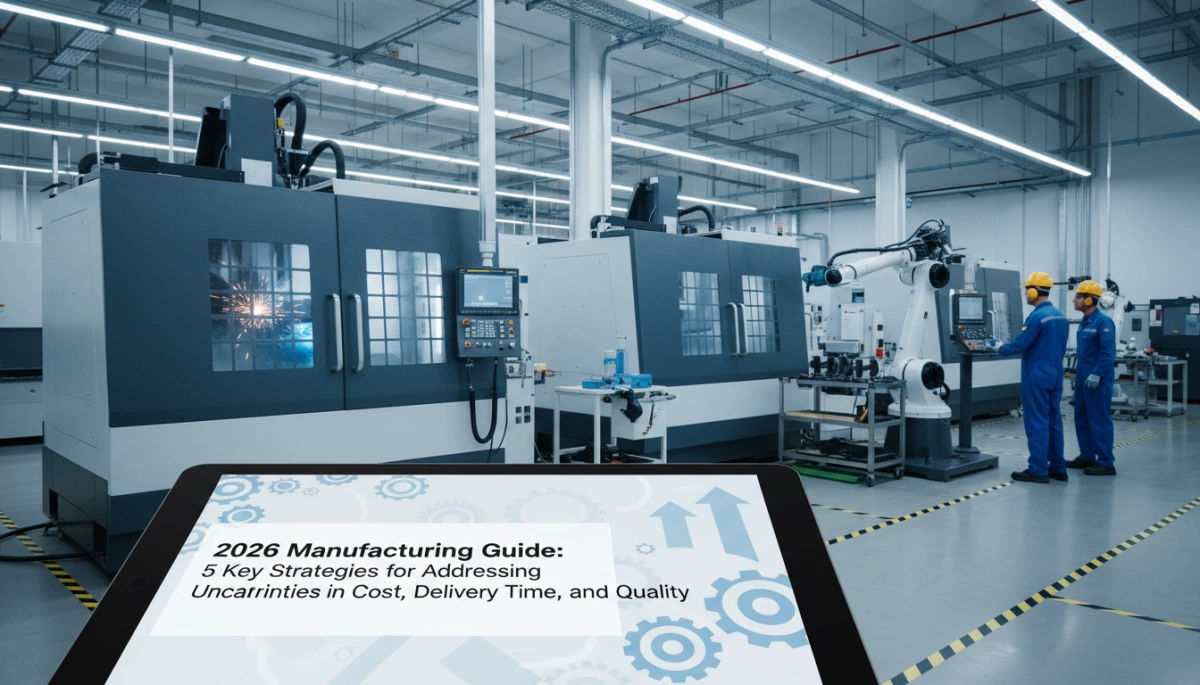
You already know that the "Iron Triangle" of manufacturing—Cost, Speed, and Quality—is becoming harder to balance every year.
With 2026 approaching, are your supply chains actually resilient enough to handle the next wave of volatility?
We aren't just talking about basic forecasting here.
We are talking about actionable, data-driven strategies that separate the market leaders from the companies stuck in reactive firefighting.
In this guide, you’re going to learn exactly how to leverage Deep DFM, AI-driven procurement, and agile production to lock in budget certainty and slash lead times.
These are the exact frameworks we use at ZSCNC to keep our partners ahead of the curve.
Ready to future-proof your production line?
Let’s dive right in.
Strategy 1: Pre-Emptive Cost Control via Deep DFM
As we approach 2026, waiting until the production phase to address budget concerns is a strategy set up for failure. With rising material costs and increasing Total Cost of Ownership (TCO), the most effective way to secure your bottom line is by shifting cost reduction to the very beginning of the process: the design phase.
At ZS CNC Parts, we believe Design for Manufacturing (DFM) is your first line of defense against market volatility. We don't just accept files; we analyze them to strip away unnecessary expenses before a single chip is cut.
Moving Cost Reduction Upstream
Our engineering team provides free DFM feedback to identify cost drivers hidden in your CAD files. By optimizing geometry early, we prevent expensive revisions later.
- Simplify Complexity: We identify features that require complex 5-axis machining when a standard 3-axis or 4-axis setup could achieve the same function for less.
- Reduce Machining Time: We highlight areas where deep pockets or tight radii increase cycle time, allowing you to adjust the design for faster, cheaper production.
Smart Material Selection
Material scarcity can drive up prices unexpectedly. We help you navigate this by suggesting alternative material options that maintain performance while reducing costs.
- Strategic Swaps: If a specific grade of Titanium or Stainless Steel is facing a price spike, we can recommend high-strength Aluminum (like 7075) or engineering plastics (like PEEK or Nylon) from our extensive stock of over 50+ materials.
- Waste Reduction: We optimize nesting and stock usage to ensure you aren't paying for scrap metal.
By leveraging our factory-direct pricing and deep engineering support, you gain control over your budget regardless of external market fluctuations.
Strategy 2: Decoupling from Logistics Risks
Global supply chains remain unpredictable, making reliance on a single, slow-moving logistics channel a liability for 2026. To maintain operational stability, we recommend transitioning to a "Just-in-Case" hybrid production model. This approach combines your standard mass production with agile, on-demand manufacturing services to act as a safety net against shipping delays or sudden demand spikes.
We help you mitigate supply chain risk through:
- Bridge Production: When hard tooling or overseas bulk shipments face delays, we utilize rapid prototyping to production workflows. This allows us to deliver functional, production-grade parts in as little as 3–7 days, keeping your assembly lines running while you wait for the main inventory to arrive.
- Speed as a Buffer: You can reduce delivery times for critical components by leveraging our fast turnaround capabilities. Instead of stockpiling months of inventory, you can rely on our ability to machine and ship urgent batches within days.
- Reduced Warehousing Costs: By utilizing our factory-direct capabilities for low-volume runs, you minimize the capital tied up in warehousing. We produce exactly what you need, when you need it, ensuring resilient supply chain strategies that prioritize cash flow and flexibility over excessive storage.
Strategy 3: Digital Quality Assurance
In 2026, quality control cannot be a guessing game. To combat manufacturing uncertainty, we have moved beyond simple visual checks to a data-driven quality assurance model. By implementing a digital thread for QC, we ensure that every specification in your CAD file is mathematically verified against the final part.
Implementing a Digital Thread for QC
We treat quality as a traceable data point rather than just a final step. This involves integrating digital twin in manufacturing concepts where the physical part is constantly compared to its digital design throughout the production cycle. This approach eliminates the "black box" of production, giving you full visibility into how your tolerances are being maintained from the first cut to the final finish.
CMM Inspections and Digital Reporting
Precision is our baseline. We utilize advanced Coordinate Measuring Machines (CMM) to verify complex geometries with precision engineering tolerances reaching as tight as +/- 0.005mm.
- Automated Verification: CMM probes map the surface of the machined part, generating digital reports that highlight any deviation from the original design.
- Data Transparency: You receive full dimensional inspection reports, ensuring the parts you receive match your digital prints exactly.
ISO 9001:2015 Adherence and Material Certifications
Consistency is built on standards. Our facilities operate strictly under ISO 9001:2015 quality control protocols. This certification governs every process, ensuring that whether we are running a single prototype or a batch of 10,000, the outcome remains uniform.
Furthermore, material integrity is non-negotiable. We provide comprehensive material certification and traceability (COA) for all projects. Whether you need guidance on precise CNC machining materials or verification for aerospace-grade alloys, we provide the documentation to prove the raw material matches your specifications perfectly.
Ensuring Consistency Across Batches
Digital tools allow us to lock in process parameters. Once a program is verified and the first article inspection (FAI) is approved, the digital data ensures that the 1,000th unit is identical to the first. This digital rigidity is essential for mitigating risk in high-stakes industries like medical and robotics, where deviation is not an option.
Strategy 4: Process Diversification Advantage
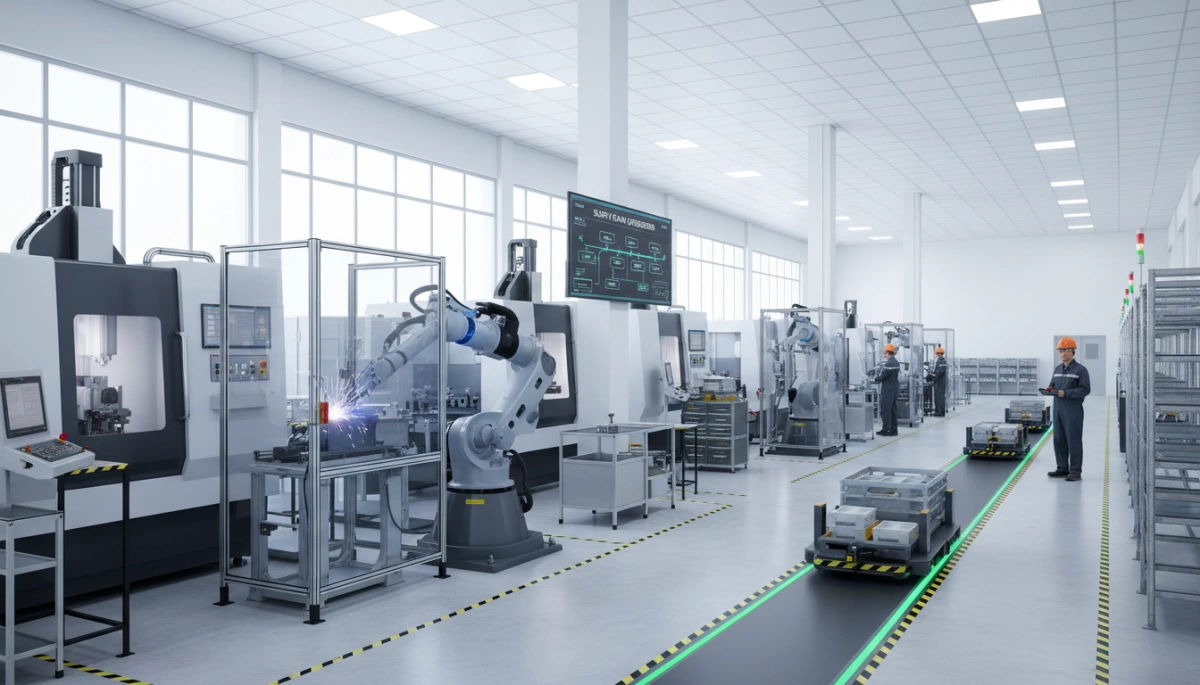
In an unpredictable market, relying on a fragmented supply chain is a significant risk. Managing separate vendors for prototyping, machining, and finishing creates communication gaps and logistical bottlenecks. By consolidating the supply chain with a multi-process partner, you regain control over your timeline and quality standards.
Consolidating Manufacturing Capabilities
We eliminate the complexity of multi-vendor management by housing diverse manufacturing technologies under one roof. Instead of shipping parts between a 3D printing shop, a machine shop, and a finishing house, we handle the entire lifecycle. This integration allows us to combine custom aluminum CNC machining parts with sheet metal fabrication components seamlessly, ensuring perfect fitment and unified quality control before the products ever leave our facility.
Seamless Scalability and Finishing
The transition from design to final product should be fluid. Our capabilities allow for a smooth shift from initial 3D printed or vacuum cast prototypes directly into scalable CNC production. Furthermore, we handle critical secondary finishes internally to save time. Whether your project requires anodizing, powder coating, plating, or polishing, we execute these processes in parallel with manufacturing.
Benefits of a Multi-Process Approach:
- Reduced Lead Times: No shipping time lost between different service providers.
- Accountability: A single point of contact for the entire project prevents the "blame game" between vendors.
- Consistent Quality: ISO 9001:2015 standards are applied across all stages, from milling to surface treatment.
- Cost Efficiency: Bundling services often reduces total project costs compared to sourcing individually.
By leveraging a partner capable of hybrid manufacturing processes, you eliminate the delays inherent in multiple vendor management and ensure your supply chain remains resilient against 2026 disruptions.
Strategy 5: AI-Driven Procurement for Budget Certainty
In an era of fluctuating material costs, waiting days for a manual quote is a liability. We have moved beyond traditional estimation methods to offer AI-driven procurement tools that provide immediate financial clarity. By utilizing an instant CNC quoting system, you gain real-time transparency into your project costs before a single machine is programmed.
Locking in Pricing with CAD File Uploads
The most effective way to secure your budget for 2026 is through direct digital integration. When you upload your 3D CAD files to our platform, our algorithms analyze the geometry, material requirements, and complexity instantly. This eliminates the back-and-forth of email chains and provides a lockable price point.
- Instant Feedback: Get quotes in seconds, not days.
- Design Validation: Automated checks often highlight features that drive up costs unnecessarily.
- Secure Data: Your IP is protected throughout the digital upload process.
Optimizing Budgets with Digital Tools
Smart procurement isn't just about the lowest price per unit; it's about understanding the Total Cost of Ownership (TCO). Our digital tools allow you to toggle between different materials, tolerances, and surface finishes to see how they impact the bottom line in real-time.
One of the top mistakes engineers make when ordering custom CNC parts is failing to visualize how volume impacts unit price. Our platform lets you compare price breaks instantly—showing you exactly how much you save by moving from a prototype run of 5 units to a pilot run of 50 or 100. This data is crucial for accurate fiscal planning and ensuring your 2026 manufacturing strategy remains profitable.
FAQ: Navigating 2026 Manufacturing Challenges
How does Design for Manufacturing (DFM) reduce costs?
DFM is your first line of defense against budget overruns. By analyzing your CAD files before a single cut is made, we identify features that unnecessarily drive up machining time or material waste. Our engineering team provides feedback to simplify geometries—such as standardizing hole sizes or reducing deep pockets—which allows us to reduce machining costs significantly. This preemptive optimization ensures you aren't paying for complexity that doesn't add value to the final part.
What are the benefits of hybrid production models?
Hybrid models combine the speed of rapid prototyping with the durability of traditional manufacturing. For example, we can utilize 3D printing (SLA/SLS) to deliver functional prototypes in as little as 3–7 days for immediate validation, while simultaneously tooling up for CNC machining or sheet metal fabrication for the final production run. This approach minimizes downtime and provides a safety net against supply chain delays, ensuring you have parts in hand when you need them.
Why is ISO 9001 certification critical for 2026?
In a volatile market, consistency is non-negotiable. Our ISO 9001:2015 quality control certification guarantees that every part we produce meets strict international standards, regardless of batch size. We back this up with advanced CMM inspections and full dimensional reports. This level of rigor eliminates the risk of receiving non-conforming parts, protecting your assembly line from costly disruptions and ensuring material certification and traceability.
How can AI quoting tools help with budget forecasting?
Uncertainty is the enemy of fiscal planning. Our instant CNC quoting system eliminates the guesswork by providing real-time pricing based on your specific CAD data and material selection. This transparency allows you to compare costs across different quantities and materials instantly. By locking in accurate pricing early, you can secure your procurement budget and avoid the shock of unexpected price hikes later in the project timeline.
 English
  German
  Dutch
Dutch  Russian
  Czech
Czech  French
  Korean
  Japanese
  Spanish
  Portuguese