
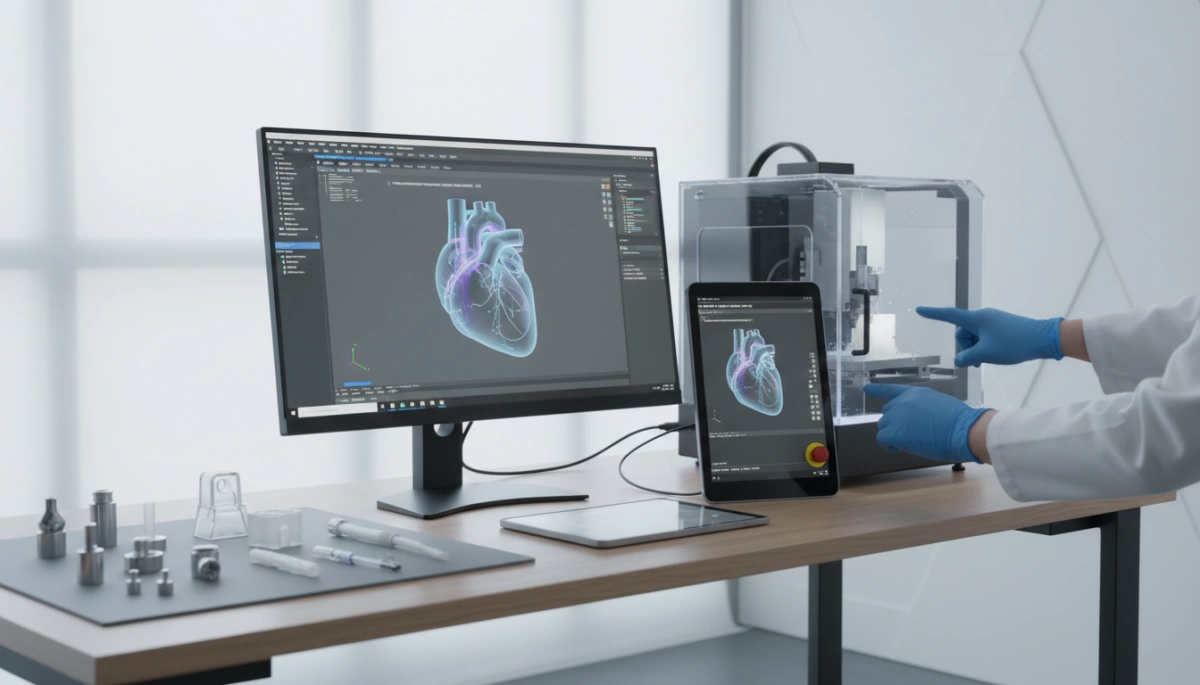
Bringing a new medical device to market is hard enough. Tight budgets, demanding investors, and unforgiving regulatory requirements don’t leave much room for trial and error—especially when it comes to your first prototypes.
That’s exactly why so many startups are quietly choosing CNC machining for medical device prototypes.
Unlike generic “rapid prototyping” methods, CNC machining gives you:
- Production-grade materials like titanium, stainless steel, and PEEK
- Micron-level precision for implants, surgical tools, and diagnostic parts
- Fast, low-volume runs without investing in expensive tooling
In other words: you can get clinic-ready, test-ready, investor-ready prototypes that behave like the final product—without blowing your timeline or budget.
In this post, you’ll see why many medical device startups choose CNC machining for prototypes, how it stacks up against 3D printing and injection molding, and what to focus on if you want to move from concept to compliant hardware as quickly as possible.
The unique demands of medical device prototyping
If you’re building a medical device, your prototypes can’t be “close enough.” They need to behave like real products under real clinical conditions. That’s why so many founders end up looking at CNC machining for medical device prototyping, even at the very first functional iteration.
Strict biocompatibility and sterilization needs
Medical prototypes often touch the body, blood, or drugs, so you can’t treat them like consumer gadgets.
- You must work with biocompatible materials (titanium, medical‑grade stainless steel, PEEK, medical plastics) that are already accepted in healthcare.
- Surfaces need to survive autoclave, gamma, EtO, and chemical sterilization without cracking, warping, or leaching.
- Early prototypes are frequently used in bench testing, cadaver labs, and sometimes clinical trial samples, so regulators and clinicians expect materials that can realistically go to market.
If you prototype in “toy” materials to save money, you often end up re-doing your entire design once you switch to real, biocompatible materials later.
Tight tolerances and functional testing
Most medical devices are mechanically demanding:
- Surgical instruments need tight tolerances for hinges, cutting edges, and mating parts.
- Orthopedic and dental components must fit human anatomy within fractions of a millimeter.
- Microfluidic channels, sensors, and miniature mechanisms require precision machining to validate flow, accuracy, and reliability.
If your prototype isn’t dimensionally accurate, your functional tests are meaningless. You can’t trust force measurements, sealing performance, or ergonomic feedback if the part is out of spec.
Why startups need rapid iteration
As a startup, you’re racing against:
- Clinical risks – proving the device actually works in realistic conditions.
- Investor timelines – you need credible, testable hardware for demos and due diligence.
- Regulatory milestones – bench data and verification results depend on reliable hardware.
You need rapid prototyping for medical devices that can move from CAD to parts in days, not months, so you can iterate on:
- Geometry and ergonomics
- Assembly and manufacturability
- Performance under load, heat, and sterilization
Slow cycles kill momentum and delay validation, which directly impacts funding and market entry.
Risks of slower or less precise prototyping methods
When teams rely on the wrong methods, the risks add up fast:
- Soft materials and hobby-grade 3D printing can’t match the strength, precision, or surface finish needed for real medical testing.
- Inaccurate tolerances hide design flaws; issues only show up later in verification or first clinical use.
- Long lead times from tooling-heavy processes (like injection molding) make each iteration expensive and slow, discouraging necessary design changes.
The result: design freeze too early, or iterate too late. Both are dangerous in medical devices. That’s why many startups shift to precision CNC machining early—so every prototype is close to production reality, and every test yields data they can trust.
Key advantages of CNC machining for medical prototypes
When I build medical device prototypes, CNC machining is usually my first choice because it hits the sweet spot of precision, speed, and real-world performance.
Precision and complex geometries
CNC machining offers unmatched precision and accuracy for medical device prototyping.
Tight tolerances on features like threads, slots, and mating surfaces are critical for:
- Surgical instruments
- Orthopedic implants
- Small diagnostic components
With high-precision turning and milling, we can consistently hit micron-level accuracy on complex medical parts. For example, our medical device CNC machining services are built around these exact demands.
Surface finish and sterility
Medical devices need surfaces that are:
- Smooth enough to be easy to clean and sterilize
- Free from sharp edges, burrs, and pores
- Ready for use with minimal polishing or secondary work
CNC machining delivers clean surface finishes that support sterility and reduce post-processing, especially on stainless steel and titanium.
Production-grade materials
With CNC machining, startups can prototype using true production-grade materials:
- Titanium for implants and high-strength components
- Stainless steel (e.g. 304, 316L) for surgical tools and housings – supported by our precision turning of stainless steel for medical equipment
- PEEK and high-performance polymers for implants and surgical guides
- Biocompatible medical plastics for housings and disposable parts
This means your prototype behaves like the final product in terms of strength, wear, and biocompatibility.
Realistic, regulatory-ready prototypes
Because we use the same materials and similar processes as production, CNC medical prototypes:
- Closely mimic final product performance
- Support early biocompatibility and functional testing
- Help you de-risk your design before validation builds and audits
That’s a big advantage when you’re preparing for ISO 13485 workflows or planning clinical trial samples.
Fast turnaround and design flexibility
For startups, time is everything. CNC machining supports rapid prototyping of medical devices:
- Direct from CAD to parts with short lead times
- Easy design changes – no molds, no expensive tooling
- Simple to iterate: update the model, adjust the program, cut new parts
You can cycle through design iteration fast enough to keep up with feedback from doctors, engineers, and investors.
Cost-effective at low volume
Unlike injection molding, CNC is cost-effective for low-volume runs and small batches:
- No upfront tooling cost
- Pay per part, not per mold
- Perfect for 1–1000 pieces, depending on complexity
That makes it ideal for clinical trial prototypes, pilot builds, and early market testing.
Scaling from prototype to bridge production
CNC machining also helps you scale smoothly:
- Start with one-off prototypes
- Move to small batches for verification and early user studies
- Use CNC as bridge production while tooling for molding or casting is being built
This flexibility lets you keep shipping parts, gathering data, and raising funding without waiting months for molds or full-scale production lines.
CNC machining vs other prototyping methods
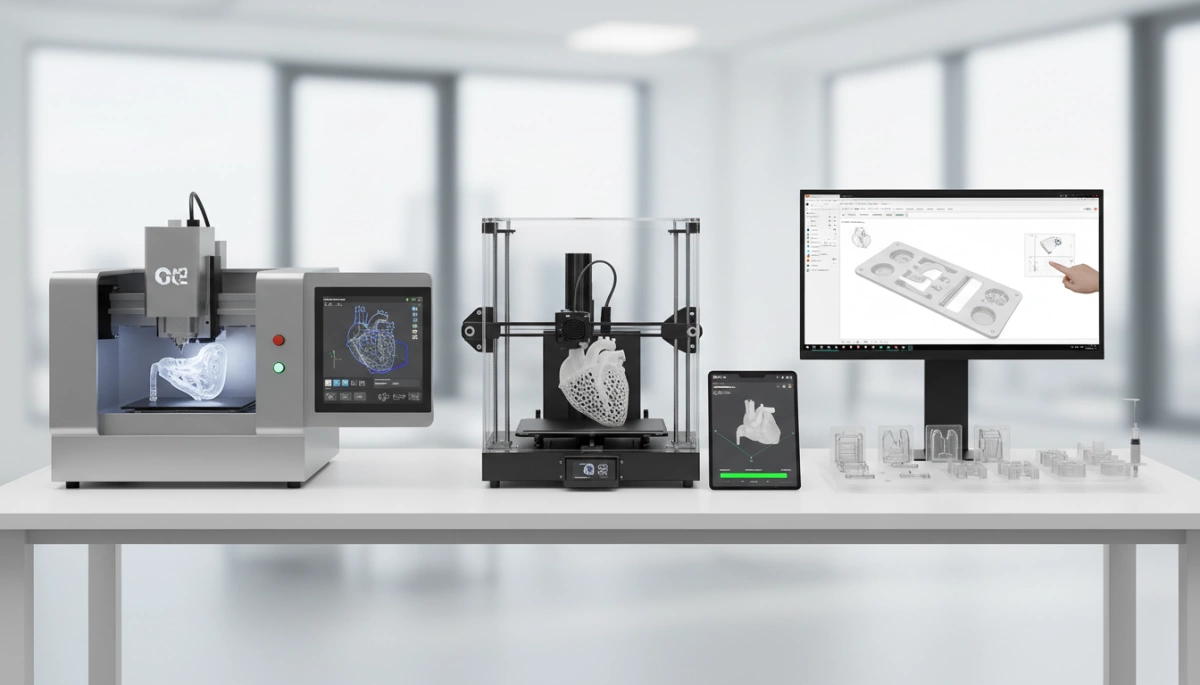
When we build medical device prototypes, I almost always default to CNC machining once the design needs to be tested in the real world. Compared with injection molding and 3D printing, CNC gives startups a better balance of speed, accuracy, and real, production-grade materials.
CNC vs injection molding for early-stage medical prototypes
For early-stage medical device prototyping, CNC machining usually beats injection molding:
-
No tooling cost
- Injection molding needs steel/aluminum molds that can cost $5,000–$50,000+ and take weeks to make.
- CNC needs only a CAD model and CAM programming. No upfront tooling.
-
Faster lead times
- Mold design + fabrication can easily take 4–8 weeks before you see the first parts.
- CNC machining can deliver parts in days to 1–2 weeks, especially with agile shops using 5-axis CNC machining for complex geometries.
-
Better for low-volume runs
- If you only need 5–100 prototypes for testing or demos, injection molding rarely makes financial sense.
- CNC is cost-effective for small batches, design changes, and quick iterations.
When you’re not yet locked into a final design, tying up cash and time in molds slows everything down and adds risk. CNC keeps everything flexible.
Tooling cost and lead time differences for startups
If you’re a startup, cash and time are your main constraints:
Injection molding:
- High tooling cost upfront
- Long lead time to first shot
- Expensive to change design (you may need to rework or remake the mold)
CNC machining:
- Almost no fixed tooling cost
- Short lead times from CAD to part
- Simple, fast design changes (just update CAM and re-run)
This is why many teams use CNC for:
- Proof-of-concept builds
- Design verification (DVT)
- Clinical trial samples
- Investor demos and early customer feedback
CNC vs 3D printing for medical device prototyping
3D printing is great for early shapes and ergonomic mockups, but it has limits for functional medical parts:
-
Material strength & stability
- Many printed plastics can’t match the mechanical strength, fatigue resistance, or temperature stability of CNC-machined titanium, stainless steel, PEEK, or medical-grade plastics.
-
Precision & tolerances
- Tight tolerances for implants, surgical instruments, or microfluidic channels are often hard to hit with common 3D printers.
- CNC machining routinely holds tight tolerances and smooth surfaces that support sterility and sealing.
-
Regulatory & biocompatibility constraints
- Not all 3D printing processes and resins are validated or accepted for ISO 13485 or FDA-facing applications.
- CNC machining lets you prototype directly in biocompatible, production-intent materials, aligning better with regulatory expectations.
For critical medical prototype parts, precision machining is still the more trusted path.
Combining 3D printing concepts with CNC finishing
A strong approach for many teams is to mix 3D printing and CNC:
- 3D print early concepts for fast, cheap form studies
- Once the geometry stabilizes, move to CNC for:
- Final dimensional accuracy
- Better mechanical performance
- Clean, medical-grade surface finishes
- In some cases, you can 3D print near-net-shape parts and then use CNC finishing to bring features into spec.
This hybrid strategy keeps iteration fast while ensuring your functional prototypes truly reflect final device performance.
Cost and lead time: typical medical prototyping scenarios
Here’s how it often plays out in real projects:
-
10–50 functional surgical instrument prototypes
- CNC: Days–2 weeks, no tooling, parts in stainless or titanium
- Injection molding: Not practical until design is frozen
- 3D printing: OK for ergonomic checks, not ideal for actual surgical use
-
Diagnostic device housings and enclosures
- CNC: Good when you need precise fits and robust materials for drop tests, ingress protection, or sterilization
- 3D printing: Good for early plastic mockups and internal layout checks
-
Clinical trial samples
- CNC: Often the only realistic way to get high-precision, biocompatible parts in low volumes with traceable quality. Many teams work with shops that understand key requirements for CNC machining medical device components and quality systems aligned with ISO expectations (see: CNC machining for medical device components).
As quantities grow, we usually shift from pure prototyping to bridge production using CNC before committing to molds.
How CNC prototypes transition to full-scale production
CNC machining fits naturally into the full product lifecycle:
-
Concept & design verification
- Rapid CNC prototypes in production-grade materials.
-
Clinical trial and pilot builds
- Low-volume, high-quality CNC parts with documented processes and quality checks.
-
Bridge production
- As demand grows, CNC can support hundreds or low thousands of units while tools are being designed for molding or forging.
-
Long-term production for complex or metal parts
- Many surgical instruments, implants, and precision components stay in CNC production long-term, especially with 5-axis CNC titanium machining services for complex geometries (titanium 5-axis medical machining).
For medical device startups, this path lets you move from idea to regulated product without constant process resets or redesigns, keeping risk and cost under control while meeting tight clinical and regulatory expectations.
Real-world medical device prototyping with CNC machining
CNC for surgical instruments and orthopedic implants
For surgical tools and orthopedic implants, most startups I work with go straight to CNC machining. You get:
- Tight tolerances for mating joints, bone plates, and screw interfaces
- Production-grade metals like titanium and surgical stainless steel
- Consistent, smooth surface finishes that support sterilization and lower contamination risk
When you’re validating a new implant design, you can’t afford dimensional drift or weak shortcuts. Precision machining gives you prototypes that behave almost exactly like final, production parts.
CNC for diagnostic housings and enclosures
Diagnostic devices need housings that are rigid, dimensionally stable, and cleanable. CNC machining in aluminum or medical-grade plastics lets you:
- Test real-world assembly, cable routing, and mounting points
- Integrate precise features for seals, gaskets, and connectors
- Run early drop, vibration, and cleaning tests
If you’re using aluminum, a partner that already does custom aluminum CNC machined parts can usually adapt quickly to medical housings and fixtures.
Microfluidic and miniature components
Microfluidic chips, tiny manifolds, and miniature valves demand micro-scale accuracy:
- Controlled channel widths and depths for fluid behavior
- Clean internal surfaces to avoid contamination
- Stable plastics like PEEK or PMMA for chemistry and bio-compatibility
CNC machining is ideal for early microfluidic prototypes where you need repeatability and reliable flow performance—not just visual models.
CNC parts for clinical trial samples
When you reach pilot or early clinical trials, you need:
- Rapid CNC machining for clinical trial samples in the same or equivalent materials as final production
- Repeatable quality across batches
- Full traceability of materials and processes
Because there’s no tooling, you can adjust design between trial batches without blowing up your budget or timeline.
Supporting ISO 13485 and regulatory demands
Most regulators don’t care how “cool” the prototype tech is; they care about process control, documentation, and consistency. CNC machining fits well with ISO 13485 workflows:
- Controlled material sourcing with certs
- Measurable, documented tolerances
- Repeatable programs and inspection routines
That makes it easier to justify your prototype pathway in design history files and technical files.
Choosing materials for medical CNC prototypes
For medical device prototyping with CNC, I usually see:
- Titanium – implants, load-bearing parts, corrosion resistance
- Stainless steel (316L, 17-4) – surgical tools, structural frames
- PEEK – implants, spinal devices, high-performance components
- Medical plastics (ABS, PC, POM, PMMA) – housings, fixtures, fluid components
Pick materials that are as close as possible to your intended production materials so your testing actually means something.
Working with the right CNC partner
For medical devices, the CNC shop is not just a supplier—it’s part of your risk profile. Look for:
- Experience with precision machining for medical parts
- Familiarity with biocompatible materials and clean handling
- Strong inspection, measurement reports, and traceability
- Willingness to iterate quickly on low-volume runs
A shop that already delivers custom aluminum CNC machining parts at tight tolerances is usually a good starting point, as they’ve already solved most of the geometric, fixturing, and finish problems you’ll face in medical device prototyping.
Challenges of CNC prototyping and how to handle them
Even though CNC machining is a top choice for medical device prototyping, there are real challenges you have to manage if you want fast, consistent, and compliant results.
Material waste in subtractive machining
CNC is subtractive, so you’re always cutting away material. For titanium, PEEK, and medical‑grade stainless steel, that waste can get expensive fast.
To keep it under control:
- Nest parts smartly in the stock to reduce offcuts.
- Use near‑net‑shape blanks (forged, cast, or saw-cut closer to size).
- Recycle chips, especially from high‑value alloys like titanium and cobalt-chrome.
- Choose the right stock size instead of oversizing “just in case.”
Using multi-axis CNC to optimize efficiency
Multi-axis CNC (4‑axis and 5‑axis) is a big win for complex medical prototypes, especially implants, surgical tools, and micro-features:
- Fewer setups = less human error and better repeatability.
- Shorter cycle times because more faces are machined in one hit.
- Better access to undercuts and organic shapes common in orthopedic and spine devices.
If you’re machining complex geometries, a shop with strong 5-axis CNC machining capability will usually give you tighter tolerances and lower total cost per part.
Programming strategies to reduce cycle time and cost
For rapid CNC prototyping in medical devices, CAM programming is where a lot of time and money is won or lost.
Smart strategies include:
- Standardize features (fillets, hole sizes, threads) so toolpaths can be reused.
- Use high‑efficiency roughing to remove material quickly while protecting tools.
- Program combined operations (milling + drilling + tapping) in one setup where possible.
- Avoid over-tolerancing non-critical areas to cut inspection and machining time.
An experienced programmer can often cut prototype cycle time 20–40% just through better toolpath planning.
Quality assurance processes for medical machining
For medical device prototyping, precision machining is only half the story—proof of quality is the other half.
You want a CNC partner with:
- Defined QA workflows: First article inspection, in‑process checks, and final inspection.
- Metrology equipment: CMM, optical measurement, surface roughness testers.
- Documented traceability: Material certs, lot tracking, and inspection reports ready for ISO 13485 files.
- Stable, repeatable CNC milling and turning processes like those used in regulated production environments (see our CNC milling capabilities for reference).
This is what lets you use CNC prototypes for verification builds and even early clinical trial samples with confidence.
Selecting the right CNC partner for medical device quality and expertise
Not every machine shop is set up for medical work. When you pick a CNC partner, look for:
- Medical experience: Prior work on implants, surgical instruments, or diagnostic components.
- Regulatory mindset: Familiar with ISO 13485, risk management, and documentation needs.
- Material expertise: Proven work with titanium, stainless steels, PEEK, and medical plastics.
- Design feedback: Ability to flag manufacturability issues and suggest tweaks before you waste budget.
If you’re building a medical device startup, treat your CNC partner as part of your engineering team, not just a supplier. It’s one of the fastest ways to get reliable, fundable prototypes without burning time and cash.
 English
  German
  Dutch
Dutch  Russian
  Czech
Czech  French
  Korean
  Japanese
  Spanish
  Portuguese