
What Is Swiss Machining?
At ZSCNC, we define Swiss machining as the premier solution for manufacturing miniature precision parts and complex micro-components. Unlike standard turning centers, a Swiss-type lathe operates on a distinct mechanical principle designed specifically to eliminate deflection and vibration during the cutting process.
Understanding the Sliding Headstock Mechanism
The defining feature of this technology is the sliding headstock. In conventional setups, the workpiece remains stationary in the Z-axis while the tool moves. In our Swiss machining centers, the headstock clamps the bar stock and slides back and forth along the Z-axis, feeding the material through the machine while the cutting tools remain stationary in that axis. This dynamic movement allows us to machine long, slender parts with exceptional accuracy.
The Critical Role of the Guide Bushing
The secret to achieving our micron-level tolerances (+/- 0.005mm) lies in the guide bushing. This component supports the workpiece right next to the cutting tool. Because the cutting action occurs mere millimeters from the support point, the material cannot bend or deflect away from the tool. This rigidity is essential when we machine high-precision components for medical and aerospace applications where stability is non-negotiable.
How Bar Stock Feeding Works
Our Swiss machines are optimized for efficiency through automated bar stock feeding.
- Continuous Operation: The machine feeds the bar stock through the guide bushing continuously, allowing for the rapid production of complex geometries in a single setup.
- Material Efficiency: By stabilizing the stock immediately at the cutting zone, we can machine expensive alloys like Titanium and Inconel with minimal waste.
- High Volume Capability: This feeding mechanism supports our ability to scale from rapid prototypes to volumes of 500+ parts with consistent quality.
What Is Conventional CNC Lathe Turning?
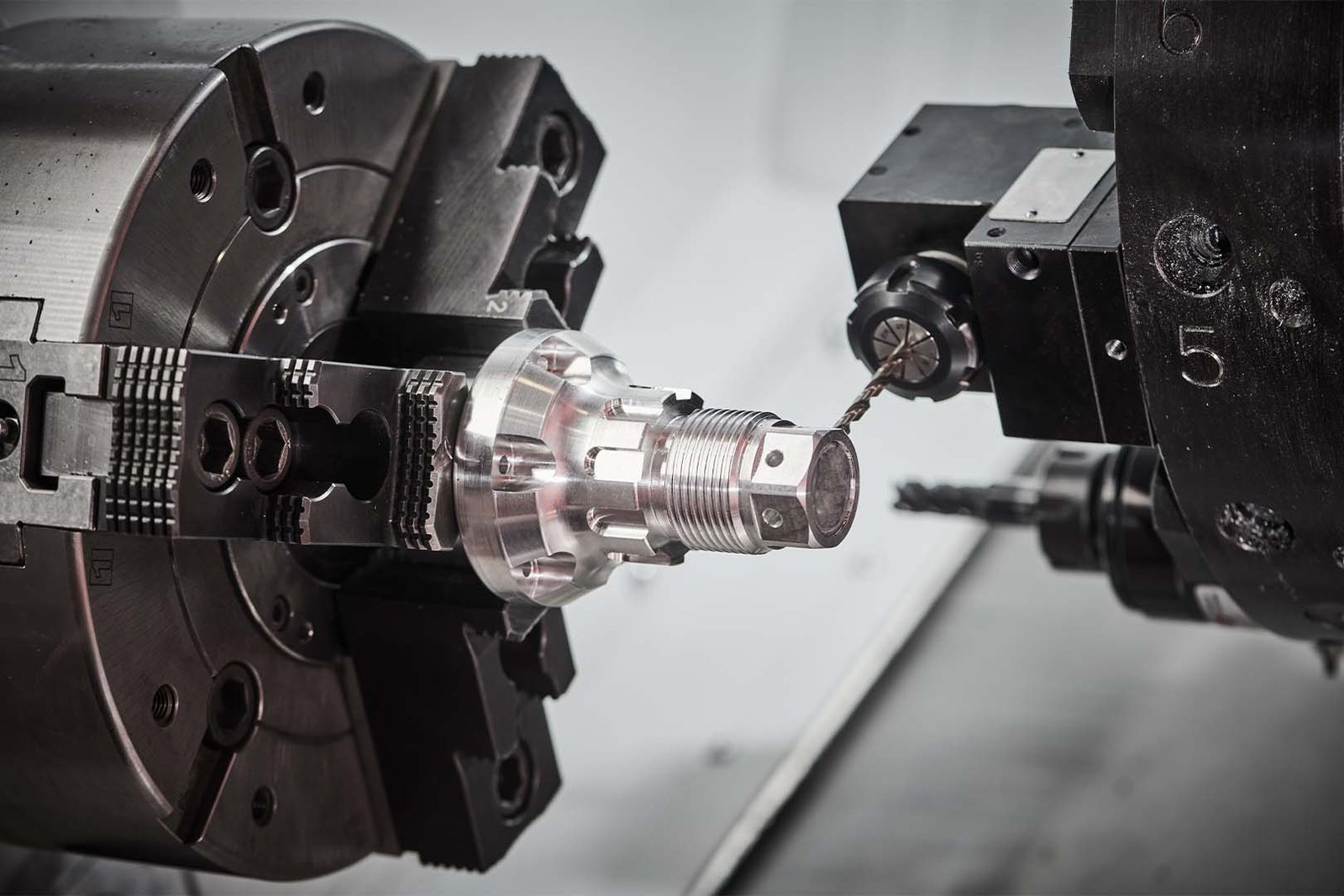
In our manufacturing facility, conventional CNC turning serves as the backbone for producing larger, structural components. Unlike the sliding action of a Swiss machine, a standard lathe operates on a fixed headstock design. The material spins in a stationary position while the cutting tool travels along the X and Z axes to shape the part. This fundamental difference defines how we approach rigidity and material removal for mid-to-large-sized projects.
Workpiece Holding: Chucks and Collets
To secure the workpiece, we utilize hydraulic chucks (typically 3-jaw or 4-jaw configurations) or precision collets.
- Chucks: Provide maximum gripping force for heavy cutting on larger diameters and irregular castings.
- Collets: Offer superior concentricity for round bar stock and prevent surface marring on finished diameters.
This rigid clamping method allows us to aggressively remove material from tough metals like stainless steel and titanium without compromising stability.
Versatility in Part Sizes and Geometries
Standard lathes offer unmatched flexibility regarding part size. While Swiss machines are constrained by the guide bushing diameter, our conventional setups can handle significantly larger billets. This makes them the ideal solution for manufacturing robust CNC turning parts such as drive shafts, industrial housings, and large threaded fittings where the length-to-diameter ratio is less critical.
Role of Live Tooling in Conventional Setups
Modern turning is no longer limited to simple cylindrical shapes. We equip our conventional turning centers with live tooling and C-axis capabilities. This allows rotating tools (like end mills and drills) to perform milling operations—such as cutting keyways, drilling cross-holes, or milling flats—while the part remains in the chuck. By integrating these steps, we reduce handling time and ensure tighter geometric tolerances for complex components.
Core Mechanical Differences Explained
At ZSCNC, we operate both systems side-by-side, and the fundamental difference lies in how the workpiece is supported and moved during the cutting process. While both machines remove material to create precision components, the mechanics inside the enclosure dictate which machine is right for your specific part geometry.
Sliding Headstock vs. Fixed Headstock Designs
The most distinct feature of a Swiss-type lathe is the sliding headstock. Unlike a conventional lathe where the part remains stationary in the Z-axis while the tool moves, a Swiss machine feeds the bar stock through the tooling area.
- Swiss Machining: The headstock moves along the Z-axis, pushing the material through a guide bushing past the stationary cutting tool.
- Conventional CNC Turning: The headstock is fixed. The cutting tool travels along the bed (Z-axis) to remove material from the spinning part.
The Critical Role of the Guide Bushing
In our factory, we rely on the guide bushing to maintain stability for long, slender parts. In a Swiss setup, the cutting tool engages the material extremely close to the bushing—often within 1mm. This proximity provides rigid support right at the point of cut, effectively eliminating deflection.
Conversely, conventional lathes use end clamping support (chucks or collets). As the tool moves further away from the chuck, the workpiece becomes more prone to vibration and bending, often requiring a tailstock or steady rest to maintain accuracy.
Axis Configurations and Simultaneous Operations
Modern manufacturing demands efficiency. While standard lathes typically operate on 2 or 3 axes, our multi-axis Swiss machining centers often feature 5 or more axes with live tooling. This allows for simultaneous operations—we can turn the main diameter while simultaneously drilling cross-holes or milling flats on the sub-spindle.
Our advanced 5-axis CNC machining capabilities enable us to complete complex geometries in a single setup, significantly reducing cycle times compared to sequential operations on a standard lathe.
Quick Comparison: Swiss vs. Conventional Mechanics
| Feature | Swiss-Type Lathe | Conventional CNC Lathe |
|---|---|---|
| Headstock Movement | Sliding: Moves material (Z-axis) | Fixed: Stationary material position |
| Support Mechanism | Guide Bushing: Supports part at the cut | Chuck/Collet: Supports part at the base |
| Deflection Risk | Near Zero (even on long parts) | Increases with part length |
| Primary Motion | Part moves to the tool | Tool moves to the part |
| Best For | Long, thin, complex parts (<32mm dia) | Large diameter, short, rigid parts |
Precision, Tolerance, and Deflection
When we compare Swiss Machining vs CNC Lathe capabilities, the conversation always turns to accuracy. In my experience, if you are chasing tight tolerances down to ±0.001mm, the Swiss-type setup is usually the winner, especially for small diameters.
In a conventional lathe, the part sticks out from the chuck. As the tool pushes against it, the material naturally wants to bend away. This is called deflection, and it kills accuracy on long, slender parts. Swiss machines solve this issue completely with the guide bushing. Because the cutting tool operates just millimeters from this support, the material has nowhere to go. It stays rigid, effectively eliminating the vibration and chatter that often ruin surface finishes in standard turning.
This mechanical stability is crucial when manufacturing components for sensitive industries. For instance, reviewing common FAQs regarding CNC machining for medical parts reveals that preventing deflection is non-negotiable for safety-critical hardware where every micron counts.
Why the Guide Bushing is the Key to Precision:
- Zero Deflection: The support is always located right next to the cutting action, regardless of part length.
- Superior Surface Finish: Significantly less vibration leads to smoother cuts, often removing the need for secondary polishing.
- Consistent Accuracy: We can run thousands of parts without the dimensions drifting due to material flex.
If the part is long and thin, the Swiss machine keeps it straight. If it is short and sturdy, a conventional lathe handles it just fine, but for deflection prevention on delicate rods, the Swiss method is unmatched.
Part Size, Geometry, and Complexity Factors
At ZSCNC, selecting between Swiss Machining vs CNC Lathe often comes down to the physical dimensions and intricacy of the design. While both processes utilize our advanced factory capabilities, they serve distinct geometric purposes.
Ideal Length-to-Diameter Ratios
The most significant mechanical advantage of a Swiss-type lathe is its ability to handle long, slender components without deflection. Because the guide bushing supports the workpiece millimeters from the cutting tool, we can achieve extreme length-to-diameter ratios:
- Swiss Machining: Easily handles ratios of 20:1 or greater, making it perfect for medical pins and aerospace needles.
- Conventional Lathe: Typically limited to ratios around 3:1. Anything longer requires a steady rest or slower speeds to prevent vibration and chatter.
Micromachining vs. Large Diameter Turning
For micromachining and small-diameter components, Swiss technology is unmatched. We utilize these machines for parts where tolerances must be held to +/- 0.005mm on diameters often smaller than 32mm. Conversely, conventional CNC turning is the powerhouse for larger structural parts. If your project involves large flanges, heavy drive shafts, or housings exceeding 50mm in diameter, the fixed headstock of a standard lathe offers the rigidity required for heavy material removal.
Handling Complex Geometries in a Single Setup
Efficiency in manufacturing relies on completing parts in a "one-and-done" workflow. Our Swiss machines are equipped with live tooling that allows for simultaneous milling and turning. This capability enables us to produce complex geometries in a single setup, eliminating the need for secondary fixtures. Similarly, for larger non-turned components, our 5-axis CNC machining services for complex aluminum parts provide the same level of multi-sided precision, ensuring that intricate features are machined with absolute alignment and accuracy.
Production Volume, Speed, and Cost Analysis
When analyzing Swiss Machining vs CNC Lathe costs, the decision ultimately balances preparation time against running speed. In our experience, understanding where the "break-even" point lies is crucial for maximizing profitability on global projects.
Setup Time vs. Cycle Time Efficiency
The fundamental trade-off here is clear: Swiss-type lathes require more time to set up but offer blazing-fast cycle times. Because the guide bushing and multiple tools must be perfectly synchronized, the initial configuration is complex. However, once the machine is running, it can produce complex parts in a fraction of the time a conventional lathe takes.
- Conventional Lathes: Faster setup (ideal for short runs), slower cycle time per part.
- Swiss Lathes: Slower setup, extremely fast cycle times (ideal for thousands of parts).
High-Volume Production Benefits
For orders exceeding 1,000 units, Swiss machining is the undisputed leader. The ability to perform single-setup machining—turning, milling, and drilling simultaneously—eliminates the need to move parts between machines. This reduction in handling not only speeds up delivery but also drastically lowers labor costs. Partnering with a capable China custom CNC machining supplier for overseas buyers allows you to leverage these high-speed capabilities to drive unit costs down significantly on large orders.
Material Utilization and ROI
While Swiss machines often leave a longer bar remnant (waste) than conventional lathes, the reduction in scrapped parts due to human error or deflection often balances this out. The return on investment (ROI) depends entirely on volume.
If you are developing initial concepts and following best practices for CNC machining automotive prototypes, a conventional CNC lathe is more cost-effective because you aren't amortizing a long setup time over just a few parts. Conversely, for high-volume small parts, the Swiss machine's efficiency pays for itself quickly, making it the smarter financial choice for mass production.
Real-World Industry Applications
When we look at Swiss Machining vs CNC Lathe applications, the choice almost always comes down to the specific demands of the industry. I see distinct patterns in how different sectors utilize these technologies to solve unique manufacturing challenges.
Medical Device Components
The medical field is the bread and butter of Swiss-type lathe operations. Because implants and surgical tools often require biocompatible materials like Titanium and PEEK, precision is non-negotiable.
- Bone Screws & Dental Implants: These parts are long, thin, and require complex threading. The sliding headstock design is perfect here because it prevents the part from bending under tool pressure.
- Surgical Instruments: Many tools used in minimally invasive surgery are incredibly small and intricate, demanding the high precision machining capabilities that only Swiss turning can provide.
Aerospace Precision Parts
In aerospace, failure isn't an option. We often use Swiss machining for smaller, critical components like fuel system pins, hydraulic valves, and electronic connectors. These parts demand extremely tight tolerances to withstand high pressure and temperature changes. However, for larger structural components or engine housings, a conventional CNC lathe is usually the better choice due to its ability to handle larger diameters and heavy material removal. When designing these critical components, avoiding top mistakes engineers make when ordering custom CNC parts is crucial for ensuring safety and compliance.
Electronics and Robotics
The trend in electronics is always "smaller and faster." This sector relies heavily on micromachining for:
- Connectors and Pins: High-volume production of tiny contact pins is standard for Swiss machines.
- Robotics Instrumentation: Small shafts and sensor housings require the simultaneous operations of a Swiss machine to keep cycle times low and accuracy high.
Automotive Shafts and Housings
The automotive industry utilizes a mix of both technologies.
- Swiss Machining: Ideal for ABS brake systems, fuel injectors, and long control shafts where the length-to-diameter ratio is high.
- Conventional CNC Turning: Used for larger bushings, transmission components, and heavy-duty housings where the part geometry is stout and requires robust holding power.
Comparison Breakdown: Swiss vs. Conventional
Choosing the right manufacturing process is critical for balancing precision, speed, and budget. While both technologies utilize computer numerical control, the mechanical differences between a Swiss-type lathe and a standard turning center dictate their ideal applications. At ZSCNC, we leverage both to ensure your parts meet ISO 9001 and AS9100 standards efficiently.
Here is a direct technical comparison of Swiss Machining vs CNC Lathe capabilities:
| Feature | Swiss Machining (Sliding Headstock) | Conventional CNC Turning (Fixed Headstock) |
|---|---|---|
| Workpiece Support | Guide Bushing: Supports stock extremely close to the tool. Eliminates deflection. | Chuck/Collet: Holds part at one end (cantilevered). Prone to vibration on long parts. |
| Diameter Range | Micro to ~32mm: Specialized for small, high-precision diameters. | Large (>32mm): Ideal for larger shafts, housings, and structural plates. |
| Length Capability | High L:D Ratio: Handles long, slender parts (up to 20:1 ratio) easily. | Short/Stout: Best for parts with low length-to-diameter ratios (typically <3:1). |
| Speed & Axis | Simultaneous: Multi-axis operations (5-axis) often happen at once. Fast cycle times. | Sequential: Typically performs one operation at a time. Slower for complex geometries. |
| Cost Efficiency | High Volume: Higher setup cost, but lowest cost-per-part on runs >500 units. | Low Volume: Lower setup cost, making it cost-effective for prototypes and small batches. |
Key Operational Differences
- Deflection Control: The defining advantage of our Swiss machining services is the sliding headstock. Because the material feeds through a guide bushing, the cutting tool always engages the stock near the support point. This allows us to hold micron-level tolerances (+/- 0.005mm) on long medical pins or electronic connectors that would bend in a conventional setup.
- Production Velocity: Swiss machines are built for speed. With the ability to perform milling, drilling, and turning simultaneously, we can complete complex geometries in a single setup. Conventional lathes generally require part transfers or secondary operations for complex features, which increases overall cycle time.
- Volume Economics: If you need 10,000 intricate screws, Swiss turning is the only viable option for speed and consistency. However, for a handful of large aluminum flanges, a conventional CNC lathe is far more economical due to faster initial machine programming and setup.
Decision Guide: When to Choose Which?
Choosing the right manufacturing process is critical for balancing cost-efficiency with part performance. At ZSCNC, our engineering team evaluates every CAD file to determine whether Swiss machining or a conventional CNC lathe offers the best ROI for your specific project. We don't just machine parts; we analyze your design to ensure the selected method meets your tolerance and budget goals.
Checklist for High-Precision Requirements
If your component falls into the "micro" category or requires exceptional straightness over a long length, the decision usually leans toward Swiss. Use this quick comparison to gauge your needs:
| Feature | Choose Swiss Machining | Choose Conventional CNC Lathe |
|---|---|---|
| Part Diameter | Under 32mm (1.25 inches) | Over 32mm (up to large industrial sizes) |
| Length-to-Diameter Ratio | High (Long & Slender, >3:1) | Low (Short & Stout, <3:1) |
| Tolerance Needs | Extremely Tight (±0.005mm) | Standard Precision (±0.01mm) |
| Deflection Risk | High (Requires Guide Bushing) | Low (Rigid parts) |
Evaluating Material Types
Material rigidity plays a massive role in machine selection. Swiss-type lathes excel with harder materials because the guide bushing supports the workpiece right at the cutting zone, effectively eliminating deflection. We frequently utilize this stability for medical and aerospace grades, such as Titanium (Ti-6Al-4V) and stainless steel. Similarly, when machining complex insulators or implants from PEEK plastic, the stability of a Swiss setup is often required to prevent the material from deforming away from the cutting tool.
Assessing Production Volume and DFM
Design-for-manufacturability (DFM) is a core part of our workflow. We assess volume to optimize your costs:
- Prototypes (1–50 parts): If the part is large or simple, conventional turning is often more cost-effective due to faster setup times.
- Volume Production (500+ parts): Swiss machining dominates here. Once the complex setup is complete, the cycle times are significantly faster due to simultaneous operations, drastically reducing the cost per unit.
Our team provides a quote and design assessment within 24 hours, ensuring you utilize the most efficient process for your specific geometry and volume requirements.
FAQs About Swiss Machining vs CNC Lathes
What is the main difference between a Swiss lathe and a conventional lathe?
The fundamental difference lies in the headstock movement and material support. In a Swiss-type lathe, the bar stock slides through a guide bushing along the Z-axis while the cutting tools remain stationary in that axis. This means the cutting action always happens close to the support point. In contrast, a conventional CNC lathe features a fixed headstock where the workpiece is clamped, and the cutting tool moves across the part. This distinction makes Swiss machining superior for high precision machining of long, slender components, whereas conventional turning is better suited for larger, structural parts.
Why is Swiss machining better for long parts?
Swiss machining excels at handling parts with a high length-to-diameter ratio because of the guide bushing. Since the material is fed through this bushing and cut mere millimeters away from the support, deflection and vibration are virtually eliminated. This allows us to achieve tight tolerances (down to +/- 0.001mm) on long, thin parts like medical pins or aerospace shafts that would otherwise bend away from the tool on a standard lathe.
Is Swiss machining more expensive than conventional turning?
Not necessarily—it depends on volume and complexity. While the initial setup for a Swiss machine can be more involved, these machines often perform simultaneous operations (milling, drilling, and turning) in a single setup. This drastically reduces cycle time and eliminates the need for secondary fixtures. For medium-to-high volume runs of complex parts, Swiss machining often provides a better ROI. However, for simpler, larger geometries, such as custom aluminum CNC machining parts, conventional turning may be more cost-effective due to lower machine hourly rates and faster setup times.
Can conventional lathes handle small precision parts?
Yes, conventional lathes can handle small parts, but they have limitations regarding length and geometry. If a part is short and rigid (low length-to-diameter ratio), a standard CNC lathe can produce it accurately. However, as the part becomes longer or requires intricate features like off-center drilling or complex milling, Swiss machining becomes the necessary choice to maintain precision and prevent part distortion. At ZSCNC, we evaluate your specific design to determine if a standard lathe is sufficient or if the advanced capabilities of a Swiss machine are required.
 English
  German
  Dutch
Dutch  Russian
  Czech
Czech  French
  Korean
  Japanese
  Spanish
  Portuguese