
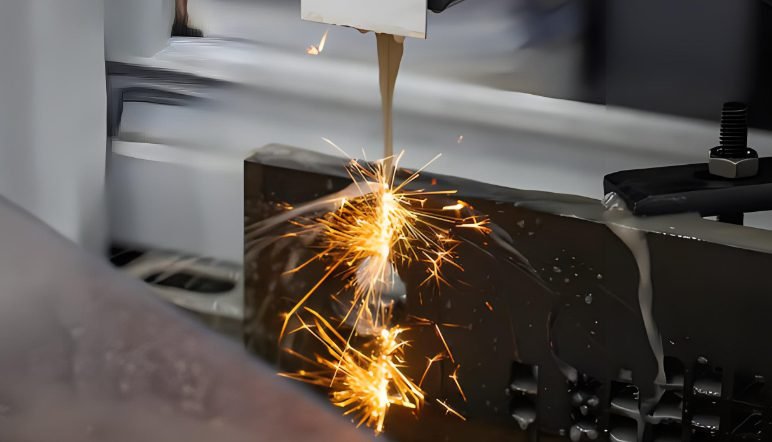
When you’re dealing with very hard materials, tight tolerances, or complex internal shapes, wire EDM machining services solve problems that traditional CNC cutting simply can’t.
Wire electrical discharge machining (wire EDM) uses a thin, electrically charged wire to cut through conductive materials under a stream of deionized water. There is no physical cutting force – the wire never actually touches the part. Instead, thousands of tiny electrical sparks erode the material along a programmed path.
Wire EDM vs Other Machining Methods
Wire EDM vs CNC milling for tight‑tolerance parts
For very complex, tight‑tolerance work, wire EDM machining services often beat standard CNC milling.
- Best for wire EDM: ultra‑tight tolerances (down to 0.0001″), sharp internal corners, thin webs, very hard materials (hardened steel, carbide, Inconel, titanium).
- Best for CNC milling: 3D surfaces, pockets with large radii, high‑volume parts where tolerances are more relaxed.
We use CNC wire EDM machining when you need precision profiles and no tool pressure. We switch to milling when material removal needs to be fast and the geometry is less critical.
Wire EDM vs laser and waterjet cutting
Compared to laser cutting and waterjet, EDM wire cutting services focus on accuracy and edge quality:
- Accuracy: Wire EDM holds far tighter tolerances than laser or waterjet.
- Edge quality: No heat‑affected zone, no hard scale, no taper on thick sections. Ideal when the profile is critical.
- Material impact: Non‑contact cutting, no mechanical force – safer for brittle or delicate parts.
Laser and waterjet are great for fast, rough blanks. We use precision wire EDM cutting when the cut is final‑dimension, not just a rough shape.
Wire EDM vs sinker EDM for tooling and molds
Both wire EDM and sinker EDM are key for tool and die EDM machining, but they do different jobs:
- Wire EDM:
- Flat or prismatic profiles
- Punches, die openings, ejector inserts, clearance slots
- Long, straight cuts with consistent taper
- Sinker EDM:
- 3D cavities for molds and dies
- Textured or shaped surfaces using electrodes
- Blind pockets and features you can’t cut through
On most tooling projects, we combine wire cut EDM machining for profiles and sinker EDM services (plus milling and grinding) for complex mold cavities.
How to decide if wire EDM is the best fit
Wire EDM is usually the right choice when:
- Your part is hard, heat‑treated, or a superalloy that’s slow or risky to mill.
- You need tight tolerance EDM machining on profiles, slots, or punches.
- You have sharp internal corners, thin sections, or features that cutters can’t reach.
- You want non‑contact machining for brittle materials to avoid distortion.
If you’re unsure, send us your model and tolerances. We’ll tell you straight whether wire electrical discharge machining services are the best value or if CNC milling, laser, waterjet, or sinker EDM makes more sense for your parts and budget.
Core Wire EDM Machining Services You Can Order
When you order wire EDM machining services from us, you get stable, repeatable precision for both prototypes and production.
Standard And Tight Tolerances
We focus on tight tolerance EDM machining that’s realistic for production work:
- Standard: ±0.0005 in (±0.012 mm) on most features
- Tight: down to ±0.0001 in (±0.0025 mm) on critical dimensions
- True position, flatness, and parallelism held consistently for precision wire EDM cutting and custom wire EDM parts
Max Part Size, Thickness, And Wire Options
Our CNC wire EDM machining handles a wide range of part sizes:
- Max part size: up to around 800 × 500 × 300 mm (31.5″ × 19.5″ × 11.8″)
- Thickness: up to 300 mm (about 12″) in a single setup
- Wire diameters: 0.05–0.30 mm to balance speed vs. detail, including micro wire EDM services for fine features
4‑Axis And Taper Wire EDM Cutting
For complex geometries, we use 4 axis wire EDM cutting:
- Taper cutting up to about 30° (material and thickness dependent)
- Accurate 3D forms, contours, and matching top/bottom profiles
- Ideal for tooling, dies, and complex aerospace and medical components
EDM Surface Finish Ranges
We tune EDM surface finish quality to match your budget and function:
- Roughing passes for fast EDM prototyping and production
- Multiple trim passes for Ra ~0.2–0.8 μm surfaces
- Many tools, molds, and precision components ship without extra grinding or polishing
From One‑Offs To High‑Volume EDM Production
We design our process to scale:
- Fast-turn one‑off prototypes and engineering samples
- Batch production with shared setups for better pricing
- Stable, documented processes for high volume EDM production in global supply chains
What Are Wire EDM Machining Services?
How Wire EDM Works in Simple Terms
Think of wire EDM as precision spark cutting:
- A brass or coated wire (typically 0.006″–0.012″ / 0.15–0.30 mm) is fed through the machine.
- The workpiece is submerged in dielectric fluid (usually deionized water).
- A controlled electrical discharge jumps from the wire to the part, vaporizing tiny bits of metal.
- The machine follows a CNC‑programmed path to create the exact 2D profile or 3D form you need.
- The wire is constantly moving and consumed; it’s not reusable.
Because it’s a non‑contact machining process, there are no cutting forces, no tool deflection, and almost no mechanical stress on the part.
Why Engineers Choose Wire EDM Over CNC Machining
Engineers and buyers turn to wire EDM machining services when:
- Tolerances are extremely tight – we routinely hold ±0.0002″ (±0.005 mm), and in some cases up to ±0.0001″ (±0.0025 mm).
- Parts are made from hardened steel, carbide, Inconel, titanium, or high‑HRC tool steels that are difficult or costly to mill.
- You need sharp internal corners, thin slots, or complex cutouts that standard end mills physically can’t reach.
- You want to machine after heat treat to avoid distortion and rework.
- You need excellent edge quality with minimal burrs and a consistent surface finish.
In short: if conventional CNC milling struggles with tool wear, vibration, or feature geometry, wire EDM is usually the better fit.
When Wire EDM Makes Sense for Your Parts and Budget
Wire EDM machining services are most cost‑effective when:
- The part has complex profiles but low to medium material removal (EDM is slower than milling for bulk stock removal).
- You’re working with high‑value materials where avoiding scrap is critical.
- You need tight‑tolerance custom wire EDM parts and repeatable accuracy across batches.
- You’re building tooling, dies, molds, or precision components where dimensional accuracy outweighs raw speed.
- You want EDM prototyping and production on the same process so prototypes match production parts.
If your design is simple, loose on tolerances, and made from an easy‑to‑machine alloy, CNC milling or turning may be cheaper and faster. For precision wire EDM cutting, the value comes from accuracy, capability, and material flexibility—not cycle time alone.
Key Limits and Constraints Before You Request a Quote
To avoid surprises, it helps to know a few practical limits for CNC wire EDM machining:
- Material requirement: The workpiece must be electrically conductive (steels, tool steels, superalloys, titanium, aluminum, copper, brass, carbide, etc.). Non‑conductive materials cannot be cut by wire EDM.
- Cut speed: Wire EDM is slower than milling or laser for large, simple shapes. Cost is heavily driven by cut length and thickness.
- Minimum feature size: Very fine details depend on wire diameter and setup; features smaller than the wire plus clearance are not possible.
- Part thickness: Very thick sections are possible but increase cut time and price. Tall parts may also limit how tight a tolerance we can guarantee through the full height.
- Taper and access: Extreme tapers or undercuts may require 4‑axis wire EDM and careful fixturing, which adds setup time.
- Heat‑affected zone: While minimal and well‑controlled, EDM does create a thin recast layer that may matter for some medical or fatigue‑critical parts.
When you send a quote request for EDM wire cutting services, share material, thickness, tolerances, and quantity up front. That lets us tell you quickly if tight‑tolerance EDM machining is the right process—or if another CNC method will save you time and money.
Materials We Cut With Wire EDM Machining Services
With our wire EDM machining services, we focus on metals where accuracy, stability, and edge quality really matter. If it’s conductive and dimension‑critical, we can probably cut it.
Common Steels and Tool Steels
We use CNC wire EDM machining every day on:
- Carbon and alloy steels (e.g., 1045, 4140, 4340)
- Tool steels: D2, A2, O1, S7, M2, H13, P20
- Stainless steels: 304, 316, 420, 440C
These are ideal for precision wire EDM cutting of dies, fixtures, and custom wire EDM parts, especially when parts are already heat‑treated and difficult to machine by milling.
Hardened and High‑HRC Alloys
Wire EDM shines on hardened materials that destroy normal tools:
- High‑HRC tool steels (D2, H13, M-series, etc.)
- Hardened die components and wear plates
- EDM machining for hardened steel inserts and punches
Because wire EDM is non‑contact, hardness doesn’t slow us down, and we keep tight tolerance EDM machining without distortion.
Superalloys and Exotic Materials
We regularly provide EDM machining for carbide and superalloys, including:
- Inconel, Hastelloy, and other nickel‑based superalloys
- Titanium and titanium alloys
- Tungsten carbide, molybdenum, and similar exotics
These are common in aerospace wire EDM machining, medical device wire EDM services, and high‑temperature tooling where traditional CNC tools wear out fast.
Aluminum, Brass, Copper, and Non‑Ferrous Metals
For conductive non‑ferrous metals, wire EDM is a clean way to get burr‑free edges and fine details:
- Aluminum alloys (when very fine features or sharp internal corners are required)
- Brass and copper for electrical components and EDM tooling
- Bronze and other copper alloys
- Conductive non‑ferrous metals used in precision connectors and inserts
These are great candidates when you need micro wire EDM services for small slots, thin walls, and intricate profiles.
What Makes a Good EDM Material?
A material is a good fit for wire electrical discharge machining services when:
- It is electrically conductive (even slightly)
- It needs tight tolerances (down to 0.0001″ in some cases)
- It’s hard, heat‑treated, or abrasive and tough on cutting tools
- You need sharp internal corners, thin sections, or fragile features
- You want minimal mechanical stress and no cutting forces
If you’re unsure whether your material works for EDM wire cutting services, send us the alloy spec and we’ll confirm it quickly and suggest the best process for your part and budget.
Typical Parts and Applications for Wire EDM Machining Services
Precision tooling, dies, and mold inserts
With our wire EDM machining services, we cut precision tooling, dies, and mold inserts that are hard to hit with standard CNC alone. Wire electrical discharge machining gives:
- Perfectly matched punch/die profiles
- Tight‑tolerance EDM machining for wear plates, inserts, and form tools
- Tool and die EDM machining on hardened steel, carbide, and high‑HRC alloys
This is where EDM machining for hardened steel and EDM machining for molds and dies really pays off.
Thin slots, sharp corners, intricate profiles
If your part needs features that are “too fragile” for milling, precision wire EDM cutting is usually the answer:
- Very thin slots with consistent width
- Sharp internal corners that cutters can’t reach
- Complex, closed‑shaped profiles without tool deflection
Because wire cut EDM machining is non‑contact, there’s no cutting force pushing or bending the part.
Micro features, small holes, fine details
For micro wire EDM services, we use fine wire to hit small and delicate geometry:
- Micro holes, narrow keyways, and tiny pockets
- Fine teeth, tiny tabs, and miniature features
- EDM machining tolerances to 0.0001 inch on critical areas
This is ideal for medical device wire EDM services, precision fixtures, and small high‑accuracy components.
Thick sections, deep cuts, tall features
Wire EDM also shines on parts that are too deep or too tall for normal cutters:
- Deep cuts with minimal taper from top to bottom
- Tall features where straight walls matter
- Thick plates and blocks that need accurate through‑profiles
With 4 axis wire EDM cutting, we can also manage complex tapers and 3D forms in thicker material.
When wire EDM beats milling
Engineers choose CNC wire EDM machining when milling hits a wall:
- Corners need to be sharper than a tool radius
- Part is already hardened or uses Inconel, titanium, or carbide
- Features are too small, too deep, or too risky for traditional tools
That’s where our custom wire EDM parts stand out—clean edges, tight tolerances, and complex geometries that milling simply can’t reach.
Wire EDM Machining Services for Aerospace and Defense
When you’re building flight‑critical hardware, our wire EDM machining services are set up to hit tight tolerances, hold stable processes, and keep documentation clean from RFQ to final inspection.
Aerospace Components That Benefit From Wire EDM
We use CNC wire EDM machining a lot for:
- Turbine and compressor components (disks, seal segments, blade root forms)
- Fuel system parts with tight flow paths and sharp internal features
- Structural brackets, hinge fittings, and actuator parts in high‑strength alloys
- Precision tooling, gauges, and fixtures that support aerospace assembly
For these parts, precision wire EDM cutting lets us keep geometry consistent part‑to‑part, even on complex profiles and small details.
Tight‑Tolerance Turbine, Fuel, and Structural Parts
Our wire electrical discharge machining services are geared for tight tolerance EDM machining on mission‑critical features:
- Typical EDM machining tolerances to ±0.005 mm (±0.0002 in), and tighter on controlled features
- Stable, burr‑free edges ideal for sealing surfaces and high‑pressure fuel passages
- 4 axis wire EDM cutting for fir‑tree shapes, slots, and undercuts that milling can’t reach
This level of control makes wire cut EDM machining a strong fit for turbine hot‑section details, fuel metering components, and thin structural features.
Managing Heat‑Sensitive and High‑Nickel Alloys
Aerospace work often means hard‑to‑machine materials. Because EDM is a non contact machining process, we can cut:
- High‑nickel superalloys: Inconel, Hastelloy, Rene, Waspaloy
- Titanium and titanium alloys
- Hardened steels and tool steels used in aerospace tooling
- Carbide wear parts and inserts
EDM wire cutting services avoid cutting forces and keep bulk heat low, which helps protect microstructure and dimensional stability on heat‑sensitive materials.
Compliance, Documentation, and Inspection
For aerospace wire EDM machining, we build the process around quality and traceability, not just cutting speed:
- ISO certified EDM shop practices with AS9100‑style process control
- Full documentation: material certs, heat lot traceability, process records, and inspection reports
- In‑process checks and final inspection using CMMs, vision systems, and precision gauges
- Clear ballooned drawings and FAIR/PPAP support when required
If you need an AS9100 wire EDM provider or are sourcing custom EDM components for aerospace and defense, we can support both EDM prototyping and production with the documentation and consistency your program expects.
Wire EDM for Medical and Precision Devices

Our wire EDM machining services are a good fit for medical and precision device work where geometry, surface quality, and documentation all matter. We combine CNC wire EDM machining with strict quality control so you get repeatable parts and clean paperwork, not headaches.
Medical Implants, Surgical Tools, and Fixtures
We use precision wire EDM cutting to produce:
- Custom trauma plates, spine components, and implant blanks
- Surgical instruments, cutting jaws, and micro forceps details
- Positioning fixtures, clamp inserts, and test blocks for validation
Wire cut EDM machining keeps parts straight, avoids mechanical stress, and holds tight tolerance EDM machining on critical fits, threads, and locking features.
Micro Wire EDM for Tiny Features
Our micro wire EDM services are set up for very small details and thin sections:
- Tiny slots, vents, and windows in implant components
- Thin‑wall features and delicate flexures that milling would distort
- Fine holes, keyways, and profiles for precision instruments
We routinely work with EDM machining tolerances to 0.0001 inch on key features when the design and material allow it.
Surface Quality and Cleanliness
Medical device wire EDM services must control both finish and contamination. We focus on:
- Stable EDM surface finish quality that’s consistent across batches
- Low recast and burr‑free edges that reduce downstream polishing
- Clean, deionized‑water processes and post‑cleaning compatible with your passivation or sterilization workflow
Tell us your target Ra and post‑processing plan, and we’ll set the cut strategy around it.
Material and Traceability Requirements
We run EDM machining for hardened steel, titanium, stainless, and other medical‑grade alloys with full lot tracking. For regulated work we support:
- Material certs and heat/lot traceability back to the mill
- ISO certified EDM shop quality controls and documented inspections
- Serialized parts, batch records, and archived CNC wire EDM machining programs
If you need AS9100‑level documentation or similar rigor on custom wire EDM parts, we can align our EDM prototyping and production process to your compliance requirements.
Wire EDM Machining Services for Automotive, Tooling, and Industrial Parts

Tooling: Injection Molds, Extrusion Dies, Stamping Tools
We use wire EDM machining services to build and repair high‑precision tooling that keeps your lines running:
- Injection molds & inserts – sharp parting lines, complex cores, and tight shut‑offs with minimal polishing.
- Extrusion dies – stable profiles in hardened steel and carbide for long tool life.
- Stamping tools – punches, dies, and stripper plates with clean edges and consistent clearance.
Our CNC wire EDM machining holds tight tolerance EDM machining on hardened tool steels, so your molds and dies last longer and run more consistently.
Gears, Splines, and Wear Components by Wire EDM
For custom wire EDM parts in powertrain and industrial drives, we cut:
- Gears, splines, keyways – precise tooth forms and profiles without distortion.
- Wear plates, guides, cams – EDM machining for hardened steel and carbide where grinding alone is not enough.
- One‑off spares and obsolete parts – fast EDM prototyping and production for legacy equipment.
Precision wire EDM cutting gives you accurate profiles and repeatable fit, even on complex geometries and superalloys.
Wire EDM in High‑Volume Automotive Workflows
In automotive, we slot our EDM wire cutting services into existing high‑volume workflows:
- Use wire cut EDM machining for complex features, then finish with milling, turning, or grinding.
- Run 4 axis wire EDM cutting for parts that need multi‑face details in one setup.
- Standardize tool designs so we can repeat setups and reduce downtime.
This approach keeps cycle times low on your main CNC lines while we handle the tight‑tolerance details by EDM.
Cutting Lead Time and Tooling Cost
We focus on reducing lead time and tooling cost for complex industrial parts:
- Cut hardened blanks directly, so you avoid multiple heat‑treat and rework steps.
- Combine custom EDM components manufacturing with our CNC machining to reduce fixture counts.
- Reuse proven EDM programs for repeat orders to support high volume EDM production.
If you need fast, reliable wire electrical discharge machining services for automotive, tooling, or industrial parts, we set up the process so you get stable quality, predictable lead times, and a clear total cost.
How a Wire EDM Machining Project Runs Start to Finish
What to send with your RFQ for wire EDM machining services
To quote wire EDM machining services accurately, I need clear data up front. With your RFQ, send:
- 3D CAD files: STEP, Parasolid, or IGES (plus native files if possible)
- 2D drawings: With all critical dimensions, GD&T, datums, and tolerances
- Material details: Grade, condition (hardened/annealed), and any approved equivalents
- Quantities: Prototype, low volume, or high‑volume EDM production
- Quality requirements: Surface finish, inspection level, PPAP/FAI, CMM reports, certificates
- Delivery needs: Target lead time, partial shipments, and packaging instructions
The more complete your RFQ, the faster I can lock in pricing and lead time for your wire electrical discharge machining services.
Design for manufacturability checks for wire EDM jobs
Before I accept a job, I run a quick DFM review focused on EDM limits:
- Minimum feature sizes and web thickness for the chosen EDM wire diameter
- Corner radii and sharp internal corners to see what’s realistic in wire cutting
- Part thickness vs. height, to avoid deflection or wire breakage
- Clamping and fixturing points that won’t mark critical surfaces
- Tolerance stack‑up and datums to ensure we can hold the callouts
If something will drive cost or risk (like over‑tight tolerances or fragile sections), I’ll flag it and suggest adjustments before we start.
Programming and setup that affect EDM price and lead time
Most of your cost in CNC wire EDM machining comes from programming, setup, and burn time:
- CAM programming: Toolpaths, skim passes, 4‑axis paths, and taper cutting setup
- Fixture design and setup: Custom fixtures, multiple setups, or re‑clamping add cost
- Number of cuts per feature: Rough + multiple skim passes for tight tolerance EDM machining
- Machine time: Long cuts, thick sections, and superalloys (Inconel, titanium, carbide) run slower
If we can reduce setups, standardize fixtures, or relax non‑critical tolerances, we can cut both price and lead time.
In‑process monitoring and final inspection
For precision wire EDM cutting, I treat quality control as part of the process, not an afterthought:
- In‑process checks:
- Cut verification on first‑off parts
- On‑machine measurement for critical dimensions
- Monitoring wire tension, flushing, and power settings
- Final inspection (based on your spec):
- CMM and vision systems for tight features and profiles
- Height gauges, micrometers, pins, and gauges for standard checks
- Full dimensional reports, material certs, and traceability when needed
If you require ISO or aerospace‑level documentation, I build that into the workflow from the start.
Packaging and shipping for delicate EDM parts
Wire cut EDM machining often produces sharp edges, thin walls, and fine details that can be damaged easily. I pack wire EDM parts like they’re instruments:
- Individual wrapping for delicate or cosmetic surfaces
- Partitioned trays or foam inserts to prevent parts touching
- Corrosion protection for tool steels, hardened steel, and EDM for Inconel and titanium
- Clear labeling and paperwork so receiving and inspection on your side is smooth
Whether you’re local or overseas, I plan packaging and logistics to match the precision of the parts, not just the shipping address.
Design Tips for Wire EDM Parts
Smart design makes our wire EDM machining services faster, cheaper, and more predictable. Here’s how I usually guide customers when we co‑engineer custom wire EDM parts.
Minimum Feature Size and Web Thickness
For most CNC wire EDM machining jobs, staying inside practical limits keeps parts stable and costs under control:
| Feature | Recommended (metric) | Recommended (inch) |
|---|---|---|
| Min slot width | ≥ 0.25–0.30 mm | ≥ 0.010–0.012″ |
| Min web / wall thickness | ≥ 0.30–0.50 mm | ≥ 0.012–0.020″ |
| Min corner radius (by wire Ø) | ≥ wire radius | e.g. 0.10 mm wire ≈ 0.004″ |
- If you need micro wire EDM services, we can go tighter, but expect higher cost and longer lead time.
- For tall parts, increase wall thickness to avoid distortion and handling damage.
Corner Radii, Slots, and Micro Features
Wire electrical discharge machining services are great for sharp detail, but the wire still has a diameter:
- Internal corners: they will always have a radius; design with a radius slightly larger than the wire radius and call it out clearly.
- Relief pockets: add small overcuts/reliefs in corners so mating parts can sit fully.
- Tiny slots / keyways: make width at least 1.2–1.5× wire diameter for stable cutting.
- Micro details: group ultra‑fine features in one area where possible to reduce setups.
Calling Out Critical Tolerances and Datums
Tight tolerance EDM machining can hit ±0.002 mm (±0.0001″) on the right setup, but don’t make the whole print that tight:
- Mark critical dimensions and functional datums (A, B, C) clearly.
- Use realistic bands: for most precision wire EDM cutting, ±0.01–0.02 mm (±0.0004–0.0008″) is efficient.
- Use geometric tolerances (position, flatness, parallelism) only where function demands it.
Drawing and Model Tips for Faster Quotes
Clean data makes online wire EDM quote work smooth on our side:
- Send a STEP/IGES + PDF drawing with tolerances, material, thickness, and quantity.
- Avoid conflicting dimensions between 3D model and 2D drawing.
- Call out surface finish only where needed; EDM surface finish quality is often enough as‑cut.
- Note if you need ISO certified EDM shop / AS9100 wire EDM provider documentation.
When to Combine Wire EDM with Milling, Grinding, or Turning
The best custom EDM components manufacturing often uses more than one process:
- Use milling/turning for bulk removal, holes, threads, and non‑precision faces.
- Use wire cut EDM machining for tight profiles, hard materials, and final geometry.
- Use grinding only where ultra‑flat faces or very low Ra finish are truly required.
If you share how the part works in your assembly, we can suggest the simplest mix of EDM, CNC machining, and finishing to hit your spec without overpaying.
Quality, Certifications, and Inspection for Wire EDM Work
Key quality checks for wire EDM machining services
For wire EDM machining services, I lock in quality from the first cut, not just at final inspection. Typical checks include:
- Dimensional accuracy: critical sizes, GD&T features, and tight tolerance EDM machining down to ±0.002 mm / ±0.0001″ where required.
- Positional accuracy & flatness: datums, true position, runout, and flatness on key faces.
- Edge and burr condition: clean precision wire EDM cutting with no recast, micro‑cracks, or burrs that could affect fit or fatigue life.
- Surface finish: verifying Ra to match your callouts so you know when EDM is “final” and when you still need grinding or polishing.
- Material compliance: checking hardness, grade, and spec for EDM machining for hardened steel, carbide, Inconel, titanium, and other superalloys.
Metrology tools for EDM tolerances
To back up the tolerances we quote, we use a mix of standard and advanced metrology tools:
- CMM (coordinate measuring machine) for tight positional tolerances and 3D features.
- Vision / optical inspection systems for micro wire EDM services, tiny slots, and small holes.
- Digital height gauges, micrometers, bore gauges, pin gauges for day‑to‑day checks.
- Surface roughness testers to confirm EDM surface finish quality.
- Profile projectors for complex profiles and EDM wire cutting services on tooling and dies.
ISO and aerospace certifications for wire EDM machining
If you’re sourcing aerospace wire EDM machining or other regulated work, certifications matter. As a CNC and EDM provider, I align our system with:
- ISO 9001 – quality management baseline for any serious ISO certified EDM shop.
- AS9100 – for AS9100 wire EDM provider needs in aerospace and defense.
- Customer‑specific approvals and process qualifications where required.
These frameworks control everything from drawing revision control to inspection, non‑conformance handling, and continuous improvement.
Traceability, documentation, and reporting
For global customers, especially in aerospace, medical device wire EDM services, and automotive, clean documentation is not optional. I typically provide:
- Full material traceability: mill certs, heat numbers, and lot tracking from raw material to final custom wire EDM parts.
- Process records: machine settings, program revisions, and inspection plans for critical jobs.
- Inspection reports: FAIR, PPAP, or custom inspection reports with full dimensional results.
- Serial and batch tracking: especially for EDM prototyping and production that move into volume.
If you need specific formats (FAI, ballooned drawings, digital inspection data), we build that into the quote so your CNC wire EDM machining parts arrive with the paperwork your QA team expects.
Choosing a Wire EDM Machining Services Partner
Questions to ask any wire EDM shop
Before you send parts, ask straight questions:
- What tolerances can you hold repeatably? (e.g. ±0.0002″ vs ±0.0005″)
- What materials do you cut every week? (hardened tool steel, carbide, Inconel, titanium, etc.)
- Do you offer 4‑axis wire EDM machining and taper cutting?
- What is your max part size and thickness?
- What inspection equipment do you use for tight‑tolerance EDM machining?
- What certifications do you have? (ISO, AS9100 for aerospace wire EDM machining)
- What are your typical lead times for prototypes and production?
- Can you handle both EDM prototyping and high‑volume EDM production?
You want clear, specific answers, not “it depends” for everything.
Red flags to watch for
Walk away if you see:
- Vague capability claims like “we can do anything” with no numbers
- No sample reports, no example parts, no measurable EDM machining tolerances
- Slow or sloppy responses to emails and RFQs
- Quotes with missing details: no delivery date, no tolerance assumptions, no material spec
- No mention of inspection, documentation, or traceability
- Pricing that’s way lower than the market with no explanation (usually means corners cut)
If they can’t explain how they control quality, they won’t protect your parts.
Comparing multiple EDM wire cutting quotes
Don’t choose on price alone. Compare:
- Process detail: number of cuts, skim cuts, rough vs finish strategy
- Tolerances and surface finish: what they’re actually committing to
- Material and stock conditions: who supplies it, what grade, what certs
- Lead time and capacity: can they hit your schedule when volumes ramp up
- Quality and reporting: CMM reports, material certs, PPAP, FAIR for aerospace wire EDM machining
- Total cost: part price + logistics + risk if parts are late or out of spec
A slightly higher price from a reliable, ISO certified EDM shop usually saves money overall.
What a long‑term EDM partnership looks like
A strong EDM manufacturing partner:
- Knows your parts, tolerances, and typical issues by heart
- Flags DFM problems early and helps you adjust designs for easier EDM machining
- Keeps stable pricing and realistic lead times as volumes grow
- Offers combined processes: CNC machining + wire EDM + (where needed) grinding
- Supports you across industries: aerospace, medical, automotive, tooling, industrial
- Communicates clearly on every order, from online wire EDM quote to final delivery
That’s what we aim for with our own wire EDM machining services: predictable quality, honest communication, and the capacity to grow with your business.
Local and Remote Wire EDM Machining Services
When a Local Wire EDM Provider Makes Sense
Sometimes “EDM machining near me” really is the best move:
- Urgent jobs: Same‑day or next‑day turnaround, fast problem‑solving on the shop floor.
- High‑touch projects: Complex tooling, first‑time builds, or jobs that need regular design reviews.
- On‑site visits: You can see our CNC wire EDM machining process, audits, and inspection in person.
- Local standards: Easier alignment on regional regulations, paperwork, and payment terms.
Remote and Online EDM Machining Services
For many global buyers, remote and online wire EDM machining services are more practical:
- Broader capability: Access 4‑axis wire EDM cutting, micro wire EDM services, and hard‑to‑find alloys in one shop.
- Fast digital workflow: Upload CAD, get an online wire EDM quote, track status in real time.
- Global coverage: We ship precision wire EDM cutting and custom wire EDM parts worldwide.
Local vs Remote: Quick Comparison
| Option | When It’s Best | Key Benefits |
|---|---|---|
| Local wire EDM shop | Urgent parts, on‑site visits, frequent engineering changes | Face‑to‑face support, quick issue resolution |
| Remote/global EDM | Complex work, special materials, cost‑sensitive programs | More capability, better pricing, scalable capacity |
Shipping, Handling, and Packaging
We treat every EDM wire cutting services shipment like a precision instrument:
- Protection: Custom foam, separators, and anti‑scratch layers for tight tolerance EDM machining.
- Stability: Rigid crates for heavy parts; small trays for micro wire EDM parts and thin walls.
- Traceability: Each package labeled with part ID, revision, batch, and inspection status.
Balancing Cost, Speed, and Risk
Here’s how I guide buyers choosing between local and distant wire EDM machining services:
- Cost: Remote shops can cut cost on long runs and complex materials; local may win on small, urgent batches.
- Speed: Local wins on rush work; remote wins when we plan high volume EDM production with stable schedules.
- Risk: For very high‑value or fragile parts, choose extra packaging and tracked shipping, or split the order between local and remote suppliers to hedge risk.
I run our EDM machining and CNC machining operations with this mix in mind, so we can adapt to your region, your logistics rules, and your tolerance for cost vs lead time.
 English
  German
  Dutch
Dutch  Russian
  Czech
Czech  French
  Korean
  Japanese
  Spanish
  Portuguese
Reviews
There are no reviews yet.