
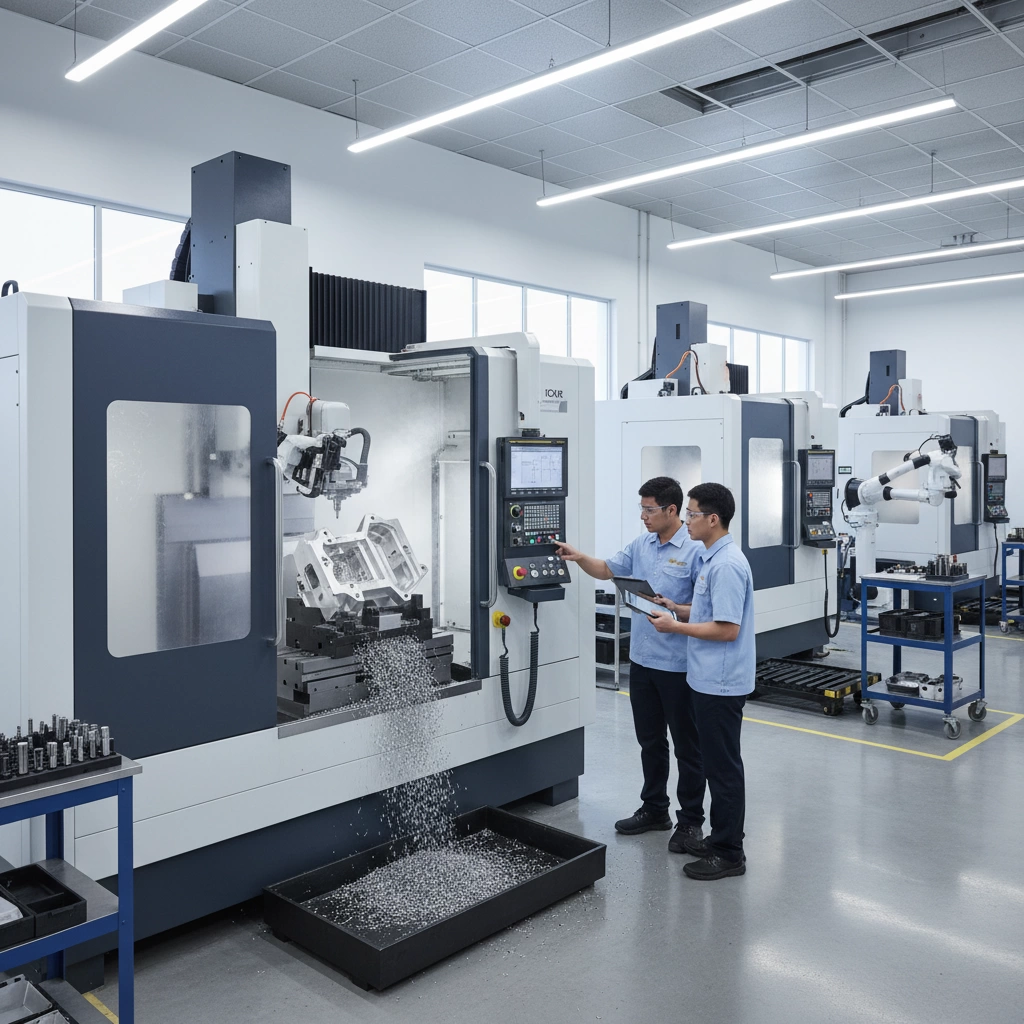
What Is 5-Axis CNC Machining for Complex Aluminum Parts?
When you design complex aluminum parts with curved surfaces, deep pockets, or tight angles, standard 3-axis machining often hits a wall. Our 5-axis CNC machining services for complex aluminum parts are built to solve exactly that problem.
Simple Breakdown of 5-Axis CNC Machining
In 5-axis CNC machining, the cutting tool can move in five directions at the same time:
- X, Y, Z – linear movement (left-right, front-back, up-down)
- A, B (or C) – rotational movement around one or two axes
This lets us tilt and rotate your part or the tool, so we can reach more faces and complex features in a single setup. It’s the foundation of precision aluminum milling for complex geometry machining.
Simultaneous 5-Axis vs 3+2 Positioning
We use both simultaneous 5-axis machining and 3+2 positioning, depending on your part:
- Simultaneous 5-axis
- All 5 axes move at once
- Ideal for curved surface machining, impellers, turbines, and organic shapes
- Delivers smoother surfaces and more accurate contouring
- 3+2 positioning (indexed 5-axis)
- Part is tilted/rotated to a fixed angle, then machined like 3-axis
- Great for multi-sided aluminum machining and features that are hard to reach
- Reduces setups while keeping programming and cost efficient
Both methods are core to our multi-axis CNC services and high-precision 5-axis milling.
5-Axis vs 3-Axis and 4-Axis for Aluminum Parts
For simple plates and prismatic parts, 3-axis or 4-axis can be enough. For complex aluminum CNC parts, 5-axis usually wins on total cost and accuracy:
- 3-axis
- One setup per side
- More fixturing, more handling, higher stack-up error
- 4-axis
- Adds rotation around one axis
- Better for parts with features around a cylinder, but still limited access
- 5-axis
- Access to nearly any surface in fewer setups
- Better for tight tolerance CNC parts, complex contours, and multi-sided features
- Less re-clamping, fewer datum shifts, higher repeatability
For aerospace aluminum components, robotics CNC parts, and complex jigs and fixtures machining, 5-axis is usually the most robust option.
Why 5-Axis Is Ideal for Complex Geometries
5-axis machining is designed for complex geometry machining where you have:
- Multiple intersecting surfaces and 3D contours
- Features spread over several faces of the part
- Critical alignments between holes, pockets, and bosses
By machining more of the part in a single clamping, we maintain better geometric relationships and deliver consistent tight-tolerance 5-axis milled components.
Handling Undercuts, Deep Features, and Tight Angles
Aluminum is often used for lightweight, high-performance designs that push geometry limits. Our advanced CNC manufacturing handles:
- Undercuts and back-side features
- Tool and part tilt let us reach areas impossible in standard 3-axis
- Deep cavities and pockets
- Optimal tool orientation reduces tool deflection and chatter
- Better chip evacuation for high-speed aluminum machining
- Tight angles and steep walls
- Precise tool tilting avoids collisions and over-cutting
- Ideal for contoured aluminum parts, housings, and structural brackets
This is how we reliably machine 5-axis machining for curved and multi-sided parts, aluminum impeller machining, and 5-axis machining for thin-wall parts with the accuracy and surface quality your project demands.
Why Choose 5-Axis CNC Machining for Aluminum?
5-axis CNC machining is the most efficient way for us to produce complex aluminum parts with high precision, clean surfaces, and shorter lead times. If your part has multiple faces, tight angles, or demanding tolerances, 5-axis is usually the smartest move.
Key Benefits of 5-Axis CNC Machining for Aluminum
Why we use 5-axis CNC machining services for aluminum parts:
- Fewer setups → lower risk of human error
- Better accuracy across all faces of the part
- Faster cycle times on complex geometry machining
- Higher-quality surface finish on precision aluminum milling
| Benefit | What It Means for Your Aluminum Parts |
|---|---|
| Multi-axis CNC services | Machine 5 sides in one setup, perfect for multi-sided aluminum machining |
| Tight tolerance CNC parts | More consistent datums, less stack-up across features |
| Advanced CNC manufacturing | Faster delivery, less rework, better repeatability |
Handling Curved, Pocketed & Thin-Wall
Our 5-Axis CNC Machining Capabilities
When you need 5-axis CNC machining services for complex aluminum parts, we’re set up for both speed and precision, from prototype to steady production.
Overview of Our 5-Axis CNC Services
We run modern simultaneous 5-axis machining centers dedicated to precision aluminum milling. These machines are optimized for:
- Complex geometry machining and multi-sided parts
- Tight tolerance CNC parts with dense features
- High-speed machining for aerospace, robotics, and automation components
You can also combine aluminum with other metals and plastics we support via our broader CNC machining materials lineup.
Travel Ranges, Spindle Speeds & Part Size
Our 5-axis machines are set up for high-speed aluminum machining with:
- Travel ranges typically up to: X 800–1000 mm, Y 600–800 mm, Z 500–700 mm
- Spindle speeds up to 15,000–24,000 rpm for fast aluminum removal
- Maximum part size roughly in the 600–700 mm cube range (depending on geometry and fixturing)
This gives us plenty of room for contoured aluminum parts, structural brackets, and multi-sided housings.
Simultaneous 5-Axis & Complexity We Support
We offer both:
- True simultaneous 5-axis machining for curved surfaces, impellers, and organic shapes
- 3+2 positioning for multi-sided features with fewer setups
We handle:
- High feature density (pockets, bosses, undercuts, tight angles)
- Thin-wall aluminum parts with controlled deflection
- Complex geometry machining that would be impractical on 3-axis or 4-axis machines
Prototyping & Low-to-Medium Volume Runs
We design our workflow for flexibility:
- Rapid aluminum prototypes and one-off development parts
- Small batches for validation, pilots, and custom machines
- Low-to-medium volume production with stable processes and repeatable quality
From custom aluminum prototypes to locked-in production, we keep the same 5-axis programs, fixtures, and inspection setups so your parts stay consistent across repeat orders.
Aluminum Alloys We Machine
For 5-axis CNC machining services on complex aluminum parts, we work with a wide range of alloys and match each grade to your application, not the other way around. You can also see a broader overview of our aluminum materials on our dedicated page for aluminum alloy machining (6061, 7075, 2026, etc.).
Main Aluminum Grades We Support
We routinely machine:
- 6061-T6 – General-purpose, excellent machinability, good strength, very common.
- 7075-T6 / T651 – Very high strength, aerospace grade, great for structural parts.
- 2026-T3 / T351 – High strength and fatigue resistance, popular in aircraft.
- 5083 – Strong with very good corrosion resistance, good for marine and harsh environments.
- MIC6 / Cast tooling plate – Stable, flat, ideal for jigs, fixtures, bases, and plates.
- Other alloys on request: 5052, 6082, 7050, 6063, and more.
How We Choose the Right Alloy
When you send your RFQ, we usually balance:
- Strength vs. weight – How strong does it need to be and how light?
- Corrosion resistance – Indoor, outdoor, marine, or chemical exposure?
- Machinability & cost – Tight tolerances and surface finish targets vs budget.
- Finishing needs – Anodizing, coating, or bare machined aluminum?
If you’re not sure which grade fits, we’ll suggest a practical option based on your use case and our experience with precision aluminum milling.
Typical Use Cases by Alloy
- 6061 – Brackets, frames, housings, automation parts, general robotics CNC parts.
- 7075 – High-load aerospace aluminum components, suspension parts, levers, structural links.
- 2026 – Aircraft fittings, high-fatigue components, aerospace tooling.
- 5083 – Marine hardware, outdoor fixtures, corrosion-critical parts.
- MIC6 – Precision bases, CMM fixtures, vacuum plates, tooling and jigs.
Strength, Weight & Corrosion Trade-offs
- 6061 – Best overall balance of strength, weight, corrosion resistance, and cost.
- 7075 / 2026 – Higher strength but less corrosion resistance; usually anodized or coated.
- 5083 – Slightly heavier focus on corrosion resistance and toughness.
- MIC6 – Excellent dimensional stability; not for high structural loads.
We always consider how these factors affect tight tolerance CNC parts and long-term stability, especially for complex geometry machining and multi-axis CNC services.
Other Metals and Plastics We Machine
Alongside aluminum, our 5-axis CNC machining services also cover:
- Metals – Stainless steel (304/316/17-4), carbon steel, copper, brass, titanium (for specific industries).
- Plastics – POM/Delrin, nylon, ABS, PC, PEEK, PTFE, and more.
This lets you combine complex aluminum CNC parts with steel inserts, plastic covers, or fixtures in one place for faster, more consistent builds.
Precision, Tolerances, and Accuracy for 5-Axis CNC Machining Services
When you trust us with complex aluminum parts, you’re buying precision first. Our 5-axis CNC machining services are built around tight control of tolerances, stability, and repeatability on real-world parts, not just test coupons.
Standard Tolerances for 5-Axis Aluminum Machining
For most 5-axis aluminum parts, we hold:
- General features: ±0.05 mm (±0.002″) as standard
- Mating faces, bores, and slots: typically ±0.02–0.03 mm (±0.0008–0.0012″)
- Flatness and parallelism: down to 0.02 mm over 100 mm, depending on geometry
For more detail on our default ranges across features and sizes, see our breakdown of standard tolerances for 5-axis parts.
Tight-Tolerance Options for Critical Aluminum Features
For precision aluminum milling and high-precision 5-axis milling, we can push tolerances tighter on critical areas:
- Bores, bearing seats, and datum faces: down to ±0.005–0.01 mm (±0.0002–0.0004″), case-by-case
- Position true location: as low as 0.01 mm with proper datums and GD&T
- Curved surface machining and contoured aluminum parts: stable, repeatable profiles for sealing faces, optics housings, and robotics CNC parts
If you need ultra-precise features (for example, high-end motion system components or aerospace aluminum components), we’ll confirm realistic limits up front, based on part geometry and alloy.
You can see how we approach industrial-grade CNC machining accuracy and 0.005 mm tolerances in our dedicated analysis of CNC machining accuracy standards.
How Geometry and Material Affect Tolerances
Not every feature on an aluminum part can or should be held to the same tolerance. We’ll tell you honestly where it makes sense and where it just burns budget. Typical factors:
- Part geometry:
- Long, thin walls, deep pockets, and slender ribs are more prone to deflection
- Very thin-wall aluminum parts and lightweight brackets may need relaxed tolerances locally
- Material:
- 6061 and MIC6 are easier for tight tolerance CNC parts
- 7075 and 2026 are stiffer, but can move with heavy stock removal
- Feature size and location:
- The larger the feature and the further from the datum, the more stack-up we must manage
- Multi-sided aluminum machining in one setup helps keep geometric tolerance tight
We’ll review your drawing and suggest where to keep tight tolerances and where you can safely loosen them to cut cost without hurting performance.
Inspection: CMM, On‑Machine Probing, Manual Gauges
To make sure your complex aluminum CNC parts match the model, we combine different inspection tools:
- CMM inspection for CNC parts:
- Full 3D measurements for contoured surfaces, complex geometry machining, and GD&T callouts
- On-machine probing:
- Automatic datum pickup, in-process checks, and compensation during simultaneous 5-axis machining
- Manual gauges and tools:
- Pin gauges, bore gauges, micrometers, and height gauges for fast, reliable checks
- Reports on request:
- Dimensional reports, capability studies, and traceable inspection data for aerospace, medical, or automotive aluminum parts
Controlling Thermal Stability and Tool Wear in Aluminum Machining
Holding precision on 5-axis CNC machining services is not just about good machines; it’s about keeping the process stable:
- Thermal control:
- Controlled shop temperature where it matters
- Optimized roughing/finishing strategies to reduce heat load in aluminum
- Coolant and air blast to keep chips moving and reduce expansion on thin walls
- Tool wear management:
- Dedicated aluminum cutters with proper coatings and geometries
- Tool life monitoring and scheduled tool changes for repeat runs
- Adaptive, high-speed aluminum machining strategies to keep cutting forces consistent
All of this adds up to reliable, repeatable accuracy on complex aluminum CNC parts, from rapid prototypes to low-volume CNC production and repeat batches.
Surface Finishes and Post‑Processing for 5-Axis Aluminum Parts
When you use our 5-axis CNC machining services for complex aluminum parts, you don’t just get accurate geometry—you get parts finished and ready to use.
Standard As‑Machined Aluminum Finish
Our standard as‑machined surface is ideal for functional parts and tight‑tolerance features:
- Typical Ra: 1.6–3.2 μm depending on toolpath and cutting parameters
- Clean tool marks, no burrs, no sharp edges
- Perfect for internal features, jigs, fixtures, and hidden faces
This is the fastest and most cost‑effective option for prototypes and low‑volume CNC production.
Bead Blasting, Polishing, and Brushing
For better cosmetics and consistent textures on contoured aluminum parts and multi‑sided components, we offer:
- Bead blasting – Matte, uniform finish, great before anodizing or painting
- Polishing – Smoother, brighter surface for visible faces and show parts
- Brushing – Linear grain finish, often used for housings, covers, and panels
These are popular for robotics CNC parts, visible aerospace panels, and custom aluminum prototypes.
Anodizing (Type II & Type III)
We handle full anodized aluminum CNC parts processing, including:
- Type II anodizing
- Decorative and protective
- Wide color range (black, clear, red, blue, etc.)
- Good corrosion resistance for general industrial and electronics parts
- Type III (hardcoat) anodizing
- Much thicker and harder layer
- Ideal for sliding surfaces, wear zones, and aerospace aluminum components
- Better abrasion resistance and durability
Anodizing pairs especially well with high-precision 5-axis milling where both performance and appearance matter.
Plating, Coating, and Heat Treatment
For projects that need more than anodizing, we also offer:
- Plating – Nickel, zinc, and other finishes where specific electrical or wear properties are required
- Coatings – Powder coat, painting, and specialty coatings on request
- Heat treatment – For certain aluminum alloys to improve hardness and stability after machining
We tune these options to your material choice (6061, 7075, 2026, etc.) and your part’s operating environment.
Light Assembly and Sub‑Assembly
If you need more than single parts in a bag, we can deliver:
- Light assembly of machined aluminum parts with inserts, fasteners, and bushings
- Sub‑assemblies for jigs, fixtures, and production tooling
- Kitted components ready for your line or final build
For customers in packaging, automation, or tooling, we often combine finished aluminum parts with other machined components similar to our CNC machined parts used in packaging machinery work:
common CNC machined parts used in packaging machinery.
With our 5-axis CNC machining services, surface finishing, and post‑processing under one roof, you get complex aluminum CNC parts that are machined, protected, and ready to drop into your build with minimal extra work.
Industries We Serve with 5-Axis CNC Machining Services
We’ve built our 5-axis CNC machining services around complex aluminum parts that need high precision, clean finishes, and repeatable quality. Here’s where our precision aluminum milling delivers the most value:
Aerospace & Aviation Aluminum Components
We machine high-strength aluminum alloy parts (including 6061 and 7075) for:
- Structural brackets, mounts, and ribs
- Complex housings, manifolds, and covers
- Lightweight contoured parts with tight tolerances
Our high-precision 5-axis milling supports complex geometry machining, multi-sided aluminum machining, and smooth curved surface machining for aerospace aluminum components where weight, accuracy, and reliability matter.
Automotive & EV Aluminum Parts
For automotive and EV customers, we handle:
- Battery system brackets and cooling components
- Motor housings, gearbox covers, and lightweight frames
- Custom jigs, fixtures, and prototype performance parts
Simultaneous 5-axis machining lets us deliver multi-axis CNC services that cut cycle time, hold tight tolerances, and keep costs under control for low-volume CNC production and rapid aluminum prototype machining services.
Robotics, Drones & Automation Components
We specialize in machining for robotics and automation parts, including:
- Precision motion system components and end-effectors
- Thin-wall drone frames and contoured aluminum parts
- Custom mounts, sensor housings, and structural arms
Our capability in 5-axis machining for curved and multi-sided parts makes us a strong 5-axis CNC supplier for complex aluminum CNC parts in high-performance robotics and UAV systems. For more on our core 5-axis capabilities, see our dedicated 5-axis CNC machining services.
Medical, Lab & Instrumentation Housings
We machine clean, accurate aluminum parts for:
- Medical device housings and enclosures
- Lab equipment brackets, trays, and mounting plates
- Precision instrumentation bodies and panels
We focus on smooth surfaces, consistent fits, and tight tolerance CNC parts that align with medical and instrumentation requirements, supported by controlled processes similar to those described in our guide on CNC machining medical device components.
Defense, Tooling, Jigs & Fixtures
Our complex jigs and fixtures machining covers:
- Production line fixtures and positioning tools
- Checking gauges and custom workholding
- Defense-related brackets, mounts, and structural aluminum parts
With advanced CNC manufacturing and CMM inspection for CNC parts, we support demanding environments where durability, accuracy, and repeatability are non‑negotiable.
Typical Applications for Complex Aluminum Parts
Curved and Contoured Aluminum Components
We use 5-axis CNC machining services to mill smooth, curved, and contoured aluminum parts where consistent surface quality matters—think housings, covers, impellers, and flow-related components. Simultaneous 5-axis machining lets us maintain precise geometry while reducing blend lines and manual polishing.
Multi-Sided Aluminum Parts in One Setup
For complex geometry machining, we machine multi-sided aluminum parts in a single setup. This keeps all features in tight relationship, cuts stack-up error, and is ideal for:
- Connector blocks and manifolds
- Enclosures with features on every face
- Parts that traditionally need 3–5 separate operations
High-Precision Robotics and Motion System Parts
We support OEMs and integrators with high-precision 5-axis milling for robotics joints, end-effectors, grippers, and motion system plates. Our multi-axis CNC services keep hole locations, bearing seats, and mounting faces in tight alignment, which is critical for repeatable robot motion and automation accuracy. You can see more about our work with robotics CNC parts on our dedicated robotics machining page.
Lightweight Structural Brackets and Frames
We machine lightweight structural aluminum brackets and frames with pockets, ribs, and thin walls to keep strength while dropping weight. This is a strong fit for:
- Aerospace aluminum components
- EV battery and powertrain supports
- Automation and machine frames
Complex Jigs, Fixtures, and Custom Tooling
Our 5-axis CNC machining services are ideal for complex jigs and fixtures machining, especially when you need:
- Multi-angle clamping and datums
- Tight tolerance CNC parts for production lines
- Tooling plates with dense, angled hole patterns
Rapid Prototypes and Functional Test Parts in Aluminum
We turn around custom aluminum prototypes quickly, using precision aluminum milling to get you functional parts that behave like final production. That includes:
- Design validation samples
- Test rigs and trial assemblies
- Low-volume CNC production runs for pilot builds
Whether you’re working with 6061, 7075, or other aluminum alloys, our complex aluminum CNC parts are built for real-world use, not just show-and-tell.
Our 5-Axis CNC Machines and Software
Advanced 5-axis machining centers
For our 5-axis CNC machining services, we run modern, multi-axis machining centers built for high-speed aluminum milling. Each machine is set up for simultaneous 5-axis machining, which lets us hit complex geometry machining and multi-sided aluminum parts in a single, stable setup.
Machine brands, configs, and tool changers
We use well-known 5-axis platforms with:
- Trunnion-style and swivel-head configurations for better reach on deep features
- Large-capacity automatic tool changers for complex aluminum CNC parts
- High-rigidity spindles that hold tolerances tight on thin-wall and contoured aluminum parts
This setup gives us the flexibility to handle everything from precision aluminum milling for robotics parts to heavier aerospace aluminum components.
High-speed aluminum machining strategies
Aluminum loves speed, so we tune our process around that:
- High RPM spindles for aggressive material removal
- Dynamic toolpaths to keep constant cutter engagement
- Optimized chip evacuation to protect surface finish on curved surfaces and pockets
These high-speed aluminum machining strategies reduce cycle time and keep quality consistent, especially on multi-sided aluminum machining and tight-tolerance 5-axis milled components.
CAD/CAM and 5-axis simulation
We program all complex aluminum parts using professional CAD/CAM for 5-axis machining with full toolpath simulation. This lets us:
- Validate reach, collisions, and over-travel before anything hits the machine
- Optimize stepovers and stepdowns for smooth contoured aluminum parts
- Balance accuracy vs cost for both aluminum prototype machining services and low-volume CNC production
For projects that mix 5-axis milling with other processes, we can tie in services like EDM machining for fine details using our in-house advanced CNC machining services.
DFM feedback and design optimization
We don’t just take a file and hit go. For every complex aluminum part we:
- Review geometry for 5-axis manufacturability (tool access, wall thickness, fillets)
- Suggest small design tweaks that lower cost or improve stability
- Flag risk areas like thin ribs, deep pockets, or tight internal corners
This DFM feedback helps you get the most out of multi-axis CNC services while keeping your parts functional, repeatable, and priced right for global production runs.
Quality Control, Inspection, and Certifications
When you trust us with 5-axis CNC machining services for complex aluminum parts, quality is non‑negotiable. We run a strict, documented system to keep every precision aluminum part consistent from prototype to repeat production.
Quality systems and standards we follow
We operate under ISO-style quality management and AS‑level practices for aerospace‑grade control. Our internal procedures cover:
- Contract and drawing review before we cut any aluminum
- Documented process control for every 5-axis machining job
- Full traceability from raw aluminum alloy to finished part
You can see how we structure our inspections and documentation on our dedicated quality control process page.
Material validation and traceability
For aluminum alloy machining (6061, 7075, 2026, etc.), we verify every batch before it hits the machine:
- Incoming material checked against PO, spec, and mill certs
- Heat numbers recorded and linked to your work order
- Separate storage to prevent mix‑ups between alloys
If you need full traceability for aerospace aluminum components or tight tolerance CNC parts, we can lock that into your job from day one.
In‑process inspection and final reports
To keep simultaneous 5-axis machining and multi‑axis CNC services under control, we combine:
- On‑machine probing for critical datums and offsets
- CMM inspection for complex geometry machining and tight‑tolerance 5-axis milled components
- Manual gauges and micrometers for fast shop‑floor checks
On request, we provide:
- Full dimensional inspection reports
- First Article Inspection (FAI)
- PPAP documentation for automotive and EV aluminum parts
Surface and cosmetic checks for visible aluminum parts
For visible contoured aluminum parts, anodized aluminum CNC parts, and robotics CNC parts, we don’t just measure sizes—we also review appearance:
- Surface finish checks for CNC milling services for aluminum
- Consistency of bead blasting, brushing, or polishing
- Visual inspection under controlled lighting for scratches, dents, and tool marks
Certifications and documentation options
Depending on your project, we can supply:
- Material certs for all aluminum alloys used
- CMM inspection reports for high‑precision 5-axis milling
- PPAP packages for production tooling, jigs, and fixtures machining
- Custom quality documentation to match your internal or customer requirements
This level of quality control is why many global customers use us as a long‑term 5-axis CNC supplier for complex aluminum CNC parts, from rapid prototypes to low‑volume CNC production.
How Our 5-Axis CNC Machining Process Works
Step-by-step: From RFQ to Finished Aluminum Parts
Here’s how we run a typical 5-axis CNC machining project for complex aluminum parts:
- RFQ & Files
- You send us your RFQ with 3D CAD (STEP, IGES, Parasolid) and 2D drawings (PDF).
- You tell us the required alloy (e.g. 6061, 7075), target quantity, required tolerances, and finish (as-machined, anodized, etc.).
- Design Review & DFM Feedback
- Our engineers review your model for 5-axis machinability, tool access, wall thickness, and fixturing needs.
- We highlight any risk areas (thin walls, deep pockets, tight radii) and suggest tweaks to cut cost and improve stability.
- When needed, we simulate toolpaths in our CAD/CAM system as part of our internal manufacturing process to confirm feasibility.
- Quoting, Pricing Drivers & Cost Trade-offs
- We send a clear quote with unit price, lead time, and process route (simultaneous 5-axis vs. 3+2).
- Main cost drivers:
- Material grade and stock size
- Part complexity and feature density
- Tolerance level and inspection requirements
- Surface finish and post-processing
- We’ll suggest cost trade-offs like slightly relaxed tolerances, small geometry changes, or batch size adjustments to hit your budget.
- Programming, Fixturing & Tooling
- Our programmers create 5-axis toolpaths optimized for aluminum: high-speed milling, stable stepovers, and controlled tool engagement.
- We design custom fixtures to hold multi-sided and thin-wall parts rigidly through the full machining cycle.
- Tooling is chosen for high-speed aluminum machining: sharp carbide cutters, proper coatings, and balanced holders to keep surface finish clean.
- Machining, In-Process Checks & Finishing
- We run your parts on our simultaneous 5-axis machining centers, minimizing setups and keeping datums consistent.
- Critical dimensions are checked with on-machine probing and gauges during machining to avoid surprises.
- After cutting, we handle deburring, surface prep, and any anodizing or coating you specified.
- Lead Times, Batching & Shipping
- Typical lead times for complex aluminum CNC parts:
- Prototypes: usually 5–12 working days (depending on complexity and finish)
- Low-volume production: agreed per batch size and inspection level
- We can split runs into batches for faster first deliveries while we finish the rest.
- Parts are cleaned, protected, and packed for global shipping, with dimensional reports and material certs attached when requested.
- Typical lead times for complex aluminum CNC parts:
This workflow keeps our 5-axis CNC machining services predictable, fast, and repeatable—whether you need one complex aluminum prototype or ongoing low-to-medium volume production.
Real Projects and Example Parts in 5-Axis CNC Machining
We use our 5-axis CNC machining services on real, demanding aluminum parts every day. Here are a few typical examples of what we actually ship to customers worldwide.
Examples of Complex Aluminum Parts We’ve Machined
We’ve delivered precision aluminum milling projects such as:
- Multi-sided robotics housings with tight alignment between bores, pockets, and mounting faces
- Aerospace aluminum components with contoured surfaces, weight‑reduction pockets, and thin walls
- High-speed impellers and turbine-style parts with twisted blades and deep channels
- Complex jigs and fixtures for production lines and automation and electronics assemblies
All of these take advantage of simultaneous 5-axis machining to hit features in one setup, keep datums tight, and avoid stack-up error.
From Drawing to Finished 5-Axis Aluminum Part
On a typical complex geometry machining job, the “before and after” looks like this:
- Before: A 3D model with intersecting pockets, undercuts, tight angles, and multi-sided features that would normally need 4–6 separate operations on 3-axis machines.
- After: One fully machined, deburred, and finished aluminum alloy part (often 6061 or 7075), completed in 1–2 setups with consistent datums, better surface finish, and fewer risks of human error.
We use advanced CAD/CAM for 5-axis machining and run toolpath simulations to prove out the process before cutting.
Solving Tight-Tolerance and Multi-Operation Challenges
Many of our projects involve tight tolerance CNC parts where customers have struggled with other suppliers. Common issues we solve:
- Positional tolerance across multiple faces (true position on hole patterns, alignment of bores)
- Thin-wall aluminum parts that kept distorting under clamping or heat on 3-axis machines
- Multi-operation misalignment, where features machined in separate setups wouldn’t line up
We tackle this with:
- Simultaneous 5-axis machining to keep everything referenced to one clamping
- Smart fixturing and support for thin sections
- On-machine probing and CMM inspection for verification
Performance and Cost Gains vs Traditional Machining
Compared with traditional 3-axis machining, our high-precision 5-axis milling often delivers:
- 30–60% fewer setups, which reduces operator time and handling
- Better repeatability and stability, especially on complex aluminum CNC parts
- Shorter lead times, because we cut programming and fixturing complexity down
- Lower total cost, even if machine hour rates are higher, because the overall process is leaner
This is especially true for curved surface machining, contoured aluminum parts, and multi-sided aluminum machining that would otherwise need multiple fixtures.
What These Case Studies Mean for Your Project
If your part has any of the following, you’re the type of customer we built this service for:
- Complex 3D surfaces or multi-sided features
- Tight alignment between several faces or bores
- Lightweight structures in 6061, 7075, or 2026 with thin sections
- High-precision components for robotics, EVs, or medical and lab equipment
These real projects prove that 5-axis CNC machining services are not just “nice to have” – they’re often the only practical way to get complex aluminum parts produced accurately, repeatably, and at a cost that makes sense for both prototypes and low-to-medium volume runs.
Frequently Asked Questions About 5-Axis Aluminum Machining
File formats we accept for aluminum parts
We keep it simple and flexible so you can send whatever you already use.
Supported file formats
| Type | Preferred formats | Notes |
|---|---|---|
| 3D CAD models | STEP (.step, .stp), IGES (.igs), Parasolid (.x_t), SolidWorks (.sldprt) | Best for 5-axis toolpathing |
| 2D drawings | PDF, DXF, DWG | For GD&T, tolerances, finishes |
| Reference files | Images (.png, .jpg), STL | For visual/reference only |
For precision aluminum milling and simultaneous 5-axis machining, a clean STEP file plus a clear PDF drawing works best.
Minimum order quantities & prototype options
We’re set up for prototypes, low-volume CNC production, and ongoing work.
- MOQ: No strict minimum – we take one-offs for complex aluminum prototypes.
- Typical ranges:
- Prototypes: 1–10 pcs
- Small batches: 10–200 pcs
- Ongoing/bridge: 200–2,000+ pcs (depending on geometry)
If you also need simple sheet parts with your aluminum components, we can combine them with our in-house sheet metal fabrication services to keep everything under one roof.
3-axis vs 5-axis CNC machining cost
Cost depends more on complexity than axis-count alone.
General cost comparison
| Scenario | Best choice | Cost impact |
|---|---|---|
| Simple prismatic parts, 1–3 sides | 3-axis | Lowest hourly rate |
| Multi-sided aluminum parts, 4–5 sides | 5-axis | Higher hourly, fewer setups |
| Complex geometry machining, undercuts, impellers | 5-axis | Cheaper overall vs many 3-axis ops |
| Tight tolerance CNC parts on many faces | 5-axis | Better accuracy, less re-fixturing |
For complex aluminum CNC parts, 5-axis often reduces total cost by cutting setups, fixtures, and handling time.
Typical lead times for complex aluminum components
Lead time depends on part complexity, quantity, and finishing.
Normal lead time ranges
| Type of work | Typical lead time* |
|---|---|
| Simple prototype (3-axis/4-axis) | 5–7 working days |
| Complex 5-axis aluminum prototype | 7–12 working days |
| Small batch 5-axis (10–100 pcs) | 2–3 weeks |
| Larger batches / multiple part numbers | 3–5 weeks |
*Lead times can tighten or stretch based on material, anodizing/plating, and inspection requirements (CMM reports, PPAP, etc.).
How to prepare CAD and drawings for 5-axis machining
Well-prepared data saves time, avoids questions, and reduces risk.
To get a fast, accurate quote for 5-axis CNC machining services:
- Send a STEP file of the 3D model (no open surfaces or gaps).
- Add a 2D PDF drawing with:
- Critical dimensions and tight tolerances
- Datum scheme and GD&T (only where it matters)
- Surface finish notes (e.g. anodizing, bead blast)
- Clearly mark:
- Critical features (e.g. bearing bores, sealing faces)
- No-go areas and cosmetic faces
- Specify:
- Aluminum alloy (e.g. 6061, 7075, 2026, MIC6)
- Required certifications or inspections (CMM, material certs, etc.)
If you’re unsure how to optimize your model for high-precision 5-axis milling, just send what you have — we’ll give you direct, practical DFM feedback before cutting any metal.
Why Work with Us for 5-Axis CNC Machining Services?
Deep Experience in Complex Aluminum 5-Axis Work
We focus heavily on 5-axis CNC machining services for complex aluminum parts. Our team runs simultaneous 5-axis jobs daily—thin-wall housings, multi-sided brackets, impellers, contoured covers, and tight tolerance CNC parts for robotics and aerospace. We know how aluminum behaves at high speeds, and we design our processes around stability, accuracy, and repeatability.
Engineering + DFM Support for Tricky Geometries
You’re not just buying machine time; you’re getting engineering support and DFM help for complex geometry machining.
We help you:
- Optimize parts for 5-axis aluminum machining instead of multiple 3-axis setups
- Reduce unnecessary features that drive cost but don’t add function
- Adjust wall thickness, fillets, and tolerances for better stability and yield
Send us your models, and we’ll give you straight feedback on manufacturability before cutting any metal.
Pricing, Lead Time, and Reliability Advantages
Our multi-axis CNC services are set up for fast, stable production:
- Reduced setups with simultaneous 5-axis machining = lower labor cost
- High-speed aluminum milling = shorter cycle times
- Smart fixturing and standardized tooling keep changeovers fast
You get competitive pricing, realistic lead times, and consistent delivery—whether it’s one custom aluminum prototype or a low-volume production run.
Support for Repeat Orders and Long-Term Projects
We build processes for the long game:
- Locked-in CNC programs and fixturing for repeat orders
- Documented setups and inspection plans for long-term projects
- Dimensional history so we can track trends and keep your tight tolerance 5-axis milled components in control
Need related processes like cutting blanks or complementary parts? We can integrate upstream work such as waterjet-cut parts through our waterjet cutting services to keep your supply chain simple.
Next Steps for Your Aluminum Machining Project
To get started with your 5-axis CNC machining for aluminum project:
- Send your 3D model and drawings (STEP, IGES, Parasolid, etc.)
- Tell us material (e.g., 6061, 7075), quantity, target lead time, and any critical features
- We review, offer DFM feedback, then quote with clear pricing and timing
If you’re still comparing processes or materials, we can also suggest when 5-axis CNC machining services are the right move versus other options in our broader manufacturing services lineup.
 English
  German
  Dutch
Dutch  Russian
  Czech
Czech  French
  Korean
  Japanese
  Spanish
  Portuguese
Reviews
There are no reviews yet.