
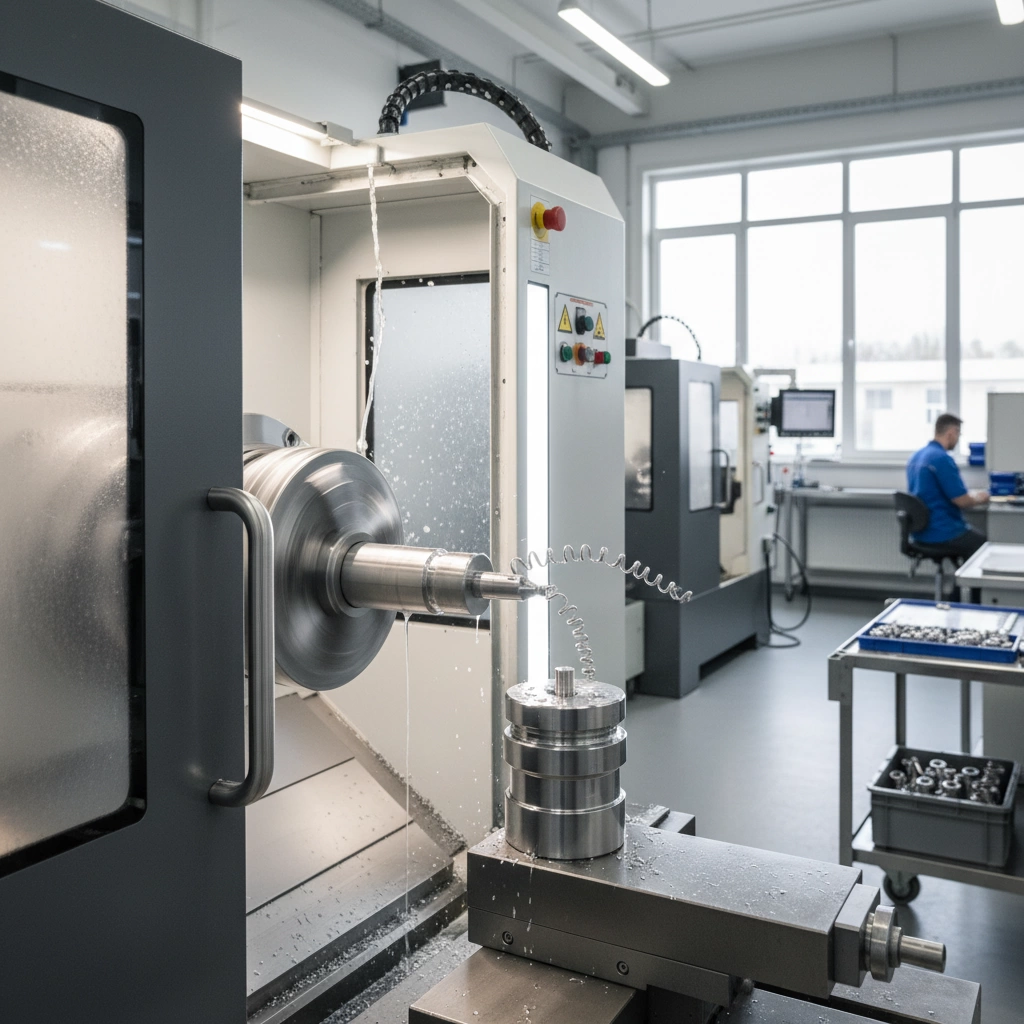
Why Stainless Steel Works for Medical Equipment
Worried about corrosion, failed sterilization, or parts not passing validation? That’s exactly why precision turning of stainless steel for medical equipment is still the go‑to choice for serious medical manufacturers.
Key Properties for Medical CNC Parts
Stainless steel hits the sweet spot of performance, cost, and regulatory acceptance:
| Property | Why It Matters in Medical Parts |
|---|---|
| Corrosion resistance | Handles blood, saline, disinfectants, and steam sterilization |
| High strength & toughness | Thin walls, tight tolerances, and high mechanical loads |
| Sterilizability | Withstands autoclave, steam, chemicals, and plasma cycles |
| Biocompatibility | Medical grades like 316L are proven safe for body contact |
| Dimensional stability | Maintains tight tolerances after machining and sterilization |
For CNC turning medical parts, this means:
- Stable cutting
- Consistent quality
- Long service life in real hospital conditions
Stainless Steel vs Titanium vs Plastics
You don’t pick a material based on trend—you pick it based on risk, performance, and cost.
| Material | Pros | Cons / Limits |
|---|---|---|
| Stainless steel | Strong, cost-effective, easy to machine, great for tools | Heavier, some grades not suitable for long‑term implants |
| Titanium | Very biocompatible, lighter, great for permanent implants | Higher cost, slower machining, more demanding tooling |
| Engineering plastics | Lightweight, X‑ray transparent, good for disposables | Limited strength, sterilization limits, creep over time |
For surgical instrument manufacturing, reusable tools, housings, and structural parts, biocompatible stainless steel (especially 316L) usually gives the best balance of:
- Performance in harsh environments
- Tight tolerance turning capability
- Total lifecycle cost
Regulatory and Compliance Angle
Regulators know stainless steel. That saves you time.
- FDA expectations:
- Use of well‑known surgical stainless steel alloys (e.g., 316L, 304, 17‑4 PH) simplifies risk assessment
- Easier to justify in 510(k) and technical files because of long clinical history
- ISO 13485 machining environment:
- Full traceability of heat lots and machining parameters
- Validated CNC turning processes for consistent dimensions and surface finish
- Documented cleaning, passivation, and packaging steps
For global OEMs and startups alike, stainless steel helps:
- Reduce regulatory friction
- Build a clean, defensible material strategy
- Align with existing corrosion resistant medical parts standards
As a CNC equipment provider, we design our high‑precision lathes specifically to handle stainless steel 316L machining and other austenitic stainless steel grades so you can hit performance, compliance, and cost targets in one shot.
Common Stainless Steel Grades for Precision Turning in Medical Applications
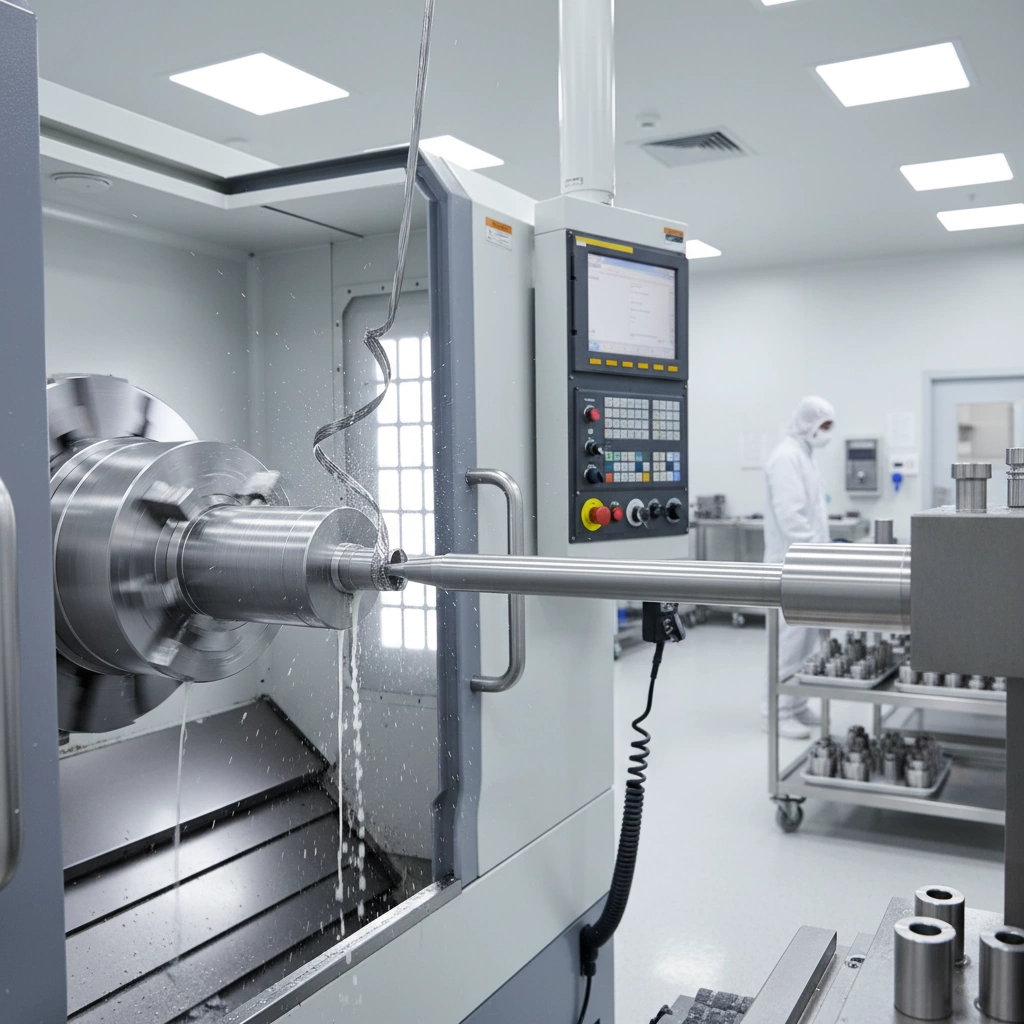
When we do precision turning of stainless steel for medical equipment, material choice is everything. The right grade decides how the part performs in the body, under sterilization, and in daily hospital use.
316L – The medical workhorse
316L is the first choice for many CNC turning medical parts:
- Low carbon, high corrosion resistance – Handles blood, saline, and aggressive sterilization without pitting.
- Biocompatible – Widely used in implants and invasive devices.
- Stable in tight tolerances – Works well for tight tolerance turning and smooth surfaces.
We use 316L a lot for bone screws, implant components, and high-end surgical instrument bodies where reliability and biocompatibility are non‑negotiable.
304 – Cost‑effective for non‑implant tools
304 is a solid option when parts don’t stay inside the body:
- Good corrosion resistance at lower cost – Ideal for external and non‑implant tools.
- Easy to machine compared with some higher alloys – Good balance of price, performance, and machinability.
- Perfect for housings, handles, fixtures – Anything exposed to cleaning and disinfection but not long‑term in vivo use.
For example, many high-precision turning projects in 304 stainless steel we run are for instrument handles, diagnostic housings, and brackets that need precision but not implant-grade performance. You can see typical use cases in our high-precision turning processing of 304 stainless steel parts examples.
420 / 440 – Cutting edges and sharp tools
For surgical instrument manufacturing where sharpness matters, we move to martensitic grades like 420 and 440:
- High hardness after heat treatment – Ideal for scalpels, scissors, and cutting jaws.
- Strong edge retention – Keeps the cutting edge longer in demanding OR use.
- Good polishability – Clean, bright, easy-to-sterilize surfaces.
These are the go‑to “surgical stainless steel alloys” for cutting tools and any component where wear resistance beats flexibility.
17-4 PH – High-strength structural parts
When you need strength and precision in one part, 17‑4 PH does the job:
- Very high strength after aging – Great for structural medical components and fixtures.
- Good corrosion resistance – Handles moisture, disinfectants, and non‑implant contact with bodily fluids.
- Dimensionally stable – Works well for high-precision lathe medical parts that must hold tolerances.
You’ll see 17‑4 PH in surgical tool joints, complex mechanical assemblies, and high-load components in diagnostic equipment.
How we choose the right stainless steel grade
For each biocompatible stainless steel part, we match the grade to its real‑world use:
- Contact type
- Long‑term in body → usually 316L or equivalent implant-grade material
- Short‑term / external → 304, 17‑4 PH, or similar
- Function
- Cutting / sharp edges → 420 / 440
- Structural and load-bearing → 17‑4 PH or 316L
- General housings and fixtures → 304
- Environment
- Constant exposure to bodily fluids → stronger corrosion-resistant grades
- Mainly external cleaning and disinfection → more flexibility in grade choice
- Cost vs performance
- High-volume, non‑implant parts can use 304 to keep cost down
- Critical or implant parts justify 316L and higher-spec grades
We design our stainless steel machining workflow around these grades, using optimized feeds, speeds, and finishing methods tailored to each material. If you’re comparing options, our overview of stainless steel materials for CNC machining gives a clear breakdown of which grade fits which medical scenario.
The Precision Turning Process for Stainless Steel Medical Parts
When we run precision turning of stainless steel for medical equipment, every step is locked in and repeatable. That’s how we keep tight tolerance turning and medical device CNC precision under control.
Step-by-step machining workflow
1. Material preparation
- Select the right biocompatible stainless steel (often 316L, 304, 17-4PH).
- Inspect bar stock for straightness and surface defects.
- Cut to length and clean to remove oil, dust, or residue before machining.
2. Toolpath programming
- Use CAM to program CNC turning medical parts with optimized paths.
- Define roughing and finishing passes separately.
- Set feeds, speeds, and coolant strategy around austenitic stainless steel grades to avoid work hardening.
3. Roughing
- Remove most of the material fast, using stable, conservative parameters.
- Focus on chip control and consistent heat removal.
- Keep the part rigidly clamped to maintain dimensional stability.
4. Finishing
- Apply fine toolpaths for critical diameters, tapers, and threads.
- Use sharp, coated inserts tailored for stainless steel 316L machining.
- Target surface finishes like Ra 0.4 μm or better for surgical instrument manufacturing and implant-quality surfaces.
5. Post-processing
- Deburr carefully for burr-free edges.
- Clean and prep parts for passivation or electropolishing stainless steel.
- Verify dimensions and surface quality before moving to finishing lines.
CNC lathes and Swiss turning for medical parts
For larger or more robust components, I rely on high-precision lathe setups with multi-axis control, similar in philosophy to advanced 5-axis CNC machining services used in other tight-tolerance industries. For tiny, long, or very delicate medical implant turning—like bone screws, micro-fittings, and probes—Swiss turning stainless steel is often the best answer:
- CNC lathes: Great for structural housings, connectors, and larger surgical stainless steel alloys.
- Swiss-type turning: Ideal for small-diameter, high-speed turning technology with continuous support near the cutting zone, which cuts vibration and boosts accuracy.
With modern multi-axis, high-speed machines and stable setups, we consistently hit micron-level tolerances on corrosion resistant medical parts and achieve smooth, sterilization-ready surfaces straight off the machine, reducing secondary work and lead time.
Key Challenges in Precision Turning Stainless Steel for Medical Use
Precision turning of stainless steel for medical equipment looks simple on paper, but in real production it’s unforgiving. If we don’t control heat, forces, and vibration, you’ll see scrap, failed inspections, and unstable quality.
Work hardening and heat build-up
Austenitic grades like 304 and 316L are highly prone to work hardening. If the tool rubs instead of cuts, the surface hardens and the next pass becomes even harder to machine.
To keep cutting stable and predictable, we focus on:
- Aggressive but controlled feeds – avoid light “rubbing” passes
- Sharp, high-quality inserts designed for stainless steel
- Consistent chip load to prevent hard skins and chatter
High cutting speeds on stainless steel create serious heat generation, which can distort parts and burn tools. We use high-pressure coolant to remove heat from the cutting zone, break chips, and protect the surface integrity of medical components.
Tool wear and insert selection
Stainless steel is abrasive and sticky, so tool wear is a constant battle in CNC turning of medical parts. To maintain tight tolerances and clean surface finishes, we rely on:
- Coated carbide inserts for most high-speed turning
- Ceramic or advanced coated tools for specific high-temperature or high-speed applications
- Strict tool-life monitoring to avoid size drift and surface defects
In medical device CNC precision work, a worn tool doesn’t just hurt productivity – it can push parts out of tolerance and risk non-compliance.
Dimensional stability in austenitic grades
Grades like 316L are tough and elastic. They tend to spring away from the tool and move as internal stresses are released. That makes dimensional stability a core challenge in tight tolerance turning, especially on thin walls, small diameters, and long, slender geometries often used in implants and surgical instruments.
We control this by:
- Using rigid machine setups and stable workholding
- Planning balanced roughing and finishing strategies
- Applying optimized cutting parameters to minimize stress and distortion
On our side, we combine Swiss turning stainless steel and multi-axis CNC setups with high-speed turning technology to keep both form and size consistent across large medical production runs. For complex parts that also need milling or EDM features, we pair turning with our 5-axis CNC machining services and EDM machining capabilities to keep the entire process under tight control.
Advanced Techniques for Precision Turning of Stainless Steel for Medical Equipment
When you’re machining medical-grade stainless, basic turning isn’t enough. To hit tight tolerances, clean finishes, and repeatable quality, you need the right mix of advanced tech and process control.
Multi‑axis CNC turning for complex medical parts
For CNC turning medical parts like bone screws, valve components, and micro fittings, multi‑axis CNC turning centers and Swiss turning stainless steel machines make a big difference:
- Simultaneous multi‑axis control handles undercuts, tapers, and complex contours in one setup.
- Swiss‑type sliding headstock supports long, small‑diameter parts with excellent stability and surface quality.
- Fewer setups mean better accuracy, less scrap, and lower overall cost per part.
This is where high‑precision medical device CNC precision equipment from brands like ZSCNC really shows its value.
Live tooling, high‑speed spindles, and high‑speed turning
To keep stainless steel 316L machining both fast and stable, I rely on:
- Live tooling for milling, drilling, and threading in the same machine, eliminating secondary ops.
- High‑speed spindles for high‑speed turning technology, helping achieve fine finishes on surgical stainless steel alloys.
- Optimized cycles to maintain tight tolerance turning while keeping heat and work hardening under control.
If you want to see how these capabilities work in practice, the machining demos in ZSCNC’s CNC equipment video resources are a good reference point.
Automation for high‑volume medical production
For global medical OEMs and contract manufacturers, throughput and consistency matter as much as precision:
- Robotic loading/unloading keeps lines running for high‑volume surgical instrument manufacturing.
- Bar feeders and part catchers reduce manual handling on high‑precision lathe medical lines.
- Integrated probing and in‑process measurement help protect ISO 13485 machining compliance with stable, repeatable results.
Modern CNC platforms from ZSCNC are built with this in mind – rigid structures, smart controls, and automation‑ready configurations that let you scale production of corrosion resistant medical parts without sacrificing accuracy or quality. For technical details and supported configurations, I usually point customers to the ZSCNC technical FAQ on CNC capabilities at their resource center.
Surface finishing and quality checks in precision turning of stainless steel for medical equipment
For precision turning of stainless steel for medical equipment, the job isn’t done when the part comes off the lathe. Surface finishing and quality checks decide whether the part is truly “medical-grade” or not.
Medical-grade surface finishes
For CNC turning of medical parts, we focus on finishes that boost hygiene, corrosion resistance, and biocompatibility:
- Electropolishing
- Smooths micro-peaks and removes surface impurities
- Improves corrosion resistance on austenitic stainless steels like 316L
- Ideal for implants, bone screws, and minimally invasive surgical components
- Passivation
- Chemical treatment that strips free iron from the surface
- Builds a stable chromium-rich passive layer for corrosion resistant medical parts
- Standard for surgical instrument manufacturing and high-precision housings
- Mirror polishing / fine mechanical polishing
- Achieves low roughness (e.g., Ra 0.4 or better)
- Helps reduce bacterial adhesion and makes cleaning easier in OR environments
We match the finish to the function: implants need maximum cleanliness and biocompatibility, while external tools focus on cleanability and wear resistance. Our dedicated metal machining capabilities are set up specifically for these medical surface requirements.
Quality assurance and inspection for medical CNC turning
To align with ISO 13485 machining expectations and support FDA-ready documentation, we use strict inspection and traceability:
- CMM (Coordinate Measuring Machine)
- Verifies tight tolerance turning down to micron-level
- Critical for mating parts like joint components, connectors, and implant interfaces
- Optical and vision measurement
- Non-contact checking of small, delicate Swiss turning stainless steel parts
- Ideal for micro features, tiny radii, and complex geometries in diagnostic devices
- Full traceability and documentation
- Lot tracking from raw biocompatible stainless steel to finished part
- Recorded toolpaths, inspection reports, and material certs to support audits
Burr-free and sterility-ready parts
For medical device CNC precision, edges and surfaces must be safe and clean out of the box:
- Deburring and edge control
- Controlled edge breaks to avoid tissue damage and fiber snagging
- Targeted deburring on surgical stainless steel alloys to keep sharp where needed and safe where not
- Clean, sterility-ready surfaces
- Oil-free, particle-free, and contamination-controlled
- Compatible with standard sterilization methods (steam, EO, gamma)
Our approach is simple: every precision turning step is backed by finishing and inspection designed for medical use, not just general machining. That’s how we keep stainless steel 316L machining and other medical alloys consistent, validated, and ready for regulatory scrutiny.
Real-world applications in medical equipment
Precision turning of stainless steel for medical equipment shows up in almost every hospital, clinic, and lab you can think of. When we machine these parts right, you get safer tools, smoother surgeries, and more reliable devices.
Surgical instruments
CNC turning of medical parts is key for:
- Forceps and clamps – tight tolerance jaws, smooth threads, and reliable locking mechanisms.
- Scalpels and cutting tools – 420/440 surgical stainless steel for sharp, stable cutting edges.
- Retractors and holders – strong, corrosion-resistant frames that handle repeated sterilization.
With high-precision lathes and Swiss turning stainless steel, we keep critical areas burr-free and mirror-smooth, which cuts infection risk and improves handling in the OR.
Implants and prosthetics
For implants and prosthetic components, biocompatible stainless steel 316L machining is common where strength and cost both matter:
- Bone screws and plates – tight tolerance threads, consistent diameters, and clean surfaces for better fixation.
- Joint components and small implant hardware – reliable fits, controlled surface finish, and stable geometry.
These precision-turned stainless steel parts support better healing, fewer revisions, and more predictable patient outcomes when paired with proper surgical techniques.
Diagnostic and monitoring devices
In diagnostic and monitoring systems, precision turning supports:
- Sensor housings and connector bodies – corrosion-resistant medical parts that protect electronics from fluids.
- Probes and shafts – slim, straight, and smooth components for endoscopes, biopsy tools, and monitoring devices.
Here, tight tolerance turning and consistent surface finish keep devices accurate, repeatable, and safe to disinfect day after day.
How precision turning improves outcomes
When we combine high-speed turning technology, smart toolpaths, and stable machines:
- Instruments feel more precise in the surgeon’s hand.
- Implants fit better and last longer.
- Diagnostic systems stay accurate over thousands of cycles.
The same engineering mindset we use for demanding sectors like aerospace-grade CNC manufacturing carries over to medical, giving you repeatable quality on every production run (see how we approach high-precision industries).
Partnering with a Reliable CNC Manufacturer for Medical Stainless Steel Turning
When you’re making stainless steel medical parts, the CNC manufacturer you work with matters as much as the material and design. The right partner helps you hit tight tolerances, pass audits, and scale production without surprises.
Why work with an experienced medical-grade CNC supplier?
Key benefits:
- Stable quality: Consistent Ra, tight tolerance turning, and repeatable setups for long runs
- Process know-how: Experience with 316L, 304, 17-4 PH, and surgical stainless steel alloys
- Regulatory alignment: Support for ISO 13485 machining workflows and documentation
- Risk reduction: Fewer non-conformities, lower scrap, smoother customer audits
| What you need | What a good CNC partner delivers |
|---|---|
| Biocompatible stainless steel components | Proven know-how in stainless steel 316L machining |
| Tight tolerance, burr-free parts | High-precision lathe and Swiss turning capability |
| Clean, passivated, sterilization-ready | Support for passivation and electropolishing flows |
| Reliable supply for global markets | Stable process control and scalable automation |
ZSCNC’s capabilities for stainless steel medical parts
As a CNC machine manufacturer, we design equipment specifically for CNC turning medical parts and surgical instrument manufacturing:
- High-precision lathe platforms optimized for austenitic stainless steel grades
- Swiss turning stainless steel solutions for small, complex, implant-scale parts
- High-speed turning technology with rigid structures to limit vibration and heat
- Automation-ready systems for high-volume, consistent medical device CNC precision
If you also run plastic components alongside metal parts, our experience spans both metals and engineering plastics like POM and ABS, helping you standardize equipment and process across your lines (see our background in engineering plastics like POM for reference).
Quality, customization, and regulatory support
Medical customers in the US, EU, and Asia all ask for the same three things: traceability, consistency, and support on compliance. We build our CNC platforms around that:
- Quality first: Stable accuracy for corrosion resistant medical parts and implants
- Custom setups: Tailored fixturing, tooling layouts, and spindle options for your specific medical device types
- Regulatory support: Process data, documentation support, and machine configurations that align with ISO 13485-oriented production environments
If you’re planning a new line for stainless steel 316L machining or upgrading equipment for biocompatible stainless steel parts, you can start by sharing your part drawings and volume targets through our project intake at the online request-a-quote page.
 English
  German
  Dutch
Dutch  Russian
  Czech
Czech  French
  Korean
  Japanese
  Spanish
  Portuguese