
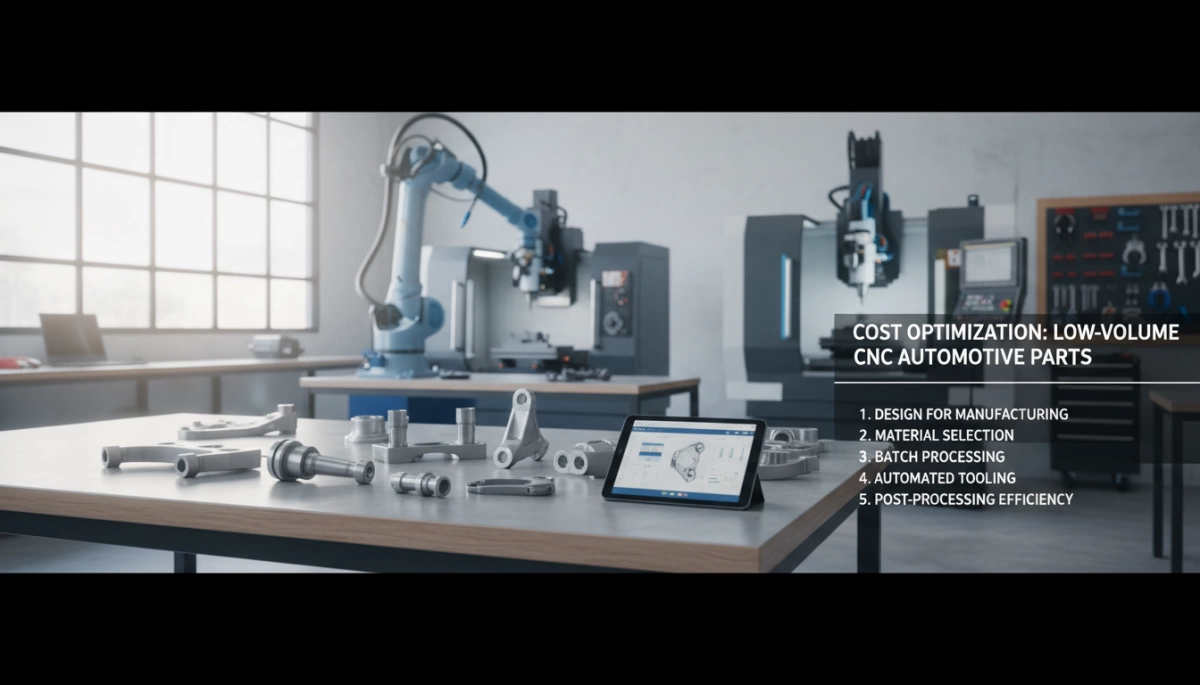
Understanding Key Cost Drivers in Low-Volume Automotive CNC Machining
When you’re buying low-volume automotive CNC parts—prototypes, small batch runs, or custom car parts—the price swings can be brutal. The parts themselves aren’t always complex, but the way the work is set up has a huge impact on cost. If you want to control CNC machining cost instead of being surprised by it, you need to understand the main cost drivers.
Setup and Programming Time in Low-Volume CNC Machining
On low volumes, setup and programming dominate the quote:
- CAM programming: Creating toolpaths, selecting tools, and simulating the job can take hours for a single part.
- Fixture setup: Designing and dialing in soft jaws, vises, or custom fixtures is time‑intensive.
- Probing and first-article checks: Getting the first part dialed in is a fixed cost, no matter if you order 5 or 500.
On a 10‑piece order, those fixed CNC setup costs get divided by just 10. That’s why we push hard for reusable fixtures, standard setups, and smart DFM for low-volume car parts to reduce setup effort.
Machining Cycle Time and Tool Wear Impact
Once the machine is running, cycle time and tool wear drive the variable cost:
- Long toolpaths, deep pockets, thin walls, and hard materials mean more time in the spindle.
- Aggressive cutting in tough alloys chews through carbide tools fast.
- Micro-tools and high-precision cutters are expensive, and breaking them on a small batch hurts.
For precision automotive components, I always look at where we can shorten toolpaths, use larger tools, and avoid fragile features that slow feeds and speeds.
Material Costs, Stock Size, and Scrap Rate
Material isn’t just about price per kg; it’s about how much of that stock turns into chips and scrap:
- Oversized bar, plate, or billet means you pay to machine away what you didn’t need.
- Poor blank selection (e.g., using thick plate instead of near-net round bar) spikes cycle time.
- Scrap rate is high on tricky prototype machining—one bad setup can kill your margin.
Choosing the right machinable aluminum (e.g., 6061) or mild steel and matching it to the right stock form is one of the simplest CNC cost reduction strategies.
Effect of Tight Tolerances and Premium Surface Finishes on Price
Every extra decimal place costs money. So do cosmetic requirements:
- Tight tolerances on non-critical surfaces force slower cutting, special tools, more inspection, and potential rework.
- High-end finishes (mirror polish, tight Ra specs, show-car cosmetics) usually mean slower passes plus extra secondary processes like polishing.
- Calling out tight tolerances on the whole drawing instead of specific features is a classic cost killer.
On most automotive CNC parts, we try to keep general dimensions to standard classes and reserve tight tolerances for what actually matters.
Cost Impact of Secondary Operations and Inspections
A part rarely leaves the machine “done”:
- Anodizing, plating, heat treatment, and engraving all add handling, logistics, and lead time.
- Extra deburring, brushing, or bead blasting adds labor, even if it looks simple on paper.
- Detailed quality control, full PPAP-level documentation, CMM reports, and first article inspection are essential for some projects, but they are not free.
If you treat every prototype like a full production part, you’ll end up with production-level inspection costs on a handful of pieces.
How Small Batch Size Affects Per-Unit CNC Pricing
This is the core issue in small batch CNC production:
- Setup and programming are fixed; they don’t shrink because your order is small.
- On a run of 5 pcs, setup can easily be 50–70% of the per-part price.
- Doubling or tripling the quantity often adds only modest machining time but dramatically lowers CNC cost per part because setup is amortized over more pieces.
That’s why, when I quote automotive prototype parts and short runs, I’ll often show price breaks and explain exactly how batch size vs unit price is linked. If you understand these drivers, you can design smarter, plan your orders, and push your supplier—whether it’s my shop or a partner like ZSCNC—to deliver the lowest realistic cost for your low-volume automotive CNC work.
Optimize Part Design for Cost Efficiency (DFM for Low-Volume CNC)
When you’re doing low-volume CNC machining for automotive parts, design is your biggest lever for cost reduction. I always push DFM (design for manufacturability) early, because changing a model is cheaper than paying for unnecessary machining time.
Simplify Complex Geometries
Every cut, tool change, and reposition adds money. To reduce machining time:
- Replace deep pockets with shallower cavities or ribs where possible
- Avoid ultra-thin walls; keep them as thick and uniform as function allows
- Use larger internal radii instead of sharp corners so standard end mills can reach
- Split ultra-complex parts into two simpler, bolted pieces if that cuts setup and machining time
Use Standard Features and Tool Sizes
Design around what shops already use:
- Stick to standard hole sizes (M6, M8, M10, etc.) and common drill diameters
- Use standard thread types and depths
- Keep radii, slots, and chamfers compatible with common tools (3 mm / 6 mm / 10 mm cutters etc.)
- Avoid tiny features that need micro-tools unless absolutely necessary
This lets your supplier run your parts with standard tooling instead of special cutters and custom setups.
Minimize Setups and Re-Fixturing
Each additional setup is a new programming, fixturing, and inspection step:
- Keep features on as few faces as possible
- Align holes, bosses, and critical faces to the same primary datums
- Avoid features on awkward angles that need custom fixtures
- Make flat clamping surfaces so the part can be held easily and repeatably
If I can get a part done in one or two setups on a 3-axis machine instead of four, your unit price drops fast.
Prefer 3-Axis-Friendly Designs Over 5-Axis
5-axis is powerful but not cheap, especially for low volume:
- Design so most features are reachable from the top and two sides
- Avoid undercuts and hard-to-reach side details unless function demands them
- Use simple angles and accessible faces that a 3-axis can hit with standard fixtures
We reserve 5-axis for truly necessary geometry or tight multi-face tolerances, not cosmetic complexity.
Remove Non-Functional or Cosmetic-Only Features
Ask a simple question on every detail: “Does this do something?” If not, consider cutting it:
- Logos, unnecessary pockets, fake “weight reduction” cutouts, decorative chamfers = more time
- Hidden surfaces (inside housings, under covers) don’t need fancy shapes or finishing
- Complex styling that doesn’t impact performance can often be simplified or flattened
On low-volume automotive CNC parts and prototype parts, clean and simple usually wins on cost.
Design Automotive Parts Specifically for CNC Manufacturability
When I design or review parts for CNC, I think like a machinist:
- Use consistent wall thickness and avoid sudden changes
- Place critical features (bearing seats, sealing faces, alignment bores) so they’re machined in the same setup
- Add small chamfers or lead-ins on assembly features to cut manual deburring
- Clearly define which surfaces are critical for fit/performance and which can be “as-machined”
If you want support from a shop that lives and breathes low-volume automotive CNC parts, I’d route designs through a partner like our own custom CNC machined automotive parts manufacturing service, where we can give DFM feedback before you lock the design and lock in unnecessary cost.
Smart Material Selection for Automotive CNC Parts
Smart material choices are one of the fastest ways to cut machining cost for low-volume automotive CNC parts without hurting performance.
Choosing cost-effective machinable aluminum and steel grades
For most automotive CNC parts, you don’t need exotic alloys. I usually recommend:
- Aluminum 6061-T6 – Best all-rounder for automotive prototype parts: easy to machine, low cost, good strength, great for brackets, housings, and non-structural components. You can see typical properties and options on our CNC aluminum materials page.
- Aluminum 7075-T6 – Higher strength and slightly higher cost. Use only where you genuinely need better fatigue or structural performance (suspension links, motorsport parts).
- Mild steel (e.g., 1018, 1020) – Cheap, strong, and weldable. Good for fixtures, flanges, and structural brackets.
- Stainless (e.g., 304/316) – Use mainly where corrosion resistance is critical (exhaust, underbody, fluid systems), as machining cost is higher. Our stainless steel options work well for precision automotive components but should be selected carefully based on real needs.
Balancing performance vs material price
Instead of jumping straight to “motorsport” or aerospace alloys, start by asking:
- What loads and temperatures will the part actually see?
- Is it safety-critical, or just cosmetic/supporting?
- Does it need to last the life of the vehicle, or is it a prototype test part?
Often the best move is:
- Prototype in 6061 or mild steel
- Move to 7075 or stronger steel only if test data shows you need it
This alone can cut material + machining cost by 20–40% for small batch CNC production.
Avoid over-specifying exotic materials
For non-critical automotive CNC parts (covers, brackets, test fixtures, cosmetic prototype parts), avoid:
- Titanium unless weight and temperature are truly critical
- High-nickel alloys and super-hard steels unless there’s a clear engineering reason
These materials are:
- More expensive per kg
- Slower to machine (higher tool wear, longer cycle time)
- Harder to source quickly in small quantities
In low-volume CNC machining, that hits both price and lead time.
Reducing material waste with better stock and blanks
Material waste is a hidden cost driver. To reduce it:
- Design parts to fit standard bar, plate, or block sizes
- Avoid oversized features that force us to start from much larger stock
- For small batch CNC production, let us quote near-net-shape blanks (waterjet, laser, saw-cut) when it saves time and scrap
- Keep wall thickness and overall size realistic so we don’t have to mill away half the block
Less waste = lower material spend + shorter machining time.
Prototypes vs end-use automotive parts
For prototypes and early fit/function tests:
- Use low-cost, highly machinable grades (6061, mild steel)
- Focus on speed and feedback, not ultimate material performance
- Accept as-machined finishes where possible
For end-use or small series automotive CNC parts:
- Upgrade to the minimum material grade that meets real requirements
- Lock in a material that’s easy to source globally for repeat orders
- Keep the same material family across part families to simplify stock and pricing
By treating prototypes and production differently, you get faster iterations upfront and better cost per part once you commit to a small batch run.
Tolerance and Surface Finish Strategies to Cut CNC Cost
When we build low-volume automotive CNC parts, tolerance and surface finish are usually the hidden cost killers. If you control them smartly, you can cut machining cost fast without hurting performance.
Define Critical vs Non‑Critical Dimensions
Start by splitting every key dimension into two groups:
-
Critical dimensions
- Anything that affects safety, sealing, fit with bearings/bushings, gear mesh, brake or steering performance, NVH, etc.
- Example: shaft diameters for seals, bores for bearings, mating faces for gearbox housings.
-
Non‑critical dimensions
- Brackets, covers, cosmetic ribs, non-mating faces, mounting slots with plenty of clearance.
- Example: outer profiles, decorative chamfers, non-locating holes.
Mark this clearly in the 3D model and drawing. That lets the CNC shop focus tight tolerances only where they matter.
If you’re not sure how tight you really need, checking standard guides like industrial CNC machining accuracy standards is a good sanity check before you overspec.
Relax Tolerances Where You Can
Every extra digit in the tolerance band raises price. For non-critical features:
- Move from ±0.01 mm to ±0.05–0.1 mm where function allows.
- Avoid “nice-looking” numbers like ±0.005 mm unless it’s a real engineering need.
- Let the shop use their normal process capability instead of forcing special setups, slower feeds, or extra inspection.
For low-volume CNC machining, pushing too many dimensions into “precision automotive components” territory is the fastest way to blow the budget.
Use Standard Tolerance Classes (ISO 2768)
For general features that don’t need special treatment, call out:
- ISO 2768-m (medium) or ISO 2768-f (fine) for overall linear and angular dimensions.
- Keep only a short list of critical dimensions with individual tighter tolerances.
This removes dozens of custom callouts and speeds both programming and inspection. It also helps the CNC supplier quote faster and more accurately.
Choose As‑Machined Surface Finishes Where Possible
Surface finish requirements can easily double your CNC cost if you’re not careful.
For automotive prototype parts and internal or hidden components:
- Accept as-machined surfaces (e.g. Ra 3.2–6.3 μm) unless there’s a sealing or sliding requirement.
- Avoid blanket notes like “Ra 0.8 on all surfaces” – reserve Ra 0.8–1.6 for sealing faces, O-ring grooves, sliding bores, etc.
- Remember: better finish often means more passes, smaller stepovers, slower feeds – all extra cycle time.
Limit Anodizing, Plating, and Polishing
Surface treatments are often more expensive than the machining itself on small batches.
To keep cost down:
- Anodize or plate only the functional or visible areas (e.g. corrosion-sensitive external faces, customer-visible trim).
- Group parts by the same material and finish so they can be processed together.
- Skip polishing on under-hood or hidden aftermarket parts unless it’s a selling point.
- For prototypes, use clear or simple anodizing instead of multi-step cosmetics unless you’re testing final appearance.
Communicate Realistic Quality Expectations
The more clearly you talk about what’s “good enough,” the less time everyone wastes and the cheaper your parts become.
Share with your CNC supplier:
- A marked drawing showing critical vs non-critical features and where ISO 2768 applies.
- Which faces need tight tolerances, low Ra, or coating thickness control, and which don’t.
- Whether parts are for fit/function tests, track testing, or final customer delivery – expectations differ.
- Whether you truly need 100% inspection, or if sample inspection + a first article inspection (FAI) is enough.
When we run low-volume CNC machining for automotive customers, clear tolerance and surface finish rules usually cut total cost by 15–30% alone, without changing the core design.
Batch Size and Production Planning for Low-Volume Automotive CNC Parts

Getting low-volume automotive CNC parts at a sensible cost is all about how you plan batch size and production. You don’t need huge volumes, but you do need a smart strategy.
Understand price breaks in small batch CNC production
CNC machining has fixed setup and programming costs. The more parts you spread that over, the cheaper each unit gets.
- Very low batch (1–10 pcs): highest cost per part, pure prototype pricing
- Small batch (20–100 pcs): big step down in unit price
- “Sweet spot” (100–300+ pcs): setups are amortized, ideal for low-volume auto parts, aftermarket parts, and motorsport builds
Ask your CNC shop for a price curve (e.g. 10 / 50 / 100 / 200 pcs) so you can see where the real price break starts.
Consolidate similar parts into combined orders
If you’re running families of automotive CNC parts (brackets, housings, mounts, carriers), don’t quote everything separately.
- Group parts that use the same material and similar setups
- Run left/right versions together
- Keep hole sizes, thickness, and tooling consistent across designs
This lets us reuse programming, tooling, and fixtures, which directly cuts setup costs and total lead time.
Slightly increase quantity to amortize setup fees
In low-volume CNC machining, adding a small number of extra pieces often barely changes the total job cost but drops the CNC cost per part.
- If 20 pcs cost $X, 30 pcs might only be 5–10% more
- Use this to cover spares, test builds, and warranty stock
- For high-risk prototype builds, plan a few extra in case of design tweaks
Always check “cost per part” at +20–30% quantity before locking in the order.
Use hybrid manufacturing: CNC + casting or printing
For some automotive prototype parts or small series, pure CNC isn’t always the cheapest long-term play.
- CNC + casting: Use CNC to make a master pattern, then cast near-net-shape parts and finish critical features by CNC
- CNC + 3D printing: Print complex internal geometries or housings, then CNC-machine critical interfaces, bores, and sealing faces
Hybrid methods let you get the look and function of production parts while keeping low-volume CNC machining cost under control.
If you’re moving toward complex shapes or multi-axis work, we can also combine hybrid routes with 5-axis CNC machining services to keep precision high and operations low.
Plan future volume scaling from prototype to small series
Think about where you’re going, not just the first 5–10 prototype parts.
- Design early prototypes with the same material and general geometry you’ll use in small batch CNC production
- Avoid “prototype-only” features that would be too expensive to machine later
- Keep fixturing and setups reusable as volumes grow
This stops you from doing a full redesign (and new programming) when volume increases.
Align prototype and production designs to avoid redesign costs
DFM for low-volume car parts starts at the prototype stage.
- Use production-intent wall thicknesses, radii, and standard hole sizes
- Avoid undercuts or features that require special tools or unnecessary 5-axis machining
- Lock in a drawing and GD&T scheme that’s realistic for recurring production
When prototypes are designed for manufacturability from day one, you can go from prototype machining to small batch CNC production with almost no rework, minimal extra validation, and far lower overall project cost.
Choosing and Negotiating with CNC Suppliers for Low-Volume Automotive Parts
When you’re trying to reduce machining cost for low-volume automotive CNC parts, the supplier you pick matters as much as the design. I treat supplier selection like a strategic decision, not just a quote comparison.
Pick CNC Shops with Real Automotive Experience
For low-volume CNC machining in automotive, you want shops that already live in this world:
- Ask for automotive project references (OEM, Tier-1, motorsport, aftermarket, EV conversions).
- Check for certifications like ISO 9001 and, ideally, IATF 16949 for automotive workflows.
- Confirm they understand PPAP, FAI, and traceability if you’re dealing with safety or precision automotive components.
A shop that knows automotive tolerances, materials, and validation cycles will cut a lot of “learning cost” out of your project.
Check Capability for Tight Tolerances and Complex Parts
Low-volume automotive CNC parts often mix simple brackets with critical, high-precision components:
- Verify they have 3-axis and 5-axis CNC milling, plus turning for shaft- or housing-type parts. For example, advanced CNC milling services are ideal for complex housings, brackets, and structural components.
- Ask for their typical tolerance range (e.g. ±0.01 mm, ±0.005 mm on key features).
- Check experience with gear forms, splines, and complex 3D surfaces if you’re into drivetrain or powertrain work. Dedicated 5-axis CNC gear machining services help avoid expensive rework.
- Confirm they can handle aluminum 6061/7075, mild steel, alloy steel, and stainless, plus occasional higher-end materials.
If they can’t hold your critical tolerances consistently, any “cheap” quote turns expensive very fast.
Get DFM Feedback Early
Don’t wait until after you’ve finished the CAD to talk to your supplier:
- Share models and basic requirements early and ask for DFM (Design for Manufacturability) feedback.
- Let them flag cost drivers: unnecessary tight tolerances, deep pockets, thin walls, 5-axis-only features, odd tool sizes.
- Be clear which features are function-critical vs. purely cosmetic so they can suggest cheaper alternatives.
Early DFM can easily cut 10–30% from CNC machining cost without hurting function.
Share Forecasts and Volume Plans
Even if you’re only ordering 10–50 pieces now, treat it like a program, not a one-off job:
- Share your prototype → pilot → small batch roadmap (for example: 10 pcs → 100 pcs → 500 pcs).
- Let them plan fixtures, tooling, and programming with scaling in mind.
- If they know you’ll repeat, they’re more willing to:
- Invest in better fixturing.
- Optimize programs for cycle time.
- Offer price breaks at each volume level.
This is how you turn low-volume CNC machining into predictable, repeatable small batch CNC production.
Negotiate Based on Long-Term Relationship and Bundles
You don’t win on price by hammering the hourly rate; you win by structuring the work smart:
- Bundle part families (e.g. left/right mirrors, multiple brackets, variations of a housing) under one program/fixture strategy.
- Negotiate setup amortization: pay a bit more upfront on NRE/setup, get a lower per-part price for repeat runs.
- Ask for tiered pricing: 10, 50, 100, 250 units, so you know when it makes sense to increase quantity to reduce unit cost.
- Commit to a preferred supplier model for low-volume CNC machining in return for better pricing and lead time priority.
Work with Specialized Partners Like ZSCNC
For global customers, I focus on suppliers who are built for exactly this niche: low-volume automotive CNC parts, prototypes, and small batch CNC production.
With ZSCNC, we:
- Run flexible 3-axis, 4-axis, and 5-axis lines that suit both prototypes and small-series runs.
- Offer DFM support, so your design, tolerance, and surface finish choices actually match your cost targets.
- Support automotive prototype parts, custom car components, and aftermarket parts with realistic lead times and stable quality.
- Help you plan the path from single prototype to low-volume production without redesigning everything from scratch.
If you choose and negotiate with your CNC supplier this way, you don’t just get a better quote—you build a setup that keeps your machining cost under control across the whole life of your automotive project.
Additional Cost-Saving Techniques in Automotive CNC Machining
When we run low-volume automotive CNC parts, every extra setup, pass, and inspection hits your unit cost. Here’s how I usually strip that out without touching performance.
Reduce Secondary Operations with Smarter CNC Programming
I always try to push as much work as possible into the main CNC cycle:
- Combine drilling, milling, and contouring in one setup.
- Use multi-function tools (drill + chamfer, thread mill, etc.) to cut handling time.
- Program deburring where possible instead of hand deburr.
Every manual step we eliminate takes labor and re-fixturing cost off your automotive CNC parts.
Integrate Threads, Chamfers, and Fillets in One Pass
Instead of adding separate ops later:
- Threads: Cut them in-cycle with taps or thread mills, not in a secondary tapping station.
- Chamfers: Use tools that automatically break edges as they drill or mill.
- Fillets/Radii: Match fillet sizes to standard cutter radii to avoid custom tools.
This is one of the fastest ways to reduce machining cost for low-volume CNC machining.
Use Advanced CAM and Optimized Toolpaths
Good CAM strategy directly lowers cycle time and tool wear:
- High-efficiency milling to cut faster with less load.
- Rest machining to remove only remaining material.
- Toolpath smoothing to reduce air cutting and sharp direction changes.
On tighter work like precision automotive components or turned shaft parts, we’ll often pair this with high-precision processes such as Swiss-style CNC machining for complex, small-diameter components.
Standardize Part Families, Setups, and Fixtures
If you’re doing multiple custom or aftermarket car parts:
- Use common hole sizes, radii, and thicknesses across parts.
- Design parts to share the same fixture or vise orientation.
- Keep a “family” of parts that runs from the same setup.
That way, setup and programming time is spread over more pieces, dropping your per-part CNC cost.
Improve Drawings, GD&T, and Communication
Unclear drawings are hidden cost:
- Clean, simple views with clear datums.
- Use GD&T only where it truly matters functionally.
- Call out realistic tolerances and finishes instead of “tight everywhere.”
Better clarity prevents scrap, back-and-forth emails, and surprise price increases.
Use Prototypes and First-Article Inspections Smartly
For low-volume and automotive prototype parts:
- Approve a first article inspection (FAI) before full small batch CNC production.
- Validate fit and function on the car or assembly early.
- Freeze design after FAI so we don’t keep reprogramming and resetting.
A single well-run prototype + FAI can save you a full batch of scrap, delays, and rushed rework.
If you’re exploring more advanced or complex features (slots, intricate profiles, or hardened inserts), we also support specialty processes like high-precision EDM machining for complex automotive geometries, which can avoid risky manual ops and reduce overall rework cost.
Practical FAQs on Reducing Machining Cost for Low-Volume Automotive CNC Parts
1. What’s the typical cost range for low-volume automotive CNC components?
For low-volume CNC machining in automotive (aftermarket, motorsport, specialty builds), you’ll usually see:
- Simple 3-axis parts (brackets, adapters, small housings):
$30–$120 per part at 10–50 pcs - Medium-complexity precision automotive components (sensor mounts, throttle parts, small gearbox parts):
$80–$300 per part at 10–50 pcs - Complex 5-axis parts (intake runners, knuckles, uprights, pump housings):
$250–$1,000+ per part at very low volume (1–10 pcs)
The biggest driver is setup and programming time. One complex part can easily carry $150–$600 in programming + fixture cost, which gets amortized over a small batch. That’s why smart DFM and slightly higher quantities can cut your CNC cost per part very quickly.
2. How much can DFM realistically reduce CNC machining cost?
Good design for manufacturability (DFM) for low-volume car parts can usually save:
- 15–30% on “normal” parts (simple brackets, covers, flanges)
- 30–50% on complex or over-designed parts
You mainly save by:
- Reducing setups (designing for 3-axis instead of unnecessary 5-axis)
- Using standard hole sizes and tool radii
- Avoiding extreme CNC machining tolerances and cosmetic-only surfaces
- Thickening thin walls to avoid slow, careful machining
If you bring us into the design early and let us tweak for machining time and tool wear, it’s common to see a prototype go from $300 → $180 with only minor geometry changes.
3. What are the best materials for low-cost automotive prototypes?
For low-volume automotive CNC parts, I normally recommend:
-
Aluminum 6061-T6
- Best all-round low-cost automotive prototype material
- Easy to machine, cheap stock, good strength, ideal for brackets, housings, non-structural parts
-
Aluminum 7075-T6
- Higher strength, still good machinability
- Great for suspension parts, steering components, load-bearing aftermarket parts
-
Mild steel (e.g., 1018/1020)
- Cheap, robust, weldable
- Good for mounts, chassis tabs, test fixtures
Only use stainless, titanium or exotic alloys when the function really demands it (corrosion, temperature, weight-critical). For most automotive prototype parts, those materials just inflate CNC cost unnecessarily.
4. When should I switch from CNC machining to another process?
As volume grows, pure low-volume CNC machining stops being the best value. Rough rule:
- 1–50 pcs: CNC machining is usually best (fast, flexible)
- 50–500 pcs: Consider hybrid strategies
- CNC for prototypes and first batch
- Then casting or 3D printing + finish-machining critical features
- 500+ pcs: Look at casting, forging, extrusion, or MIM, with CNC only as a finishing step
Switch when:
- Your CNC cost per part stabilizes and isn’t dropping with volume
- Geometry is stable (no more design changes)
- Tooling cost for another process can be paid back within 1–2 production runs
We often use CNC for prototype machining for automotive and then help customers transition to a semi-production route with cast blanks and CNC finishing.
5. How do I work with a CNC supplier to keep small batch prices down?
To keep small batch CNC production affordable, you’ll want to:
- Share clear priorities
- Tell us: “Function first, cosmetics second” or “Show car finish only on this face”
- Mark critical vs non-critical dimensions
- Use tight CNC machining tolerances only where needed; allow ISO 2768 general tolerances elsewhere
- Bundle work
- Combine several automotive CNC parts in one order so we amortize setup costs across multiple references
- Align prototype and production designs
- Avoid changing features later that require a brand new setup or fixture
- Ask for DFM feedback up front
- A 30-minute review can remove costly features, reduce setups, and simplify tooling
If you need a partner used to automotive CNC parts and low-volume work, our team at ZSCNC runs dedicated cells for CNC prototyping and small batch machining. You can see our core capabilities on our CNC machining services page and our dedicated automotive machining solutions.
 English
  German
  Dutch
Dutch  Russian
  Czech
Czech  French
  Korean
  Japanese
  Spanish
  Portuguese