
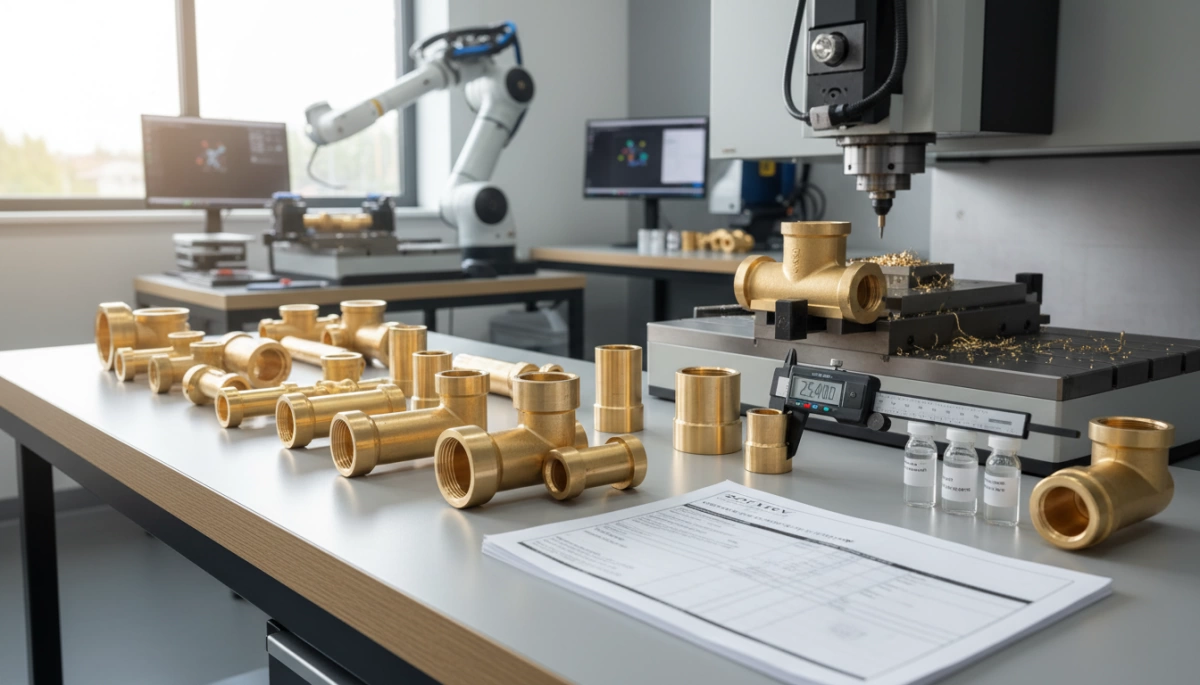
The Metallurgy of Reliability: Solving Dezincification in CNC Brass Components
In high-moisture and subterranean plumbing environments, standard brass often falls victim to dezincification, an electrochemical process colloquially known as "zinc rot." We see this frequently in sub-par fittings where the zinc selectively leaches out of the copper alloy. This leaves behind a weakened, porous copper structure—essentially a brittle sponge—that inevitably leads to catastrophic weeping leaks or structural failure under pressure.
The DZR Solution: Arsenic and Antimony Inhibitors
To ensure lifetime performance, we utilize Dezincification-Resistant (DZR) brass. By strategically adding trace amounts of Arsenic (As) or Antimony (Sb) to the melt, we create a protective film on the alloy's crystalline structure. This metallurgical "shield" effectively halts the leaching process, maintaining the component's integrity even in aggressive water conditions.
Key Materials for Plumbing Success
Selecting the right grade is a balance between machinability and environmental resistance. While C36000 (Free-Machining Brass) is the industry standard for high-speed CNC turning due to its incredible chip formation, it's often the wrong choice for certain plumbing applications. Here’s why:
- C35330 / CW602N: Our go-to for Dezincification-Resistant (DZR) brass. It offers excellent corrosion resistance and meets global standards for reliability. It’s significantly more durable than CW614N or C36000 in acidic or alkaline water.
- C36000: Still used for non-exposed, low-pressure components due to its 100% machinability rating. However, it’s susceptible to "zinc rot" in potable water or high-stress environments.
- Navigating Lead-Free (NSF/ANSI 61) Compliance: For potable water systems in the US and EU, we use C27450 and C46400 (Naval Brass). These alloys are specifically formulated to meet strict lead-leaching regulations while providing the strength and corrosion resistance required for residential and industrial plumbing.
Material Comparison Table: DZR vs. Free-Cutting Brass
| Alloy Grade | Dezincification Resistance | Lead-Free Compliant | Best Use Case |
|---|---|---|---|
| C35330 (CW602N) | High | Select Grades | High-pressure plumbing, valves, manifolds |
| C36000 | Low | No | Dry fittings, pneumatic components |
| C27450 | Moderate | Yes | Potable water, NSF/ANSI 61 fittings |
| C46400 | High | Yes | Marine plumbing, high-corrosion potable water |
By leveraging these advanced alloys, we move beyond simple part production and into the realm of long-term reliability, preventing the "leaky sponge" phenomenon that plagues standard brass fittings.
Critical Tolerances: Engineering the "Zero-Leak" Connection
In the world of fluid dynamics, a "good enough" fit is just a future leak waiting to happen. For CNC machining brass plumbing components, precision isn't a luxury—it is the baseline for safety and efficiency. We don't just cut metal; we engineer reliability into every thread and groove.
Thread Precision (NPT/BSP)
Standard machining tolerances of ±0.005" often fall short in high-pressure plumbing systems. When manufacturing NPT and BSP thread profiles, even a minor deviation in pitch diameter can compromise the seal integrity under hydraulic load. We adhere to strict gauging standards to ensure every fitting engages perfectly, preventing the micro-gaps that lead to weeping leaks in industrial manifolds.
Sealing Interfaces and GD&T
The most critical areas of any brass valve or fitting are the sealing interfaces. For O-ring grooves and valve seats, we push beyond standard specs to achieve ±0.0005" (±0.013mm) tolerances. This level of precision is non-negotiable for creating airtight seals in gas and potable water systems.
Beyond linear dimensions, Geometric Dimensioning & Tolerancing (GD&T) is vital. In multi-port manifolds, factors like cylindricity and concentricity ensure that internal spools move freely without bypass leakage. You can read more about how to achieve a perfect tolerance of 0.005mm to understand the rigorous standards required for these critical features.
Leveraging Swiss Lathe Technology
To consistently hit these numbers, we rely on advanced equipment. We utilize 9-axis Swiss lathes for complex internal geometries that standard turning centers struggle to replicate. This setup allows us to machine intricate features in a single setup, maintaining strict alignment between multiple axes. Understanding the differences between precision Swiss machines and conventional lathes highlights why this technology is superior for producing high-volume, high-precision brass components.
CNC Machining Techniques for High-Performance Brass Plumbing Components
Manufacturing reliable plumbing hardware requires more than just standard cutting; it demands specific strategies to handle the unique properties of brass alloys while maintaining strict geometric tolerances. At our facility, we adapt our machining processes to ensure every fitting, valve, and manifold meets industrial fluid-handling standards.
High-Speed Turning and Thread Integrity
For high-volume production of connectors and fittings, CNC Turning for threaded fittings is our primary method. The challenge lies in balancing high RPMs with the need for pristine thread quality. We utilize rigid turning centers that allow us to maximize material removal rates without introducing vibration that could chatter the surface. This approach ensures that NPT and BSP threads remain burr-free and dimensionally accurate, which is critical for creating a leak-proof seal during assembly.
CNC Drilling & Tapping for Manifolds
Complex distribution blocks often require deep-hole drilling where tool drift is a major risk. If a drill bit wanders even slightly, the internal channels won't align, ruining the flow path.
- Peck Drilling Cycles: We use advanced peck cycles to clear chips efficiently, preventing heat buildup that can work-harden the brass.
- Rigid Tapping: Synchronized tapping ensures thread depth is precise, preventing stripped threads during installation.
- Efficiency: By optimizing these tool paths, we can significantly speed up CNC lead times for complex manifold orders without compromising quality.
Micro-Machining for Smart Fixtures
Modern "smart" plumbing systems rely on tiny, intricate components like sensor housings and flow-control pins. We leverage Swiss-style machining for these micro-components. This method supports the workpiece close to the cutting tool, eliminating deflection. It allows us to hold tolerances as tight as ±0.005mm on parts with diameters under 3mm, ensuring the sensitive electronics inside smart faucets fit perfectly.
Managing Tool Wear with DZR Alloys
Machining Dezincification-resistant (DZR) brass presents different challenges compared to standard C36000 free-cutting brass. Because DZR alloys contain structural inhibitors like Arsenic to prevent corrosion, they are often harder and more abrasive.
- Tool Geometry: We adjust rake angles to shear the material cleanly rather than pushing it.
- Carbide Grades: We utilize specialized carbide inserts that resist the abrasive wear of DZR alloys, ensuring the surface roughness (Ra) remains consistent from the first part to the thousandth.
- Coolant Strategy: High-pressure coolant is applied directly to the cutting edge to manage thermal expansion, ensuring the final dimensions stay within spec.
Surface Integrity and Post-Processing for Dezincification Resistance
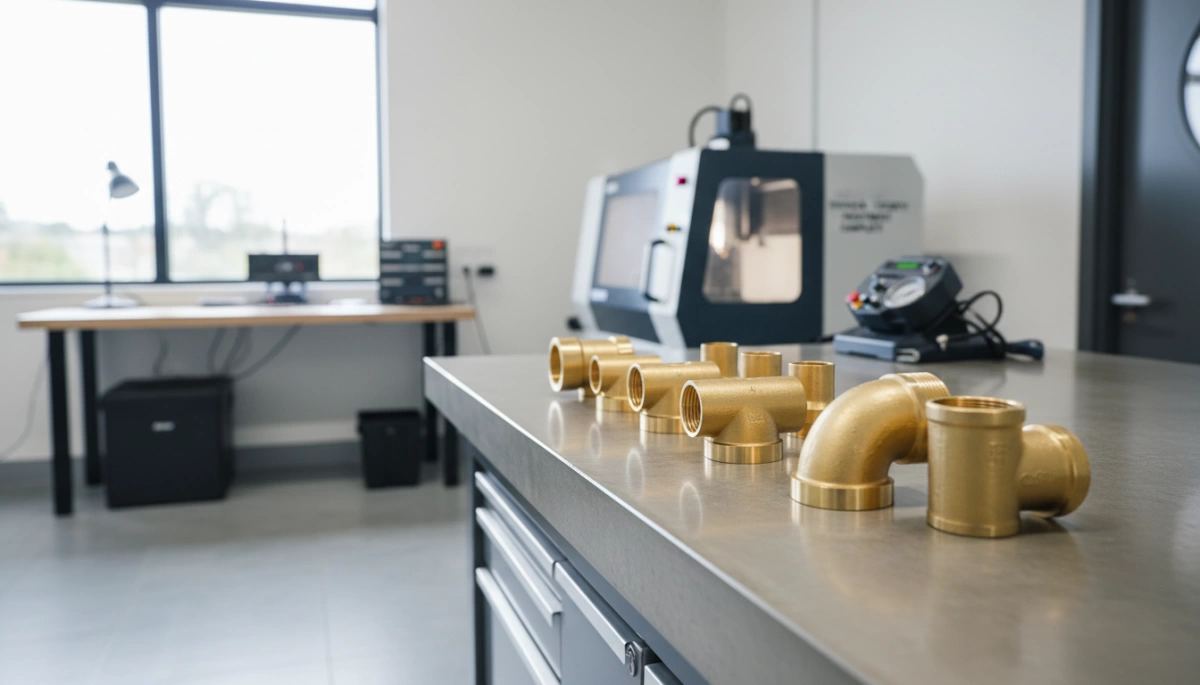
Surface quality in CNC machining brass plumbing components is not just cosmetic; it dictates the longevity of the entire system. A surface that is too rough acts like sandpaper against rubber O-rings and gaskets, leading to premature seal failure. We utilize precision finishing techniques to achieve surface roughness levels as low as Ra 0.4 μm for critical sealing interfaces. Understanding how surface roughness (Ra) influences part performance allows us to engineer valve seats and connector grooves that maintain a leak-proof seal for years.
Eliminating Failure Points: Deburring and Stress Relief
Internal burrs are silent killers in fluid systems. Left inside a manifold or fitting, a burr creates turbulence in the water flow. This turbulence accelerates localized erosion and can strip away the protective oxide layer of the brass, inviting corrosion. We implement rigorous deburring protocols to ensure smooth internal geometry.
Furthermore, heavy machining induces residual stress in the metal. In brass, this tension can eventually lead to Stress Corrosion Cracking (SCC), especially in the presence of ammonia or specific water chemistries. We apply post-machining heat treatments to relieve this stress, stabilizing the component without altering its dimensions.
Post-Processing Treatments for Durability
To further enhance dezincification resistance and chemical stability, we offer specific surface treatments tailored to the plumbing industry:
| Treatment | Primary Function | Application Benefit |
|---|---|---|
| Electroless Nickel Plating | Uniform chemical barrier | Provides excellent corrosion resistance and hardness, protecting the base brass from aggressive fluids. |
| Chrome Plating | Hard, decorative finish | Offers high wear resistance for exposed fixtures and an additional layer of oxidation protection. |
| Stress Relieving | Thermal stabilization | Neutralizes internal stresses from cold working to prevent SCC failure in the field. |
| Passivation | Surface purification | Removes free iron and contaminants from the surface to prevent initial rust formation. |
Quality Control: Testing CNC Brass Components for Lifetime Performance
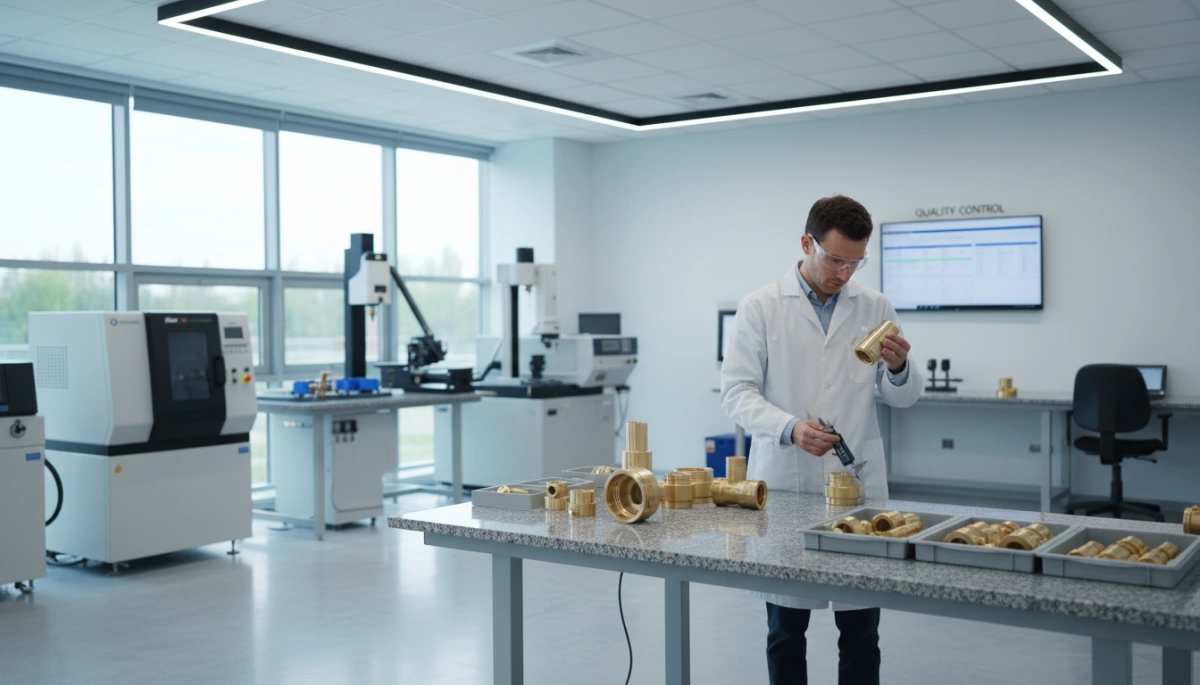
I ensure every part we manufacture stands up to the pressures of real-world use. When CNC machining brass plumbing components, the final quality check is what separates a reliable fitting from a potential flood. We focus on three critical testing pillars to guarantee lifetime performance.
Pressure Integrity: Hydrostatic & Pneumatic Testing
We subject our brass components to rigorous hydrostatic pressure integrity tests. By applying 1.5x the rated working pressure, we validate that the material structure is sound and that there are no microscopic cracks or porosity issues. This is vital for high-pressure systems where a single failure can lead to significant damage.
CMM Inspection for Complex Manifolds
Manual measurements cannot capture the complexity of a modern manifold block. I use automated CMM inspection (Coordinate Measuring Machines) to:
- Verify precise NPT and BSP thread tolerances.
- Ensure perfect alignment across multiple ports and internal geometries.
- Confirm that high-precision valve seats meet the exact design specs for an airtight seal.
Corrosion Resistance Verification (ISO 6509)
To prove dezincification resistance, we adhere to the ISO 6509 standard. We test brass samples in a controlled corrosive environment to measure the maximum depth of zinc leaching. This ensures that the DZR alloys—like CW602N—will maintain their structural integrity for decades, even in aggressive water conditions.
Our role as a custom CNC machining supplier is to provide parts that are not just dimensionally accurate but chemically and physically durable for the long haul.
| Test Type | Objective | Standard/Requirement |
|---|---|---|
| Hydrostatic | Burst and leak prevention | 1.5x Operating Pressure |
| Pneumatic | Micro-leak detection | Dry Air / Nitrogen |
| CMM | Geometric accuracy | ±0.0005" on critical seats |
| ISO 6509 | Dezincification depth | Max 100-200μm (typical) |
Frequently Asked Questions About CNC Machining Brass Plumbing Components
What are the best DZR brass grades for high-pressure CNC machining?
For high-pressure applications where durability is non-negotiable, we recommend CW602N (European Standard) or C35330 (ASTM). These are specifically engineered as Dezincification-Resistant (DZR) brass, containing small amounts of arsenic to inhibit the leaching of zinc. While standard C36000 free-cutting brass is excellent for general machining due to its lead content, it lacks the corrosion resistance required for aggressive water environments. For potable water systems requiring lead-free compliance, C46400 (Naval Brass) or Eco-Brass are superior alternatives that maintain structural integrity under pressure.
How do tight tolerances (±0.0005") affect the manufacturing cost of plumbing fittings?
Achieving ±0.0005" (approx. ±0.013mm) tolerances significantly impacts cost because it moves production from standard turning to precision engineering. Standard fittings might run on high-speed automatic lathes, but tight tolerances for valve seats or O-ring grooves often require slower feed rates, frequent tool changes to maintain edge sharpness, and rigorous in-process inspection. While this increases the unit price, it eliminates the much higher cost of field failures and leaks. For startups, understanding how to balance these requirements is crucial; you can learn more about managing expenses in our guide on how to reduce machining cost for low-volume automotive CNC parts.
Can CNC machining prevent stress corrosion cracking (SCC) in brass?
Machining itself doesn't prevent SCC—in fact, aggressive machining can induce residual stresses that promote it. However, a controlled CNC process combined with post-processing can mitigate the risk. We use optimized cutting parameters to minimize heat generation and mechanical stress during material removal. More importantly, we recommend a stress-relieving heat treatment after machining but before plating or assembly. This thermal cycle relaxes the internal tensions created during cold working, ensuring the brass component doesn't crack when exposed to ammonia or other corrosive agents in the service environment.
Why is ISO 6509 testing critical for brass plumbing reliability?
ISO 6509 is the global benchmark for determining the dezincification depth of copper alloys with zinc. It involves exposing the brass to a heated copper chloride solution to simulate years of exposure to aggressive water. For manufacturers, passing this test verifies that the material won't turn into a porous, weak sponge over time. We view this testing as essential validation, not just paperwork. It confirms that the DZR alloys we source actually perform as promised, protecting your brand from catastrophic plumbing failures down the line.
 English
  German
  Dutch
Dutch  Russian
  Czech
Czech  French
  Korean
  Japanese
  Spanish
  Portuguese