
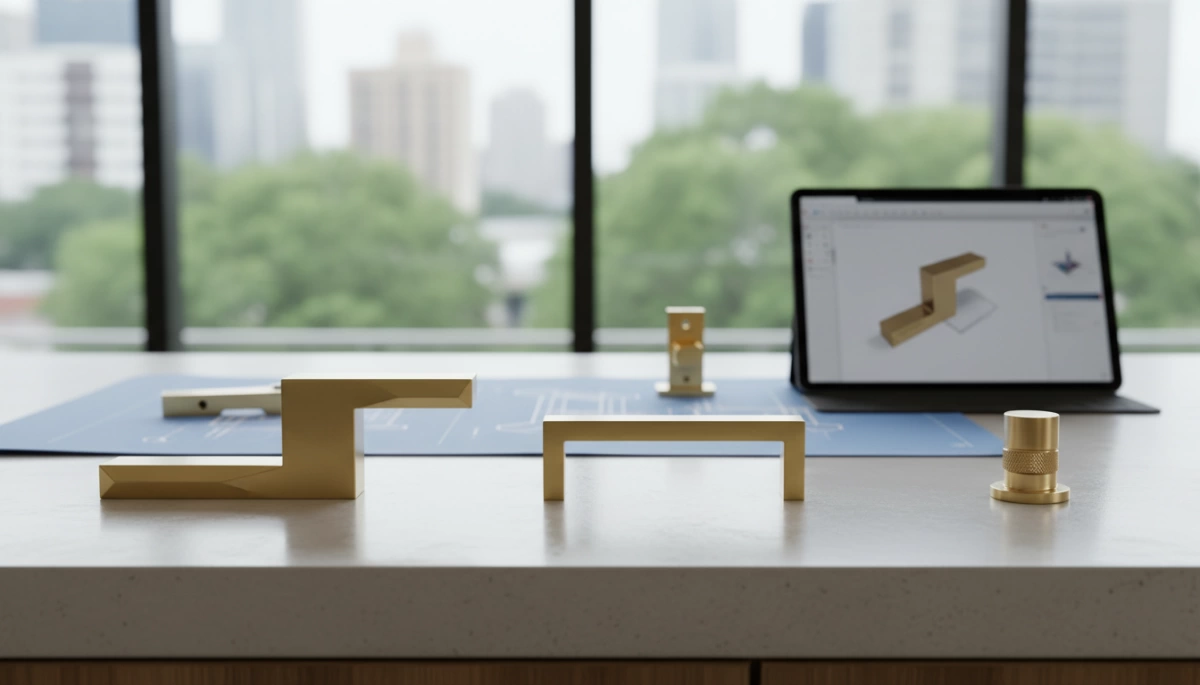
Introduction to CNC Machining for Brass Architectural Hardware
What is Brass CNC Machining?
Brass CNC machining plays a critical role in producing high-end architectural hardware that requires both precision and aesthetic excellence. At ZSCNC, we specialize in machining complex brass components with tolerances up to ±0.01mm using advanced 3-axis, 4-axis, and 5-axis CNC equipment. From custom prototypes to large-scale production, we help global clients manufacture durable, visually refined brass hardware with consistent quality and fast turnaround.
Brass CNC machining is a precision manufacturing process that uses computer-controlled milling, turning, and multi-axis machining to produce complex brass components. This method allows for micron-level accuracy and tight tolerance control, essential for fabricating architectural hardware with intricate designs and precise fit. The process supports both small batch customization and large-scale production, ensuring consistent quality across various project sizes.
Why Brass is Ideal for Architectural Applications
Brass is favored in architectural hardware for its excellent machinability, durability, and natural corrosion resistance. Its low friction properties and strength make it ideal for moving parts such as hinges and locks. Furthermore, brass offers a premium aesthetic with a warm, golden color that enhances the visual appeal of doors, windows, fittings, and fixtures. Its inherent antimicrobial and sustainability qualities also align with modern architectural demands.
The Role of Precision in Hardware Design
Precision in CNC machining is critical for architectural hardware to ensure seamless assembly, flawless operation, and long-term reliability. Tight tolerances prevent gaps, misalignments, and wear, contributing to both functional and aesthetic excellence. Achieving fine details through precise milling and turning allows for innovative designs that meet rigorous engineering standards while maintaining structural integrity.
Key Advantages of Brass for Architectural Components
Superior Machinability and Production Efficiency
Brass stands out for its excellent machinability, allowing CNC machining processes like milling and turning to run smoothly and efficiently. This means complex architectural hardware can be produced with fine details and tight tolerances while minimizing tool wear and machining time. Free-cutting brass alloys like C36000 improve chip control and speed up production, making brass a smart choice for both small batch prototypes and high-volume manufacturing.
Natural Corrosion Resistance for Longevity
One of brass’s strongest advantages in architectural applications is its inherent resistance to corrosion. Its copper and zinc composition creates a durable surface that withstands moisture and atmospheric exposure better than many other metals. This natural corrosion resistance reduces maintenance needs and ensures hardware remains structurally sound and visually appealing over long periods, even in outdoor environments.
Premium Aesthetic Appeal and Material Value
Brass offers a warm golden tone that enhances the visual impact of architectural hardware. Its lustrous finish and ability to take various surface treatments—from mirror polishing to antique patinas—make it ideal for luxury door handles, fixtures, and decorative elements. Beyond looks, brass adds perceived value, making it a favored choice in upscale architectural projects seeking both function and style.
Sustainability and Recyclability of Brass
Brass is highly sustainable thanks to its full recyclability without loss of quality. Using recycled brass conserves natural resources while maintaining the alloy’s excellent mechanical and aesthetic properties. For environmentally conscious architecture and manufacturing, brass offers a responsible, circular-material option that aligns with modern sustainability goals.
For more detailed material options and machining techniques, exploring our metal material capabilities provides insights tailored to architectural hardware production.
Common Brass Grades for Architectural Machining
C38500 (Architectural Bronze)
C38500, known as architectural bronze, is a high-performance alloy favored for its excellent corrosion resistance and durability. It withstands harsh environmental conditions, making it ideal for heavy-duty exterior fittings and structural hardware. Its superior strength combined with a rich, dark patina adds both functional and aesthetic value in architectural applications.
C36000 (Free-Cutting Brass)
C36000 free-cutting brass is prized for its outstanding machinability and ease of fabrication. This makes it a top choice for precision CNC machining of intricate brass architectural hardware requiring tight tolerances and fine details. Its balanced copper-zinc composition allows fast production runs without sacrificing surface finish or mechanical integrity.
C46400 (Naval Brass) for Coastal Environments
Naval brass C46400 contains a small amount of tin, enhancing its resistance to seawater corrosion. It is especially suitable for architectural hardware used in coastal or marine settings where exposure to salt spray can accelerate wear. Its corrosion resistance ensures longer-lasting components that maintain appearance and strength over time.
C26000 (Cartridge Brass) for Decorative Details
C26000 cartridge brass offers excellent ductility and a warm golden tone favored for decorative architectural details. It can be easily formed and finished, making it suitable for ornamental fittings, trim, and accent hardware. Its adaptability supports diverse design requirements while maintaining corrosion resistance in interior or protected outdoor use.
Design Considerations for CNC Machined Brass Hardware
Optimizing Geometry for Milling and Turning
Effective brass architectural hardware design starts with geometry tailored for CNC milling and turning. Simple, clean lines and gradual transitions reduce tool wear and minimize machining time. Avoid overly sharp internal corners and tight radii that complicate chip removal and increase risk of tool breakage. Designs should allow easy access for cutting tools to maintain high precision and surface finish quality. Strategic placement of holes, slots, and undercuts helps ensure smooth production without compromising strength.
Achieving Tight Tolerances and Fine Details
CNC machining brass enables micron-level tolerances essential for precision architectural hardware. To maintain tight tolerances, designs must consider brass’s ductility and thermal expansion. Fine detail work requires stable setups and optimized feeds to prevent distortion. Close attention to tool path and multi-axis machining capabilities, such as 5-axis milling, supports intricate patterns and fine engravings without sacrificing dimensional accuracy.
Material Selection Based on Structural Requirements
Selecting the right brass grade is critical based on application demands:
| Brass Grade | Key Benefit | Typical Use Case |
|---|---|---|
| C38500 | High strength, corrosion resistance | Load-bearing structural hardware |
| C36000 | Excellent machinability | Complex milling with tight details |
| C46400 | Superior corrosion resistance | Coastal or humid environment fixtures |
| C26000 | Good formability, decorative finish | Detail-rich decorative hardware |
Matching material properties with functional requirements ensures the hardware maintains durability, aesthetic appeal, and corrosion resistance throughout its service life. For highly specialized brass components, partnering with precision CNC machining providers experienced in brass materials is essential to meet exacting architectural standards, ensuring components perform reliably over time. For further insights on precision machining of brass components, refer to our detailed overview of custom CNC machining solutions for brass and copper parts.
Surface Finishing Options for Brass Hardware
Mechanical Polishing and Mirror Finishes
Mechanical polishing is a common finishing method that enhances brass hardware with a smooth, reflective surface. By using abrasives and polishing compounds, the metal attains a mirror-like finish that highlights its natural golden tone. This finish not only improves aesthetic appeal but also aids in corrosion resistance by minimizing surface roughness where moisture and contaminants could settle.
Bead Blasting for Matte and Satin Textures
Bead blasting offers a textured finish by propelling small glass or ceramic beads onto the brass surface. This process produces uniform matte or satin effects, favored in modern architectural applications for a subtle, muted look. It also helps in reducing glare and fingerprints while providing a consistent base for subsequent coating or patination.
Antique and Decorative Chemical Finishes
Chemical finishing treatments enable brass hardware to acquire antique or decorative appearances through controlled oxidation or patination. These finishes add depth and character, replicating vintage or aged looks that suit classic architectural styles. Additionally, chemical finishes can impart extra surface protection and prepare the hardware for clear coating or lacquering.
| Finish Type | Appearance | Benefits |
|---|---|---|
| Mechanical Polishing | High-gloss mirror | Enhances color, corrosion resistance |
| Bead Blasting | Matte or satin | Reduces glare, fingerprint resistance |
| Chemical/Antique Finishes | Aged, rustic, decorative | Adds character, surface protection |
These surface finishing options balance visual impact and durability, making CNC machined brass architectural hardware suitable for various design preferences and functional demands. For precision machining and finishing, combining these treatments with expert CNC milling supports delivering superior architectural components. Further details on material preparation and finishing are aligned with ZSCNC’s integrated manufacturing and rapid prototyping services.
Enhancing Corrosion Resistance and Durability
Natural Patina vs. Surface Preservation
Brass naturally forms a protective patina, a thin oxide layer that enhances corrosion resistance over time. This patina provides an aged look valued in architectural settings but can alter the original sheen. For projects requiring long-term surface preservation, controlling patina development is essential. Options include sealing or applying protective coatings to maintain the brass’s initial brightness while still benefiting from corrosion resistance.
Electroplating: Nickel, Chrome, and Gold Options
Electroplating brass hardware improves durability and aesthetics by adding thin layers of corrosion-resistant metals. Common finishes include:
| Plating Type | Benefits | Typical Use |
|--------------|----------|-------------|
| Nickel | High corrosion resistance, smooth finish, prevents tarnish | Door handles, window fittings |
| Chrome | Hard, shiny surface; excellent weather resistance | Outdoor hardware, trim |
| Gold | Luxurious appearance and added corrosion protection | Decorative interior fixtures |
Electroplating also enhances wear resistance and is ideal for architectural hardware subjected to frequent handling.
Clear Coating and Lacquering Techniques
Clear coatings and lacquers protect brass surfaces by forming a barrier against moisture and pollutants. These transparent finishes:
- Prevent tarnishing and oxidation
- Maintain color and surface gloss
- Are available in matte, satin, or glossy textures
Lacquering is especially useful for preserving polished or bead-blasted brass finishes without affecting the hardware's overall design. Controlled application ensures long-lasting corrosion protection while keeping the material’s premium look intact.
These corrosion resistance strategies are vital for optimizing the lifespan and visual quality of CNC machined brass architectural hardware in any environment.
Brass CNC Machining Capabilities at ZSCNC
Our CNC machining capabilities for brass architectural hardware include precision milling, turning, and multi-axis machining. We work with a wide range of brass grades such as C36000, C38500, C26000, and C46400 to meet different strength, corrosion resistance, and aesthetic requirements.
With advanced machining strategies and optimized tooling, we ensure:
Excellent surface finishes (Ra 0.8 or better
Consistent dimensional accuracy
Efficient production cycles
Reliable repeatability for batch orders
Applications of CNC Machined Brass in Modern Architecture
Luxury Door and Window Hardware
CNC machined brass is a top choice for luxury door and window hardware due to its precision engineering and rich appearance. The material’s natural corrosion resistance and ability to hold tight tolerances make it ideal for creating intricate handles, locks, and hinges that combine functionality with design elegance. Its durability ensures long-lasting performance, even in high-traffic environments.
Decorative Interior Fittings and Fixtures
Brass architectural hardware adds a timeless aesthetic to interior fittings such as cabinet handles, switch plates, and ornamental trim. CNC machining allows for detailed customization, producing finely crafted components that elevate interior design. The metal’s natural warm tone, combined with various finishing options, supports diverse styles from classic to contemporary.
High-End Plumbing and Lighting Components
In high-end plumbing and lighting, brass CNC machining enables the production of precise valves, faucets, and fixture parts that require both visual appeal and reliability. Brass’s low friction properties and corrosion resistance are critical for fluid fittings and connectors, while its machinability supports complex component geometries. For enhanced quality assurance, these components often undergo rigorous inspection and finishing, ensuring they meet both aesthetic and operational standards. Exploring options like specialized surface treatments further extends these parts’ durability in demanding architectural applications.
These applications showcase the versatility of brass CNC machining for premium-quality architectural hardware, blending practical strength with visual refinement. For tailored production that meets stringent architectural design requirements, our comprehensive CNC machining services deliver consistent quality and timely delivery. For further details on brass material options and machining capabilities, reviewing specific brass alloy profiles helps select the best fit for each project.
Best Practices for Successful Brass CNC Machining
Selecting the Right Tooling and Cutting Parameters
Choosing the proper tooling is critical for efficient brass CNC machining. Tools made of carbide or high-speed steel with sharp cutting edges reduce tool wear and enhance surface finish. Using the right cutting speed and feed rate tailored to brass’s high machinability optimizes production and prevents defects like tool chatter or excessive burrs. Typically, slower speeds with higher feed rates yield smooth cuts, preserving fine details required in architectural hardware.
Managing Heat and Chip Removal
Brass generates moderate heat during machining, so controlling temperature is essential to avoid material distortion or tool damage. Effective coolant application and chip evacuation prevent overheating and improve machining stability. Using proper chip breakers and directional coolant flow helps maintain clean cutting zones, ensuring dimensional accuracy and prolonging tooling life.
| Best Practices for Heat & Chip Control |
|---|
| Use flood coolant or mist systems |
| Implement chip breakers on tooling |
| Maintain steady feed to avoid heat buildup |
| Clear chips frequently during long runs |
Quality Control and Surface Inspection Standards
Precision is paramount in brass architectural hardware production. Adopt rigorous quality control measures including dimensional checks with micrometer accuracy and visual inspections for surface finish consistency. Utilize advanced inspection tools to verify tight tolerances and fine details, ensuring every component meets ISO 9001 standards. Traceability documentation supports batch compliance and facilitates continuous process improvements.
For multi-axis precision machining and micron-level tolerance achievements, advanced five-axis CNC machining services can be integrated to produce complex brass parts with exceptional surface quality and structural integrity.
Frequently Asked Questions
How do you prevent brass hardware from tarnishing?
Preventing tarnish on brass hardware involves protective surface treatments such as clear coating or lacquering to seal the metal from air and moisture exposure. Electroplating with nickel or chrome can also provide a durable barrier against oxidation. Regular cleaning and polishing maintain the finish and slow natural patina development while preserving the brass’s corrosion resistance.
Is brass more cost-effective than stainless steel for machining?
Brass generally offers better cost efficiency than stainless steel for CNC machining due to its superior machinability and lower cutting tool wear. Brass’s free-cutting grades reduce cycle times and tooling costs. Additionally, brass’s corrosion resistance often eliminates the need for secondary treatments required with stainless steel, further cutting total production expenses.
What is the best brass grade for complex architectural designs?
C36000 free-cutting brass is the preferred grade for complex architectural hardware thanks to its excellent machinability and ability to hold tight tolerances and fine details. For components requiring enhanced corrosion resistance in coastal environments, C46400 naval brass is ideal. C38500 architectural bronze offers superior strength and aesthetics for premium projects. Selecting the correct brass grade depends on balancing machinability, corrosion resistance, and design complexity.
For advanced precision and finish requirements, integrating CNC milling and turning techniques ensures optimal results during fabrication. More on CNC machining specifics can be found in our detailed CNC mill-turn services.
Start Your Brass CNC Machining Project Today
Looking for a reliable CNC machining partner for brass architectural hardware? ZSCNC provides precision manufacturing, surface finishing, and full-process engineering support tailored to your project needs.
Whether you need prototypes or mass production, our team ensures high quality, competitive pricing, and fast delivery.
Get a Quote (≤24h Response)
/contact
Upload CAD Files (STEP, PDF)
/contact
 English
  German
  Dutch
Dutch  Russian
  Czech
Czech  French
  Korean
  Japanese
  Spanish
  Portuguese