
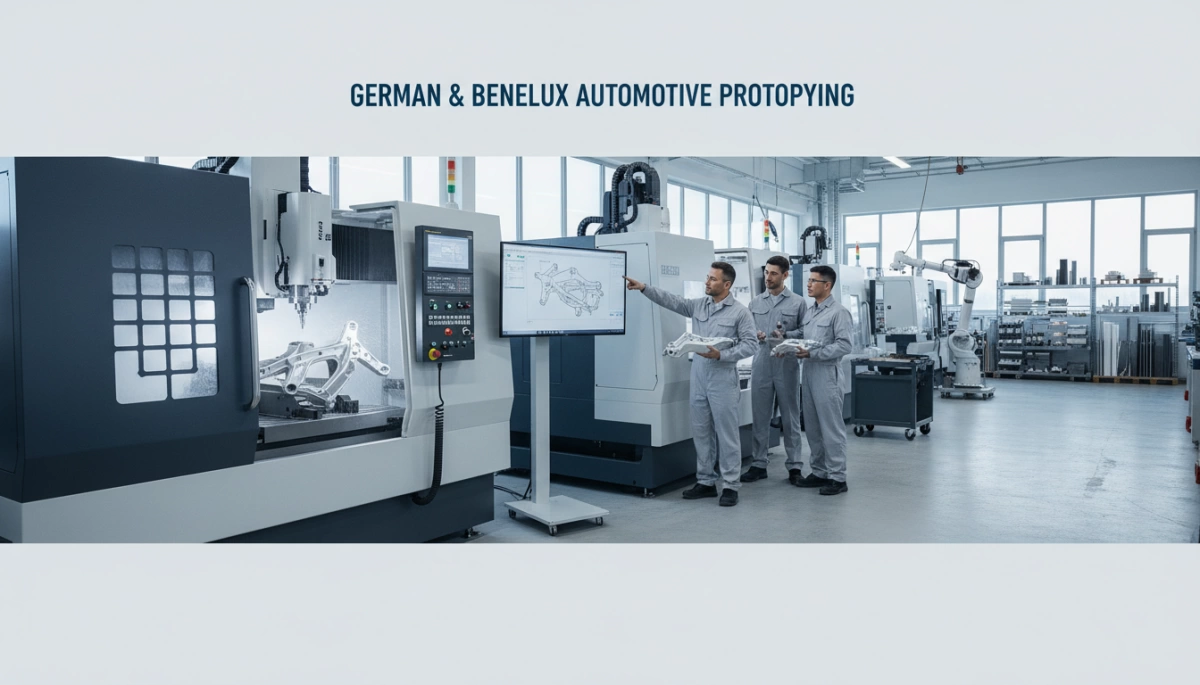
Understanding CNC Machining Automotive Prototypes for German and Benelux Markets
When teams in Germany, the Netherlands, Belgium, and Luxembourg look for CNC machining automotive prototypes, they expect more than just parts delivered on time. They expect production-grade thinking applied to rapid prototyping: strict tolerances, clean documentation, and workflows already aligned with German automotive CNC standards and the wider EU automotive ecosystem.
User Intent and Expectations in Germany and Benelux
Most engineers and buyers in these markets come with clear, demanding expectations:
- Production-like quality, even for 1–10 pcs – Prototypes must behave like pre-series parts for testing, assembly, and validation.
- Predictable, transparent process – Clear lead times, risk communication, and fast feedback on manufacturability.
- Documentation-ready output – Measured reports, material certs, and traceability suitable for OEM and Tier‑1 reviews.
- Fluent technical communication – Drawings, GD&T, and tolerance schemes fully understood and executed as intended.
When I work with German and Benelux teams, I assume OEM-level scrutiny from day one, even if the order is “just a prototype.”
Why Region-Specific CNC Best Practices Matter
You can machine an automotive bracket anywhere. But to make it usable for CNC prototyping automotive Europe—and especially for German and Benelux OEMs—you need region-specific best practices:
- Local standards mindset – Alignment with DIN, ISO, IATF, VDA expectations even at prototype stage.
- Automotive-grade traceability – Material batches, process parameters, and inspection results linked to each part.
- Consistent tolerance interpretation – Familiarity with ISO 2768, fit systems, and automotive-specific GD&T schemes.
- Supplier integration – Ability to plug into existing German and Benelux automotive prototyping supply chains and digital workflows.
These markets don’t separate “prototype quality” and “production mindset.” The same rigor applies, only with shorter deadlines.
How Precision, Reliability, and Compliance Shape CNC Workflows
For precision CNC milling prototypes in automotive applications, three pillars drive the entire workflow:
-
Precision
- Tight, realistic automotive prototype machining tolerances based on function and assembly stack-ups.
- Stable processes for multi-axis CNC automotive prototypes in aluminum, steels, and engineering plastics.
-
Reliability
- Repeatable setups, robust fixturing, and proven CNC machining strategies for under-the-hood and structural parts.
- Process control that minimizes surprises between design revision A and C.
-
Compliance
- Built-in consideration for EU automotive component regulations and OEM requirements.
- Documentation ready for audits: material certs, inspection reports, and process records that match German and Benelux automotive suppliers’ expectations.
In my shop, we design the entire CNC machining automotive prototypes workflow around these three pillars. That’s how we deliver prototypes that don’t just “fit the car,” but also fit into the way German and Benelux automotive teams already work.
Automotive prototyping needs in German and Benelux markets
Germany and the Benelux region are tough but rewarding markets for CNC machining automotive prototypes. OEMs and Tier‑1s here expect high precision, repeatable quality, and full traceability even for low-volume and one‑off builds. When I support German, Dutch, Belgian, or Luxembourg customers, they usually want three things at the same time: speed, OEM-level quality, and rock‑solid documentation.
Key CNC project types: EV, autonomous, lightweight
Most CNC machining automotive prototypes we handle for these markets fall into a few core project types:
- EV components
- Battery mounts, cooling plates, busbar carriers, inverter housings
- Structural brackets for e‑axles and motor mounts
- Autonomous & ADAS parts
- Sensor housings, radar and camera brackets, LIDAR mounts
- Precision brackets for ECUs and cable routing blocks
- Lightweight vehicle structures
- Aluminum chassis brackets, suspension links, subframe interfaces
- Topology‑optimized mounts and crash-relevant trial parts
For this kind of work, customers often look for a dedicated CNC machining supplier for automotive aluminum parts with strong know-how in thin‑wall and multi‑axis machining, similar to what we offer in our custom CNC machined automotive parts service.
Common CNC machined prototypes and their functions
In practice, CNC machining automotive prototypes for German and Benelux projects usually includes:
- Brackets and mounts – under‑the‑hood brackets, suspension and chassis mounts, sensor carriers
- Housings and covers – power electronics enclosures, gear covers, battery box lids
- Fluid and thermal components – cooling plates, manifolds, pump bodies, adapter blocks
- Test and validation hardware – rig fixtures, measurement blocks, dummy parts for crash and NVH tests
These parts are used for fit checks, functional tests, durability runs, thermal validation, and track trials, not just for show.
Typical challenges in these markets
When machining automotive prototypes for Germany and Benelux customers, a few challenges come up again and again:
- Tight deadlines
- Design freezes move; parts still need to be on the dyno or test bench “next week”
- Short lead times for rapid prototyping automotive components without sacrificing precision
- High validation demands
- Tolerance chains must match OEM standards (ISO 2768, ISO fits, GD&T)
- Even prototypes often need CMM reports, material certs, and heat treatment records
- Supplier coordination
- Multi‑supplier setups: machining, coating, heat treatment, and assembly across countries
- Cross‑border logistics between Germany and Benelux with just‑in‑time deliveries
Because of this, I design our CNC workflows around clear drawings, proactive DFM feedback, and transparent communication from RFQ to shipment. That’s the only way to hit tight timing, demanding tolerances, and strict documentation in these four markets.
Regulatory and standards requirements for CNC automotive prototypes
When we machine automotive prototypes for Germany and the Benelux, we treat regulatory and standards compliance like a design feature, not an afterthought. It directly shapes geometry, tolerances, materials, and documentation.
Core EU automotive framework & type-approval basics
For parts that may move toward SOP, we align early with the EU type-approval logic:
- EU type-approval (Regulation (EU) 2018/858 and UNECE regulations) defines how components and systems get approved before being used on vehicles sold in the EU.
- Even for “prototype only” parts, we design and document as if they could enter a type-approval flow later.
- We focus on:
- Correct material specs and certificates
- Reproducible CNC machining processes
- Traceable measurement and inspection records
This makes it much easier for your internal team to link our prototype data to later homologation and validation work.
Using E-mark and e-Mark in Germany & Benelux
Many teams mix up E-mark and e-Mark. In practice:
- E-mark (circle E + number) = UNECE component approval mark (e.g., lighting, mirrors, some safety components).
- e-Mark (rectangle e + number) = EU whole-vehicle or system approval mark.
For CNC machined automotive prototypes, we:
- Never put any E/e mark on a part unless:
- The design calls for it, and
- You confirm the approval strategy.
- Keep part engravings clearly separate from any regulatory marking to avoid confusion in audits or customs checks.
If a prototype design is “pre-homologation,” we usually label it clearly as Prototype / Not for road use on the drawing or documentation.
Relevant ISO, IATF, and VDA standards
German and Benelux OEMs expect that even prototypes respect automotive quality logic. At minimum, we work in line with:
- ISO 9001 – baseline QMS for our CNC machining operations.
- IATF 16949 – if your project is close to SOP or small-batch series, we align with IATF-style process control and APQP logic, even if prototypes themselves are outside strict IATF scope.
- ISO 2768 – general tolerances for linear dimensions and geometrical tolerances on non-critical features.
- VDA standards (e.g., VDA 6.x, VDA volume for MSA and capability) – often referenced by German OEMs for audits and documentation style.
- ISO/TS standards for specific tests (hardness, roughness, etc.) where required.
For tighter tolerance work, we apply internal CNC accuracy guidelines consistent with industrial-grade precision as outlined in our own CNC machining accuracy standards for ±0.005 mm tolerance work.
How compliance shapes design, tolerances, and documentation
Compliance is not just paperwork – it drives practical choices:
- Design choices
- We avoid features that are impossible to measure or verify consistently.
- We support you in choosing geometries that can be machined and inspected according to ISO and VDA methods.
- Tolerances
- We use ISO 2768 as the baseline for non-critical dimensions and tighten only where function demands it.
- For German automotive CNC prototypes, we clearly separate:
- Functional, safety‑critical dimensions (with specific, justified tolerances)
- Non-critical dimensions (with general ISO tolerance classes)
- Documentation
- Full material certificates (EN standards, batch/heat numbers).
- Measurement reports / CMM reports linked to drawing balloon numbers.
- Process traceability: machine, program, tool batch, operator, date.
- If needed, we structure reports in a PPAP-style format (dimensional results, material certs, capability where relevant) to match German and Benelux OEM expectations.
By locking in standards and regulatory logic from the first prototype, we reduce friction later—no rework due to missing certs, unclear markings, or non-compliant tolerances when your project moves from rapid CNC prototyping to low-volume build or pre-series.
Material selection best practices for CNC automotive prototypes
Material choice makes or breaks CNC machining automotive prototypes for German and Benelux customers. OEMs and Tier‑1s expect parts that behave like production parts in strength, stiffness, corrosion resistance, and documentation. I always start from the real use case, then match alloy, heat treatment, and finish to that.
Choosing aluminum alloys for lightweight automotive structures
For lightweight automotive structures and brackets, aluminum is usually the first choice in Europe:
- 6061‑T6 / 6082‑T6 – Great balance of machinability, strength, and price. Ideal for chassis brackets, housings, and general structural prototypes.
- 7075‑T6 – High strength, closer to steel, often used for high‑load suspension or steering components in early testing.
- 5xxx series (e.g., 5083) – Better corrosion resistance, good for underbody and coastal markets.
For complex, weight‑critical parts, I often move to multi‑axis machining and high‑strength alloys similar to what we use in our custom aluminum CNC machined parts, to get production‑level behavior already in the prototype phase.
Key points:
- Define required strength-to-weight ratio and stiffness at the RFQ stage.
- Lock in temper (T6/T651) and surface finish (anodizing, bead-blast, etc.) early.
- Avoid “generic aluminum” on drawings; German and Benelux engineers expect exact alloy specs.
Using steels and titanium for high-stress automotive applications
For high‑stress, safety‑relevant, or thermal‑loaded parts, CNC machining automotive prototypes in steel or titanium is often non‑negotiable:
- Steels (e.g., 42CrMo4, C45, 1.4301 / 304, 1.4542 / 17‑4PH)
- Used for powertrain parts, drivetrain flanges, hubs, and safety‑critical brackets.
- Heat treatment (quenching, tempering, nitriding) should mirror the intended series process as much as possible.
- Titanium (Ti‑6Al‑4V)
- When you need high strength, low weight, and corrosion resistance combined, typically in motorsport, high‑end EV, or special‑purpose prototypes.
For German OEMs, be very clear on:
- Hardness range and target mechanical properties.
- Heat treatment certificates and traceable batch numbers.
- Whether the prototype must withstand functional or durability testing, not just fit‑check.
Engineering plastics in non-structural and functional test parts
Engineering plastics are ideal where you don’t need metal strength but do need realistic function:
- PA6/PA66 (with/without glass fiber) – Under‑the‑hood clips, covers, brackets for functional checks.
- POM (Delrin) – Low friction, precise moving parts, housings, and test fixtures.
- PEEK / PPS – High temp, chemical resistance, used in more demanding EV and power electronics environments.
When CNC machining automotive prototypes from plastic:
- Match the expected series resin where possible, especially for functional testing.
- Include moisture and temperature conditions in the test plan; many German and Benelux labs will ask for this.
- Use plastics to cut cost and lead time for early design validation, then switch to metal once geometry stabilises.
Balancing corrosion resistance, thermal stability, and recyclability
In German and Benelux markets, sustainability and lifetime performance are part of the spec, even at prototype stage:
- Corrosion resistance
- Use stainless steels, anodized aluminum, or coated carbon steels for parts exposed to road salt and moisture.
- For anodized aluminum, specify type, color, and layer thickness; this impacts both corrosion behavior and dimensional accuracy.
- Thermal stability
- For EV battery mounts, inverters, and cooling plates, choose alloys with stable mechanical properties at temperature and good thermal conductivity.
- Recyclability
- Favor commonly recycled alloys (6000 series aluminum, standard steels) and avoid unnecessary mixed-material assemblies, especially for EU projects with strong sustainability KPIs.
Material documentation and traceability for European OEM audits
German and Benelux OEMs treat serious prototypes almost like pre‑series parts. That means your material traceability must be tight:
- Always keep mill certificates (3.1 certificates) with:
- Heat/lot number
- Chemical composition
- Mechanical properties
- Link each CNC machined automotive prototype to its material batch in your internal system.
- Include material specs and batch IDs in:
- Inspection reports (CMM, hardness, roughness)
- PPAP‑style documents when requested
- Any 8D or complaint reports if issues arise
A clean material trail is often what decides whether a German or Benelux OEM treats you as a long‑term CNC prototyping partner or just a one‑off supplier.
Design for manufacturability for CNC automotive prototypes
When I work on CNC machining automotive prototypes for German and Benelux customers, DFM is what keeps projects on time, in tolerance, and within budget. If the part is designed for manufacturability from day one, you avoid painful rework and surprises during validation.
DFM principles for CNC machining automotive parts
For CNC machining automotive prototypes, I focus on a few non‑negotiables:
- Machine-friendly features: avoid deep, narrow pockets and ultra-thin fins unless truly required for testing.
- Standard tools first: design around standard cutter diameters and lengths to keep costs and lead times down.
- Stable setups: minimize the number of re-clamps; if possible, allow full access in one or two setups, especially on 5-axis.
- Access for inspection: CMM and gauges must be able to reach critical features easily.
For complex geometries, using proper 5‑axis CNC design tips early avoids costly redesigns later.
Optimizing geometry: radii, wall thickness, pockets, ribs
To make CNC machining automotive components consistent and repeatable, I usually recommend:
-
Internal radii:
- Keep inside corners ≥ tool radius × 1.5–2.
- Avoid sharp internal corners; use generous fillets to reduce tool wear and chatter.
-
Wall thickness:
- For aluminum: ≥ 1.5–2.0 mm for prototypes, thicker for large parts.
- For steels: go a bit thicker to prevent distortion.
- Keep wall height-to-thickness ratios reasonable to avoid vibration.
-
Pockets and cavities:
- Use stepped depths instead of one very deep pocket.
- Add relief radii at the bottom; avoid “keyhole” shapes that force tiny tools.
-
Ribs and strengthening features:
- Use tapered ribs instead of knife-edge ribs.
- Blend ribs smoothly into walls to reduce stress concentrations and machining time.
Designing under-the-hood and powertrain prototypes for CNC
Under-the-hood brackets, housings, and powertrain prototypes for German and Benelux OEMs need both robustness and serviceability:
- Heat and fluid exposure: allow space for O-ring grooves, gasket faces, and sealing surfaces that can be machined cleanly.
- Assembly access: leave room around bolt holes for tools and sockets; avoid hidden fasteners that need awkward machining.
- Directional strength: orient critical load-bearing sections so they can be machined from strong stock directions, especially in aluminum.
For highly contoured engine brackets or housings, multi-axis CNC machining strategies help maintain strength while reducing unnecessary material.
Setting realistic tolerances and surface finish
In automotive prototype machining, I always push to set tolerances based on function, not habit:
-
Tolerances:
- Use general tolerances (e.g. ISO 2768 fine or medium) for non-critical features.
- Reserve tight fits (IT6–IT7 range) for locating faces, bearing seats, and interfaces.
- Over-tolerancing everything just increases cost and risk of delays.
-
Surface finish:
- Only call out fine finishes (e.g. Ra ≤ 0.8 µm) on sealing faces, sliding surfaces, and optical/sensor-related areas.
- Keep structural / non-functional surfaces at rougher, faster-to-machine finishes.
If you’re working mainly in aluminum, aligning tolerances with proven CNC machining tolerances for precision parts helps avoid unrealistic expectations.
Using early DFM reviews to cut cost, time, and risk
For German and Benelux automotive projects, early DFM review is where most savings happen:
- Before releasing drawings: sit down with your CNC supplier to review geometry, tolerances, and critical interfaces.
- Flag risks: long slender parts, deep bores, tight positional tolerances, or heavy material removal.
- Lock the iteration loop: agree on what can be adjusted (radii, wall thickness, non-critical tolerances) without re-approval.
With a proper DFM pass, you get:
- Fewer change requests during machining
- More stable prototype quality
- Shorter lead times and a smoother path from CNC prototype to low-volume production
Precision tolerances and quality control in CNC automotive machining
In the German and Benelux markets, CNC machining automotive prototypes is all about repeatable precision, clean documentation, and zero surprises at installation.
Defining tolerance classes for German and Benelux automotive prototypes
For most CNC machining automotive prototypes, I normally align with common European frameworks:
- ISO 2768-mK / fK for general tolerances on non-critical features
- ISO 286 (fits like H7/g6, H7/p6, etc.) for shafts, bores, and precise assemblies
- Tolerance callouts in mm with clear limit values, no “approx.” or ambiguous notes
- Critical-to-function dimensions flagged clearly (CTQ/CC) on drawings
German OEMs and Tier‑1s often expect VDA/IATF thinking even in prototype phase: stable processes, documented decisions, and consistent tolerance strategy.
Achieving tight fits for assemblies, mounts, and brackets
For brackets, mounts, and under‑the‑hood assemblies, I work backwards from how the part is actually used:
- Locating features (bores, slots, datums) get tighter tolerances (IT7–IT8)
- Non-critical features (outer profiles, chamfers) stay looser to control cost
- For bolted joints and sensor brackets, I target repeatable alignment over ultra‑tight numbers that add no value
- I match tolerances to real assembly conditions: painted surfaces, bushings, inserts, weldments, etc.
This keeps CNC machining automotive parts both install-friendly and cost-effective.
Inspection methods: CMM, surface roughness, hardness checks
To hit German and Benelux expectations, you can’t skip metrology:
- CMM inspection for datums, GD&T (position, flatness, perpendicularity)
- Surface roughness (Ra) checks on sealing faces, sliding areas, and cosmetic surfaces
- Hardness tests after heat treatment (especially for steel and titanium brackets)
- Basic go/no-go gauges for quick checks on repeated features
For complex geometries or multi‑axis work, I rely heavily on CMM plus well‑planned fixturing. When parts need 5‑axis accuracy, partnering with a capable 5-axis CNC machining service keeps quality under control.
Managing measurement reports, PPAP-style documentation, and traceability
Even at prototype stage, German and Benelux customers often want production-like documentation:
- Dimensional reports referencing drawing item numbers and tolerances
- PPAP‑style elements: control plan light, IMDS/material certs, and process traceability
- Linking each part to material heat batch, machine, and program revision
- Clear digital file structure: CAD, drawings, NC code version, inspection results
This makes later PPAP or SOP ramp-up much faster, especially when prototypes feed into low-volume production.
Avoiding common machining and metrology mistakes in prototypes
To keep CNC machining automotive prototypes smooth and predictable, I actively avoid:
- Over‑tightening tolerances without a functional reason
- Ignoring tool wear compensation on long runs of prototype brackets
- Measuring warm parts straight off the machine (especially aluminum)
- Inconsistent datum setups between machining and inspection
- Missing or incomplete material and hardness documentation
Getting tolerances, inspection, and paperwork right early means your prototypes don’t just “fit once” – they form a solid base for real automotive programs in Germany and the Benelux.
Advanced CNC machining strategies for automotive prototypes
For German and Benelux automotive prototypes, advanced CNC machining is what keeps you competitive on lead time, price, and consistency.
When to use 3-axis, 4-axis, and 5-axis CNC
I usually match the setup to the part type:
-
3-axis CNC
- Flat brackets, simple housings, plates, flanges
- Best for rapid prototyping automotive components with simple geometry and tight but not extreme tolerances
- Lowest cost per part and fastest setup
-
4-axis CNC
- Shafts, small powertrain prototypes, under‑the‑hood brackets with side features
- Allows rotary machining in one clamping, better positional accuracy, fewer setups
- Good balance for low‑volume automotive CNC production
-
5-axis CNC
- Complex EV components, sensor brackets, impellers, multi‑face housings, structural knuckles
- Critical when you need:
- One‑clamp accuracy on multiple faces
- Smooth 3D contours and tight positional tolerances
- Ideal for German OEM-style multi‑axis CNC automotive prototypes where GD&T is tight and inspection is strict
Toolpath and cutting strategies for aluminum and steels
For automotive CNC machining, I focus on stable, repeatable toolpaths rather than pushing the absolute limit:
-
Aluminum machining automotive parts
- Use high‑speed machining (HSM) toolpaths with light radial engagement and higher feed
- Prioritize chip evacuation and coolant; avoid recutting chips
- Use sharp, high‑helix tools for good surface finish on lightweight automotive aluminum prototypes
- Keep wall finishing passes separate from roughing to avoid deflection
-
Steels and heat‑treated parts
- Lower cutting speeds, higher rigidity, shorter tool overhang
- Use trochoidal/constant‑engagement paths to control heat and tool load
- Carbide tools with proper coatings (TiAlN, etc.) for dry or MQL cutting, depending on the part
- Always pre‑plan stock allowance for finishing after heat treatment
If you’re looking for a partner that already has proven toolpath recipes for automotive-grade aluminum, I’ve standardized a lot of this on our custom aluminum CNC machining parts line to keep cuts clean and stable.
Managing distortion, chatter, and tool wear
Precision CNC machining automotive prototypes for German and Benelux OEMs means you can’t ignore process stability:
-
Distortion control
- Start from stress‑relieved material whenever possible
- Symmetric roughing from both sides, leave uniform finishing stock
- Clamp lightly on thin walls, use soft jaws, vacuum fixtures, or custom nests
- For long plates (e.g. EV battery mounts), rough, stress‑relieve, then finish
-
Chatter reduction
- Shorten tool overhang, increase tool diameter where possible
- Adjust spindle speed to avoid resonance; use stable rpm “sweet spots”
- Reduce radial engagement and use higher feed with HSM toolpaths
- Use support features or temporary ribs on long or thin parts when needed
-
Tool wear management
- Standardize tool libraries and life limits per material
- Use tool presetters and regular inspection for diameter and length offsets
- Track worn tools against surface finish or tolerance drift, especially on precision CNC milling prototypes
Post-processing: anodizing, heat treatment, and coatings
For EU and German OEM work, post‑processing is not just cosmetic; it’s functional and audited:
-
Anodizing (Aluminum)
- Hard anodizing for structural brackets and wear zones
- Decorative or clear anodizing for sensor housings and visible surfaces
- Always account for layer thickness in dimensions (especially fits and threads)
-
Heat treatment (Steels and some aluminums)
- Define sequence: rough‑machining → heat treatment → finish‑machining
- Verify hardness with documented test reports for automotive prototype quality control
- Plan extra stock for potential distortion after heat treatment
-
Protective coatings
- Zinc plating, passivation, or e‑coat for steel brackets and chassis parts
- Conversion coatings before painting or bonding
- For EV and ADAS parts, consider corrosion + conductivity + grounding paths
Rapid iteration loops between design and CNC shop
For German and Benelux projects, the real edge is how fast you can iterate without losing control:
- Lock in a DFM + CNC review loop on every new revision (10–20 min online review saves days later)
- Use standard tolerance schemes (e.g. ISO 2768) plus a short list of critical GD&T features
- Share 3D models + fully detailed 2D drawings; avoid “3D only” if you need production‑style inspection
- Freeze interfaces (mounting points, fits) and iterate on non‑critical geometry first
- Keep a clear versioning system and traceability on materials, programs, and inspection reports
When we work with German or Benelux automotive teams, I typically set up a fixed feedback rhythm (daily or every 2–3 days) so designers, buyers, and the CNC shop move in sync—this is what keeps rapid prototyping in Europe both fast and controlled.
CNC machining best practices for EV and autonomous components
For German and Benelux customers, CNC machining automotive prototypes for EV and autonomous systems is all about repeatable accuracy, clean documentation, and fast iteration without compromising safety.
Machining EV battery mounts, cooling plates, and housings
For EV battery mounts, cooling plates, and housings, I focus on:
- Flatness & sealing: Tight flatness and surface finish on cooling plates so gaskets and seals actually work under pressure and temperature cycling.
- Flow-optimised channels: Smooth internal channels, consistent wall thickness, and deburring in all cavities to avoid hotspots and flow restrictions.
- Strength–weight balance: High-strength aluminum alloys with pocketing and ribs to keep weight down while passing vibration and crash-relevant tests.
- Thermal stability: Material choice and tolerances that hold up under continuous high current and temperature swings, especially for German OEM thermal validation.
When geometry gets complex (multi-sided channels, tight space in packs), I use 5‑axis CNC milling for automotive EV parts to hit all features in one setup and keep tolerances stable; if you want details, see our 5-axis CNC machining capabilities for tight-tolerance work: 5-axis CNC machining services.
Best practices for suspension, steering, and chassis brackets
For suspension brackets, steering mounts, and chassis components, the priorities are predictable stiffness, fatigue strength, and dimensional stability:
- Right material for load paths: Heat-treated aluminum or steel where fatigue and crash loads are high.
- Generous radii & transitions: Avoid sharp internal corners to reduce stress risers; use smooth transitions around bolt holes and mounting ears.
- Consistent hole quality: Tightly controlled hole position, diameter, and perpendicularity so K-factor, bushing press fits, and alignment are valid for testing.
- Realistic test geometry: Machine prototypes as close as possible to production thickness and geometry so suspension and steering test data is trustworthy.
CNC strategies for sensor brackets, camera mounts, and radar housings
Sensor brackets, camera mounts, LiDAR and radar housings need both precision and stability:
- Stable, low-warp designs: Compact, stiff designs with ribs and support material to keep optics and sensors aligned.
- Multi-axis positioning: Use 4- or 5‑axis setups so all features are machined in relation to the same datums, keeping sensor pointing angles within microns/arc-minutes.
- Clean interfaces: Well-machined sealing faces, cable entry points, and connector pockets to protect electronics in European weather conditions.
- EMI-ready housings: Material and wall thickness chosen with shielding in mind for radar and camera systems.
For very small or high-precision sensor components, I sometimes combine milling with Swiss machining for tight-tolerance pins, shafts, and fasteners: Swiss CNC machining for precision automotive parts.
Thermal and vibration considerations in EV and ADAS prototypes
EV and ADAS prototypes in Germany and Benelux must survive tough thermal and vibration tests from OEMs and TIER1s:
- Thermal paths: Short, direct paths from heat sources to housing or cooling elements; avoid thin, isolated tabs near high-power electronics.
- Vibration-friendly design: Avoid tall, slender features; use gussets and ribs on brackets and mounts exposed to road and motor vibration.
- Controlled mass: Keep sensor and battery-related parts light but stiff so natural frequencies stay out of critical ranges found in vehicle testing.
- Process consistency: Same tools, same setups, and documented parameters so the prototype part that passes vibration/thermal tests can actually be repeated in low-volume runs.
I build EV and autonomous CNC machining automotive prototypes with this in mind from day one, so German and Benelux teams can move faster from design review to track testing with fewer redesign loops.
Supply chain and project management for CNC machining automotive prototypes
Managing CNC machining automotive prototypes for German and Benelux customers is all about predictability, transparency, and clean documentation. I run projects with a clear structure from RFQ to delivery, so OEM and Tier 1 teams know exactly what to expect.
Lead times, batch sizes, and revision cycles
For Germany, Netherlands, Belgium, and Luxembourg, buyers expect clear, realistic timing and zero surprises.
Typical ranges (can vary by geometry and finish):
| Item | Typical Range (prototype) |
|---|---|
| CNC quote turnaround | 24–48 hours |
| Machining lead time (simple parts) | 5–7 working days |
| Machining lead time (complex / 5‑axis) | 10–15 working days |
| Usual batch size for prototypes | 1–200 pcs |
| Design change / revision cycle | 2–5 days after updated data |
Best practices I follow:
- Confirm target SOP, test dates, and gate reviews (DV, PV, etc.) upfront.
- Lock batch size and revision cut-off before machining starts.
- Use versioned CAD + drawing naming (e.g. “P/N_1234_RevC”) to prevent mix-ups.
- Flag “time-critical for test” parts and adjust planning accordingly.
Technical communication and drawing standards
German and Benelux engineers care a lot about clean drawings and standard-compliant communication.
I usually work to:
- Drawing standards: ISO, DIN, ISO 2768 for general tolerances, ISO fits (H7/h6, etc.).
- GD&T: ISO-based GPS standards, with clear datum definition.
- Languages: English by default; German notes accepted if needed.
Best practices:
- Send a full RFQ package: 3D (STEP/Parasolid), 2D drawing (PDF), BOM, spec sheet. A good RFQ structure like in this checklist for RFQs to CNC suppliers helps avoid back-and-forth.
- Define:
- Critical-to-function dimensions and tolerance classes.
- Surface finishes (Ra), coatings, and heat treatment.
- Inspection requirements: CMM report, material certs, PPAP-style docs.
- Keep all feedback written: email, Teams, or PLM comments, not just calls.
Handling confidential data, NDAs, and OEM requirements
For German OEMs and Benelux Tier 1s, IP and data security are non‑negotiable.
What I put in place:
- NDA / secrecy agreement signed before detailed data exchange.
- Controlled access to CAD files and technical docs (role-based, logged).
- Storage on secure servers; no uncontrolled subcontracting without approval.
- Follow OEM-specific rules (VW, BMW, Mercedes, Stellantis, etc.) on:
- Data formats and naming
- Logo and part marking
- Archiving and retention times
I keep only production-relevant data and delete obsolete revisions when the project closes, unless you ask for long-term retention.
Logistics, customs, and cross-border deliveries
German and Benelux programs expect on-time deliveries with full traceability, whether parts come from inside or outside the EU.
Key points I manage:
| Topic | Best Practice |
|---|---|
| Shipping method | Express courier (FedEx, DHL, UPS) for prototypes |
| Packaging | Foam / custom inserts, individual bagging, part labels |
| Documentation | Packing list, invoice, HS codes, country of origin, material data |
| Customs (into EU) | Clear Incoterms (usually DAP or DDP), correct customs value and HS code |
| Traceability | Batch IDs, material heat numbers, inspection reports per shipment |
For time-critical builds, I:
- Align shipping date with your build or test slot.
- Share tracking numbers and documents the moment parts leave.
- Plan buffer time for customs if shipping from outside the EU.
If you want to reduce issues in the supply chain even further, it helps to avoid common ordering mistakes; this guide on top mistakes engineers make when ordering custom CNC parts is a good reference I often align with when setting up new projects.
Choosing a CNC machining partner for German and Benelux automotive work
For CNC machining automotive prototypes in Germany and the Benelux, your supplier choice is half the project. I treat every prototype like it’s already in the PPAP pipeline – that’s the mindset you want from a partner.
Key criteria: certifications, equipment, automotive experience
When you shortlist CNC partners, filter hard:
| Criteria | What to look for | Why it matters in DE + Benelux |
|---|---|---|
| Certifications | ISO 9001, ideally IATF 16949 aligned | Matches German OEM and Tier‑1 expectations |
| Standards know‑how | Familiar with ISO 2768, GD&T, VDA expectations | Less back‑and‑forth on drawings and tolerances |
| Equipment | Modern 3/4/5‑axis CNC milling and turning, probing, live tool | Handles complex EV, chassis, and ADAS brackets in one setup |
| Materials | Proven in aluminum, steels, titanium, engineering plastics | Covers most prototype and low-volume auto work |
| Automotive track record | References with OEMs / Tier‑1 / Tier‑2 | Reduces risk on deadlines and quality claims |
If you need complex milled parts, make sure your partner runs serious CNC milling services with multi-axis capability, not just basic job-shop level work.
Evaluating quality control systems and reporting
For German and Benelux automotive projects, QC is non‑negotiable:
-
Inspection capability
- CMM with full 3D reports
- Surface roughness measurement
- Hardness testing where needed
-
Documentation
- Dimensional reports linked to drawing balloons
- Material certs and heat numbers
- Traceable batch and revision control
-
Systems
- Clear NC program revision control
- Measured vs. nominal data in Excel/PDF, PPAP‑style if required
Ask for a sample inspection report before you commit.
How to brief your CNC supplier for faster, cleaner projects
The better the brief, the smoother the project. For CNC machining automotive prototypes, I recommend you always send:
- 2D drawing + 3D model (STEP/IGES + PDF with all tolerances/GD&T)
- Clear tolerance strategy (what’s critical, what’s general ISO 2768)
- Functional notes:
- Which faces are sealing surfaces
- Which holes are locating/assembly critical
- Where you need specific surface finishes
Also specify:
- Target lead time and batch size
- Required inspection depth (full, sampling, only key dims)
- Any coatings, heat treatment, or assembly needs
This upfront clarity cuts quoting time and reduces rework.
Benefits of working with an experienced CNC prototyping partner
With an automotive‑focused CNC partner, you get:
- Faster design iterations thanks to realistic DFM feedback
- Lower risk on tight deadlines for tests, demos, and audits
- More reliable fit and function on multi-part assemblies
- Cleaner documentation that drops straight into your OEM systems
If you also need turned shafts, bushings, or housings alongside milled parts, we can keep everything under one roof using integrated CNC turning services, which simplifies logistics and reporting for your German and Benelux teams.
 English
  German
  Dutch
Dutch  Russian
  Czech
Czech  French
  Korean
  Japanese
  Spanish
  Portuguese