

You might think that high CNC machining prices are just an unavoidable part of product development.
But what if I told you that strategic Design optimization could slash your Production overhead by 30%?
As a manufacturing specialist at ZSCNC, I see it every day: Engineers over-specifying Tight tolerances or ignoring Right-size stock, inadvertently driving up Material wastage and Machining time.
The solution is not to reduce quality; instead, it is to assess the manufacturability design (DFM) through the ZSCNC team.
In this post, you’re going to learn exactly how to leverage Aluminum 6061—the king of Machinability—to maximize Work efficiency and minimize Tooling costs.
From Batch size optimization to strict Scrap control, this is your practical blueprint for cost-effective Custom machining.
Let’s get to work.
Aluminum 6061 Machinability & Cost Benefits
At ZSCNC, we consistently recommend Aluminum 6061 as the primary choice for balancing performance with budget. Understanding the correlation between machinability and tooling expenses is crucial for reducing overall manufacturing expenses. When you select a material with a high machinability rating, you allow our CNC milling and CNC turning centers to operate at optimal efficiency, significantly cutting down cycle times.
Machinability Ratings and Material Removal Rates
Aluminum 6061 machinability is superior to many other structural metals. Its composition allows for high Material Removal Rates (MRR), meaning we can remove more material per minute compared to harder alloys like Stainless Steel 304 or Titanium.
- Higher Feed Rates: We can push cutting tools faster without sacrificing precision.
- Reduced Cycle Time: Faster cutting speeds directly translate to shorter machining time, which is the primary driver of CNC machining prices.
- Chip Evacuation: 6061 produces chips that break easily and evacuate the cutting zone efficiently, preventing re-cutting and surface damage.
Impact on Tooling Costs and Work Efficiency
Harder materials are abrasive and accelerate tool wear, leading to frequent tool changes and increased machine downtime. By choosing cost-effective metals like Aluminum 6061, we extend the life of our end mills and drills. This reduction in consumable usage lowers tooling costs and boosts work efficiency on the shop floor.
Cost Comparison: Aluminum 6061 vs. Stainless Steel 304
| Feature | Aluminum 6061 | Stainless Steel 304 | Cost Impact |
|---|---|---|---|
| Machinability Rating | High (~270%) | Low (~45%) | 6061 reduces machine time significantly. |
| Tool Life | Extended | Shortened | 6061 lowers production overhead. |
| Cutting Speed | Fast | Slow | Faster throughput for 6061. |
| Raw Material Cost | Moderate | High | Raw material costs are lower for Aluminum. |
Balancing Functional Requirements with Budget
While high-strength alloys like Aluminum 7075 are necessary for specific aerospace applications, they often exceed the functional requirements of standard structural parts. Over-specifying materials is a common cause of bloated budgets.
- Supply Chain Stability: Aluminum 6061 is globally standardized and readily available, ensuring stable raw material costs and preventing delays.
- Design for Manufacturing (DFM): We assist clients in evaluating whether the added cost of harder alloys is strictly necessary. If 6061 meets the yield strength requirements, switching to it can immediately save 20-30% on the final quote.
By prioritizing Aluminum 6061 machinability, we help you achieve tight tolerances and complex geometries without the premium price tag associated with difficult-to-machine materials.
Right-Size Stock & Material Optimization
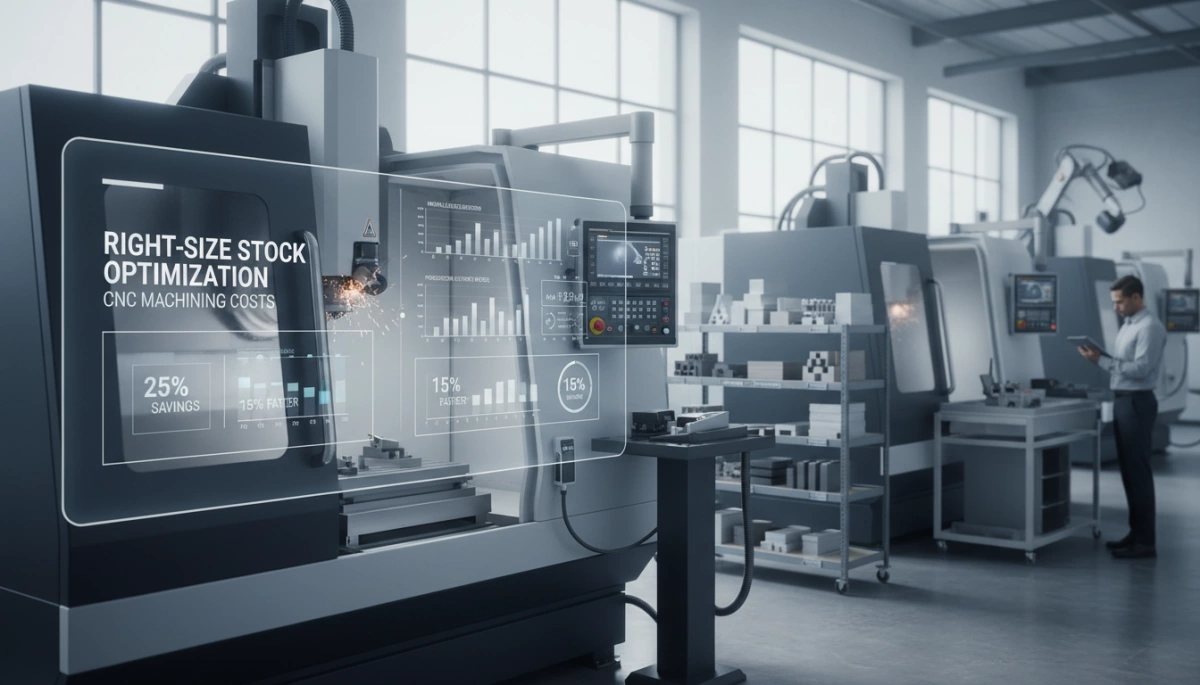
One of the most effective ways to lower CNC machining prices is by aligning your component dimensions with standard raw material sizes. We often see designs that are just a fraction over a standard bar or plate size, forcing us to use the next size up. For example, if a part is designed at 51mm diameter, we must machine it from a 55mm or 60mm bar. By simply adjusting the design to 49mm, we can utilize standard 50mm right-size stock, instantly reducing raw material costs and minimizing waste.
Minimizing Material Wastage and Scrap Control
In subtractive manufacturing, every millimeter of material removed is money spent on both the material itself and the machining time required to remove it. This is particularly critical when working with expensive materials like Copper or high-performance engineering plastics. Scrap control is not just about cleaning up chips; it is about selecting stock volume that is as close to the final part geometry as possible.
Key strategies for stock optimization include:
- Standard Sizing: Design parts to fit within standard sheet thicknesses or bar diameters to avoid paying for custom stock preparation.
- Avoiding "Air Cuts" & Excessive Removal: Starting with oversized stock increases the material removal rate workload and tool travel time, inflating production overhead.
- Volume-Based Quoting: Your final quote is heavily influenced by the starting block size. Reducing the initial stock volume directly lowers the material portion of the expense.
- Nesting for Multi-Part Runs: For projects involving materials like Nylon, we can optimize how parts are laid out on a sheet to maximize yield and reduce material wastage.
DFM Tactics for Tight Tolerances & Geometry
Design for Manufacturing (DFM) is the most effective lever we have to control costs before the metal even touches the machine. At our factory, we often see designs that are technically possible but unnecessarily expensive due to over-engineering. By focusing on design optimization, we can significantly reduce manufacturing expenses without compromising the part's functionality.
The Real Financial Cost of Tight Tolerances
While our equipment is capable of achieving tight tolerances down to ±0.005mm, applying this level of precision to every feature drives up CNC machining prices exponentially. High precision requires slower feed rates, specialized tooling, and rigorous inspection processes.
To save costs, define tolerances based strictly on functional requirements. If a surface doesn't mate with another part, standard tolerances are usually sufficient. Understanding standard tolerances for 5-axis parts helps in setting realistic expectations that align with budget constraints.
Optimizing Geometry for Machining Time
Component complexity directly impacts the machining time and the setup process. Here are key areas where smart design saves money:
- Corner Radii: CNC tools are round. Designing sharp 90-degree internal corners forces us to use smaller tools or expensive EDM (Electrical Discharge Machining) processes. Adding a generous corner radius allows for larger, sturdier tools, reducing tool wear and cutting time.
- Wall Thickness: Thin walls lack stiffness and are prone to vibration (chatter). This forces machinists to slow down the machine to maintain quality, hurting work efficiency. Increasing wall thickness improves stability and allows for faster material removal.
- Hole Depth: Deep, narrow holes are difficult to machine and prone to drill breakage. Limiting hole depth to 3-4 times the diameter ensures a smoother process.
By simplifying parts and consulting design tips for parts that will be machined on 5-axis CNC, you can avoid the "Air Cut" phenomenon and ensure your project remains cost-effective. We aim to be your partner in DFM, helping you modify designs to slash production overhead while maintaining the quality you expect.
Setup Process & Batch Size Optimization
Minimizing the setup process is one of the most effective ways to slash manufacturing expenses. Every time a machinist has to manually reorient a part or change fixtures, it adds labor hours and machine downtime to the bill. We strongly advocate for part simplification during the design phase. By designing components that can be machined in a single operation—or utilizing our multi-axis capabilities efficiently—we reduce the number of machine setups, directly improving work efficiency.
Another major factor driving CNC machining prices is the volume of the order. Every project incurs Non-Recurring Engineering (NRE) costs, such as CAD/CAM programming and tooling preparation. These are fixed costs regardless of how many parts you make.
- Single Prototype: You bear the full weight of setup costs on one unit.
- Batch Production: We amortize NRE costs over the entire quantity, resulting in significantly lower unit costs.
Batch size optimization is critical when you are ready to move from metal prototypes to full production runs. Even increasing an order from 10 to 50 pieces can dramatically drop the price per part. As a custom CNC machining supplier, we work with you to calculate the ideal production volume that balances unit savings with your inventory needs. By planning for larger runs early, you avoid the inefficiencies of ordering small, sporadic batches.
Surface Finish Requirements & Expenses
Surface finishing is often the hidden driver of high manufacturing expenses. While a glossy, mirror-like appearance looks professional, it requires significant manual labor and machine time. To save 30% on costs, you must strictly differentiate between what the part needs to do and how it needs to look.
As-Machined vs. Secondary Finishing Operations
The most cost-effective finish is "as-machined." This leaves the part with visible tool marks but maintains tight tolerances and full functionality. Standard as-machined roughness (typically Ra 3.2μm) is perfectly adequate for internal components, brackets, and mounting plates.
Adding secondary operations like polishing, plating, or painting immediately increases production overhead. When ordering custom aluminum CNC machined parts, sticking to a standard machined finish wherever possible eliminates the need for extra processing steps and reduces lead times.
Distinguishing Between Functional and Aesthetic Needs
Designers often apply a blanket surface finish requirement to an entire drawing, which is a costly mistake. We recommend a targeted approach:
- Functional Surfaces: Focus on mating surfaces or bearing fits where precision matters.
- Aesthetic Surfaces: Only apply high-end finishes to visible exterior faces.
- Hidden Surfaces: Leave internal or non-visible areas as-machined to lower CNC machining prices.
Cost-Effective Surface Treatments for Aluminum 6061
Aluminum 6061 is highly versatile and accepts various finishes well. If your part requires corrosion resistance or a specific color, choose standard treatments that offer the best value.
Common Finishes & Cost Impact:
| Finish Type | Cost Impact | Best Use Case |
|---|---|---|
| As-Machined | Low | Internal parts, prototypes, mounting brackets. |
| Bead Blast | Low-Medium | Uniform matte texture, hides tool marks. |
| Anodizing (Type II) | Medium | Corrosion resistance, color coding, durable surface. |
| Powder Coat | Medium | High durability, aesthetic variety, wear resistance. |
| Polishing | High | Cosmetic parts requiring a mirror-like reflection. |
Avoiding Unnecessary Post-Processing
To control manufacturing expenses, avoid over-specifying surface roughness. Demanding an Ra 0.8μm finish on a surface that no one will ever see forces us to use slower feed rates and specialized tooling. By aligning your surface finish requirements with the actual application, you streamline the production flow. For industrial components, our aluminum CNC milling service focuses on achieving the necessary geometric tolerances first, ensuring you don't pay for cosmetic perfection that doesn't add value.
FAQs: CNC Machining Prices & Materials
Why is Aluminum 6061 considered the gold standard for cost-efficiency?
Aluminum 6061 machinability is widely regarded as the benchmark for balancing performance and budget. It offers a high material removal rate, meaning we can cut it faster with less wear on our tools compared to harder alloys like 7075 or Stainless Steel. This directly reduces machining time and tooling costs. Additionally, it provides excellent corrosion resistance and a high strength-to-weight ratio, making it one of the most cost-effective metals for both metal prototypes and production runs.
How much do tight tolerances actually increase CNC machining prices?
Demanding excessive precision is one of the fastest ways to inflate CNC machining prices. While we are capable of holding extremely strict dimensions, moving from a standard tolerance to a high-precision requirement can double or even triple the cost. This is because achieving a perfect tolerance of ±0.005mm requires slower feed rates, specialized tooling, and more rigorous inspection processes. To save money, only apply tight tolerances to critical features where functional requirements absolutely demand it.
What are the quickest ways to reduce production overhead?
To cut production overhead, focus on Design for Manufacturing (DFM) and batch size optimization.
- Simplify Designs: Remove unnecessary complexity to reduce the setup process and run times.
- Right-Size Stock: Use standard material sizes to minimize material wastage and scrap.
- Increase Volume: Transitioning from single prototypes to low-volume production allows us to amortize setup costs across more units, significantly lowering the per-part price.
How does ZSCNC assist with design optimization for cost reduction?
At ZSCNC, we act as more than just a machine shop; we are your manufacturing partner. Our team reviews your CAD files to identify cost drivers like deep pockets, sharp internal corners, or thin walls that increase component complexity. We provide actionable design optimization feedback to improve work efficiency and ensure your parts are optimized for our 3-axis, 4-axis, or 5-axis machines. This proactive approach helps eliminate manufacturing risks and ensures you aren't paying for unnecessary raw material costs or wasted machine time.
 English
  German
  Dutch
Dutch  Russian
  Czech
Czech  French
  Korean
  Japanese
  Spanish
  Portuguese