
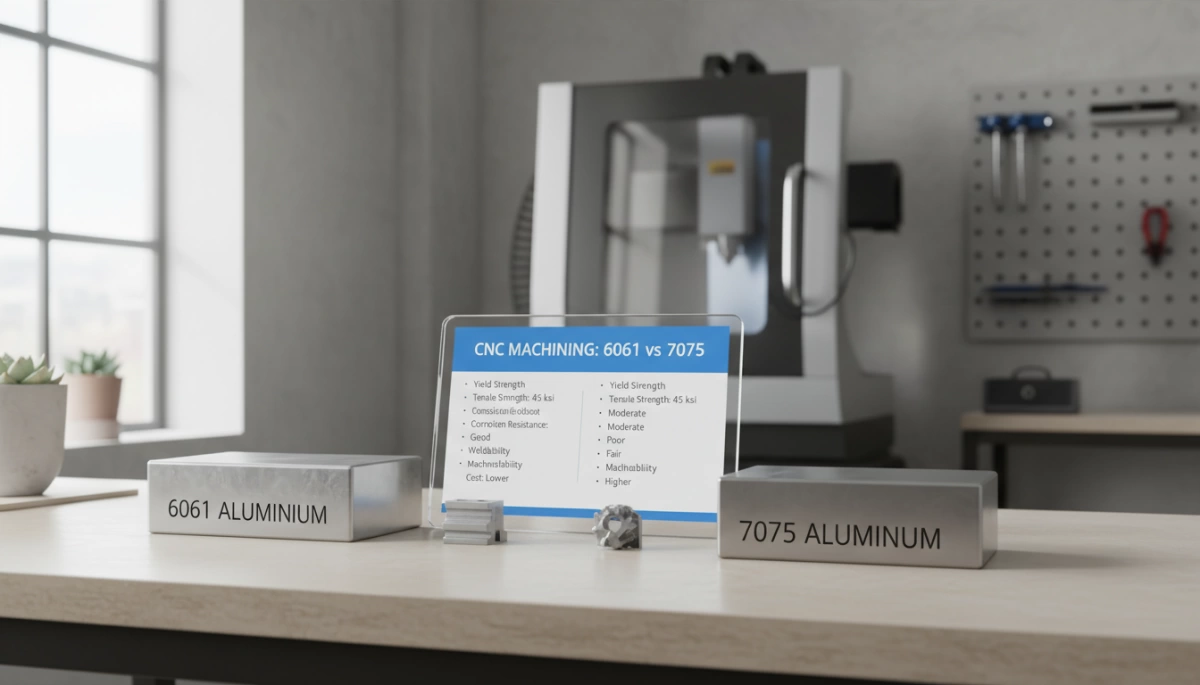
Struggling to decide between the two titans of the manufacturing world?
On the surface, they look identical. But on the machine shop floor, they behave like two completely different metals.
Select the wrong one, and you’re looking at either catastrophic part failure or a blown budget on over-engineered components. I’ve seen it happen too many times.
In this post, we are cutting through the datasheet noise. You’re going to get the 6061 vs 7075 aluminum: complete comparison guide for CNC machining, based on real-world manufacturing data.
From yield strength and weldability to the brutal truth about cost, here is exactly how to choose the right alloy for your parts.
Let’s get to work.
At a Glance: The 6061 vs 7075 Cheat Sheet
Choosing between 6061 and 7075 aluminum often feels like the first major hurdle in any CNC project. At ZSCNC, we see these two alloys dominate our shop floor, but they serve vastly different masters. Before diving into the technical weeds, here is the quick breakdown of how we categorize them for our clients.
6061: The Jack-of-All-Trades for General Purpose
If you need a reliable, cost-effective material that can do a little bit of everything, 6061 aluminum is the undisputed workhorse. It is the standard for a reason. This alloy offers a balanced mix of mechanical properties—good strength, excellent corrosion resistance, and superb weldability. Whether we are running a 5-axis milling job or a simple turning operation, 6061 behaves predictably. It is perfect for structural frames, electronic enclosures, and automotive components where extreme stress isn't the primary concern.
7075: The Strongman for High-Stress Applications
When "good enough" won't cut it, 7075 aluminum steps in. Often compared to steel in terms of strength-to-weight ratio, this is the go-to alloy for aerospace and high-performance applications. It is significantly harder and stronger than 6061, making it ideal for parts under immense fatigue stress, like aircraft wing spars or rock climbing gear. However, that strength comes with trade-offs: it is more expensive, harder to weld, and less resistant to corrosion without proper surface treatment. If your part needs to survive in a high-stress environment, 7075 is the clear winner.
Chemical Composition and Aluminum Alloy Properties
The DNA of these two alloys determines everything from how they cut under a CNC spindle to how they hold up in the field. At ZSCNC, we analyze these aluminum alloy properties to ensure the material matches the specific mechanical requirements of your project.
Magnesium/Silicon (6061) vs. Zinc/Copper (7075)
The core difference lies in the primary alloying elements used to give the metal its character:
- 6061 Aluminum: Relies on Magnesium and Silicon. This combination creates a "Jack-of-all-trades" metal that is easy to weld, highly corrosion-resistant, and very stable during machining.
- 7075 Aluminum: Its "Strongman" reputation comes from Zinc and Copper. While this makes the alloy incredibly tough and hard, the high copper content makes it more prone to corrosion and much harder to weld without cracking.
| Element | 6061 Aluminum | 7075 Aluminum |
|---|---|---|
| Primary Alloy | Magnesium (Mg) & Silicon (Si) | Zinc (Zn) |
| Secondary Alloy | Iron, Copper, Chromium | Copper (Cu), Magnesium |
| Main Strength | Versatility & Corrosion Resistance | Extreme Tensile Strength |
Decoding the T6 Temper: What is 6061-T6 vs 7075-T6?
In the world of CNC machining, you will rarely use these materials in their "O" (annealed) state. The T6 temper is the industry standard for high-performance parts. This designation means the material has undergone a two-step strengthening process:
- Solution Heat Treatment: The aluminum is heated to a high temperature to spread the alloying elements evenly.
- Artificial Aging: The metal is cooled and then heated again at a lower temperature for a set time, which "locks" the elements into a high-strength crystalline structure.
Choosing the right temper is vital for precision. When we optimize for aluminum 6061 machinability and design, the T6 state provides the necessary hardness to prevent "gumming" while maintaining enough ductility for complex geometries. For 7075-T6, this treatment is what allows it to compete directly with the strength of many steel alloys.
Comparison Factor 1: Strength & Hardness
When clients ask us about the biggest difference between these two alloys, the conversation always starts with mechanical strength. While 6061 is perfectly adequate for general structural components, 7075 is engineered for pure performance.
Yield Strength and Tensile Strength Breakdown
The gap in strength between these two materials is massive. 7075-T6 is nearly twice as strong as 6061-T6.
In our manufacturing experience, 6061 works well for brackets and frames where moderate stress is expected. However, if the part is under heavy load, 6061 may deform permanently (yield) far sooner than 7075.
Here is a quick data comparison based on standard T6 temper specifications:
| Mechanical Property | 6061-T6 Aluminum | 7075-T6 Aluminum |
|---|---|---|
| Yield Strength | ~276 MPa (40,000 psi) | ~503 MPa (73,000 psi) |
| Tensile Strength | ~310 MPa (45,000 psi) | ~572 MPa (83,000 psi) |
| Hardness (Brinell) | 95 HB | 150 HB |
| Shear Strength | ~207 MPa | ~331 MPa |
Why 7075 Replaces Steel in Weight-Critical Parts
We frequently recommend 7075 for applications where weight reduction is critical but failure is not an option. Because 7075-T6 possesses a strength-to-weight ratio comparable to some low-carbon steels, it allows engineers to replace heavy steel components with aluminum without sacrificing structural integrity.
This characteristic makes it the primary material for our aluminum for aerospace CNC parts, where shedding weight directly translates to fuel efficiency and payload capacity. If your project requires the durability of steel but the lightness of aluminum, 7075 is the undisputed winner.
Comparison Factor 2: Machinability & Surface Finish
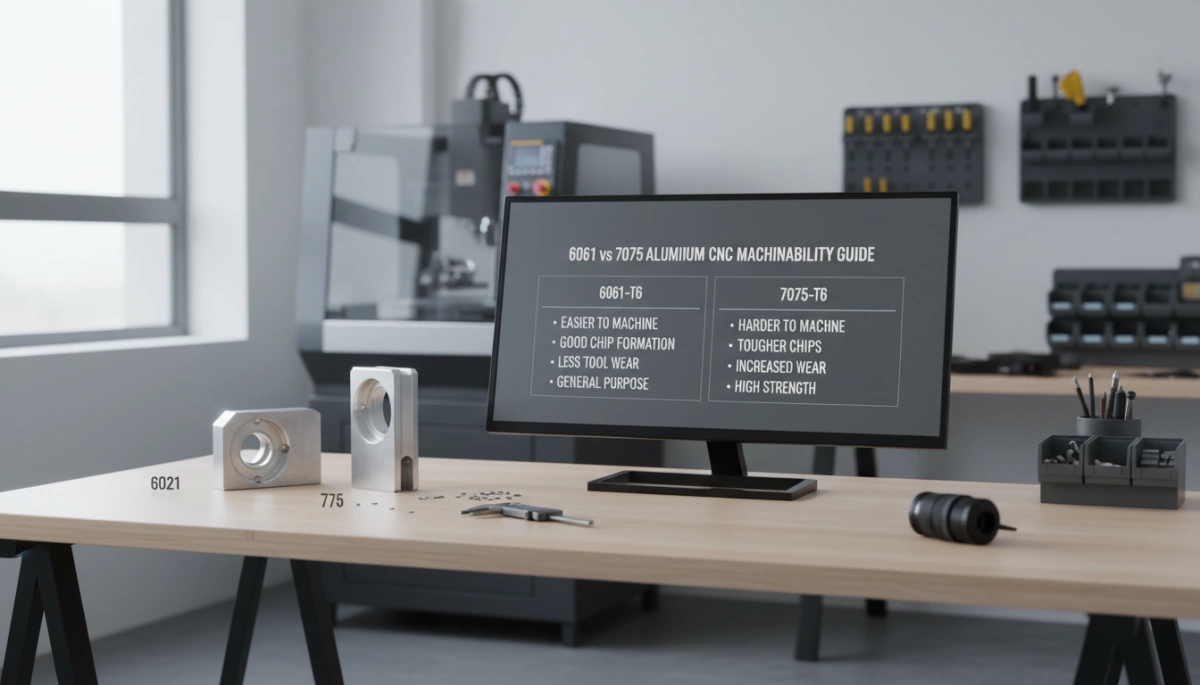
When we run these materials through our CNC centers, the difference in behavior is immediate. While both alloys are considered "free-machining," they require distinct strategies to achieve optimal results.
Dealing with the 'gumminess' of 6061
6061 aluminum has a machinability rating of roughly 90%, but its softer nature presents a specific challenge: gumminess. During milling, the material tends to smear or stick to the cutting tool rather than breaking away cleanly. This phenomenon, known as Built-Up Edge (BUE), can ruin surface quality if not managed correctly.
To counter this in our factory, we use:
- Sharp, polished tooling (typically 2- or 3-flute end mills).
- High-pressure flood coolant to evacuate chips instantly.
- Aggressive chip loads (0.05–0.25 mm) to shear the metal cleanly rather than rubbing it.
Why 7075 offers superior surface finish quality
If your part requires a pristine, cosmetic look right off the machine, 7075 is often the better choice. Because it is harder and more brittle, it fractures into small, clean chips. This "chip-breaking" action prevents material from re-welding to the part surface.
Consequently, 7075 delivers a smoother natural finish with lower roughness values. Understanding how surface roughness (Ra) impacts part performance is critical for high-precision mating components, where 7075 often eliminates the need for extra polishing steps.
ZSCNC insight: Adjusting feed rates for precision
At ZSCNC, we adjust our parameters based on the alloy's hardness. While 7075 gives a better finish, it is abrasive and wears out tools faster. We balance speed and tool life to keep costs down for you.
Machining Parameter Cheat Sheet:
| Feature | 6061 Aluminum | 7075 Aluminum |
|---|---|---|
| Chip Character | Stringy, gummy | Short, brittle |
| Tool Wear | Low | Moderate to High |
| Surface Speed (SFM) | High (800–1200) | Moderate |
| Primary Risk | Material welding to tool (BUE) | Rapid tool dulling |
| Best For | High-volume production runs | Complex parts requiring tight tolerances |
Comparison Factor 3: Corrosion Resistance & Anodizing
When manufacturing parts for outdoor or marine environments, corrosion resistance is often the deciding factor. While both alloys are aluminum, their reaction to the elements—and to surface treatments—differs significantly due to their chemical makeup.
Corrosion Resistance Capabilities of 6061
For general applications, 6061 aluminum is the superior choice regarding corrosion resistance. Its magnesium and silicon composition creates a natural oxide layer that protects the material from rust and degradation. This makes it the go-to material for our clients needing aluminum CNC milling services for machinery parts exposed to moisture or varying weather conditions. It holds up exceptionally well in its raw state, though we almost always recommend anodizing to extend its lifespan further.
Challenges with Anodizing Aluminum 7075
While 7075 aluminum is incredibly strong, its high copper content (zinc is the primary alloying element, but copper is significant) makes it much more susceptible to corrosion compared to 6061. Without a protective coating, 7075 will corrode relatively quickly in harsh environments.
Regarding surface finishing, 7075 presents unique challenges:
- Anodizing Consistency: 7075 can be anodized, but the result is often less consistent than 6061. The high zinc and copper content can lead to a yellowish or "off" tint, especially with clear anodizing.
- Color Matching: Achieving vibrant, uniform colors is harder with 7075. If cosmetic appearance is critical for your automotive aluminum parts, 6061 is generally safer.
- Protection Requirement: For 7075, Hard Anodizing (Type III) is often required not just for wear resistance, but to provide a necessary barrier against corrosion that the alloy lacks naturally.
| Feature | 6061 Aluminum | 7075 Aluminum |
|---|---|---|
| Natural Corrosion Resistance | Excellent (Good for outdoor/marine use) | Fair/Poor (Prone to corrosion without coating) |
| Anodizing Response | Excellent (Accepts clear & color well) | Good (Colors may vary; often yellowish) |
| Primary Alloy Risks | Minimal | High Copper/Zinc content leads to oxidation |
| Recommended Finish | Type II (Decorative) or Type III (Hard) | Type III (Hard Coat) essential for protection |
Comparison Factor 4: Weldability & Fabrication
When your project involves joining parts together, the choice between these two alloys becomes black and white. If your design relies on welding, you need to know exactly how these materials react under heat.
Weldability of Aluminum Alloys: Why 6061 Wins
For fabrication projects that require welding, 6061 aluminum is the undisputed champion. It is highly weldable using standard techniques like TIG (Tungsten Inert Gas) or MIG (Metal Inert Gas). Whether you are building structural frames, bicycle chassis, or custom brackets, 6061 accepts the weld pool cleanly and maintains decent strength in the heat-affected zone, especially when post-weld heat treatment is applied.
Because of this versatility, we frequently recommend 6061 for custom aluminum CNC machining parts that will later be assembled into larger welded structures. It behaves predictably, making it the go-to for general fabrication.
The Cracking Risks of Welding 7075
In contrast, 7075 aluminum is generally considered unweldable for most commercial applications. The high zinc and copper content that gives 7075 its incredible strength also makes it extremely susceptible to hot cracking (micro-cracks forming as the weld solidifies).
Trying to weld 7075 often results in:
- Micro-cracking: Invisible structural weaknesses that fail under load.
- Stress Corrosion: The heat destroys the temper, significantly lowering corrosion resistance.
- Brittle Joints: The welded area becomes the weakest point of the part.
If you need the strength of 7075 but require assembly, we advise using mechanical fasteners (bolts, rivets) or industrial adhesives rather than welding.
| Feature | 6061 Aluminum | 7075 Aluminum |
|---|---|---|
| Weldability | Excellent (TIG/MIG compatible) | Poor (Not recommended) |
| Joining Method | Welding, Brazing, Soldering | Bolts, Rivets, Adhesives |
| Fabrication Risk | Low (Forgiving material) | High (Prone to cracking) |
Comparison Factor 5: Cost Analysis

When budgeting for a CNC project, the choice between 6061 and 7075 aluminum often comes down to a balance of performance versus price. For many of our clients at ZSCNC, understanding where the money goes—raw materials versus machining time—is critical for cost-effective manufacturing.
Raw Material Cost Differences
There is a distinct price gap here. 7075 aluminum is significantly more expensive than 6061. Because 7075 contains high amounts of zinc and copper, and undergoes a more complex heat treatment process to achieve its high strength, the raw stock costs more to produce.
- 6061 Aluminum: Generally the most economical choice. It is widely available and standard for general-purpose parts.
- 7075 Aluminum: Can cost 2 to 3 times more than 6061 depending on the form (plate vs. bar) and market conditions.
If your part doesn't require the extreme yield strength of 7075, sticking with 6061 is the easiest way to reduce machining costs for low-volume automotive CNC parts or general prototypes.
Machining Cost and Tool Wear Considerations
Beyond just the price of the metal block, the actual machining process impacts the final quote.
- Machinability: While 7075 cuts cleanly and offers a superior surface finish with less effort, it is harder. This increased hardness can lead to faster tool wear compared to the softer 6061.
- Production Speed: 6061 is softer but can be "gummy," meaning we sometimes have to adjust feeds and speeds to prevent material from building up on the tool edge. However, its overall softness usually allows for faster bulk material removal.
| Cost Factor | 6061 Aluminum | 7075 Aluminum |
|---|---|---|
| Raw Material Price | Low ($) | High ($$$) |
| Tool Life | Longer life (less abrasive) | Shorter life (harder material) |
| Machining Speed | Fast (high removal rates) | Moderate (requires rigid setup) |
| Overall Part Cost | Budget-Friendly | Premium |
For most commercial projects, 6061 is the cost-efficiency champion. We typically recommend reserving 7075 for parts where the high strength-to-weight ratio is absolutely non-negotiable, such as in aerospace or high-stress robotics.
Application Scenarios: When to Choose Which?
Deciding between 6061 vs 7075 aluminum usually comes down to the specific demands of the final operating environment. At ZSCNC, we see thousands of designs pass through our shop floor, and the choice is rarely difficult once you understand the "personality" of each alloy. 6061 is your reliable daily driver, while 7075 is the high-performance race car.
Best Use Cases for 6061 Aluminum (Enclosures, Frames)
6061-T6 is the undisputed workhorse of the machining world. Because it offers excellent corrosion resistance and weldability at a lower price point, it is the default choice for general-purpose structural applications. If your part needs to be welded or will be exposed to the elements without a hard-coat anodize, 6061 is usually the correct path.
We frequently machine 6061 for:
- Electronic Hardware: Custom enclosures, heat sinks, and mounting plates.
- Automotive Components: Chassis parts, brackets, and fluid fittings where our CNC machining services for automotive aluminum parts ensure high precision and durability.
- Construction & Architecture: Window frames, structural tubing, and platforms.
- Consumer Goods: Camera lenses, couplings, and marine fittings.
Best Use Cases for 7075 Aluminum (Aerospace, Gears)
7075-T6 is reserved for when high strength-to-weight ratio is the critical factor. It is significantly stronger than 6061—comparable to some steels—but it comes with higher material costs and lower corrosion resistance. You choose 7075 when the part will be under immense cyclic stress or when you need to shave off weight without sacrificing structural integrity.
Typical applications for 7075 include:
- Aerospace & Defense: Wing spars, fuselage frames, and missile components.
- High-Stress Machinery: Gears, shafts, and worm wheels.
- Sports Equipment: High-end bicycle frames, rock climbing carabiners, and hang glider airframes.
- Mold Making: Blow molding tools and injection mold bases due to its hardness and polishability.
Quick Selection Guide
| Feature | Choose 6061 Aluminum If... | Choose 7075 Aluminum If... |
|---|---|---|
| Primary Goal | Cost-efficiency and versatility | Maximum strength and weight reduction |
| Fabrication | You need to weld the parts | You are machining complex, high-stress geometries |
| Environment | Exposed to moisture/weather (corrosion concern) | Controlled environment or high-wear friction zones |
| Budget | Standard budget constraints | Performance justifies a higher material cost |
ZSCNC’s Approach to Aluminum Machining
At ZSCNC, we don't just cut metal; we engineer solutions. Whether you are leaning towards the versatility of 6061 aluminum or the sheer strength of 7075 aluminum, our process is built to extract the best performance from the material. We understand that the difference between a functional part and a failed component often comes down to how the material was handled during production.
Quality Control and Material Verification
The foundation of precision machining is knowing exactly what you are putting into the machine. We implement rigorous material verification protocols for every batch of stock we receive.
- Material Certification: We verify mill test reports to ensure the chemical composition matches the specific alloy standards (ASTM, AMS).
- Pre-Machining Inspection: We check for surface defects or inconsistencies in the raw stock that could affect the final structural integrity.
- In-Process Monitoring: Our quality control team uses CMM (Coordinate Measuring Machines) to ensure tolerances are held tight from the first cut to the final pass.
Precision Capabilities for Complex Geometries
Machining aluminum, especially the harder 7075-T6, requires a specific approach to tool pathing and speed. Our facility is equipped with advanced multi-axis CNC centers capable of handling complex geometries without sacrificing speed or finish.
- Optimized Feed Rates: We adjust our cutting parameters based on the specific alloy. For 6061, we manage chip evacuation to prevent "gumming," while for 7075, we focus on rigidity to handle higher cutting forces.
- Tight Tolerances: We routinely achieve tolerances as tight as +/- 0.005mm, essential for aerospace and high-performance automotive applications.
- Surface Finish Excellence: By using high-speed machining techniques and dedicated tooling for aluminum, we deliver superior surface finishes straight off the machine, reducing the need for extensive post-processing.
Frequently Asked Questions
Is 7075 stronger than steel?
It depends on the specific steel alloy, but 7075-T6 is remarkably competitive. With a tensile strength reaching up to 83,000 psi (572 MPa), 7075-T6 is actually stronger than many common low-carbon steels and comparable to some stainless steels. However, the real advantage lies in its strength-to-weight ratio. While it may not match the absolute hardness of hardened tool steel, 7075 delivers steel-like strength at roughly one-third the weight, making it the preferred choice for aerospace components where every gram counts.
Can you anodize 7075 aluminum?
Yes, you can, but the results differ from 6061. Due to its high zinc content, 7075 can be more challenging to anodize consistently. The zinc can cause the anodized layer to appear yellowish or inconsistent in color, especially with clear or bright dyes. However, hard-coat anodizing (Type III) works quite well on 7075 and is often used to improve wear resistance, even if the aesthetic finish isn't as uniform as what you would achieve with 6061.
Why is 7075 so expensive?
The price premium comes down to composition and processing difficulty. 7075 contains high levels of zinc and copper, which are more expensive alloying elements than the magnesium and silicon found in 6061. Furthermore, the manufacturing process for 7075 is more complex; it is harder to extrude and requires more rigorous heat treatment cycles to achieve the T6 temper. Finally, because it is harder to machine, it wears down cutting tools faster, indirectly adding to the total production cost compared to the more economical 6061.
 English
  German
  Dutch
Dutch  Russian
  Czech
Czech  French
  Korean
  Japanese
  Spanish
  Portuguese