
Understanding the Contenders: Definitions & Kinematics
Choosing between 5-axis simultaneous machining and multi-axis turning often comes down to understanding how the machine moves relative to the workpiece. At ZS CNC, we utilize both technologies to achieve tolerances as tight as ±0.005mm, but the starting point for your part design dictates which machine we use.
What is 5-Axis CNC Milling?
In 5-axis milling, the workpiece remains stationary (or rotates on a trunnion table) while the cutting tool moves with extreme freedom. The machine operates on three linear axes (X, Y, Z) and two rotational axes (A and B/C) simultaneously.
- Kinematics: The cutting tool can approach the part from virtually any direction.
- Primary Focus: Prismatic parts. Think of block-like geometries with complex contours, undercuts, or features on multiple faces.
- Key Advantage: We can machine five sides of a part in a single setup, eliminating the need for manual fixturing changes. This is critical for complex aerospace components and medical implants where accuracy is non-negotiable.
What is Multi-Axis Turning (Mill-Turn)?
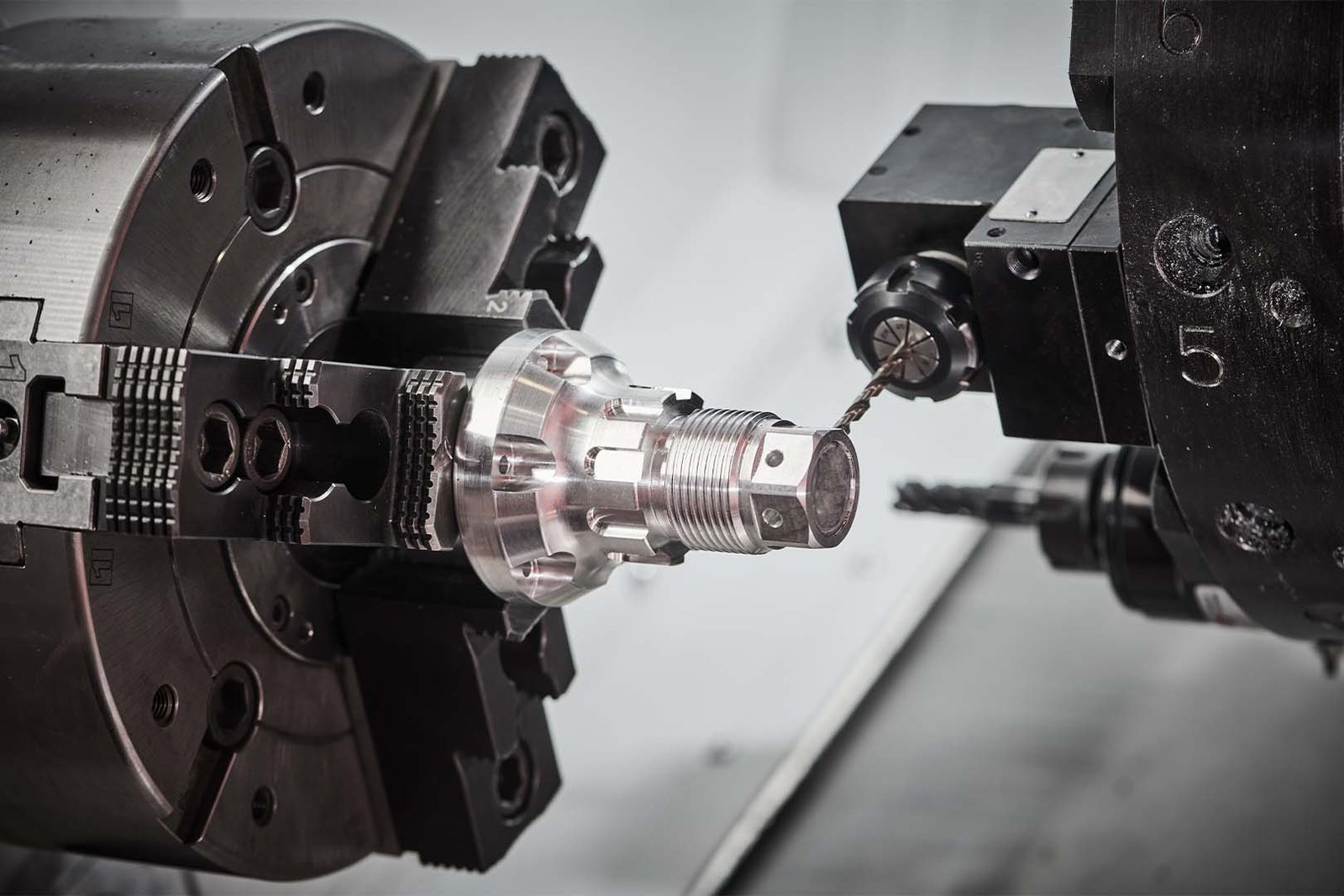
Multi-axis turning, often performed on a live tooling lathe, flips the script. Here, the workpiece spins at high speeds (like a traditional lathe) to create cylindrical features, but the machine is equipped with powered milling tools and often a Y-axis or sub-spindle.
- Kinematics: The part rotates for turning operations, while live tools engage to mill flats, drill cross-holes, or cut slots without removing the part from the chuck.
- Primary Focus: Cylindrical parts with secondary features. If your part looks like a shaft or a complex bolt, this is the route.
- Key Advantage: Done-in-one machining. We go from raw bar stock to a finished component in one cycle, drastically reducing handling time and ensuring concentricity between turned and milled features.
The Decision Matrix: How to Choose the Right Process
Deciding between 5 axis machining vs multi-axis turning isn't about guessing; it comes down to specific engineering and economic constraints. At ZSCNC, we analyze four critical pillars to determine the most efficient manufacturing route for your components.
1. Part Geometry (The #1 Factor)
The shape of your raw material and the final part is the primary filter. We look at the dominant features of the design:
- Cylindrical Dominance: If the part is round, shaft-like, or requires perfect concentricity, multi-axis turning (or Mill-Turn) is the winner. Spinning the part against a stationary tool is always faster for removing material from a cylinder.
- Prismatic Dominance: If the part is blocky, flat, or has complex organic surfaces (like an impeller or a hip implant), 5-axis simultaneous machining is the standard.
- Complex Geometry Manufacturing: When you have a square block that needs holes drilled at compound angles, 5-axis milling is the only logical choice. Conversely, if you have a shaft that needs a keyway and side holes, a live tooling lathe handles this in a single operation without moving the part.
2. Production Volume & Speed
Volume dictates the machine architecture we select.
- High Volume (1,000+ parts): Multi-axis turning centers equipped with bar feeder manufacturing capabilities are unbeatable here. We can feed long bars of stock, machine the part, cut it off, and grab it with a sub-spindle. This automation drastically reduces CNC production cycle time.
- Low Volume / High Mix: For prototyping or small batches, 5-axis milling often wins. The setup is generally more flexible. While a mill-turn machine is faster per part, the setup time to align bar feeders and synchronize spindles can take hours. 5-axis offers significant setup time reduction for short runs.
3. Accuracy & Surface Finish
Both processes aim for done-in-one machining, which means we finish the part without moving it to a second machine. This eliminates "stack-up errors" caused by re-fixturing.
- Tolerance: Both machines hold tight CNC machining tolerance standards (often ±0.005mm). However, turning centers generally hold better roundness and concentricity.
- Finish: The toolpath matters. Turning produces a continuous spiral finish, which is excellent for sealing surfaces. Milling produces scallops. Understanding the influence of surface roughness Ra on performance is vital; if your part requires a specific texture for friction or sealing, that requirement might dictate the machine choice regardless of geometry.
4. Cost Implications
Is 5-axis machining always more expensive? Not necessarily, but machine hourly rates differ.
- 5-Axis Milling: Typically has a higher hourly rate due to machine complexity. Best for high-value complex parts where multiple setups on a 3-axis machine would kill profitability.
- Mill-Turn: Often has a lower cost-per-part in volume due to speed, but higher initial programming costs.
If you are looking to reduce machining cost for low-volume automotive CNC parts, choosing the process that minimizes fixture costs is key.
Quick Comparison: 5-Axis Mill vs. Multi-Axis Lathe
| Feature | 5-Axis Machining | Multi-Axis Turning (Mill-Turn) |
|---|---|---|
| Primary Shape | Boxy, Flat, Complex Contours | Round, Cylindrical, Shafts |
| Stock Material | Cut Blocks / Castings | Bar Stock / Billets |
| Best For Volume | Low to Medium | Medium to High |
| Surface Finish | Milled Finish (Scallops) | Turned Finish (Smooth) |
| Key Advantage | Complex 3D Contouring | Rapid Material Removal |
Real-World Industry Applications
When deciding between 5 axis machining vs multi‑axis turning, looking at industry standards often gives the clearest answer. Different sectors prioritize specific geometries and production speeds, which naturally dictates the machinery we use on the shop floor.
Aerospace & Medical (5-Axis Dominance)
In industries where safety and precision are non-negotiable, 5-axis milling is usually the king. This is because parts in these sectors—like turbine blisks or titanium knee implants—feature highly complex, organic curves rather than simple round shapes.
Aerospace component machining requires the tool to approach the workpiece from unique angles to carve out deep pockets and undercuts. We use 5-axis simultaneous machining here because it maintains optimal cutting conditions along complex contours without multiple setups. Similarly, medical device startups rely on CNC machining to produce intricate surgical tools and prototypes that demand exceptional surface finishes and tight tolerances that standard turning centers can't achieve on prismatic shapes.
Key characteristics for this group:
- Complex Geometry Manufacturing: Handling free-form surfaces and non-cylindrical shapes.
- Low to Medium Volume: Focus is on high value and precision over mass production speed.
- Material Hardness: Often machining superalloys and medical-grade titanium.
Automotive & Robotics (Multi-Axis Turning Dominance)
Conversely, the automotive and robotics sectors are dominated by parts that rotate—drive shafts, pistons, gears, and hydraulic cylinders. For these cylindrical components, multi-axis turning (or mill-turn) is the superior choice.
Using a machine with sub-spindle turning operations allows us to machine the front and back of a part in a single cycle. For example, precision shaft machining for a robotic arm often involves turning the diameter and then using live tooling to mill keyways or drill cross-holes. This "done-in-one" capability drastically reduces cycle time. When we provide CNC turning services for automotive clients, the priority is efficient material removal from round stock while maintaining concentricity.
Key characteristics for this group:
- Cylindrical Dominance: Parts start as round bar stock.
- High Volume Production: Mill-turn centers paired with bar feeders offer rapid throughput.
- Combined Operations: Turning is the primary process, with milling as a secondary feature.
When to Use a Hybrid Approach (Mill-Turn Centers)
Sometimes the best solution isn't choosing between a dedicated mill or a lathe—it's using a machine that does both simultaneously. We call these multi-tasking machine tools, and they bridge the gap between 5-axis milling and standard turning. If your part is primarily cylindrical but features complex off-axis holes, pockets, or irregular contours, a hybrid mill-turn center is often the most efficient choice.
The biggest advantage here is Done-in-one machining. We load the raw material, and the machine performs both the turning operations and the 5-axis simultaneous machining tasks in a single setup. This eliminates the need to manually move the part from a lathe to a mill, which drastically cuts down on handling time and potential errors.
Why we recommend Mill-Turn Centers:
- Setup Time Reduction: By consolidating operations, we avoid the downtime associated with multiple fixtures.
- Enhanced Precision: Every time a part is re-fixtured, you risk losing tolerance. Keeping the part in one chuck (or passing it to a sub-spindle turning operation) guarantees superior concentricity.
- Complex Geometry Handling: For components like intricate transmission shafts, utilizing 5-axis CNC gear machining services on a mill-turn machine ensures the gear profile aligns perfectly with the turning axis.
This approach is ideal when you need the speed of a live tooling lathe combined with the geometric freedom of a mill. If you are seeking a China custom CNC machining supplier for overseas buyers to handle parts that don't fit neatly into just "milling" or "turning" categories, this hybrid technology offers the best balance of speed, cost, and accuracy.
Why Partner with ZSCNC for Complex Machining?
Choosing between 5 axis machining and multi-axis turning isn't just about machine capabilities; it's about finding a partner who understands the nuances of your design. At ZS CNC, we operate as an extension of your engineering team, leveraging ISO 9001:2015 certified processes to deliver high-precision parts. We don't just manufacture; we optimize.
Unbiased DFM Analysis
Many shops will push you toward the machines they have available, regardless of efficiency. Because ZS CNC houses both advanced 5-axis simultaneous machining centers and high-speed live tooling lathes, our advice is completely objective. We evaluate your CAD files based strictly on geometry and volume to determine the most cost-effective production route.
When you upload your design to our online portal, our engineers provide comprehensive DFM feedback to highlight potential manufacturing risks. Whether your part requires the intricate contouring of our 5-axis CNC machining services for complex aluminum parts or the rapid cycle times of a mill-turn center, we guide you toward the method that balances precision with budget.
Capacity & Precision
Complex geometries demand tight tolerances, and we deliver consistently. Our facility is equipped to handle complex geometry manufacturing with tolerances as tight as ±0.005mm. We process a vast range of materials, from standard Aluminum 6061 and 7075 to difficult-to-machine alloys like Titanium, Stainless Steel (303, 304, 316), and engineering plastics like PEEK and POM.
- High-Speed Production: We offer quotes in as little as 1 hour.
- Rapid Turnaround: Get production-grade parts in just 3–7 days.
- Quality Assurance: Every part undergoes rigorous inspection to ensure it meets your exact specifications before shipping.
One-Stop Shop
Managing multiple vendors for a single project introduces unnecessary risk and delays. ZS CNC provides a complete done-in-one machining solution. From the initial rapid prototyping phase to full-scale low-volume production, we handle everything under one roof.
Beyond machining, we offer extensive surface finishing options—including anodizing, plating, passivation, and polishing—ensuring your parts arrive ready for assembly. By consolidating these steps, we reduce lead times and ensure accountability from the raw material stage to the final cosmetic finish. For deeper insights into how material choice impacts production speed, review our guide on Aluminum 6061 machinability and DFM, which breaks down how design choices influence tooling costs.
Checklist: Quick Selection Guide
Choosing between 5 axis machining vs multi‑axis turning often comes down to the fundamental "DNA" of your part—specifically its shape and the required production volume. While both methods at ZS CNC utilize advanced technology to achieve tolerances as tight as ±0.005mm, aligning the process with the part geometry is the key to cost efficiency and setup time reduction.
Use this quick checklist to determine the best manufacturing route for your project:
When to Choose 5-Axis Milling
- Geometry: The part is prismatic (block-shaped or non-round) rather than cylindrical.
- Complexity: You require complex geometry manufacturing, such as impellers, turbine blades, or medical implants with organic curves.
- Access: The design demands machining on five or more sides, requiring the cutter to approach the workpiece from unique angles to avoid collisions.
- Service: You need high-end 5-axis CNC machining services for parts that cannot be held in a standard lathe chuck.
When to Choose Multi-Axis Turning (Mill-Turn)
- Geometry: The part is primarily cylindrical or requires rotational symmetry as its base feature.
- Features: You need precision shaft machining combined with secondary off-center features like drilled cross-holes, milled flats, or slots.
- Volume: You are running a larger batch size where bar feeder manufacturing can automate material loading for continuous operation.
- Efficiency: The goal is done-in-one machining for round parts, eliminating the need to move the workpiece to a separate mill for finishing.
If your part sits somewhere in the middle—or if you are unsure which method yields the best ROI—our engineering team provides unbiased DFM (Design for Manufacturing) feedback to steer you toward the most economical solution.
Frequently Asked Questions (FAQs)
Is 5-axis machining always more expensive?
Not necessarily. While the hourly machine rate for 5-axis simultaneous machining is higher than a standard 3-axis mill, the efficiency gains often offset the cost. By completing complex parts in a single setup, we achieve significant setup time reduction and eliminate the labor costs associated with manually flipping parts. For intricate designs, our advanced 5-axis machining services often prove cheaper per unit than running multiple operations on simpler machines.
Can a mill-turn machine handle square stock?
Yes, a mill-turn machine can handle square stock, though round bar is the industry standard. We can use specialized collets or bar feeders to accommodate square material. However, in many cases involving prismatic vs cylindrical parts, it is more efficient to start with round stock and mill the flat features using the machine's live tooling capabilities.
Which process offers tighter tolerances?
Both processes meet rigorous CNC machining tolerance standards, but they excel in different areas.
- Multi-Axis Turning: Superior for cylindrical features, offering unmatched concentricity and roundness for precision shaft machining.
- 5-Axis Milling: The winner for true position tolerances on complex 3D contours and features located on multiple faces of the part.
 English
  German
  Dutch
Dutch  Russian
  Czech
Czech  French
  Korean
  Japanese
  Spanish
  Portuguese