

What Is Small-Batch CNC Machining?
Definition and Production Quantities
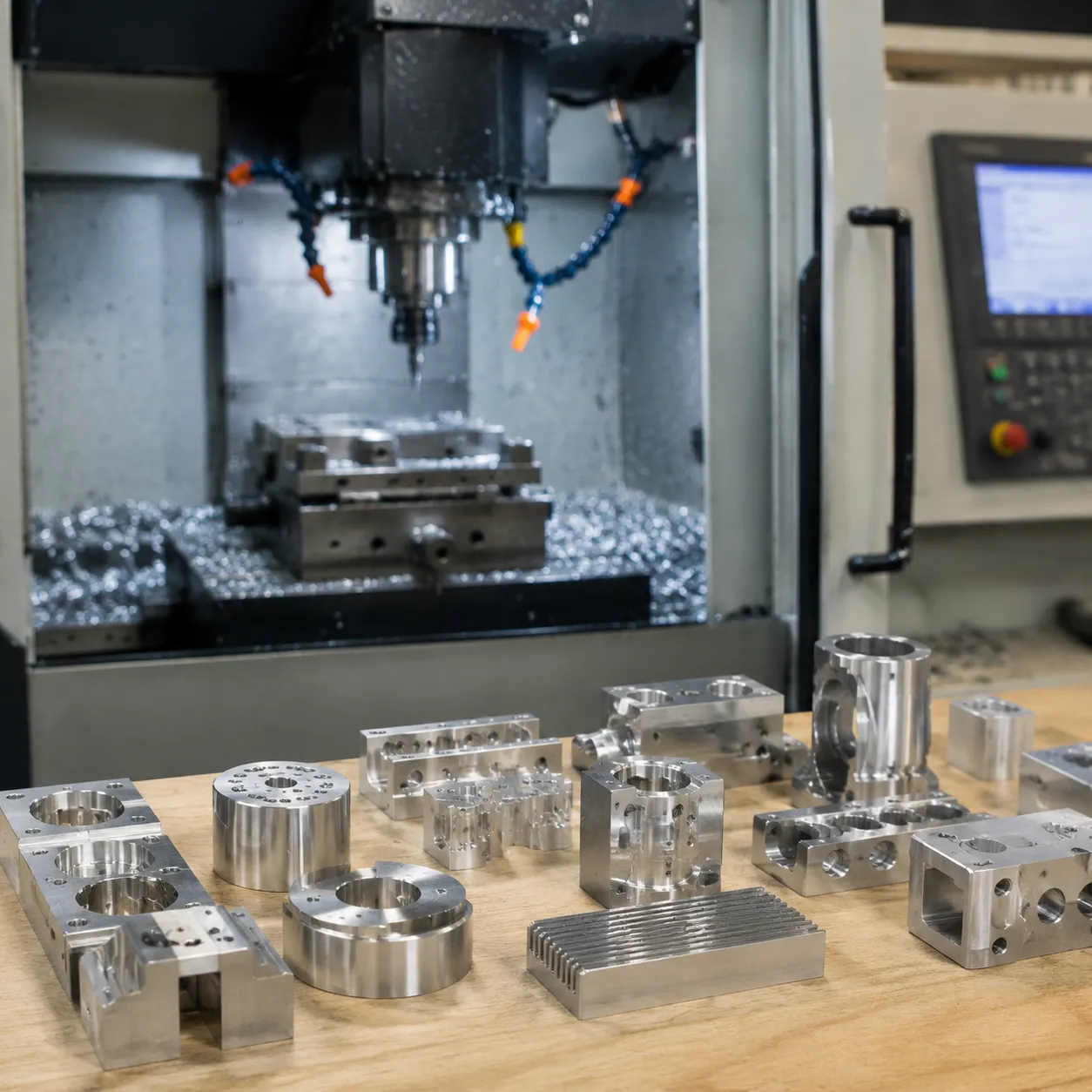
Small-batch CNC machining is the targeted production of custom parts in low volumes using computer-controlled (CNC) equipment. Instead of committing to expensive tooling and massive series production, we focus on small quantity CNC part processing—typically anywhere from a single prototype up to a few hundred units per run.
In practice, small-batch CNC machining is ideal for:
– Rapid prototyping of new designs
– Low-volume manufacturing before full-scale launch
– Bridge production between prototype and mass production
– Specialized, custom parts that will never reach large volumes
With modern multi-axis milling and CNC turning centers, we can switch quickly from one design to another, deliver precise parts in small lots, and provide an accurate CNC part quotation even for highly complex geometries.
How It Differs from Large-Scale Production
Small-batch CNC machining differs from traditional large-scale production in several critical ways:
-
- No expensive molds or long tooling cycles
Large-scale processes like die casting or injection molding need high upfront investment and long lead times. Small-batch CNC relies on flexible programming, making it perfect for frequent design changes and short production runs. - Faster lead times and CAD iteration
Because setup is lighter and programming is digital, we can move from CAD file to finished parts quickly, enabling rapid design iteration and online manufacturing workflows with near-instant quotes. - Higher flexibility, lower risk
Small quantity CNC part processing lets you test designs, validate performance, and refine geometry before committing to full series production. You avoid overstock, reduce inventory risk, and keep engineering changes under control. - Cost structure built around machining time, not volume
In large-scale production, unit cost drops dramatically with quantity. In small-batch CNC, the focus is on optimizing machining strategies, material selection (for example, 6061 aluminum for a strong yet cost-effective choice), and smart fixturing to keep low-volume runs economical.
- No expensive molds or long tooling cycles
This approach gives product teams, hardware startups, and global manufacturers a reliable way to get custom parts quickly, without locking themselves into expensive, inflexible large-scale processes.
Key Benefits of Small Quantity CNC Part Processing
When you’re pushing a new product to market or updating an existing design, small-batch CNC part processing gives you speed, control, and cost clarity. I run my operation around these core benefits because this is exactly what global customers care about: faster launches, lower risk, and predictable CNC part quotation.
Accelerated Product Development and CAD Iteration
With small quantity CNC part processing, you move from CAD model to physical custom parts in days, not months.
How it speeds up development:
-
- Rapid prototyping: Test fit, function, and assembly quickly before you commit to series production or tooling.
- Fast CAD iteration: Update your 3D model, send a new file, get revised parts cut on the same equipment.
- Short lead times: No need for molds or dies; multi-axis milling and turning jump straight from CAD to chip-cutting.
Typical workflow
| Step | What happens | Impact on lead time |
|---|---|---|
| CAD file upload | You send STEP/IGES drawings | Same day review/DFM feedback |
| CNC part quotation | We cost materials + machining time | Often within 24 hours |
| Programming & setup | CAM programming + machine setup | Hours instead of weeks |
| Machining & inspection | First article parts produced and checked | 2–7 days for most low volumes |
This kind of rapid prototyping and low-volume manufacturing lets you validate form, fit, and function early, then scale only when the design is locked.
Reduced Inventory and Minimal Material Waste
Small-batch CNC machining helps you avoid tying up cash in stock you don’t need.
Inventory and waste advantages:
-
- Make only what you need: Order 5, 20, or 50 parts instead of minimums in the thousands.
- Lower storage risk: Less space, less handling, and less risk of design changes making stock obsolete.
- Optimized raw material use: We plan bar and plate nesting to cut 6061 aluminum, steels, and plastics with minimal offcuts.
Cost impact overview
| Area | High-volume production | Small-batch CNC part processing |
|---|---|---|
| Inventory cost | High (large upfront purchase) | Low (produce on demand) |
| Obsolescence | High risk if design changes | Low risk; design updates each batch |
| Material waste | Higher if over-ordered | Controlled via accurate batch planning |
With smart programming and material planning, we keep material waste and your working capital locked in inventory to a minimum.
Cost-Effectiveness for Prototypes and Low Volumes
For prototypes and short runs, small quantity CNC part processing is usually cheaper and less risky than tooling-based methods like casting or injection molding.
Why it’s cost-effective at low volume:
-
- No tooling investment: You pay for machine time and material, not expensive molds.
- Transparent cost calculator logic: Every CNC part quotation is built on setup time, cycle time, and raw material cost.
- Easy budget control: You see exactly how each design change affects price.
Relative cost comparison (per part)
| Volume range | CNC machining (per part) | Tooling-based (per part) | Best choice |
|---|---|---|---|
| 1–10 pcs | Moderate | Very high | CNC machining |
| 10–200 pcs | Competitive | High | CNC machining / bridge runs |
| 500+ pcs | Higher per part | Lower after tooling cost | Depends on lifetime and budget |
We machine a lot of prototype and pilot-run parts in aluminum and plastics. For example, our custom CNC machining of plastic parts is specifically tuned for functional prototypes and short-run end-use parts in automation and medical devices.
Flexibility to Handle Engineering Changes
Designs change. That’s normal. Small-batch CNC part processing is built to handle that without blowing up your schedule.
How we stay flexible:
-
- Digital programs: Changes to hole size, pocket depth, or fillets are updated in CAM and pushed straight to the machine.
- Short batch cycles: You’re rarely stuck with outdated stock; each batch reflects your latest CAD.
- Quick ECO response: Engineering Change Orders (ECOs) are implemented between batches or even mid-run if needed.
Change handling at a glance
| Change type | Typical handling approach | Impact on lead time |
|---|---|---|
| Dimensional tweak (e.g., ±0.1) | CAM update, no fixture change | Minimal impact |
| New feature (extra hole/pocket) | Program update + possible re-fixture | Slight lead time and cost increase |
| Material switch (e.g., to 6061 aluminum) | New material sourcing + re-optimization | Moderate but controlled impact |
This flexibility is especially valuable in industries like automotive and aerospace where requirements evolve fast. For example, in our aluminum CNC machining parts supplier service, we routinely adapt small batches to new drawings without forcing clients into new tooling or long delays.
Small-batch CNC part processing gives you real-world parts fast, keeps costs in check at low volumes, and stays flexible enough to follow your design—wherever it goes.
Core Processes and Capabilities for CNC Part Processing
When you’re ordering small-batch CNC part processing, you’re really buying three things: machining capability, process consistency, and repeatable quality. I set up my shop to focus on small quantity CNC part processing, rapid prototyping, and low-volume manufacturing, so every process is tuned for fast turnarounds, stable tolerances, and predictable CNC part quotations.
Custom CNC Milling (Aluminum, Steel, and Plastics)
For custom parts in low volumes, CNC milling is usually the workhorse: flat faces, pockets, slots, threads, and complex 3D surfaces. I rely heavily on multi-axis milling to keep setups low and accuracy high, especially on complex geometries.
Typical capabilities for small-batch CNC milling:
-
- Materials
- Aluminum alloys (including 6061 aluminum for general-use parts and high dimensional stability)
- Carbon steel and alloy steel for stronger, load-bearing parts
- Stainless steels for corrosion resistance in automotive, medical, and food equipment
- Engineering plastics (POM/Delrin, nylon, ABS, PC, PEEK) for lightweight or non-conductive components
- Part types
- Structural brackets, housings, plates, fixtures, and jigs
- Precision bearing seats, handles, and ergonomic parts (similar to our custom CNC aluminum jump rope handle with tight turning and milling features: precision aluminum handle machining)
- Functional prototypes that match production-level quality for testing and validation
- Process focus for small batches
- Quick CAM programming for frequent CAD updates and design changes
- Tooling strategies optimized for low-volume manufacturing, not mass production
- Stable setups to maintain repeatability from prototype to small series production
If your CAD includes 3D surfaces, undercuts, or combined milled/turned features, multi-axis CNC milling is what keeps costs controlled and lead times short on small-batch orders.
Precision CNC Turning and Lathe Operations
Whenever a part is primarily round—shafts, spacers, bushings, threads, bearing seats—precision CNC turning is usually more efficient and more accurate than milling alone. For small quantity CNC part processing, I use turning to keep cycle times down and surface finish consistent across batches.
Key turning capabilities:
-
- Typical turned parts
- Shafts, axles, pins, and rollers
- Precision spacers and sleeves
- Threaded connectors, fittings, and custom fasteners
- Operations handled in one setup
- OD/ID turning, grooving, and threading
- Boring and facing
- Drilling, tapping, and light milling on live-tool lathes
- Why it matters for small batches
- Lower machining time per part versus milling round features
- Better dimensional control on diameters, concentricity, and runout
- Easier repeatability if you need to reorder the same custom parts later
When the job needs both turning and milling, I combine lathe work with secondary milling or multi-axis setups, so small runs stay cost-effective without sacrificing precision.
Tolerances, Inspection, and Quality Control Standards
Small-batch CNC part processing doesn’t mean “loose” standards. For me, small quantity CNC part processing has to hit the same quality as larger series production, especially for automotive, medical, and industrial customers who rely on repeat orders.
Typical tolerance and QC approach:
-
- Standard tolerances
- General CNC machining: ±0.05 mm (±0.002″) on most features
- Tighter features: down to ±0.01 mm (±0.0004″) on critical areas, depending on material and geometry
- Threads and fits controlled per ISO/metric or inch standards as specified in your drawings
- Inspection tools and methods
- Calipers, micrometers, height gauges, and bore gauges for everyday dimensional checks
- Gauges for threads and fits on shafts and holes
- First Article Inspection (FAI) on initial parts for new small-batch CNC jobs
- Quality control flow
- Drawing and CAD review before machining to avoid tolerance conflicts
- In-process checks during machining for critical dimensions
- Final inspection and documentation as required by your industry
For materials like aluminum, I also pay attention to stress relief and dimensional stability, especially when machining from high-stress plate or bar stock. If you are sensitive to warping or tight flatness requirements, my process references best practices similar to those described in our guide on 6061-T651 vs 6061-T6 aluminum for CNC parts: aluminum stress relief and dimensional stability.
By combining capable milling and turning with disciplined tolerances and inspection, I keep small-batch CNC part processing reliable, predictable, and ready to scale from one-off rapid prototyping to steady low-volume manufacturing.
Common Materials Used in Small-Batch CNC Processing
Metals: Aluminum, Steel, Stainless Steel, and Titanium
For small-batch CNC part processing and rapid prototyping, metal choice directly affects performance, lead times, and CNC part quotation.
Aluminum (especially 6061)
– Go-to option for low-volume manufacturing and custom parts.
– Lightweight, strong enough for most housings, brackets, and automation components.
– Machines fast, which lowers machining time and cost.
– Great for multi-axis milling when you need complex geometries without insane cycle times.
If you’re comparing alloys, I often recommend starting with a general overview like this guide on how to choose the right aluminum for CNC machining, especially when you’re torn between 6061 aluminum and other grades.
Carbon Steel
– Better for structural parts where strength matters more than weight.
– Good for shafts, fixtures, machine bases, and series production where parts must handle heavy loads.
– Needs coatings (painting, plating) to fight corrosion, which adds to the CNC part quotation.
Stainless Steel
– Used when corrosion resistance and clean appearance are key: food equipment, medical devices, outdoor components.
– Harder to machine than aluminum, so machining time and tool wear are bigger cost drivers.
– Ideal for small quantity CNC part processing when you need tight tolerances and long-term durability.
For recurring stainless parts and low-volume manufacturing, consistent quality is crucial, and that’s why we align our practice with what you’d expect from a dedicated custom stainless steel CNC machining supplier.
Titanium
– High strength-to-weight ratio and excellent corrosion resistance.
– Common in aerospace, high-end automotive, and medical implants.
– Difficult to machine, slower feeds and speeds mean higher cost per part, so it’s usually reserved for parts where performance clearly justifies the quote.
When we build a CNC cost calculator or prepare an instant quote, metal selection is one of the first inputs because it defines not only performance but also how long the machine will be cutting, which is directly tied to your final CNC part quotation.
Plastics and Composites
Plastics and composites are often the smartest choice for small-batch CNC machining when you want fast turnaround, lower cost, and easy design changes.
Common CNC Plastics
– ABS: Tough, impact-resistant, ideal for prototype housings and fixtures.
– Delrin (POM): Low friction, dimensional stability, perfect for bushings, gears, and moving components.
– Nylon: Strong, slightly flexible, good for mechanical parts that handle wear.
– Polycarbonate: Clear and tough, used for windows, guards, and protective covers.
These materials machine quickly, so machining time stays low. That’s why small quantity CNC part processing in plastics is often the cheapest way to validate a design before committing to tooling or large-scale production.
Engineering Plastics and Composites
– PEEK and similar high-performance plastics are used when parts see high temperatures or aggressive chemicals.
– Fiber-reinforced composites (like glass-filled or carbon-filled plastics) offer higher stiffness and strength without the weight of metal.
– Great for rapid prototyping and low-volume manufacturing where you want metal-like performance but need quicker lead times.
From a cost standpoint, plastics typically reduce machining time and tool wear, but raw material cost can vary a lot between commodity plastics and engineering grades. When we quote custom parts, we balance material choice, machining strategy, and batch size to keep your small-batch CNC part processing efficient, predictable, and aligned with real-world usage.
Understanding the CNC Part Quotation and Cost Structure
When customers ask me for a CNC part quotation for small-batch or small quantity CNC part processing, I always break the price down into clear pieces. That way, you understand exactly what you’re paying for and where you can save money. Small-batch CNC machining is all about balance: speed, flexibility, and cost control.
The Fundamental CNC Machining Cost Formula
For most small-batch CNC part processing, the cost structure follows a simple formula:
Total CNC part price ≈
Setup & programming cost + (Machine hourly rate × machining hours) + Material cost + Finishing cost + Inspection & handling
In practice, that means I’m looking at:
-
- Setup & programming: Preparing CAM programs, fixtures, and tools for your custom parts.
- Machining time: How long the part spends on the CNC mill or lathe, including multi-axis milling if needed.
- Material usage: Raw stock plus the scrap generated during machining.
- Post-processing: Deburring, surface finishing, anodizing, heat treatment, etc.
- Inspection: Dimensional checks, reports, and any special quality documentation.
A proper CNC part quotation or instant quote tool is basically a cost calculator that plugs your 3D CAD model, material choice, and quantity into this formula. For more complex international work, especially for European buyers, I often follow the same transparent cost logic as in our guide on CNC machining services in China for European buyers, just optimized for small-batch and low-volume manufacturing.
Key Cost Drivers: Raw Materials and Machining Time
Two factors dominate the price in small-batch CNC part processing: raw materials and machining time.
1. Raw materials
-
- Material type: 6061 aluminum, 7075 aluminum, mild steel, stainless steel, and titanium all sit at different price levels.
- 6061 aluminum is usually the sweet spot for rapid prototyping and low-volume manufacturing because it’s affordable, easy to machine, and strong enough for most applications.
- Stainless steel and titanium cost more per kg and are slower to cut, so they hit your CNC part quotation twice—higher material and longer machine time.
- Stock size and shape:
- Round bar vs. plate vs. block stock can change how much raw material we have to buy for your custom parts.
- Larger stock with more material removal means higher material cost and longer cutting time.
2. Machining time
-
- Geometry complexity: Thin walls, deep pockets, tight corners, and complex contours increase machining hours. Multi-axis milling can shorten setups but raise hourly rates.
- Tight tolerances: Tighter tolerances and critical surfaces often require slower feeds, special tools, and extra inspection.
- Toolpaths and setups: More faces to machine and more setups to re-clamp the part will push machining time up.
As a rule of thumb:
– Simple prismatic parts in 6061 aluminum with normal tolerances are the most cost-effective.
– Complex parts with deep cavities, fine details, or hard materials will drive the CNC part quotation higher because the machine simply needs more time.
Labor Costs: Setup, Programming, and the Impact of Quantity
In small-batch CNC machining, labor costs are a bigger share of the price than most people expect. A lot of work happens before the first chip is cut.
Main labor components:
-
- Programming & CAM
- Importing your CAD model, setting up toolpaths, simulating, and checking.
- Even for small quantity CNC part processing, this step is mandatory and doesn’t care if you order 5 or 500 parts.
- Machine setup
- Installing fixtures, loading tools, setting work offsets, and test runs.
- Setup is a fixed cost; it’s spread over your total quantity.
Why quantity matters so much:
-
- For very low volumes (e.g., 1–10 parts), setup and programming can be the largest cost component.
- As you increase the batch size (e.g., 50–200 parts), those fixed labor costs are spread over more pieces, dropping the per-part price significantly.
- That’s why you often see a steep price drop in the CNC part quotation when moving from a prototype quantity to a small production run.
This is exactly where smart buyers play the game: balancing rapid prototyping (small runs, higher per-part cost) with series production (larger runs, lower per-part cost) based on real demand and lead times.
Post-Processing and Surface Finishing Costs
Many small-batch CNC parts don’t come straight off the machine ready for final use. Post-processing and surface finishing can be a solid chunk of the total cost, especially for customer-facing or high-performance components.
Common finishing steps that influence the CNC part quotation:
-
- Deburring and edge-breaking
- Manual or automated deburring removes sharp edges and burrs; mandatory for most industrial and consumer parts.
- Surface finishes
- Anodizing (clear or colored) for aluminum parts, especially 6061 aluminum.
- Powder coating or painting for cosmetic or corrosion-resistant surfaces.
- Bead blasting or brushing for a uniform, matte appearance.
- Heat treatment
- Hardening, tempering, or stress relieving for steels and some aluminum alloys.
- Plating and coatings
- Zinc plating, nickel plating, hard anodizing, or specialty coatings for wear and corrosion resistance.
Each of these adds:
-
- Per-part cost: Paid per component or per batch, depending on the process.
- Extra lead time: Especially if parts go to a secondary supplier for finishing.
When I build a CNC part quotation for small-batch CNC machining, I always separate machining cost and finishing cost so you can clearly decide:
– Do you want production-level cosmetic finishes for a prototype?
– Or is a simple deburr and basic finish enough for early-stage rapid prototyping?
For complex parts, especially where precision and finishes are critical, I also lean on knowledge from our work comparing advanced setups like 5-axis vs 3-axis CNC machining. Choosing the right machining strategy upfront can reduce both machining and finishing costs in small-batch runs.
By understanding how each element—material, machining time, labor, and finishing—feeds into your CNC part quotation, you’re in a much stronger position to control cost, negotiate smarter, and plan your low-volume manufacturing with fewer surprises.
How to Optimize and Control Small-Batch CNC Processing Costs
Design for Manufacturability (DFM) Tips to Lower Quotes
For small-batch CNC part processing, good DFM is the fastest way to get a lower CNC part quotation without sacrificing performance. When I review customer CAD and drawings, these points almost always move the needle on price:
-
- Simplify geometries where possible
- Reduce deep pockets, ultra-thin walls, and sharp internal corners that need special tools or multi-axis setups.
- Replace complex 3D surfaces with simpler profiles if they don’t add real functional value.
- Keep critical features on as few setups as possible to cut machining time.
- Relax tolerances strategically
- Only call out tight tolerances where function really demands it (mating surfaces, bearing seats, sealing areas).
- Avoid “blanket” ±0.0005″ across the entire drawing; it forces slower feeds, extra inspection, and higher cost.
- Use geometric tolerancing (GD&T) selectively, focusing on key datums instead of over-constraining the part.
- Optimize features for tooling and fixturing
- Standard hole sizes, common thread pitches, and accessible features allow faster multi-axis milling and turning.
- Add simple clamping or locating surfaces if needed; better fixturing reduces cycle time and scrap.
- Design parts so they can be machined with standard cutters instead of custom tools.
- Design for low-volume manufacturing and rapid prototyping
- Split very complex parts into two simpler pieces that can be machined separately and joined if that reduces total time.
- Use consistent wall thicknesses and standard stock sizes to minimize material prep and waste.
- Plan for iterative changes; keep non-critical aesthetics flexible so updates don’t trigger expensive re-programming.
For more in-depth DFM guidance, especially when working with 6061 aluminum and tight tolerances, I recommend reviewing our article on aluminum 6061 machinability and design optimization for CNC milling and turning:
Aluminum 6061 machinability & DFM tips for CNC machining.
Selecting Cost-Effective Materials and Finishes
Material and finishing choices can swing a small quantity CNC part processing quote by 30–50% or more, especially in low-volume manufacturing. I usually look at three cost levers: material grade, stock form, and finishing stack.
-
- Pick the right material tier for the job
- 6061 aluminum is often the best balance of cost, strength, and machinability for custom parts and series production.
- Use standard mild steel or common stainless grades (like 304) unless there is a clear need for exotic alloys or titanium.
- For prototypes or non-structural parts, consider plastics like ABS, Delrin, or nylon to reduce machining time and tool wear.
- Use readily available stock sizes
- Design around standard bar, plate, or tube sizes; this reduces cutting and raw material cost.
- Avoid oversized blocks that require heavy roughing passes and generate unnecessary scrap.
- When possible, keep parts within standard dimensions that fit common workholding and machine envelopes.
- Choose finishes based on function, not habit
- Skip cosmetic surface finishes on prototype parts unless they’re needed for customer demos.
- Use anodizing for aluminum only where corrosion resistance or wear performance is required; otherwise, a clean machined finish is enough.
- Limit multi-step finishing (grinding + polishing + coating) to truly critical applications, such as medical or automation components that need tight surface specs.
- Balance performance vs. budget for small batches
- For early-stage rapid prototyping, prioritize fast lead times and low total cost over premium materials.
- Standardize material choices across your part family so we can source in bulk and pass volume efficiencies back into your CNC part quotation.
- Use a cost calculator mindset: every added material spec and finish requirement typically adds time, tooling, and handling, which shows up directly in the quote.
When parts are used in demanding applications like medical or automation, material and finish choices matter even more. Our guide on CNC machining for medical devices—covering materials, tolerances, and surface finishes shows how to balance performance with cost in these sectors:
CNC machining for medical device materials and finishes.
How to Choose the Right Small-Batch CNC Machining Partner

Evaluating Production Capabilities and Turnaround Time
When I pick a small-batch CNC machining partner, I focus on one thing first: can they deliver consistent quality on time for low-volume manufacturing and rapid prototyping?
Key checks for production capability
-
- Machine types
- 3-axis, 4-axis, and multi-axis milling centers
- CNC turning centers with live tooling
- Capable of both prototype and series production runs
- Material coverage
- Core alloys like 6061 aluminum, 7075, tool steel, stainless, titanium
- Engineering plastics and composites for custom parts
- Tolerances and accuracy
- Clear, written tolerance standards (e.g. ±0.01–0.02 mm for critical features)
- Documented inspection process with CMM, calipers, gauges
- Reference to recognized CNC machining accuracy standards helps; I prefer partners who understand how to hit tight tolerances down to 0.005 mm, similar to the methods in this analysis of industrial-grade CNC accuracy standards: how to achieve a tolerance of 0.005 mm.
Turnaround time and lead times
-
- Ask for typical lead times by quantity:
- Prototypes: 3–7 days
- Small-batch runs: 7–15 days
- Repeat orders: often faster due to saved setups and programs
- Check if they offer:
- Instant quote or fast cost calculator response
- Parallel machining (multiple machines running your job)
- Overtime or priority slots for urgent builds
Quick checklist
| Topic | What I Look For |
|---|---|
| Machine capability | Multi-axis CNC milling + turning, stable for low volumes |
| Supported materials | Aluminum, steels, plastics, composites |
| Tolerance control | Documented QC and inspection reports |
| Standard lead time | Clear ranges for prototypes and small-batch CNC orders |
| Capacity planning | Ability to scale from samples to series production |
If a shop cannot clearly explain their small-batch CNC part processing capability and promised turnaround, I move on quickly.
Streamlining the Workflow from CAD to Finished Parts
For small quantity CNC part processing, speed and clarity from CAD upload to shipment are everything. I choose partners who make this workflow almost frictionless.
What an efficient CAD-to-part workflow looks like
-
- Simple RFQ and CAD upload
- Support for STEP, IGES, and native CAD files
- Online portal or email-based RFQ with fast CNC part quotation
- DFM feedback before cutting chips
- Quick review for undercuts, thin walls, deep pockets
- Suggestions to reduce machining time and cost, similar to the practical cost-saving strategies used for low-volume CNC parts ordered from China in this guide on reducing machining cost for low-volume automotive CNC parts: low-volume machining cost reduction.
- Transparent CNC part cost structure
- Clear breakdown of material, machining time, setup, and finishing
- Option to compare price by different batch sizes (e.g. 10 vs 100 pcs)
Communication and tracking
-
- One project owner or engineer who:
- Answers technical questions in plain language
- Confirms critical dimensions and tolerances
- Gives status updates without being asked
- Digital tracking:
- Order status (programming, machining, inspection, shipping)
- Shared photos or inspection reports for critical custom parts
What I demand from a small-batch CNC partner
| Stage | My Requirement |
|---|---|
| Quotation | 24–48h CNC part quotation with clear cost breakdown |
| DFM & review | Practical design suggestions to cut cost and lead time |
| Programming & setup | Reuse of programs for repeat jobs to lower unit cost |
| In-process control | In-line checks for high-precision or safety-critical parts |
| Final delivery | Packed, labeled, and documented for easy incoming check |
A good small-batch CNC machining partner doesn’t just have machines; they have a clean, repeatable workflow from CAD model to finished parts, with predictable lead times and transparent CNC part processing costs.
Frequently Asked Questions About Small-Batch CNC Processing
How is a CNC part quotation calculated?
For small-batch CNC part processing, I calculate each CNC part quotation using a simple cost structure that balances speed and transparency:
-
- Material cost – Type of material (e.g., 6061 aluminum, stainless steel, engineering plastics), stock size, and waste factor.
- Machining time – Actual cutting time on the machine, driven by part complexity, multi-axis milling or turning operations, and required tolerances.
- Setup and programming – CAM programming, fixture design, and machine setup, which is spread across the total quantity in low-volume manufacturing.
- Inspection and quality – Required dimensional reports, extra measuring steps, and special quality control needs.
- Post-processing and finishing – Surface treatments, deburring, anodizing, polishing, or coating.
In practice, it’s:
Total cost = (Material + Machining Time + Setup/Programming + QC + Finishing) ÷ Quantity
This is why small quantity CNC part processing tends to have higher unit prices than large series production, but still offers the best value for rapid prototyping and custom parts. If you want to dig deeper into cost drivers and practical ways to reduce them, take a look at these focused machining cost reduction tips for low-volume CNC parts: https://zscncparts.com/how-to-reduce-machining-cost-for-lowvolume-automotive-cnc-parts/
What is the typical turnaround time for small quantity orders?
For small-batch CNC machining, typical lead times are designed to support fast iteration:
-
- Prototypes and very small runs (1–20 pcs): usually 3–7 working days, depending on material availability and complexity.
- Low-volume manufacturing (20–200 pcs): typically 7–14 working days, especially if multi-axis milling, tight tolerances, or special finishes are involved.
- Urgent jobs: rush capacity is often available; lead times can be shortened with flexible scheduling and streamlined CAD-to-CAM workflows.
Lead times are mainly driven by:
– Part geometry and required precision
– Material type and stock availability
– Surface finishing and inspection level
– Current shop load and machine capacity
My goal with small quantity CNC part processing is to keep turnaround times predictable while still allowing quick changes, which is critical for rapid prototyping and early series production.
How are urgent design changes handled during production?
Urgent design changes in small-batch CNC part processing are common, and I handle them with a clear, controlled workflow:
-
- Immediate engineering review
I check the updated CAD and technical drawings to confirm what changes affect toolpaths, fixtures, tolerances, and material. - Revised CNC programming
CAM programs and setup sheets are updated, and the new revision is locked in our system to prevent mix-ups between versions. - Stage-based changes
- If parts are still in programming or setup, changes are usually simple and low-cost.
- If machining has started, I stop the current run, isolate in-process parts, and confirm whether they can be reworked or need to be scrapped.
- If finishing has begun, we assess the impact on coating, anodizing, or secondary operations.
- Updated CNC part quotation
Any change that affects machining time, tooling, or finishing will trigger an updated instant quote or cost calculator result so you see the impact before we resume.
- Immediate engineering review
This flexible approach is exactly why small-batch CNC machining is ideal for projects where design is still evolving and engineering changes need to be absorbed quickly without derailing the whole production schedule.
 English
  German
  Dutch
Dutch  Russian
  Czech
Czech  French
  Japanese
  Spanish
  Portuguese
  Korean
Reviews
There are no reviews yet.