

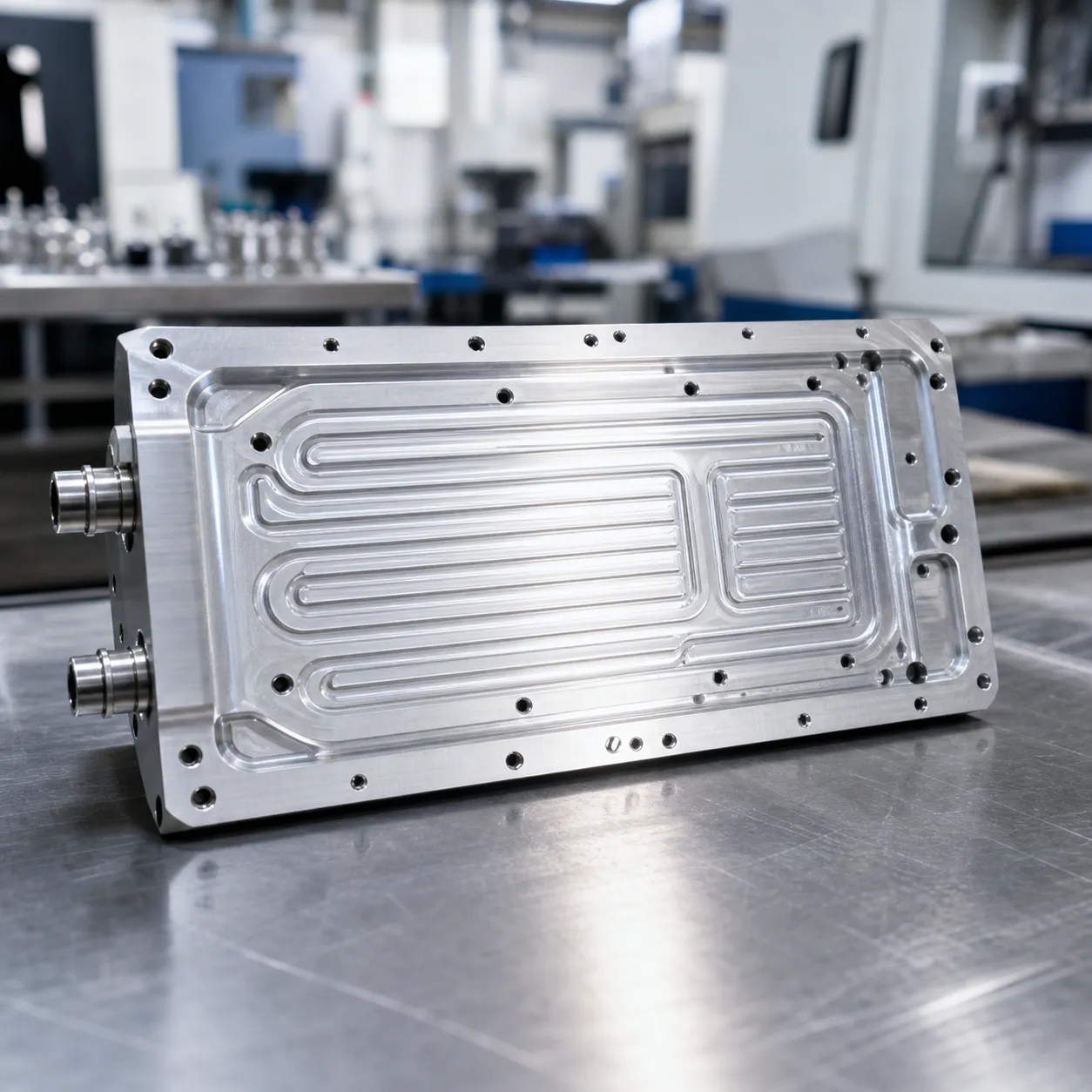
Liquid Cold Plates in Energy Storage
Managing heat in high-capacity energy storage systems is a critical operational hurdle. As battery cells pack higher power into smaller footprints, thermal stress rises rapidly. Unchecked heat leads to thermal runaway, accelerated cell degradation, and severe safety risks. Effective thermal management is not optional—it is the foundation of battery longevity and system efficiency.
What Are Energy Storage Liquid Cold Plates?
Energy storage liquid cold plates are specialized, high-efficiency heat exchangers designed to draw thermal energy directly away from battery cells, power conversion units, and inverters. Through dedicated liquid cold plate machining, we construct metal plates featuring intricate internal fluid pathways.
Coolant flows through these precision-engineered pathways, absorbing excess heat at the contact surface and transporting it away to maintain optimal operating temperatures during heavy charge and discharge cycles.
Why Liquid Cooling Beats Air Cooling for High-Density BESS
Air-based cooling systems fall short when applied to modern high-density Battery Energy Storage Systems (BESS). Custom CNC precision machining allows us to build liquid cold plates that vastly outperform forced-air solutions:
| Performance Metric | Traditional Air Cooling | Machined Liquid Cooling Plates |
|---|---|---|
| Heat Transfer Efficiency | Low thermal conductivity of air | Up to 4x faster heat dissipation |
| Cell Temperature Delta | High risk of hot spots and uneven wear | Uniform temperature distribution across all cells |
| Spatial Footprint | Bulky fans and large air ducting | Low-profile, space-saving integrated plates |
| System Isolation | Exposes electronics to ambient dust/humidity | Fully sealed closed-loop thermal loop |
Core Components of a Machined Liquid Cold Plate
A reliable cold plate depends on exact machining and structural integrity. Every unit we produce consists of four essential elements:
-
- Channeled Baseplate: Machined from high thermal conductivity aluminum or copper alloys with optimized internal flow channels.
- Cover Plate / Lid: Welded or brazed over the channels to form a fully sealed, high-pressure fluid chamber.
- Fluid Ports & Connectors: Threaded ports or quick-disconnect fittings engineered for leak-proof coolant inlet and outlet flow.
- Sealing & Mounting Features: Machined O-ring grooves and flat mounting surfaces that ensure direct thermal contact with battery modules.
Custom CNC Precision Machining Processes
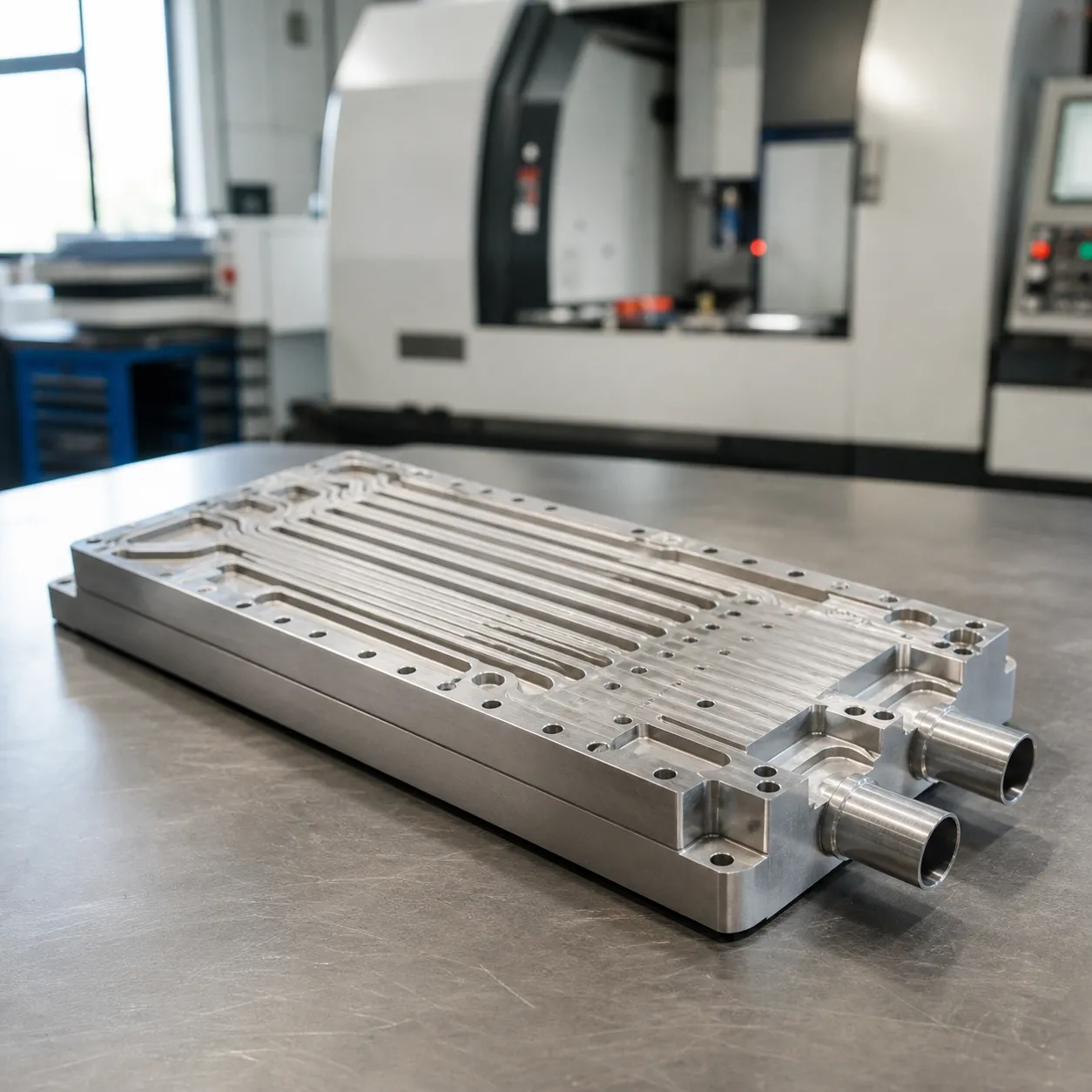
CNC Milling for Complex Flow Channels
We use high-precision CNC milling to carve out intricate micro-channel flow paths that dictate coolant distribution. Managing heat dissipation in high-density battery setups requires absolute precision. Our multi-axis machining centers cut complex, curved pathways into the metal with zero tool deflection. This ensures uniform wall thickness and optimized fluid dynamics, preventing hot spots across the battery modules.
Material Selection: Aluminum Alloys vs. Copper
Choosing the right metal balances thermal performance, weight, and production costs. We specialize in custom CNC precision machining for both primary options:
| Material | Key Advantages | Best Used For |
|---|---|---|
| Aluminum Alloys (e.g., 6061, 3003) | Lightweight, highly cost-effective, excellent corrosion resistance, and great machinability. | Standard commercial BESS, modular battery racks, weight-sensitive applications. |
| Copper (e.g., C101, C110) | Maximum thermal conductivity for extreme heat dissipation. | Ultra-high-power density systems, specialized military or racing energy storage. |
For most projects, balancing performance and cost comes down to material efficiency. You can review our insights on aluminum 6061 machinability for design optimization to see how we cut scrap control costs during execution.
Tolerances and Surface Roughness Control for Tight Seals
Liquid cold plate machining leaves no room for error. A single micro-gap can lead to catastrophic coolant leaks near high-voltage electronics. We enforce strict manufacturing controls to guarantee structural integrity:
-
- Flatness Tolerance: We maintain a flatness within 0.02mm to 0.05mm across the mating surfaces to ensure maximum thermal contact with the battery cells.
- Surface Roughness: O-ring grooves and sealing surfaces are machined to a finish of Ra 0.8 micrometers or better, preventing microscopic bypass leaks.
- Dimensional Precision: Micro-channel depths are strictly controlled to maintain predictable coolant pressure drops throughout the thermal management system.
Key Joining and Sealing Technologies
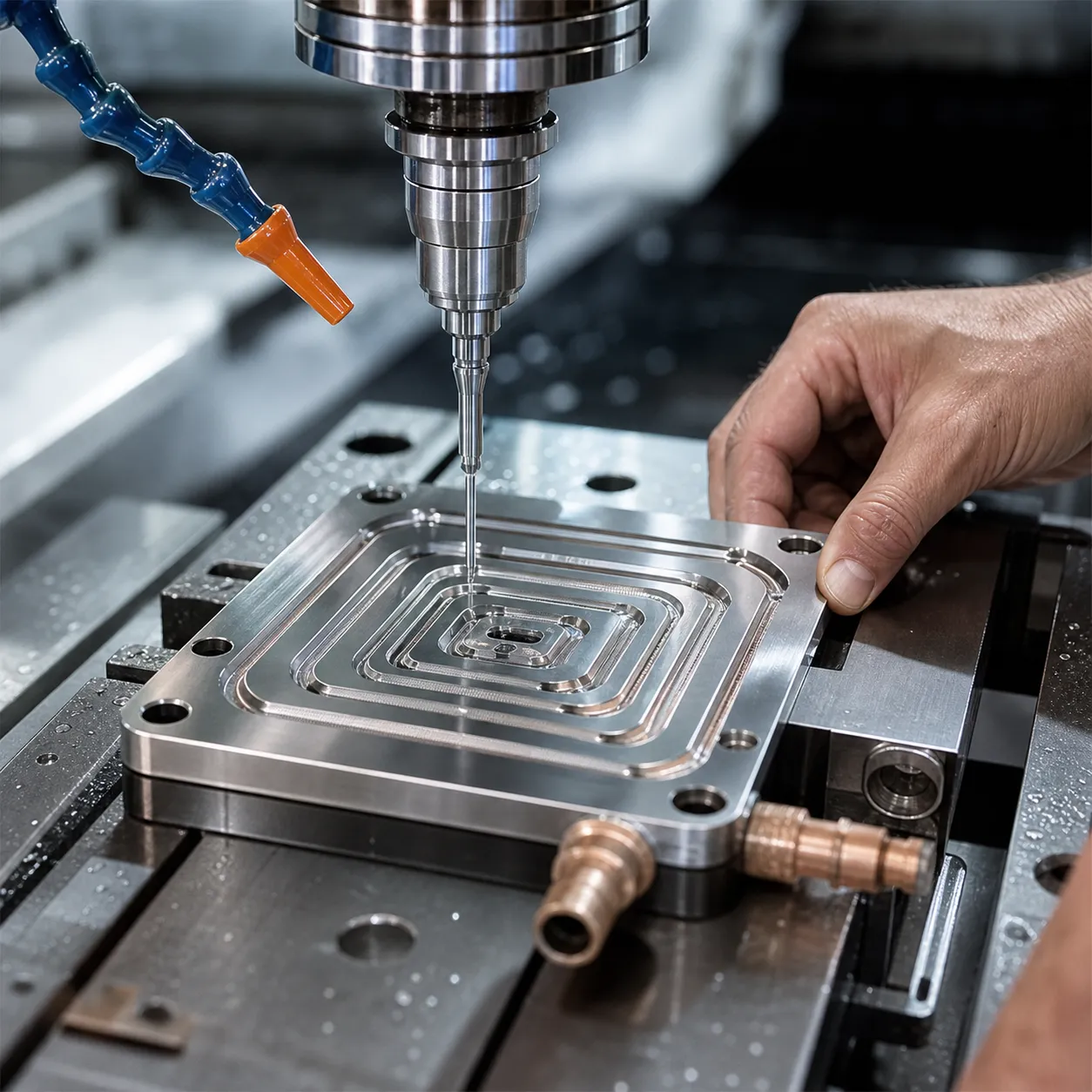
Proper joining and sealing methods determine whether energy storage liquid cold plates can survive years of continuous thermal cycles without catastrophic fluid leaks. We combine custom CNC precision machining with advanced metal joining processes to create hermetically sealed cooling units.
Friction Stir Welding vs. Vacuum Brazing
Choosing between friction stir welding (FSW) and vacuum brazing depends on your internal flow channel geometry and production volume:
-
- Friction Stir Welding (FSW): A solid-state joining process that bonds the cover plate to the machined base without melting the material. FSW delivers superior mechanical strength, eliminates porosity, and minimizes thermal distortion in aluminum cold plate fabrication.
- Vacuum Brazing: Best suited for complex internal micro-channel flow paths. In a clean vacuum furnace, filler alloys melt across the entire surface area, bonding multi-layer cold plates in a single cycle while maintaining uniform thermal conductivity.
| Feature | Friction Stir Welding (FSW) | Vacuum Brazing |
|---|---|---|
| Best For | Perimeter joints & linear flow paths | Intricate micro-channels & multi-layer plates |
| Thermal Distortion | Extremely low | Very low |
| Joint Strength | Near parent metal strength | High uniform bond strength |
| Production Fit | High-speed automated runs | Large batch processing |
O-Ring Groove Machining and Gasket Sealing
For removable covers or modular fluid connections, precise liquid cold plate machining of sealing channels is critical. A tiny surface flaw in an O-ring groove can cause coolant loss under system pressure.
-
- Groove Geometry: We execute exact tool paths to maintain strict depth and width tolerances, avoiding over-compression or pinch points on elastomeric gaskets.
- Surface Finish: Sealing surfaces require smooth tool finishes to ensure complete contact. Adhering to strict industrial-grade CNC machining accuracy standards prevents micro-gaps that lead to slow fluid weeping.
Pressure Resistance and Leak Testing Standards
Coolant leaks inside a high-voltage battery enclosure are unacceptable. We subject every assembly to rigorous validation before it leaves our facility:
-
- Helium Mass Spectrometry: Detects ultra-fine micro-leaks down to 1×10^-6 mbar·l/s, ensuring long-term seal integrity under vacuum and positive pressure.
- Hydrostatic Pressure Testing: Validates that the welded or brazed joints withstand working pressures well above standard BESS operating limits (typically 3 to 6 bar) without structural deformation.
- Pressure Drop Verification: Confirms coolant flows through the internal channels at target rates without excessive hydraulic resistance.
Thermal and Hydraulic Performance Design
Optimizing micro-channel geometries to minimize pressure drop
We use custom CNC precision machining to cut precise micro-channel flow paths directly into cold plate cores. While narrower channels increase heat transfer area, they can dramatically increase fluid resistance if designed incorrectly.
To keep coolant pressure drop low while maximizing thermal exchange, we optimize key geometric factors:
Aspect Ratio Tuning: Adjusting channel width and depth ratios to balance fluid velocity and surface contact.
Radiused Turn Transitions: Machining smooth bend radii instead of sharp 90-degree corners to eliminate turbulent stagnation zones.
Fluid Distribution Manifolds: Ensuring equal coolant allocation across all parallel channels to prevent localized hot spots.
For system connections, we ensure all integrated ports align seamlessly with standard hydraulic and pneumatic fittings to maintain steady fluid pressure throughout the cooling loop.
Balancing heat dissipation and coolant flow rate
Ramping up pump speed doesn’t always guarantee better cooling. Beyond a certain flow threshold, thermal resistance flattens out while pump strain and energy consumption skyrocket.
We engineer energy storage liquid cold plates to strike the optimal balance between heat dissipation and fluid dynamics:
| Design Strategy | Thermal Impact | Hydraulic Impact |
|---|---|---|
| Parallel Channel Layouts | Uniform heat distribution across battery cells | Reduces total loop resistance and pressure drop |
| Targeted Pin-Fin Arrays | Disrupts thermal boundary layers for high-heat zones | Adds controlled turbulence without choking flow |
| Variable Channel Depth | Compensates for fluid heating along the flow path | Maintains consistent cooling along the entire plate |
Preventing corrosion through surface treatment and anodization
Coolants like water-glycol mixtures can degrade bare aluminum over years of continuous operation. To ensure long-term reliability in liquid cold plate machining, we apply robust protective coatings that resist corrosion without sacrificing heat transfer.
-
- Type II & Type III Anodizing: Creates a hard, non-conductive aluminum oxide layer inside flow channels to stop oxidation and galvanic corrosion.
- Chromate Conversion Coatings (Chem Film): Provides excellent corrosion resistance with near-zero thermal barrier impact, ideal for tight-tolerance mating surfaces.
- Controlled Surface Roughness: Similar to our approach for precision surface finishes, we maintain strict Ra values inside channels to prevent chemical pitting and debris accumulation over time.
Manufacturing Quality Control and Customization
CMM Inspection and Dynamic Pressure Testing
A single leak or uneven surface in an energy storage liquid cold plate can ruin an entire battery rack. To prevent fluid cross-contamination and thermal hotspots, we strictly control every step of our liquid cold plate machining process.
We verify critical surface flatness, channel depth, and port positions using high-precision Coordinate Measuring Machines (CMM). Maintaining tight standard tolerances for 5-axis parts ensures that coolant channels align perfectly after friction stir welding or vacuum brazing.
Our dual-stage quality testing protocol includes:
Dimensional & Flatness Audits: 100% CMM verification of contact surfaces to guarantee seamless contact with battery cells.
Dynamic Pressure Testing: High-pressure hydraulic testing to confirm burst strength and flow path integrity.
Helium Leak Detection: Vacuum-assisted leak testing to guarantee zero coolant seepage under extended operational pressures.
Customizing Cold Plates for Modular Battery Racks
No two BESS (Battery Energy Storage System) layouts are identical. We work directly from your thermal models to engineer tailored energy storage liquid cold plates built for your specific cabinet dimensions and cell geometries.
| Customization Feature | Technical Implementation | BESS Application Benefit |
|---|---|---|
| Flow Channel Architecture | CNC-milled micro-channels & variable-width paths | Optimized coolant velocity & minimal pressure drop |
| Manifold Integration | Integrated quick-connect ports & dual-inlet designs | Simplified plumbing in tight modular racks |
| Surface Finish & Coating | Anodizing, chromate conversion, or nickel plating | Superior corrosion resistance & dielectric protection |
| Mounting Interface | Custom hole patterns & flush-mount hardware | Direct drop-in fit for prismatic or pouch cell packs |
Prototyping to Mass Production Workflow
Scaling up custom CNC precision machining requires an agile production pipeline that maintains strict quality control from first-article inspection to full-scale manufacturing.
[ DFM Optimization ] ➔ [ Rapid CNC Prototyping ] ➔ [ Joining & Leak Testing ] ➔ [ Automated Mass Production ]
-
- Design for Manufacturability (DFM): We evaluate your CAD files to eliminate tool interference, optimize feed rates, and reduce material waste.
- Rapid Prototyping: We produce functional aluminum or copper prototypes in as fast as 5 to 7 days for early thermal validation.
- Process Standardization: Once prototype testing passes, we transfer tooling and multi-axis machining programs directly to high-capacity CNC cells.
- Full Production & Traceability: Every mass-produced cooling block undergoes 100% pressure verification and material batch tracking.
Through our specialized custom CNC machining services, we help OEMs scale seamlessly from design concepts to reliable, volume-produced liquid cooling solutions.
Frequently Asked Questions
What is the best material for liquid cold plate machining?
Aluminum alloys are the top choice for energy storage liquid cold plates. Aluminum 6061 and 6063 deliver an outstanding balance of light weight, high thermal conductivity, and cost efficiency. Selecting 6061 aluminum for CNC machining allows us to create intricate internal micro-channels while maintaining high structural integrity. Copper is also used when maximum thermal transfer is needed, though it increases weight and cost.
How do you prevent coolant leaks in CNC machined cold plates?
Zero-leakage reliability comes down to precise machining and proper joining techniques:
-
- Tight Groove Tolerances: We machine O-ring grooves to exact depth and width tolerances to guarantee proper gasket compression.
- Advanced Joining: We utilize Friction Stir Welding (FSW) or vacuum brazing to seal fluid channels completely without air pockets.
- 100% Quality Testing: Every finished unit undergoes pneumatic bubble tests, helium mass spectrometer leak detection, and dynamic hydraulic pressure testing before shipping.
Can liquid cold plates be customized for different BESS designs?
Yes. Liquid cold plate machining is inherently flexible. We customize internal flow channel geometries, inlet/outlet port locations, mounting hole patterns, and overall block dimensions to fit any modular battery rack or containerized battery energy storage system (BESS).
What CNC machining tolerances are required for liquid cold plates?
Maintaining strict tolerances ensures optimal surface contact with battery cells and prevents seal failures under high coolant pressures.
| Key Feature | Standard Tolerance | Primary Objective |
|---|---|---|
| Surface Flatness | ± 0.05 mm (or 0.02 mm/100 mm) | Eliminates air gaps for maximum heat transfer |
| Channel Dimensions | ± 0.02 mm | Maintains predictable coolant pressure drop and flow rate |
| O-ring Grooves | ± 0.015 mm | Ensures a reliable liquid-tight seal under pressure |
| Overall Thickness | ± 0.05 mm | Fits tight battery module assembly envelopes |

 English
  German
  Dutch
Dutch  Russian
  Czech
Czech  French
  Japanese
  Spanish
  Portuguese
  Korean
Reviews
There are no reviews yet.