

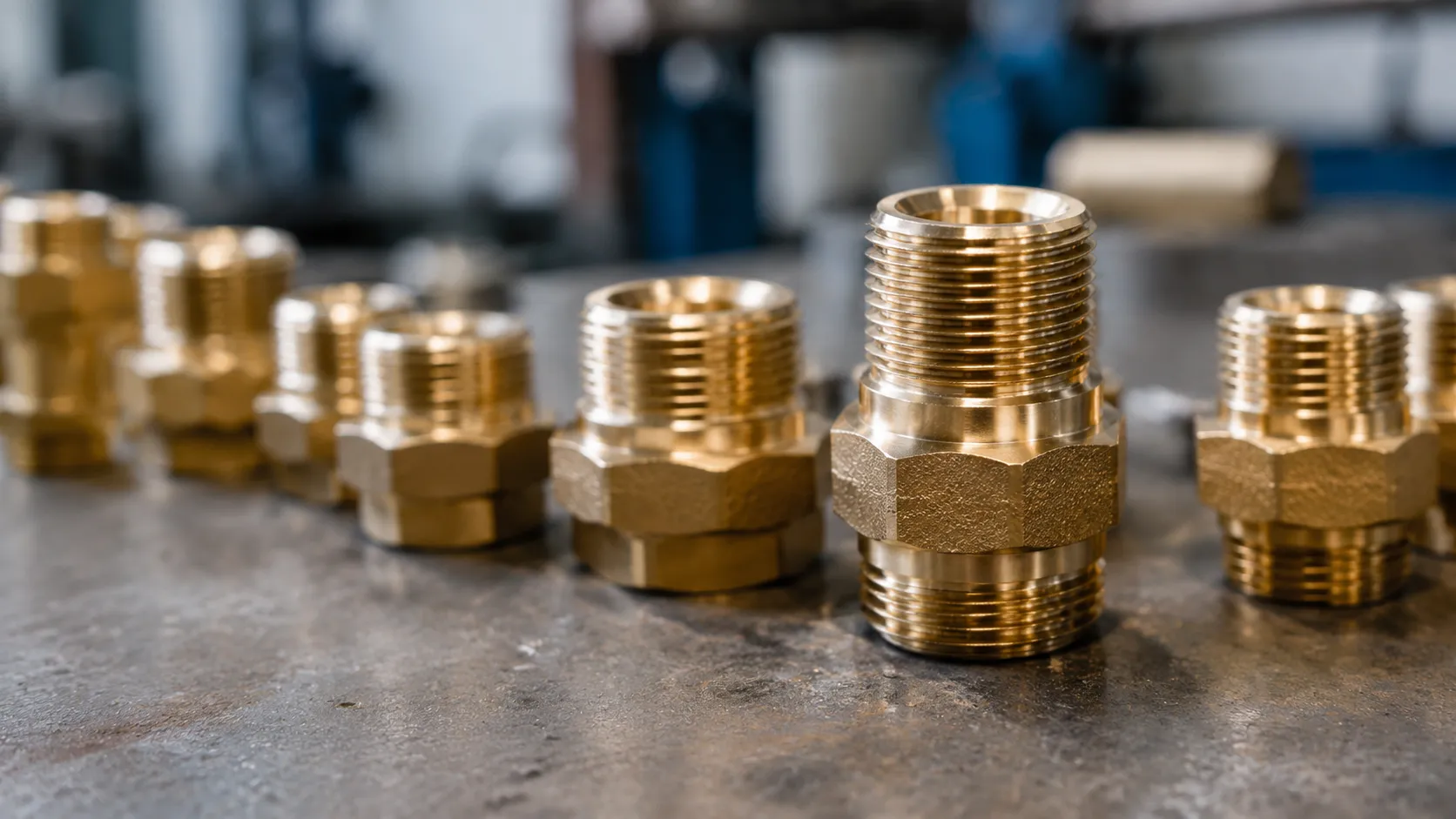
Understanding CNC Machining for Brass Hydraulic and Pneumatic Fittings
The Role of Precision Machining in Fluid Power Systems
Fluid power systems rely on absolute integrity to maintain pressure and prevent catastrophic leaks. CNC machining delivers the tight tolerances and repeatable precision components required to handle demanding hydraulic and pneumatic forces. Even minor dimensional deviations can lead to pressure drops or system failure. By leveraging advanced CNC turning and milling, manufacturers can ensure that every fitting meets exact blueprint specifications, ensuring seamless integration into critical industrial machinery.
Why Brass is Preferred for Hydraulic and Pneumatic Applications
Brass stands out as the premier material choice for fluid power applications due to its unique balance of physical and mechanical properties:
- Excellent Machinability: Brass reduces tool wear and allows for faster cycle times, which lowers production costs.
- Corrosion Resistance: It naturally resists moisture, oxidation, and various industrial chemicals, ensuring a long operational lifespan.
- Spark Resistance: Non-sparking properties make brass fittings essential for hazardous environments involving volatile gases.
- Superior Sealing Capability: Brass is malleable enough to form tight, leak-free seals under pressure without cracking.
Common Brass Material Grades (C360, C464, and Low-Lead Alloys)
Selecting the right alloy grade is vital to balancing a component's machinability rating with its performance under high working pressure.
| Alloy Grade | Common Name | Key Characteristics | Typical Application |
|---|---|---|---|
| C360 (C36000) | Free-Cutting Brass | 100% machinability rating; optimal for high-speed CNC turning and intricate threading. | Standard pneumatic valves, hose ends, and low-pressure adapters. |
| C464 | Naval Brass | High strength and excellent corrosion resistance in seawater and harsh environments. | Marine hydraulics, industrial pumps, and heavy-duty fluid systems. |
| Low-Lead Alloys | Eco-Brass / Lead-Free | Compliant with global environmental regulations (RoHS/REACH); maintains good strength. | Potable water systems, medical fluid devices, and consumer electronics. |
Essential Thread Profiles and Connection Types
Choosing the right thread standard determines the success of fluid power systems. In our production of CNC machining brass hydraulic and pneumatic fittings, we focus heavily on the geometry of each thread profile to ensure absolute compatibility and prevent field failures.
NPT (National Pipe Tapered) Thread Basics and Geometry
NPT threads rely on a 1° 47' taper angle to create a mechanical seal. As the male and female threads mate, the wedges flatten against each other, creating a tight joint. When manufacturing these precision components, keeping a strict tolerance on the thread pitch and taper is critical. We utilize advanced tooling to maintain the exact profile, preventing the threads from galling or losing their seal under high working pressure.
JIC 37° and SAE 45° Flare Connections
Flare connections do not rely on the threads to seal the fluid. Instead, the threads generate the mechanical holding power to seat a machined cone against a flared tube.
JIC 37° Connections: Widely used in hydraulic applications, requiring highly precise angular cuts during turning.
SAE 45° Connections: Common in pneumatic and low-pressure brass refrigeration lines.
To meet strict industrial CNC machining accuracy standards, our lathe operations ensure the surface finish on these mating cones is flawless, preventing microscopic leak paths.
BSP (British Standard Pipe) and DIN Metric Standards
For global distribution, mastering international thread profiles is mandatory. We regularly machine BSP and DIN metric fittings to support overseas machinery networks.
| Thread Type | Sealing Strategy | Common Application |
|---|---|---|
| BSPT (Tapered) | Thread engagement (Requires sealant) | European pneumatic systems |
| BSPP (Parallel) | O-ring or bonded washer | Medium to high-pressure hydraulics |
| DIN Metric | 24° cone or cutting ring | Heavy-duty industrial machinery |
We verify every batch against an updated master thread chart to ensure universal compatibility and guaranteed performance at maximum pressure.
Sealing Mechanisms for Leak-Free Performance
In fluid power systems, the choice of sealing method directly impacts the working pressure and overall safety of the assembly. We utilize advanced CNC machining for brass hydraulic and pneumatic fittings: threads, seals and pressure ratings to ensure every component prevents fluid bypass under extreme operating conditions.
Metal-to-Metal and Tapered Thread Sealing
Tapered threads, such as NPT, rely on a metal-to-metal wedging action to create a seal.
- Deformation Sealing: As the male and female threads mate, the thread crests and roots compress against each other.
- Thread Standard Compliance: We machine these precision components to exact thread standards, ensuring the taper angle is perfectly consistent to prevent spiral leakage.
- Pressure Limits: While effective, tapered metal-to-metal joints often require thread sealants to handle maximum pressure without weeping.
ORFS (O-Ring Face Seal) and Elastomeric Seals
For high-pressure hydraulic systems, O-Ring Face Seal (ORFS) connections offer superior leak protection.
- Elastomeric Compression: The seal is achieved by compressing a captive O-ring (typically made of nitrile or EPDM) within a precision-machined groove on the flat face of the fitting.
- Zero-Leakage Design: This sealing method eliminates the risk of over-tightening damage and handles system vibration exceptionally well.
- Groove Precision: Our CNC turning centers cut these O-ring grooves with micron-level depth accuracy to prevent seal extrusion under high working pressure.
Achieving Precise Surface Finishes for Reliable Sealing
A leak-free seal requires an exceptionally smooth mating surface. Any tool marks, scratches, or tool chatter can create microscopic leak paths for gases or low-viscosity hydraulic fluids.
We control cutting parameters on our CNC machines to achieve optimal surface roughness (typically Ra 0.8 to Ra 1.6) on all sealing faces. Just as achieving a precision surface finish on brass is critical for performance in specialized applications, it is equally vital in fluid dynamics to ensure elastomeric seals seat perfectly flat without micro-gaps.
- Flatness: Prevents uneven seal compression across the mating surface.
- Roughness Control: Minimizes friction and wear on nitrile and EPDM O-rings during assembly.
- Burr-free Edges: Prevents sharp metal edges from cutting or damaging the seal during installation.
Pressure Ratings and Wall Thickness for CNC Machining Brass Hydraulic and Pneumatic Fittings
Determining Pressure Ratings for Hydraulic vs. Pneumatic Systems
When we manufacture precision components for fluid power systems, understanding the stark contrast between hydraulic and pneumatic demands is critical. Hydraulic systems operate under immense pressure, often ranging from 1,000 to over 5,000 PSI, requiring heavy-duty brass fittings that can withstand intense fluid dynamics. Pneumatic systems, on the other hand, typically run at a much lower working pressure, usually between 90 and 150 PSI.
Because compressed air stores significant potential energy, pneumatic failures can be explosive. This makes structural integrity a top priority even at lower pressures. For heavy-duty hydraulic applications, we utilize high-precision CNC turning to ensure our components maintain strict dimensional accuracy to prevent catastrophic bursts or micro-leaks under maximum pressure.
Calculating Safe Wall Thickness for High-Pressure Components
Calculating the correct wall thickness is a non-negotiable step in the design phase to prevent material failure. We determine the safe bursting pressure of a cylindrical brass fitting using Barlow's Formula:
$P = frac{2 · S · t}{D}$
Where:
P = Internal burst pressure (PSI)
S = Allowable stress of the material (PSI)
t = Wall thickness (inches)
D = Outside diameter of the fitting (inches)
To find the safe working pressure, we apply a strict safety factor (typically 4:1 for hydraulics and 4:1 to 5:1 for pneumatics) to the ultimate burst pressure.
| Brass Grade | Machinability Rating | Tensile Strength (PSI) | Yield Strength (PSI) |
|---|---|---|---|
| C36000 (Free-Cutting) | 100% (Baseline) | 58,000 | 45,000 |
| C46400 (Naval Brass) | 30% | 75,000 | 40,000 |
For high-pressure environments, our CNC turning services for precision hydraulic components allow us to hold incredibly tight tolerances. This ensures that the minimum wall thickness is never compromised by machining drift during high-volume production runs.
Performance Under Varying System Temperatures
Temperature fluctuations directly impact the mechanical properties of brass alloys. As system temperatures rise, the allowable stress value of brass decreases, which subsequently lowers the maximum pressure rating of the fitting.
- Elevated Temperatures: Brass retains excellent structural integrity up to 200°C (392°F), but prolonged exposure to higher temperatures will soften the metal and reduce its pressure capability.
- Sub-Zero Conditions: Unlike carbon steels, brass does not become brittle at low temperatures, making it highly reliable for outdoor pneumatic systems in freezing climates.
- Sealing Degradation: While the brass fitting itself handles thermal shifts well, the elastomeric seals inside them can fail. We pair our machined fittings with Nitrile (Buna-N) for standard hydraulic oil lines (-30°C to 100°C) and EPDM for specialized pneumatic or steam applications requiring higher thermal resistance.
Advanced CNC Machining Techniques for Brass Fittings
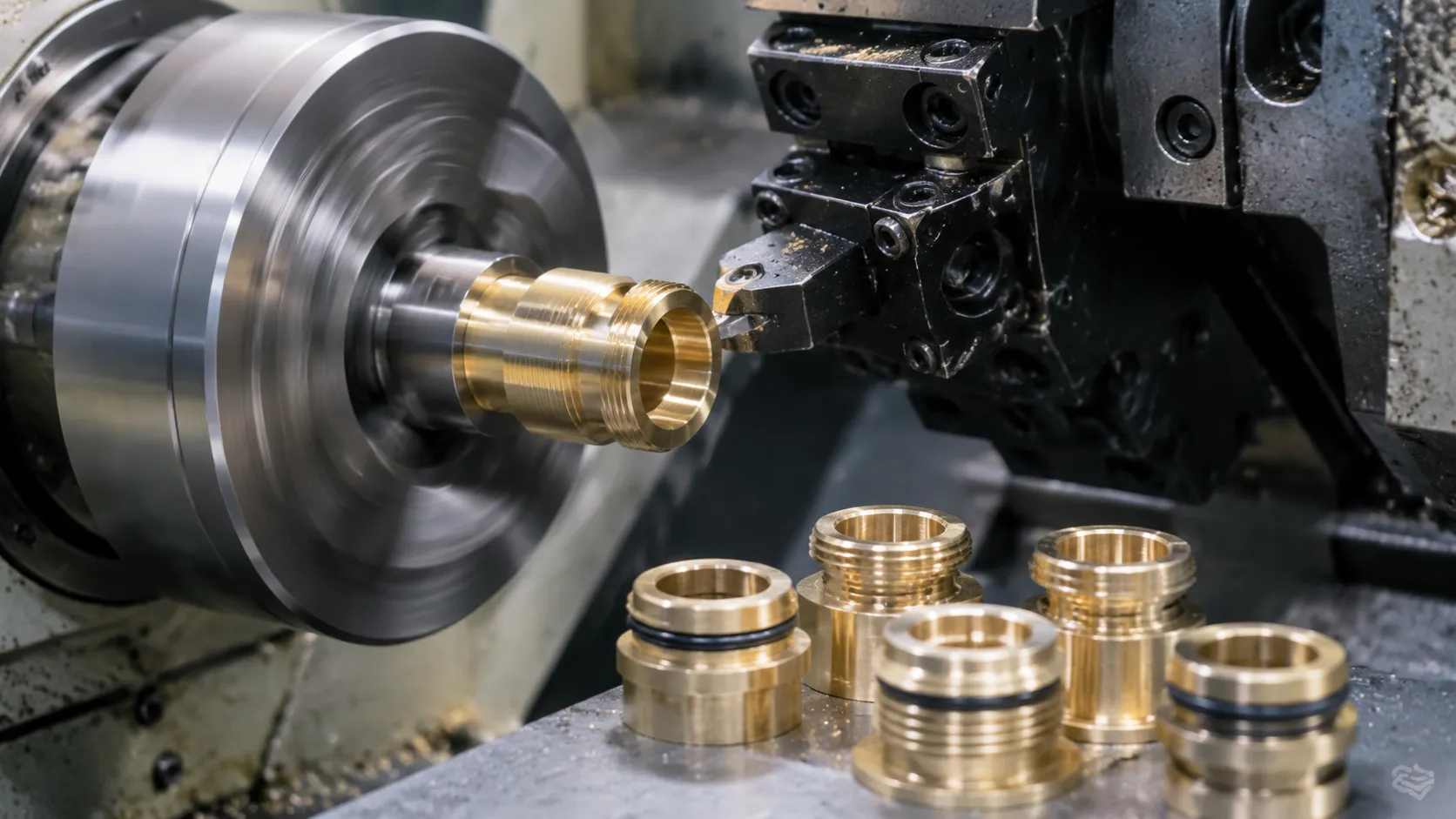
Producing high-performance fluid power components requires advanced manufacturing methods. When executing CNC machining brass hydraulic and pneumatic fittings: threads, seals and pressure ratings all rely heavily on the precision of the cutting process. We utilize specialized setups to ensure every thread profile and sealing surface meets strict global standards.
Swiss-Type CNC Turning for Small and Intricate Components
For miniature pneumatic valves and low-pressure connectors, Swiss-type CNC turning is our go-to method. This technique provides unmatched stability for long, slender parts by supporting the workpiece close to the cutting tool.
- Tight Tolerances: Maintains dimensional accuracy within microns.
- Surface Finish: Eliminates secondary polishing operations for critical sealing seats.
- High Efficiency: Drops completed parts in a single cycle.
Multi-Axis CNC Milling and Mill-Turn Centers
Complex geometry in modern fluid systems demands multi-axis capabilities. Mill-turn centers combine lathe and milling functions, allowing us to machine intricate ports, cross-holes, and hex shapes without repositioning the part. This level of single-setup integration is vital for eliminating stacking tolerances, reflecting the same manufacturing excellence required in high-precision CNC machining brass for automotive applications.
- Single-Setup Machining: Eliminates fixture errors and guarantees perfect alignment between threads and O-ring grooves.
- Complex Porting: Easily cuts precise internal cavities required for specific working pressure profiles.
Optimizing Feed Rates and Tooling for Free-Cutting Brass
Brass alloys like C36000 boast an excellent machinability rating, but high-speed production still requires deliberate tooling choices to avoid burrs and tool wear.
- Tool Selection: We use carbide tooling with polished flutes to prevent material build-up and ensure clean thread forms.
- Spindle Speeds and Feeds: High spindle speeds paired with optimized feed rates deliver crisp, clean cuts without deforming thin wall sections.
- Chip Control: Though free-cutting brass creates small, brittle chips, proper coolant delivery flushes them out immediately to protect internal sealing faces.
Design for Manufacturability (DFM) and Cost Optimization
Smart design lowers production costs without sacrificing performance. When engineering CNC machining brass hydraulic and pneumatic fittings: threads, seals and pressure ratings must all be balanced with efficient manufacturing practices. Focusing on Design for Manufacturability (DFM) ensures high-yield production and reliable field performance.
Optimizing Tolerances, Radii, and Thread Accessibility
Over-specifying tolerances drives up production costs unnecessarily. For precision components made from C36000 brass, utilizing its excellent machinability rating allows us to hold tight dimensions where they matter most, such as seal seats and thread pitches.
- Tolerances: Keep tight tolerances (+/-0.02 mm) restricted to critical sealing surfaces; use standard commercial tolerances (+/-0.1 mm) elsewhere.
- Internal Radii: Avoid sharp internal corners. Ensure internal radii match standard turning tool nose geometries to reduce tool wear and cycling times.
- Thread Accessibility: Allow adequate clearance for thread chasers or taps, particularly on blind holes, to maintain clean profiles according to your target thread standard.
Comparing Brass vs. Stainless Steel and Plastic Fittings
Choosing the right material impacts both the manufacturing process and the ultimate working pressure of the fluid power system.
| Material Property | Free-Cutting Brass (C36000) | Stainless Steel (316) | Plastic (POM/Nylon) |
|---|---|---|---|
| Machinability | Excellent (100%) | Poor (~45%) | Easy (High deflection) |
| Maximum Pressure | Medium to High | Extremely High | Low |
| Corrosion Resistance | High | Excellent | Outstanding |
| Cost-Efficiency | High (Fast cycle times) | Low (Slow machining) | High (Molded/Low-pressure only) |
While stainless steel handles extreme maximum pressure limits, brass offers the best balance of speed, tool life, and sealing reliability for standard hydraulic and pneumatic networks.
Finishing Operations and Corrosion-Resistant Plating
Post-machining treatments enhance both the aesthetics and durability of brass parts. While raw brass offers inherent corrosion resistance, specific environments require advanced surface engineering. We provide specialized brass plating and finishing services for CNC machined parts to protect fittings against harsh chemicals and oxidation.
Applying industrial-grade electroless nickel or chrome plating ensures a uniform layer across complex geometries, protecting the internal sealing method areas from degradation. Selecting the correct plating also ensures compatibility with system seals like nitrile or EPDM O-rings, preventing premature leaks and maintaining stable pressure ratings over time.
Quality Control, Testing, and Compliance Standards
Every brass hydraulic and pneumatic fitting we manufacture must meet strict performance boundaries. For high-pressure fluid power applications, there is zero room for leaks, micro-cracks, or dimensional drift. We enforce rigorous quality control at every stage of production to ensure these precision components handle their rated working pressure without failure.
Pressure Testing and Leak Detection Protocols
To guarantee structural integrity, our parts undergo strict testing regimes before shipping:
- Hydrostatic Testing: Parts are subjected to fluids at pressures exceeding their maximum pressure rating to verify wall strength.
- Pneumatic Leak Detection: Air-under-water or differential pressure decay testing catches even the smallest paths for gas escape.
- Seal Compatibility Analysis: Checking that sealing surfaces interface perfectly with elastomeric seals like nitrile and EPDM.
Thread Inspection and Thread Gauge Verification
A perfect sealing method relies entirely on thread precision. We eliminate assembly failures by implementing hard checking limits on every production lot.
| Inspection Metric | Tooling Used | Purpose |
|---|---|---|
| Thread Form & Pitch | Go/No-Go Ring & Plug Gauges | Verifies adherence to the specific thread standard (NPT, BSP, or Metric). |
| Profile Evaluation | Optical Comparators | Inspects crest and root truncation angles for a perfect mechanical lock. |
| Dimension Checks | Digital Micrometers | Confirms pitch diameter tolerances on free-cutting C36000 brass parts. |
Our advanced inspection workflows are a key feature of our CNC machining services, ensuring global buyers receive parts that screw together perfectly every time.
Compliance with ISO 9001, RoHS, and REACH Certifications
We build international trust through full compliance with global manufacturing regulations. Our facility operates under a strict ISO 9001 quality management system, tracking material traceabilities from raw brass stock to finished fittings. Furthermore, we provide certified low-lead and lead-free brass options that fully satisfy RoHS and REACH environmental standards, allowing you to deploy our components seamlessly into any regulated market worldwide.
 English
  German
  Dutch
Dutch  Russian
  Czech
Czech  French
  Japanese
  Spanish
  Portuguese
  Korean