

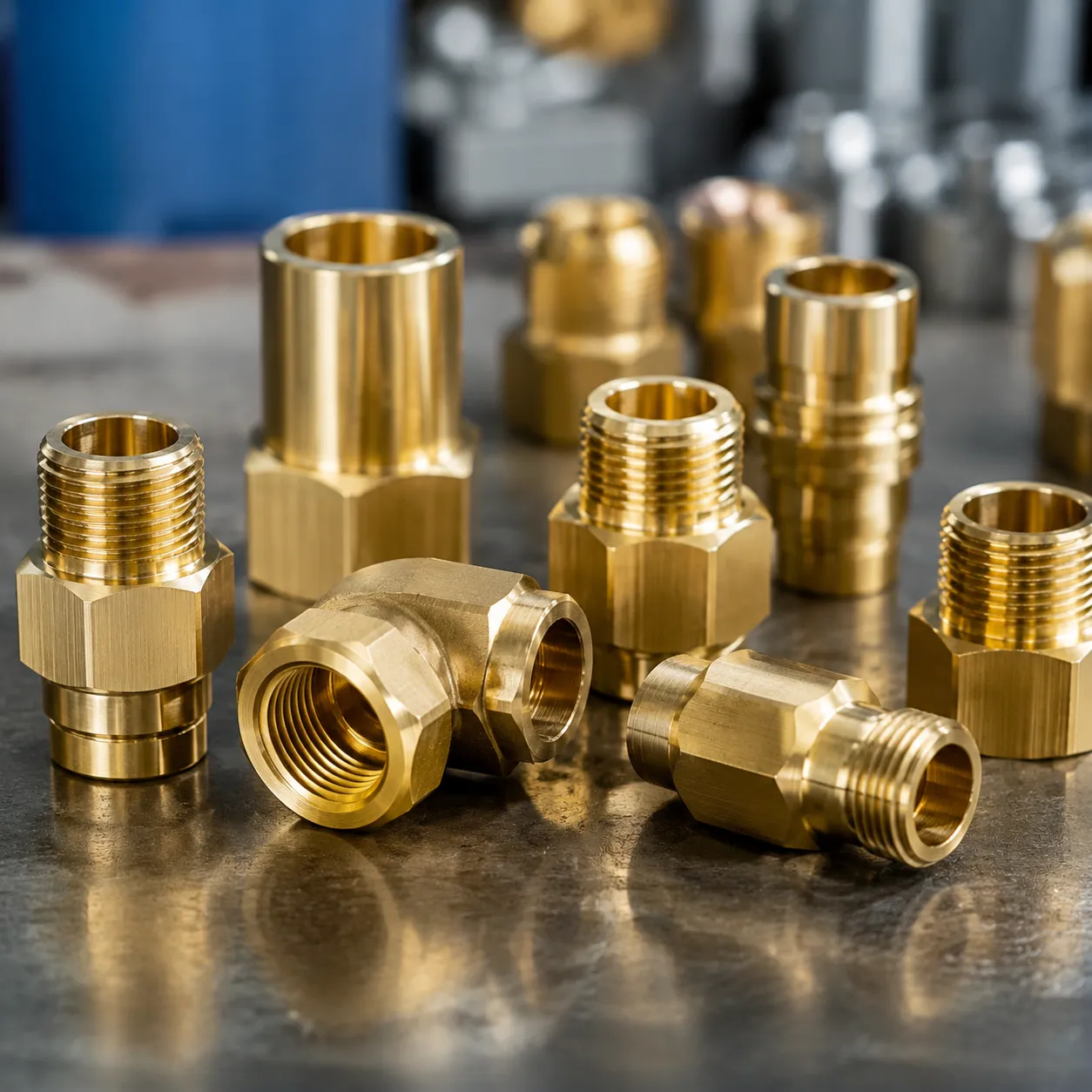
Introduction to CNC Machined Brass Hydraulic and Pneumatic Fittings
What are Precision Brass Fluid Power Components?
In industrial systems, every leak, pressure drop, or seal failure translates into downtime and cost. Precision brass fluid power components are the critical connectors that keep hydraulic and pneumatic circuits stable, safe, and efficient. These include custom brass fittings, sockets, connectors, bushings, manifolds, and dosing or flow-control elements that manage the movement of liquids and compressed air inside your equipment.
As a CNC machining factory, we focus on precision brass components for fluid power where dimensional accuracy and repeatability are non‑negotiable. Using CNC turning, CNC milling, and Swiss-type machining, we produce turned and milled parts with consistent geometry, tight threads, and smooth sealing surfaces. This ensures your hydraulic and pneumatic fittings assemble easily, seal reliably, and perform under continuous industrial load.
The Role of CNC Machining in Fluid System Integrity
Fluid system integrity depends on how well every brass fitting, hose interface, and threaded connection is machined. Even a small deviation in diameter, thread pitch, or surface finish can cause micro-leaks, vibration issues, or premature wear. That is why we rely on high-precision CNC turning, polygonal turning, threading, CNC drilling, and multi-axis CNC milling to control every detail of your brass hydraulic and pneumatic fittings.
Our in-house factory maintains tolerances down to ±0.005 mm with IT6-level accuracy, supported by advanced inspection systems and First Article Inspection for each order. This micron-level control over dimensions, threads, and sealing faces helps eliminate variability between batches and keeps your industrial systems running without unplanned shutdowns. By combining robust process control with expert DFM (Design for Manufacturability) feedback, we provide brass hydraulic and pneumatic fittings CNC machining for industrial systems that support long-term leak-free performance and stable operating pressure.
Key Advantages of CNC Brass Fittings for Industrial Systems
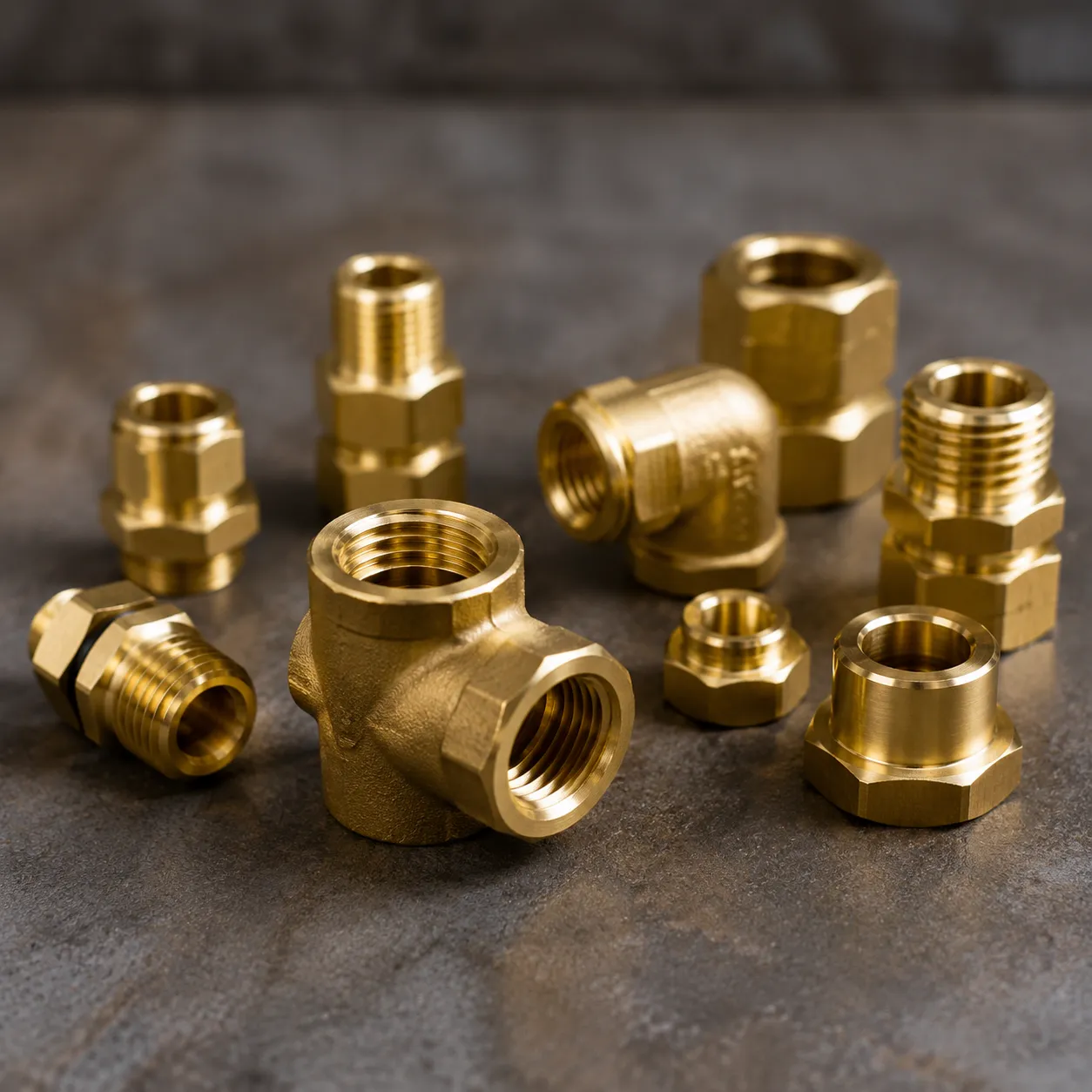
High-Pressure and Temperature Resistance
For industrial hydraulic and pneumatic lines, stable pressure and temperature performance is non‑negotiable. With our brass hydraulic and pneumatic fittings CNC machining for industrial systems, we hold tolerances down to ±0.005 mm, which keeps sealing surfaces, threads, and mating geometries consistent under load.
-
- Precision brass components with controlled wall thickness and concentricity handle demanding pressure cycles when used within brass’s normal operating range.
- Tight CNC turning, CNC milling, and CNC drilling processes ensure uniform flow paths, minimizing stress points that can trigger early failure.
- From small turned and milled parts to larger sockets and housings, we machine fittings so they maintain dimensional stability in real-world operating temperatures, helping protect your system from pressure shocks and downtime.
Excellent Corrosion Resistance and Durability
Industrial systems face moisture, chemicals, and fluctuating temperatures daily. Properly selected and machined brass fittings give a strong balance of corrosion resistance, mechanical strength, and long service life.
-
- Brass naturally resists rust, making it ideal for many hydraulic and air systems, especially where long‑term reliability matters more than ultra‑high strength.
- Our in‑house CNC machining factory optimizes geometries and surface finish (down to Ra 0.4–3.2) to reduce crevice areas where corrosion can start.
- For projects that need deeper material guidance, we also share best practices on brass grades and dezincification resistance in our article on CNC machining brass plumbing components, materials, tolerances, and dezincification resistance at https://zscncparts.com/cnc-machining-brass-plumbing-components-materials-tolerances-and-dezincification-resistance/.
The result is durable brass fittings and connectors that stay dimensionally accurate and maintain performance over long maintenance cycles.
Superior Sealing Performance and Leak Prevention
Leaks cost money, cause safety issues, and stop production. That’s why we focus our CNC brass fitting production on sealing integrity from the first cut.
-
- Micron‑level accuracy and IT6 precision help threads, seats, and sealing faces align perfectly, reducing the risk of micro‑gaps.
- We machine sockets, pistons, sealing housings, and push‑to‑connect bodies with consistent geometry so O‑rings, compression sleeves, and other seals work exactly as intended.
- Our controlled threading and polygonal turning keep thread profiles repeatable from part to part, which is critical when you’re installing hundreds or thousands of fittings across a plant.
By combining precise swiss‑type machining with rigorous inspection, we deliver brass hydraulic and pneumatic fittings that help eliminate pressure drops, minimize leaks, and keep industrial systems running steadily.
Types of CNC Machined Brass Fittings and Components
Hydraulic Sockets, Connectors, and Sealing Housings
For hydraulic systems, the weak point is almost always the fitting. That’s why I focus on tight-tolerance brass hydraulic sockets, connectors, and sealing housings that keep pressure stable and leaks out. Using high-precision CNC turning and multi-axis CNC milling, we machine:
-
- Threaded sockets and adapters with clean internal and external threads for consistent seal engagement
- Brass connectors and couplings for pumps, cylinders, and valve blocks in industrial mechanisms
- Sealing housings and bushings designed around O-rings and compression seals for reliable fluid containment
With turning diameters from 1 mm up to 250 mm and lengths up to 1000 mm, we can cover everything from compact dosing components to larger hydraulic manifolds. Our ±0.005 mm tolerance capability and IT6-level accuracy help minimize pressure drops and keep hydraulic lines running without unplanned downtime.
Pneumatic Push-to-Connect and Valve Bodies
Pneumatic systems demand smooth flow paths and precise interfaces. We machine brass pneumatic push-to-connect fittings and valve bodies that install quickly and stay tight under cycling pressure:
-
- Push-to-connect fittings with carefully controlled bore sizes and surface finishes for repeatable tube gripping
- Valve bodies and internal blocks produced via CNC milling and drilling to maintain accurate port alignment
- Turned and milled parts for pilot valves, sensor interfaces, and air preparation units
Our precision brass components for pneumatic lines are built for global customers running high-volume automation, packaging, and assembly equipment, where air leaks and inconsistent flow mean lost output. For specialized plumbing-style pneumatics and manifolds, we also offer brass valve and fitting machining similar to our work shown in these brass plumbing components CNC machining valves, fittings, and manifolds projects.
Manifold Blocks and Flow Control Throttle Fittings
Complex fluid power systems often rely on custom manifold blocks and throttle fittings to control direction and flow. With 3-, 4-, and 5-axis CNC machining, we manufacture:
-
- Brass manifold blocks with multiple ports, intersecting internal channels, and mounting features
- Flow control and throttle fittings with precise orifice diameters and smooth passages for predictable flow curves
- Custom nozzles and dosing manifolds for metering, mixing, and distribution in hydraulic and pneumatic circuits
Our machining envelope up to 48″ x 24″ x 24″ lets us handle both compact manifold blocks and larger industrial fluid power manifolds. Combined with surface finishes down to Ra 0.4 and thorough inspection on CNC measuring and optical systems, these brass fluid power components integrate cleanly into industrial systems where stability, repeatability, and long-term durability are non-negotiable.
Technical Specifications and Thread Standards
NPT vs. BSP Thread Adaptability
For brass hydraulic and pneumatic fittings CNC machining for industrial systems, thread compatibility is critical. Most global plants run a mix of NPT (North American) and BSP (European/Asian) standards, and we machine brass connectors to match both systems accurately.
Key points:
-
- NPT (National Pipe Taper)
- Tapered thread profile for sealing by thread interference
- Common in USA and many industrial plants in North America
- Requires tight concentricity and precise taper angle to avoid leaks
- BSP (British Standard Pipe – BSPP/BSPT)
- BSPP: parallel thread, typically seals with O‑ring or gasket
- BSPT: tapered thread, similar sealing logic to NPT but different geometry
- Widely used across Europe and Asia in fluid power systems
We machine custom brass adapters, sockets, and manifolds that bridge NPT and BSP systems with ±0.005 mm tolerances, following the same accuracy principles we apply to our industrial‑grade CNC tolerance control for complex 5‑axis parts, as detailed in our guide on standard tolerances for 5‑axis parts.
Thread Adaptability Table
| Thread Type | Profile | Typical Region | Seal Method |
|---|---|---|---|
| NPT | Tapered | USA / North America | Thread interference |
| BSPP | Parallel | Europe / Asia | O‑ring / gasket |
| BSPT | Tapered | Europe / Asia | Thread interference |
Compression, Flare, and Hose Barb Interfaces
Beyond the thread standards, the interface style decides how your tube or hose connects and seals. We machine precision brass components with different joining geometries to fit your line design:
-
- Compression fittings
- Brass body with ferrule that compresses onto tube
- Strong mechanical grip and reliable seal for hydraulic and pneumatic lines
- Good for rigid tubing and vibration‑prone systems
- Flare fittings
- Tube end is flared and mates with a conical seat in the fitting
- Provides robust sealing under moderate to high pressure
- Common for automotive and refrigeration lines
- Hose barb fittings
- Machined barbed profile that bites into hose inner wall
- Simple, quick installation with clamps
- Ideal for low to medium pressure air, coolant, and lubrication circuits
Interface Overview Table
| Interface Type | Best Use Case | Connection Medium |
|---|---|---|
| Compression | High integrity tube lines | Metal / rigid tube |
| Flare | Medium–high pressure circuits | Metal tube |
| Hose Barb | Flexible hose applications | Rubber / plastic |
Compliance, Tolerances, and Material Specifications
As an in‑house CNC factory, I keep all specs tightly controlled, because hydraulic and pneumatic systems do not forgive sloppy tolerances. Our brass hydraulic and pneumatic fittings CNC machining for industrial systems is set up around repeatable accuracy and verified materials.
Tolerances & Accuracy
-
- Dimensional tolerances down to ±0.005 mm (micron‑level capability)
- IT6‑grade precision on critical diameters, threads, and sealing faces
- Full first article inspection (FAI) reports with each new part number
- Use of CNC turning, 5‑axis CNC milling, and Swiss‑type machining for complex turned and milled parts
You can see how we structure accuracy and verification in our detailed article on industrial‑grade CNC machining accuracy standards: how to achieve a perfect tolerance of 0.005 mm.
Material Specifications
-
- Base material: engineered brass grades suitable for hydraulic and pneumatic service
- Supported materials in the same production line:
- Metals: aluminum (6061/6063/7075), stainless steel (303/304/316L), copper, titanium, bronze
- Engineering plastics: POM, PEEK, Nylon, PTFE
- Surface finish: Ra 0.4–Ra 3.2, with options such as anodizing (for aluminum), polishing, passivation, and wear/corrosion‑resistant coatings for surrounding components
Spec Summary Table
| Parameter | Capability / Range |
|---|---|
| Dimensional Tol. | Down to ±0.005 mm, IT6 precision |
| Max Turning Ø | 1 mm – 250 mm (up to 500 mm line‑dependent) |
| Max Turning Length | Up to 1000 mm |
| Surface Roughness | Ra 0.4 – Ra 3.2 |
| Material Family | Brass, metals, engineering plastics |
These technical specs are what keep brass fluid power connectors leak‑free, interchangeable across regions, and reliable in real‑world industrial systems.
Industrial Applications of Brass Fluid Power Connectors
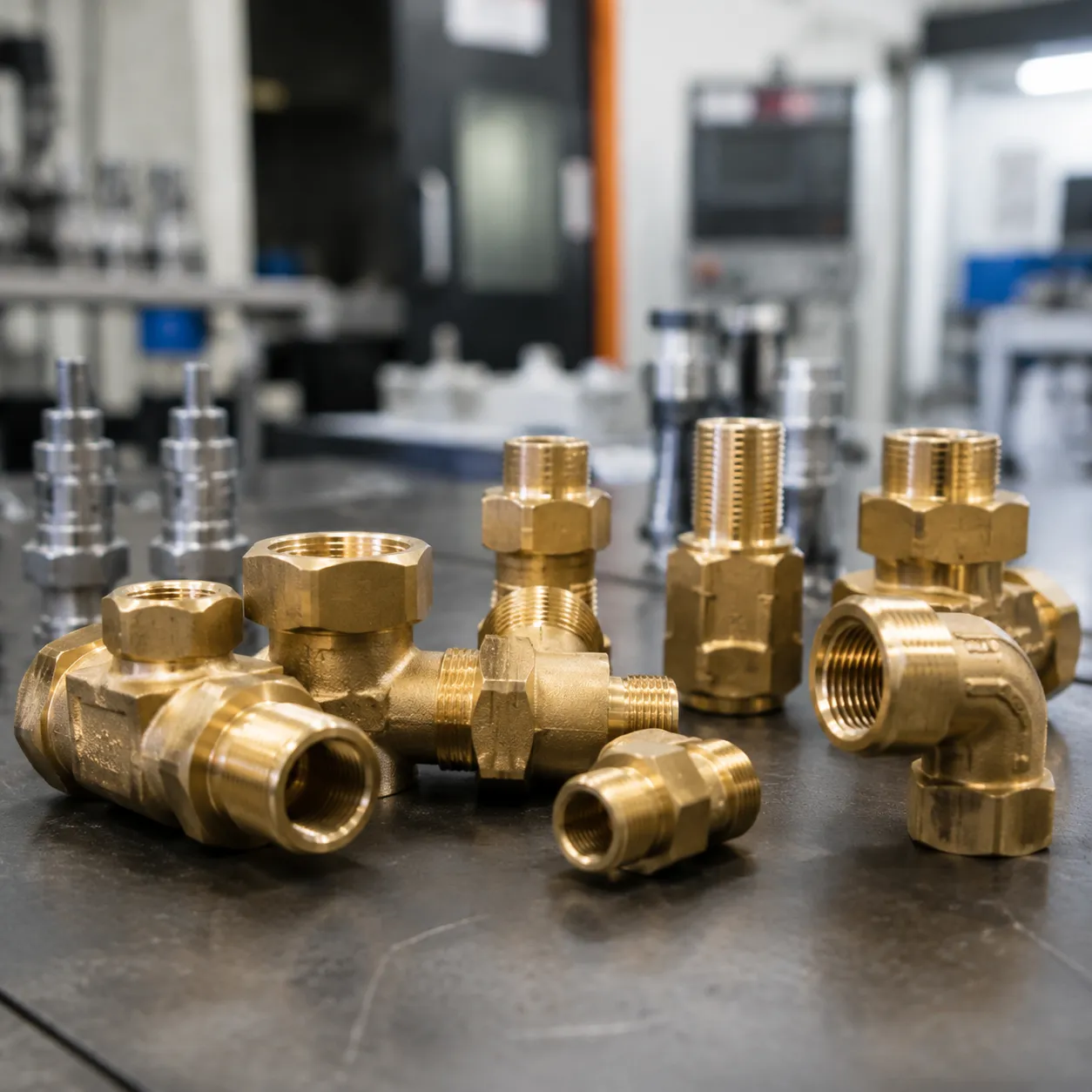
Automotive and High-Volume Manufacturing Systems
In automotive and high-volume manufacturing, downtime is expensive and leaks are not acceptable. That’s where CNC machined brass hydraulic and pneumatic fittings come in. We use precision brass components and turned and milled parts to build stable fluid power circuits in assembly lines, paint systems, robotic arms, and test benches.
Brass hydraulic and pneumatic fittings CNC machining for industrial systems allows us to hold tight tolerances on threads, sealing faces, and socket interfaces, so pressure stays consistent and cycle times remain predictable. For global automotive programs that need repeatable quality across large batches, our no-MOQ model and scalable production—backed by CNC turning, CNC milling, CNC drilling, and swiss-type machining—helps customers move smoothly from pilot lines to full-scale production.
For teams specifically focused on vehicle platforms and components, our experience with CNC machining brass for automotive applications supports reliable fluid routing in fuel dosing, lubrication, and compressed air systems:
Brass CNC machining for automotive fluid systems
Aerospace and Defense Fluid Controls
Aerospace and defense customers demand repeatable performance and traceable quality. In these projects, brass fluid power connectors are often used in control panels, ground support equipment, test rigs, and auxiliary systems where robust sealing and stable flow control matter more than weight savings.
We machine brass hydraulic and pneumatic fittings with micron-level accuracy to keep valve bodies, sockets, pistons, and manifold ports aligned, reducing the risk of micro-leaks that can affect calibration or safety-critical test data. Our IT6-level tolerances and FAI-backed inspection give engineers confidence when integrating custom brass connectors into complex fluid control assemblies.
Combined with our experience exporting to the USA, Europe, and Japan, we support aerospace and defense teams that need consistent parts, documented inspection, and secure, tracked shipping for both prototypes and repeat orders.
Industrial Automation and Air-Powered Machinery
In industrial automation, compressed air and low-viscosity fluids power cylinders, grippers, actuators, and dosing systems. Here, CNC machined brass pneumatic fittings and hydraulic connectors keep equipment running day after day with minimal maintenance.
We focus on leak-free push-to-connect fittings, valve bodies, manifolds, and throttle components that hold up under constant cycling. With stable machining of polygonal turning features, threading, and precision bores, our brass hydraulic and pneumatic fittings CNC machining for industrial systems ensures:
-
- Consistent actuator speed thanks to accurate flow paths and orifice sizes
- Reliable sealing at joints, bulkheads, and equipment interfaces
- Fast replacement using repeatable, interchangeable turned and milled brass parts
For global machinery builders and EU industrial equipment manufacturers, our dedicated CNC machining services support everything from small customization runs to large, standardized connector programs:
Precision CNC machining services for EU industrial machinery
Custom CNC Machining Services for Brass Fittings
Custom Prototype to High-Volume Production
At ZSCNC, I run an in-house CNC shop focused on brass hydraulic and pneumatic fittings CNC machining for industrial systems. We handle everything from urgent one-off prototypes to stable high-volume runs.
What we offer:
-
- No MOQ: 1 piece, pilot runs, or 100,000+ turned and milled parts
- Rapid prototyping: Typical lead time from 3–7 days, depending on complexity
- Scaling up: Same process control and inspection from sample to full production
- DFM-backed quotes: Cost-optimized designs that can cut up to 30% off production costs
Typical brass components:
-
- Precision brass connectors, sockets, and sealing housings
- Valve bodies, pistons, and fluid power manifold blocks
- Custom adapters, nozzle tips, and air-powered machine fittings
For customers needing mixed metal and plastic assemblies in machinery and robotics, we also support custom CNC machining services for machinery and robotics parts with the same workflow and quality control:
custom CNC machining services for machinery and robotics parts
Advanced Swiss Machining and Precision Capabilities
To keep hydraulic and pneumatic systems tight and reliable, we rely on Swiss-type machining, CNC turning, and multi-axis CNC milling with strict process control.
Core capabilities (brass fittings & connectors):
| Capability | Typical Range / Note |
|---|---|
| CNC turning diameter | Approx. 1 mm – 250 mm |
| Turning length | Up to about 1000 mm |
| CNC milling envelope | Up to about 48″ × 24″ × 24″ |
| Tolerance | Down to ±0.005 mm / IT6-level accuracy |
| Surface roughness | Approx. Ra 0.4 – Ra 3.2 |
Process highlights:
-
- Swiss-type machining for slender, high-precision brass fittings
- Polygonal turning, threading, CNC drilling for complex fluid interfaces
- Multi-spindle CNC turning with live tooling for efficient mass production
- Full FAI (First Article Inspection) and optical checking on every order
This setup lets us deliver zero-defect brass hydraulic and pneumatic fittings that hold pressure, seal reliably, and fit right the first time.
Surface Finishing and Plating Options
Brass fittings in industrial systems need not only tight tolerances but also controlled surface finishes for sealing and corrosion resistance. We treat surface finish as part of functional design.
Standard finishing options:
-
- Precision machining finish: Ra 0.4 – Ra 3.2 for sealing faces and threads
- Polishing: For smoother flow paths and improved appearance
- Passivation and protection layers: To enhance wear and corrosion resistance
- Coatings: Tailored to demanding environments where media or atmosphere is aggressive
Why this matters for fluid power components:
-
- Better thread engagement and gasket performance
- Lower risk of galling and wear on mating parts
- More stable performance under repeated pressure and temperature cycles
Every brass hydraulic and pneumatic fitting we machine is matched with the right finish so it stays reliable in real-world industrial systems, whether it’s in high-volume automation lines or precision equipment.
Frequently Asked Questions About Industrial Brass Fittings
What is the Maximum Pressure Rating for Machined Brass Fittings?
Pressure performance depends on your fitting geometry, wall thickness, and the overall system design, not just the base material. With high-precision CNC turning and milling, we control dimensions down to ±0.005 mm, which helps avoid weak spots, poor threads, or misalignment that can cause early failure under pressure.
In real projects, we machine brass hydraulic and pneumatic fittings for industrial systems so they can be matched to the pressure class of the rest of your hardware. We keep tolerances tight and surfaces smooth (Ra 0.4–3.2) so sealing areas are consistent and reliable. For exact pressure limits, we always recommend using your application standards and safety factors, then we machine the precision brass components to fit that spec.
Can Brass Fittings Be Used for Both Hydraulic and Pneumatic Systems?
Yes, CNC machined brass fittings are widely used in both hydraulic and pneumatic systems when the pressure range and media are suitable for brass.
Because we handle both turned and milled parts on multi-axis CNC and Swiss-type machining centers, we can produce:
-
- Compact hydraulic sockets and connectors for oil-based systems
- Lightweight pneumatic push-to-connect bodies and manifolds for air or inert gas
The same in-house processes—CNC turning, threading, drilling, and 5-axis CNC milling—let us keep interface dimensions accurate so hydraulic threads, pneumatic ports, and sealing faces line up perfectly. That consistency is what keeps leaks under control in mixed fluid power systems.
Why is Brass Preferred Over Stainless Steel for Certain Fluid Applications?
In many industrial systems, brass is chosen over stainless steel because it delivers a solid balance of machinability, corrosion resistance, and cost. For fittings, that balance really matters.
A few practical reasons customers pick brass fittings:
-
- Better machinability: Brass cuts cleanly on CNC lathes and mills, which helps us hold micron-level tolerances on threads, cones, and sealing seats. This lowers machining time and cost compared with harder alloys.
- Reliable sealing surfaces: The material allows smooth finishes and sharp, repeatable thread forms, which support superior sealing performance when paired with the right seals or flares.
- Good corrosion behavior in many media: For many oils, air, and non-aggressive fluids, brass has more than enough corrosion resistance while staying cost-effective.
For projects where appearance and conductivity also matter, we can combine CNC machining with specialized brass plating and finishing services to add nickel, chrome, or gold layers. That gives brass hydraulic and pneumatic fittings CNC machining for industrial systems both functional and visual advantages without jumping straight to stainless steel.

 English
  German
  Dutch
Dutch  Russian
  Czech
Czech  French
  Japanese
  Spanish
  Portuguese
  Korean
Reviews
There are no reviews yet.