

Choosing the wrong metal for your vehicle components can stall your production line and drive up costs overnight.
As an automotive engineering insider, I’ve seen how choosing CNC machining brass can completely transform both manufacturing efficiency and part longevity. In an industry where a fraction of a millimeter or a microsecond of tool wear dictates your bottom line, brass automotive parts deliver unmatched reliability and high-speed production.
But how does it hold up under the hood, and does the high recyclability value truly offset the initial material costs?
In this comprehensive guide, we'll break down everything you need to know about automotive brass grades, critical component applications, and how to optimize your designs for maximum cost-performance efficiency.
Let's dive right in.
Introduction to CNC Machining Brass for Automotive Applications
The automotive industry demands components that meet strict standards for precision, reliability, and cost-efficiency. CNC machining brass has emerged as a premier manufacturing solution for producing high-performance automotive components. By leveraging computer numerical control (CNC) technology, manufacturers can shape brass alloys into highly intricate, tightly toleranced parts that withstand the rigorous environments of modern vehicles.
What is CNC Brass Machining?
CNC brass machining is a subtractive manufacturing process that utilizes automated cutting tools to remove material from a solid brass workpiece. Guided by precise G-code programming, CNC machines—including mills, lathes, and Swiss-type turning centers—execute cutting, drilling, and milling operations with exceptional accuracy.
Because brass possesses superior machinability, it allows for extreme precision techniques at high cutting speeds, resulting in flawless surface finishes and highly repeatable parts manufacturing.
The Role of Brass Components in Modern Vehicles
Brass plays a critical role in the evolution of automotive engineering. As vehicles integrate more advanced electronics, complex fluid dynamics, and robust safety systems, the demand for reliable engineering materials has spiked.
[Modern Vehicle Systems] ---> Requires ---> [High Conductivity & Corrosion Resistance] ---> Solution: [CNC Machined Brass]
Brass components are vital to the structural integrity and functionality of several vehicle systems:
- Electronic Components: Terminal blocks, pins, and heavy-duty electrical connectors that ensure uninterrupted signal transmission.
- Fluid Management: Precision turned parts, valve cores, and hydraulic fittings that manage fuel, oil, and coolant lines.
- Sensors and Actuators: Robust housings protecting delicate internal circuitry from thermal stress and moisture.
By balancing mechanical strength with high-volume production efficiency, CNC machined brass remains indispensable for global automotive supply chains focused on long-term vehicle lifecycle cost optimization.
Why Brass is Ideal for Automotive CNC Machining
Brass is a powerhouse in vehicle manufacturing because it strikes a perfect balance between speed, performance, and longevity. When we look at automotive components, the material needs to handle intense friction and environmental stress without failing. Brass doesn't just meet these requirements; it exceeds them while keeping production costs down.
Excellent Machinability and Production Speed
One of the biggest wins for CNC machining brass for automotive applications is how fast we can cut it. Brass is often the benchmark for manufacturing efficiency.
- High-Volume Production: Its superior machinability allows for higher spindle speeds and feed rates compared to steel or aluminum.
- Reduced Tool Wear: Because it is less abrasive, your cutting tools last significantly longer, maintaining tolerances over thousands of cycles.
- Chip Control: Brass produces small, brittle chips that are easily cleared, preventing machine downtime.
High Thermal and Electrical Conductivity
Modern vehicles are essentially rolling computers. Brass is vital for electronic components because of its ability to move heat and electricity efficiently.
- Thermal Management: It quickly dissipates heat in engine sensors and cooling systems.
- Electrical Reliability: With high electrical conductivity, it is the go-to for precision turned parts like terminals and battery connectors where signal integrity is non-negotiable.
Inherent Corrosion Resistance and Durability
Under-the-hood environments are brutal, involving road salt, moisture, and chemicals. The corrosion resistance of copper and zinc alloys ensures that brass parts don't seize or degrade over time.
- Structural Integrity: Even in extreme temperatures, brass maintains its mechanical properties and doesn't become brittle.
- Long Lifecycle: This durability and strength mean fewer replacements and higher vehicle reliability scores.
Aesthetic Appeal and Natural Antimicrobial Properties
While often hidden, the surface finish of brass is naturally clean and professional. For high-end or visible custom components, brass offers a premium look that other industrial metals can't match. Additionally, its natural antimicrobial properties make it a smart choice for interior touchpoints in shared mobility or public transport vehicles, adding an extra layer of value to the material selection process.
Key Brass Material Grades for the Automotive Industry
Choosing the right alloy grade is essential for balancing manufacturing efficiency with the mechanical properties required in automotive components. Different brass compositions offer distinct advantages in strength, formability, and wear resistance. When evaluating options within our broader selection of metal machining materials, specific brass grades stand out for automotive applications.
C360 Free-Cutting Brass: High-Speed Machining Choice
C360 is the gold standard for high-volume production. It delivers 100% machinability, minimizing tool wear and maximizing cycle times on the shop floor.
- Key Benefits: Unmatched production speeds, clean chip formation, and excellent surface finish.
- Common Automotive Parts: Custom components like sensor bodies, threaded inserts, and fluid fittings.
C464 Naval Brass: Enhanced Strength and Corrosion Resistance
For harsh under-the-hood environments exposed to moisture and road salt, C464 provides superior durability and strength. The addition of tin gives this alloy its robust structural integrity.
- Key Benefits: High resistance to zinc stripping (dezincification) and excellent fatigue strength.
- Common Automotive Parts: Marine-grade automotive connectors, pump shafts, and heavy-duty structural fasteners.
C260 Cartridge Brass: Superior Cold Working Properties
C260 possesses the highest ductility among the yellow brasses, making it ideal for components requiring a mix of precision turned parts manufacturing and severe cold forming.
- Key Benefits: Exceptional formability, great electrical conductivity, and high tensile strength after cold working.
- Common Automotive Parts: Radiator cores, electrical terminals, and deep-drawn enclosures.
Eco-Friendly and Low-Lead Brass Alternatives
Strict global environmental regulations demand compliant material selection. Modern low-lead and lead-free brass alloys match traditional performance standards without the environmental baggage.
| Alloy Grade | Key Features | Primary Automotive Use |
|---|---|---|
| C27450 (Lead-Free) | Compliance-safe, good formability | Fuel systems, potable fluid control |
| C69300 (Eco-Brass) | High strength, stress corrosion cracking resistance | Electronic components, heavy-duty valves |
These eco-friendly alternatives ensure long-term regulatory compliance while maintaining the tight tolerances required for high-performance automotive systems.
Critical Automotive Applications of CNC Machined Brass
Electrical Systems, Connectors, and Terminals
Modern vehicles rely heavily on stable electrical architectures. We leverage the high electrical conductivity of brass to manufacture high-volume precision turned parts like battery terminals, pin connectors, and ground lugs. Because automotive electronics face constant vibration, our custom components ensure uninterrupted signal transmission and tight contact fits, preventing electrical failures in both traditional ICE vehicles and electric vehicles (EVs).
Fluid Control Systems, Valves, and Sensor Housings
Automotive fluid management demands structural integrity under fluctuating pressures. CNC machined brass is our go-to for thermostat housings, HVAC control valves, and specialized sensor bodies. The natural corrosion resistance of copper and zinc alloys ensures these components do not degrade when constantly exposed to water, coolants, and refrigerants, maintaining precise sensor readings over the vehicle's lifecycle.
Fuel System Components and Injector Nozzles
Fuel delivery systems require tight tolerances that alternative metals simply cannot match efficiently. We utilize advanced metal machining techniques to produce fuel injector nozzles, carburetor jets, and fuel pump fittings. Brass withstands the chemical degradation caused by modern bio-fuels and gasoline additives, while its exceptional machinability allows us to drill micro-holes with perfect geometric accuracy to optimize fuel atomization.
Braking Systems and Hydraulic Fittings
Safety-critical systems leave no room for material failure. For hydraulic braking systems, we manufacture brass proportioning valves, bleed screws, and air brake fittings. These heavy-duty automotive components handle immense hydraulic pressure without cracking.
| Brass Component | Key Requirement | Primary Benefit |
|---|---|---|
| Brake Fittings | High Pressure Resistance | No deformation under sudden braking |
| Sensor Housings | Environmental Sealing | Protects delicate electronic components |
| Terminal Pins | Continuous Conductivity | Low resistance, minimizing signal loss |
By choosing brass for these high-stress areas, manufacturers achieve the perfect balance of long-term durability and manufacturing efficiency.
Ensuring Reliability and Precision in Brass Machining
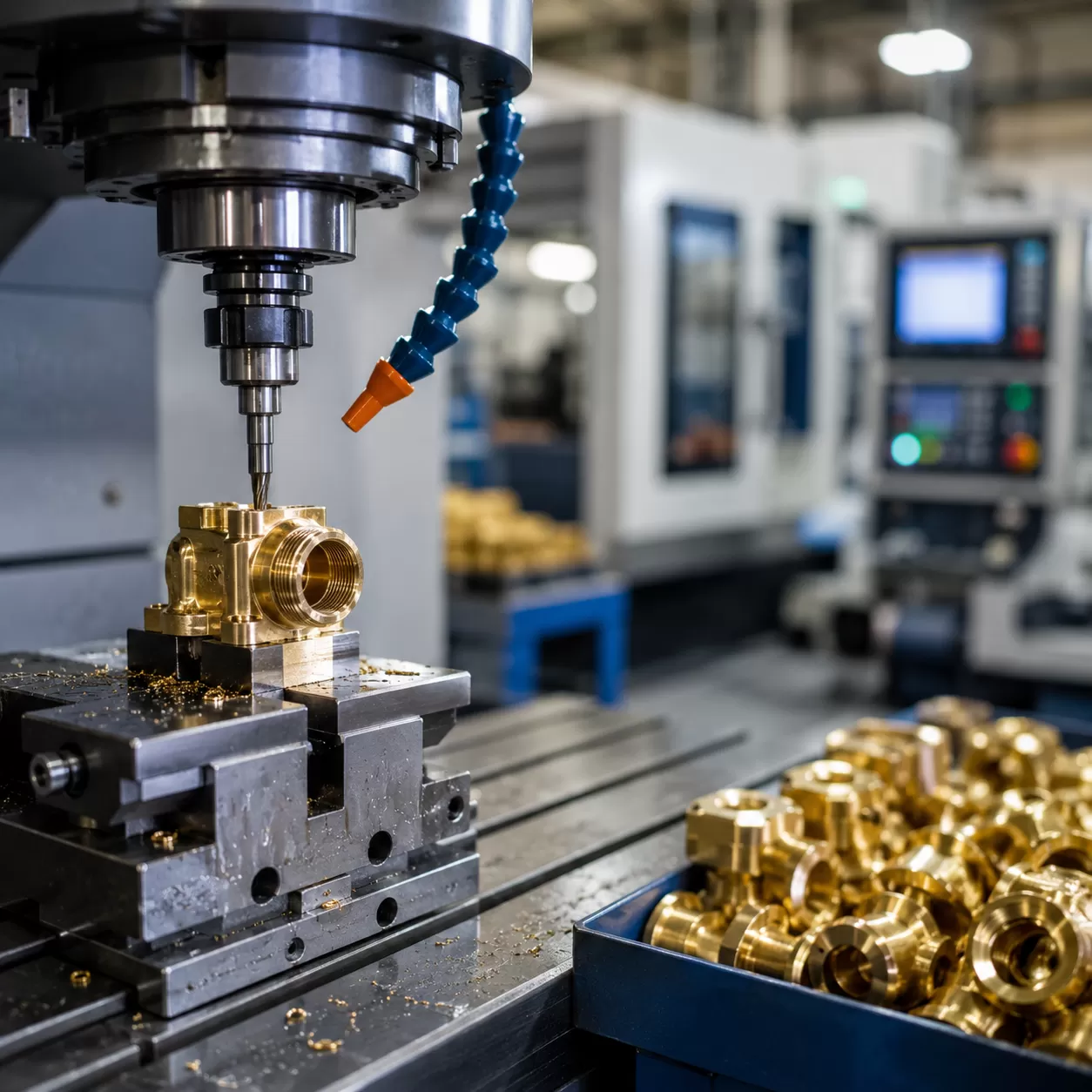
In the automotive sector, reliability isn't optional. When we produce automotive components, maintaining extreme precision across massive production runs is our top priority. Brass is inherently stable, but hitting strict automotive benchmarks requires tight process control, specialized tooling, and strict quality compliance.
Tight Tolerances and Geometric Dimensions Control
Automotive applications demand perfect repeatability for parts like sensor housings and hydraulic fittings. Brass responds beautifully to high-speed cutting, allowing us to hit incredibly tight dimensional limits without material distortion.
| Feature | Standard Tolerances | Critical Precision Capabilities |
|---|---|---|
| Linear Dimensions | ± 0.05 mm | ± 0.01 mm |
| Shaft Diameters | ± 0.03 mm | Achievable via standard tolerances for 5-axis parts |
| Surface Roughness (Ra) | Ra 1.6µm | Ra0.4µm\with specialized finishing |
Advanced Tooling Selection and Cutting Parameters
While brass is known for its excellent machinability, choosing the wrong tools causes unnecessary downtime and micro-burrs. We optimize our CNC setup using specific cutting parameters tailored for brass metal machining:
- Tool Material: We utilize premium carbide tools or diamond-coated inserts to virtually eliminate tool wear during high-volume production.
- Geometry: High rake angles and polished flutes prevent chip welding and ensure seamless chip evacuation.
- Speed and Feed: We push spindle speeds to their limits while maintaining stable feed rates to guarantee an ultra-smooth surface finish.
Process Monitoring and Quality Closed-Loop Management
Our quality control doesn't wait until a batch is finished. We implement a closed-loop quality management system right on the shop floor:
- In-Line Inspection: Real-time probing system measures critical dimensions inside the CNC machine.
- Statistical Process Control (SPC): Continuous data collection tracks tool wear trends and catches deviation before it impacts structural integrity.
- Automated Optical Sorting: High-speed cameras inspect 100% of precision turned parts for flawless visual and dimensional accuracy.
Certifications and Automotive Compliance (ISO 9001, IATF 16949)
We manufacture all custom components under a strict quality framework. Meeting international automotive engineering materials standards guarantees that every machined brass part stands up to harsh road conditions:
Industry Standards We Maintain:
- IATF 16949: The gold standard for automotive quality management, ensuring zero defects in mass production.
- ISO 9001: Validates our entire manufacturing efficiency, workflow, and customer satisfaction metrics.
- RoHS & REACH Compliance: Strict tracking of alloy grades to meet global environmental regulations on lead content.
Surface Finishing and Post-Processing for Automotive Brass Parts
While CNC machining brass for automotive applications delivers excellent precision right off the machine, the right surface finish is what ensures long-term reliability and performance. Post-processing enhances corrosion resistance, improves wear properties, and guarantees tight seals in critical vehicle systems.
As-Machined and Polished Finishes
Leaving brass in its as-machined state is the most cost-effective route. Thanks to the material's excellent machinability, the natural surface finish is already smooth and clean, making it perfect for internal, non-exposed components like structural brackets or internal fluid paths. When a part requires better aesthetics or lower friction, a quick mechanical polish removes tool marks and delivers a bright, smooth exterior.
Plating Options (Nickel, Chrome, and Electroless Plating)
Plating is the go-to choice for severe under-the-hood and exterior environments. It adds a protective barrier that prevents tarnish and handles friction beautifully.
- Nickel Plating: Provides excellent wear resistance and a clean look. It is highly valued for electrical contacts and terminals.
- Chrome Plating: Adds a layer of extreme hardness and exceptional corrosion resistance, ideal for parts exposed to road salt and moisture.
- Electroless Nickel Plating: Delivers a completely uniform thickness over complex geometries, internal threads, and deep recesses. This is vital for precision automotive valves and fuel system components.
Chromate Conversion and Powder Coating
For parts facing harsh chemical exposure or extreme weathering, advanced coatings provide the necessary durability.
- Chromate Conversion: A chemical passivation process that enhances the natural corrosion resistance of copper and zinc alloys without altering part dimensions. It also acts as an excellent primer for subsequent coatings.
- Powder Coating: Used primarily for visible or heavily exposed components. It creates a thick, durable barrier against physical impacts, debris, and chemical spills.
Honing and Polishing for Critical Sealing Surfaces
In fluid control and hydraulic braking systems, even a micro-scratch can cause pressure drops or fluid leaks. Specialized secondary operations like honing and precision polishing refine critical sealing surfaces to micro-inch tolerances. This ultra-smooth surface finish guarantees a perfect, airtight mating surface with seals and O-rings, preventing fluid bypass and maximizing the lifecycle of the assembly.
of Surface Finishing Options
| Finish Type | Primary Benefit | Common Automotive Application |
|---|---|---|
| As-Machined | Lowest cost, clean natural finish | Internal structural brackets, fluid paths |
| Electroless Nickel | Uniform thickness, high wear resistance | Sensor housings, fuel injector components |
| Chrome Plating | Extreme hardness, salt-water resistance | Exterior fittings, exposed connectors |
| Honing & Polishing | Ultra-smooth micro-finish, tight sealing | Hydraulic valves, braking system pistons |
Cost-Performance Analysis of CNC Brass Machining
Raw Material Costs vs. High-Speed Machining Efficiency
When analyzing the upfront cost of metal machining, brass carries a higher raw material price tag compared to steel or aluminum. However, looking at the raw material cost alone is a mistake. The true value lies in its exceptional manufacturing efficiency.
Brass allows for incredibly high cutting speeds and feed rates during high-volume production. Because it machines so quickly, cycle times drop drastically. This massive jump in production speed frequently offsets the initial material investment, yielding a lower per-part cost for complex automotive components.
Reduced Tool Wear and Extended Tool Life
Tooling expenses can quickly drain a project's budget, but brass changes the equation. Its unique mechanical properties mean it behaves beautifully under a cutting edge, creating minimal friction and heat.
- Extended Tool Life: CNC inserts and drills last significantly longer when cutting brass compared to stainless steel.
- Minimal Tool Wear: Less friction means fewer tool changes, minimizing machine downtime.
- Consistent Quality: Reduced wear ensures tight tolerances and precision standards remain stable throughout long production runs.
Scrap Value, Recyclability, and Material Utilization
| Material Factor | Impact on Lifecycle Cost |
|---|---|
| Turnings & Chips Value | Highly recyclable scrap retains up to 60-80% of raw material value. |
| Material Utilization | Buy-back programs for brass turnings directly recoup initial production spend. |
| Sustainability | Low melting point of brass scrap reduces the carbon footprint during recycling. |
In parts manufacturing, turnings and chips are inevitable. Fortunately, brass is highly sustainable and has an incredibly high scrap value. We routinely recycle 100% of our brass turnings, allowing us to reclaim a massive portion of the initial material cost and pass those savings directly to our customers.
Long-Term Maintenance and Reliability Savings
Choosing the right engineering materials requires looking at the total lifecycle cost. While alternative metals might seem cheaper upfront, they often fail early due to corrosion or wear in harsh automotive environments.
The inherent durability and strength of brass ensure that precision turned parts—such as core valves, electronic connectors, and hydraulic fittings—perform reliably for years. By preventing premature component failure, CNC machined brass eliminates expensive warranty claims and long-term maintenance costs for automotive brands.
Design for Manufacturability (DFM) and Optimization Tips
When designing automotive components, implementing smart Design for Manufacturability (DFM) strategies saves both time and money. Brass is highly forgiving, but optimizing your part geometry ensures you unlock maximum manufacturing efficiency and flawless structural integrity.
Optimizing Wall Thickness, Radii, and Chamfers
Achieving high-volume production success with CNC machining brass for automotive applications requires a close look at your part geometry. Fine-tuning these physical dimensions keeps production smooth:
- Wall Thickness: Maintain a minimum wall thickness of 0.75 mm. While brass is highly machinable, ultra-thin walls can distort under cutting forces.
- Internal Radii: Avoid sharp 90-degree internal corners. Use a radius that is at least 10% to 15% larger than the radius of the cutting tool to prevent tool chatter and speed up CNC milling cycles.
- Chamfers and Deburring: Add a 0.5 mm chamfer on external edges. This simple design choice eliminates sharp edges naturally during the machining process, cutting down on manual post-processing.
Choosing the Right Process: Swiss-Type vs. Multi-Spindle Machining
Selecting the ideal equipment depends entirely on the size, complexity, and production volume of your custom components.
| Feature / Requirement | Swiss-Type CNC Machining | Multi-Spindle Machining |
|---|---|---|
| Part Diameter | Best for small, slender parts (under 32 mm) | Ideal for larger, robust components |
| Production Volume | Medium to high volume | Ultra-high mass production |
| Complexity | Exceptional for intricate, complex geometry | Optimized for high-speed, simpler parts |
| Tight Tolerances | Achieve sub-micron engineering precision | Standard automotive tolerances |
For long, thin automotive components like sensor housings or electronic connectors, Swiss-type turning prevents part deflection. For massive production runs of standard hydraulic fittings, multi-spindle setups offer the lowest lifecycle cost per part. Deciding between these methods often mirrors the strategic choices made when comparing 5-axis machining vs. multiaxis turning to find the fastest, most cost-effective production route.
Mitigating Common Challenges: Burrs and Thin-Wall Deformation
While brass offers excellent mechanical properties, it isn't completely immune to manufacturing hiccups if pushed past its limits. We use specific precision techniques to counteract common issues:
- Controlling Burrs: Brass can leave micro-burrs at the exit points of drilled holes or deep threads. We manage this by optimizing tool wear paths, using sharp, dedicated carbide tooling, and programming proper exit chamfers.
- Preventing Thin-Wall Deformation: High clamping pressure or aggressive feed rates can crush thin-walled brass cylinders. We utilize custom collets that distribute clamping pressure evenly, alongside tailored cutting parameters to safeguard the part's geometric dimensions.
Frequently Asked Questions (FAQs)
Is brass more cost-effective than stainless steel for automotive parts?
Yes, brass is often more cost-effective than stainless steel for high-volume automotive components. While the raw material cost of brass can be higher, its exceptional machinability drastically reduces overall production costs.
- Faster Cycle Times: Brass can be machined at much higher speeds, cutting production time significantly.
- Reduced Tool Wear: It causes less friction, extending the life of cutting tools and reducing downtime.
- High Scrap Value: Brass turnings and chips are highly recyclable and command a high buy-back price, recovering a large portion of the initial material cost.
What tolerances can be achieved with CNC brass machining?
Thanks to the excellent dimensional stability of the material, our high-precision metal machining processes routinely achieve exceptionally tight tolerances.
| Machining Feature | Standard Tolerance | High-Precision Tolerance |
|---|---|---|
| Linear Dimensions | ±0.05 mm | ±0.005 mm |
| Hole Diameters | ±0.025 mm | ±0.005 mm |
| Surface Roughness ($R_a$) | 0.8 to 1.6 µm | Up to 0.4 µm |
Achieving these tight tolerances ensures that precision turned parts fit perfectly into critical automotive assemblies without leaking or failing.
How does lead content in brass impact environmental compliance?
Traditional free-cutting brass (like C360) contains small amounts of lead to improve lubrication and chip breaking during production. However, global automotive regulations like RoHS and ELV (End-of-Life Vehicles) place strict limits on lead content. To maintain full environmental compliance, we utilize eco-friendly, low-lead, and lead-free alloy alternatives that deliver the same high durability and strength without compromising global market access.
Can machined brass components withstand harsh under-the-hood environments?
Absolutely. Brass is highly reliable in punishing under-the-hood conditions. Its mechanical properties resist thermal degradation, allowing it to withstand constant temperature fluctuations near the engine. Furthermore, its inherent corrosion resistance ensures that fluid control valves, sensor housings, and fuel system connectors remain structurally sound when exposed to moisture, road salt, and automotive fluids over a long operational lifecycle.
 English
  German
  Dutch
Dutch  Russian
  Czech
Czech  French
  Japanese
  Spanish
  Portuguese
  Korean