

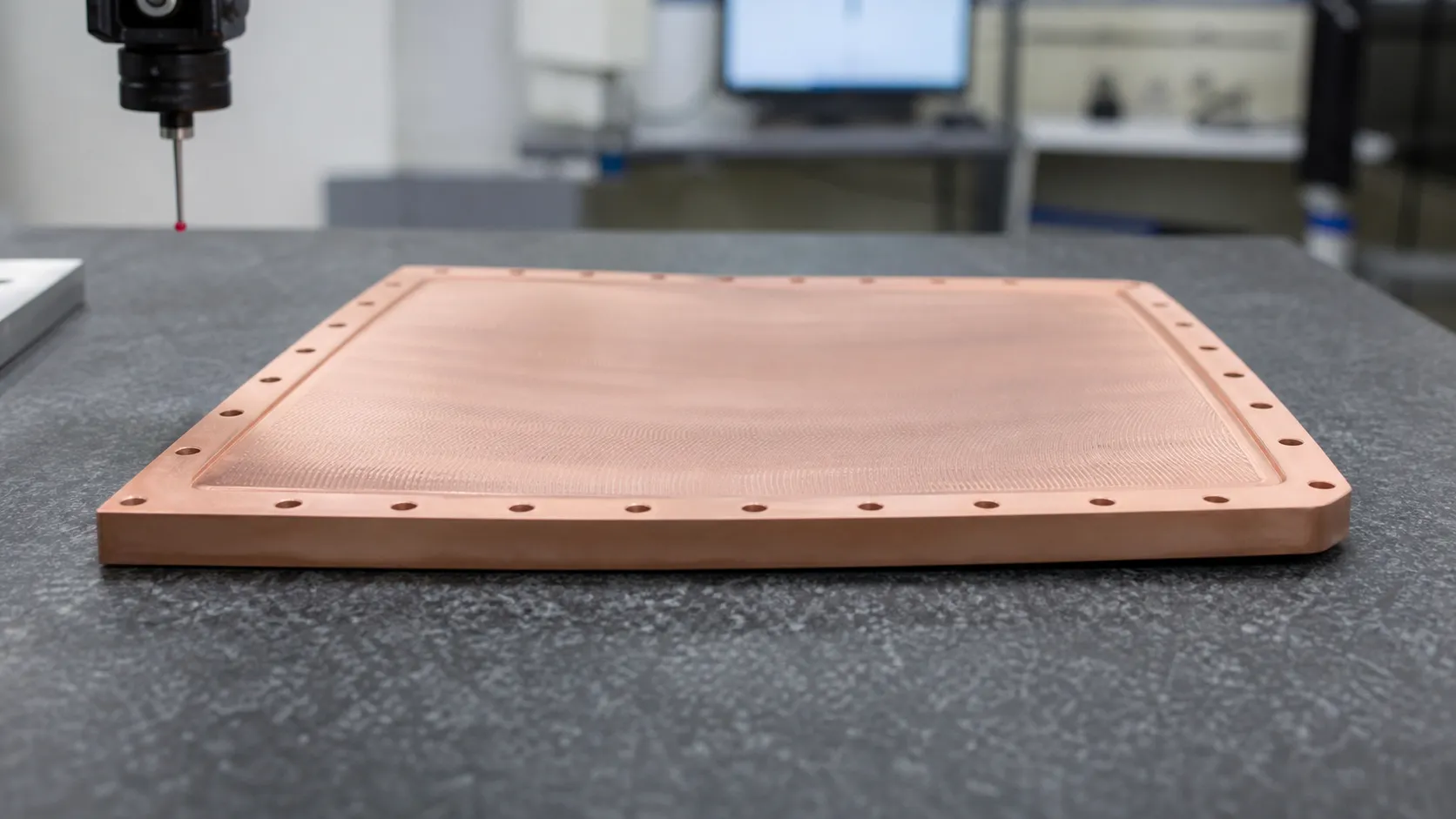
Overview of Energy Storage Liquid Cold Plates
Energy storage liquid cold plates are engineered components used to move heat away from battery packs, power electronics, and other high-power equipment. Their internal fluid paths and external contact surfaces support stable thermal management where compact layouts, high heat loads, and reliable sealing are required.
For aluminum or copper cold plate assemblies, vacuum brazing can join complex internal channel structures into a sealed unit. However, the heating and cooling cycle may introduce vacuum brazing distortion, affecting flatness, mounting interfaces, and sealing surfaces. Precision post-braze CNC machining helps restore critical dimensions on finished cold plates.
Liquid Cooling for High-Power Systems
Liquid cooling transfers heat through circulating coolant, allowing energy storage equipment to maintain more consistent operating temperatures than passive methods alone. A properly designed liquid cold plate supports thermal contact across the intended component interface while directing heat toward internal cooling channels.
Key design priorities include:
-
- Stable contact surfaces for effective heat transfer
- Sealed coolant pathways to protect the assembly
- Accurate mounting features for reliable installation
- Controlled flatness on critical thermal and sealing faces
For high-power energy storage applications, machining energy storage liquid cold plates requires attention to both thermal function and structural accuracy. CNC milling can finish mounting holes, connector areas, O-ring grooves, and flat contact surfaces after joining.
Why Vacuum Brazing Matters
Vacuum brazing is used to create joined cold plate structures with enclosed fluid passages and complex internal geometries. It is particularly relevant where multiple metal layers or channel components must be assembled into a unified cooling plate.
The process can support:
-
- Complex internal coolant-channel designs
- Clean, integrated metal assemblies
- Production of sealed liquid-cooling structures
- Subsequent precision machining of critical external features
Because thermal exposure during brazing can cause bowing, twisting, or local displacement, vacuum brazing distortion must be considered in the cold plate design and manufacturing plan. ZSCNC supports aluminum and copper component machining with multi-axis CNC capability, DFM analysis, and ISO 9001-aligned quality controls for energy storage components requiring tight dimensional control.
Understanding the Vacuum Brazing Process
Vacuum brazing joins cold plate layers in a controlled low-pressure environment. The brazing filler melts and flows between prepared surfaces, creating enclosed coolant paths without the bulk of mechanical fasteners. For energy storage thermal management, the process supports compact aluminum liquid cold plate designs with complex internal flow channels.
Key Parameters: Temperature, Vacuum Degree, and Cooling Speed
Vacuum brazing distortion is closely tied to process consistency. We focus on the parameters that affect joint quality, plate shape, and residual thermal stress.
| Process parameter | Why it matters for liquid cold plates |
|---|---|
| Brazing temperature | Must be controlled to melt the filler while limiting unnecessary base-material exposure and deformation. |
| Vacuum degree | A stable vacuum helps protect clean joining surfaces and supports consistent brazing conditions. |
| Heating rate | More even heating reduces temperature differences across thin walls, channel areas, and larger plate surfaces. |
| Cooling speed | Controlled cooling helps reduce residual stress that can contribute to bowing, twisting, or flatness variation. |
A reliable process considers the full thermal cycle, not only the peak temperature. Plate size, wall thickness, internal channel layout, material selection, and joint design all influence how the part responds during heating and cooling.
Key Advantages of Vacuum Brazed Liquid Cold Plates
Vacuum brazed cold plates can combine multiple formed or machined components into a sealed thermal management assembly. This makes the process suitable for energy storage equipment where available space, fluid routing, and structural integration must work together.
Key advantages include:
-
- Integrated coolant channels for compact liquid-cooling layouts
- Fewer mechanical joints across the plate assembly
- Flexible geometry options for mounting faces, ports, and thermal contact areas
- A practical base for post-braze CNC machining of critical sealing and mounting features
- Compatibility with aluminum and copper component designs used in thermal applications
After brazing, precision finishing may be required to restore critical faces and interfaces. Our custom CNC machined liquid cold plates for energy storage support post-braze machining requirements for flat surfaces, mounting points, and sealing-related features.
Causes of Vacuum Brazing Distortion in Cold Plates
Vacuum brazing distortion can affect the flatness, channel alignment, and sealing faces of an aluminum liquid cold plate. For energy storage thermal management, even small shifts may complicate assembly, reduce thermal contact, or affect O-ring sealing areas. We evaluate material behavior, part geometry, and furnace support conditions early to reduce avoidable movement.
Thermal Expansion and Residual Stress
During vacuum brazing, cold plate components expand as temperatures rise and contract as they cool. Thin walls, large plate surfaces, internal fluid channels, and uneven section thicknesses do not always expand at the same rate. This creates thermal stress that can leave the part bowed, twisted, or locally uneven after cooling.
Residual stress may also be present in the original material or introduced during forming and prior machining. Selecting dimensionally stable material conditions is important; our guidance on 6061 aluminum stress relief and dimensional stability for CNC parts helps support better flatness control in precision components.
Material Phase Transformations During Heating and Cooling
Material properties change throughout the brazing cycle. As the base material and filler approach brazing temperature, strength and stiffness decrease, making thin cold plate sections more likely to move under their own weight or fixture contact. During cooling, uneven contraction between the plate, channel cover, and brazed joints can lock stress into the assembly.
For aluminum and copper cold plates, material selection, wall thickness, joint layout, and cooling rate should work together. A design that appears stable at room temperature may respond differently under a full thermal cycle, especially where microchannel features or broad sealing surfaces are used.
Improper Fixture Design and Temperature Inhomogeneity
Fixture design has a direct effect on vacuum brazing distortion. A fixture that supports only limited points can allow unsupported areas to sag. Excessive restraint can create stress as the cold plate expands, while uneven clamping pressure may leave localized distortion after release.
Temperature inhomogeneity across the furnace load adds another risk. If one area heats or cools faster than another, the resulting differential expansion can pull the plate out of flatness. For complex cold plates, we review support locations, contact areas, part orientation, and geometry before precision CNC machining so critical sealing faces and mounting features can be controlled more reliably.
How to Control Distortion After Vacuum Brazing
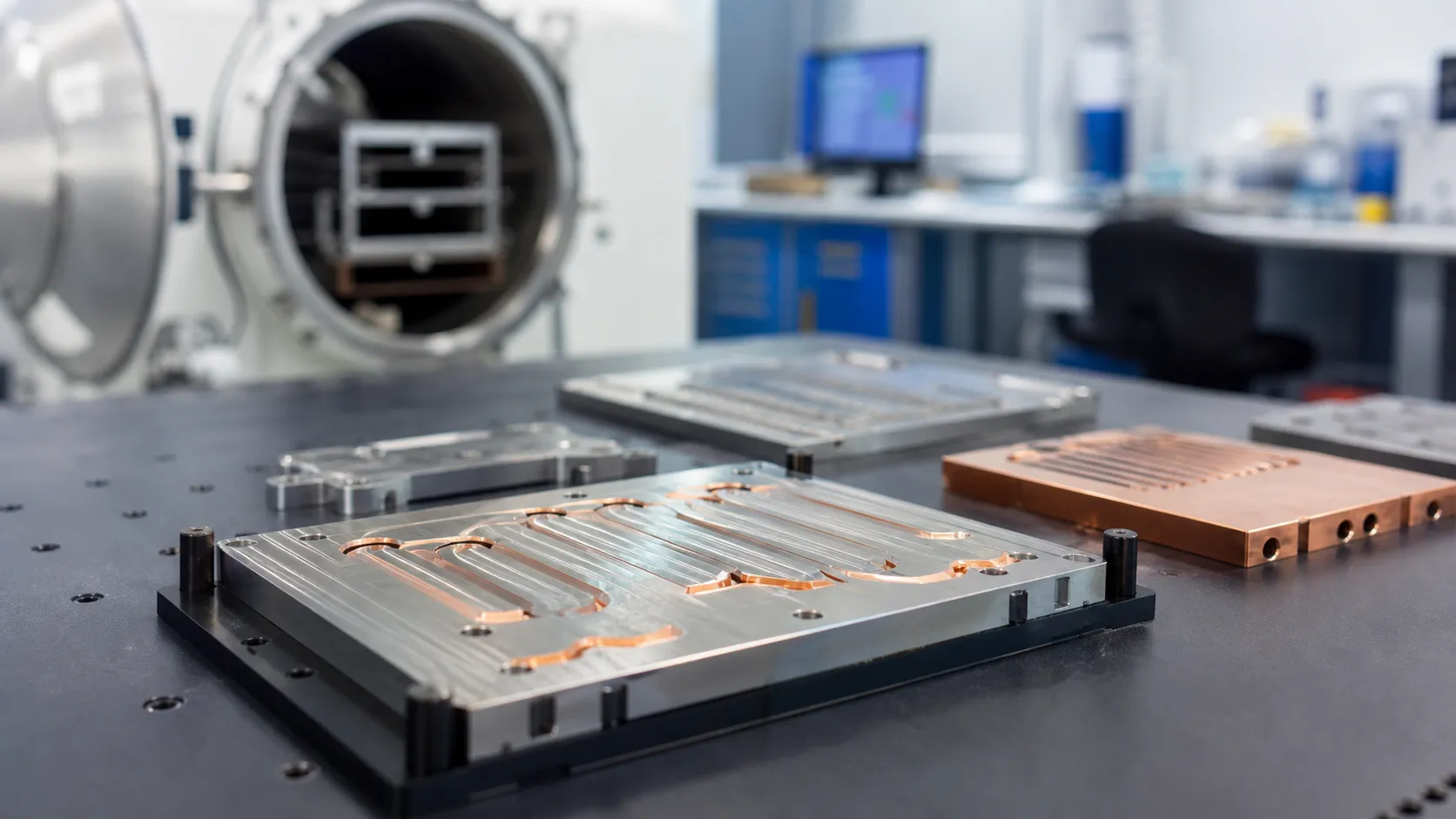
Controlling vacuum brazing distortion starts before the brazing cycle and continues through post-braze handling. For energy storage liquid cold plates, we focus on stable thermal processing, support that matches the part geometry, and machining allowances that protect critical sealing and mounting surfaces. This approach helps maintain dependable flatness control for aluminum and copper cold plate assemblies.
Optimizing Heating Rates and Cooling Cycles
Heating and cooling should be managed as a controlled process rather than a rapid temperature change. Uneven thermal expansion across thin walls, internal fluid channels, and larger plate areas can create thermal stress that remains after brazing.
Key process controls include:
-
- Using gradual, consistent heating rates to reduce temperature differences across the cold plate
- Allowing enough soak time for complex channel structures to reach a more uniform temperature
- Applying controlled cooling cycles to reduce sudden contraction and residual stress
- Avoiding unsupported handling while the brazed assembly is still hot
For parts that require tight sealing surfaces, we also reserve appropriate material for post-braze CNC milling. This gives us a controlled way to restore critical faces after the brazing cycle without over-machining the plate.
Advanced Fixture Design and Clamping Force Control
A fixture must support the cold plate without forcing it into an unnatural shape. Excessive clamping can temporarily flatten a part during brazing, then allow it to spring back once the load is removed. Too little support can permit bowing or twisting as the assembly heats and cools.
Our fixture planning considers:
-
- Plate size, thickness, and internal channel layout
- Thin-wall areas that need stable support
- Symmetrical load distribution across the workpiece
- Controlled clamping force to prevent local marking or mechanical deformation
- Clearance for thermal movement during the vacuum brazing process
Well-designed support also improves repeatability during secondary operations. After brazing, multi-axis machining can re-establish mounting features, O-ring grooves, and flat contact surfaces with accurate part location. Our approach follows the same principles used for industrial CNC machining accuracy and tight tolerance control.
Thermal and Stress Analysis Using Finite Element Modeling
Finite element modeling helps identify distortion risks before production. By reviewing heat flow, material expansion, and likely stress concentration areas, we can improve cold plate geometry, fixture support, and machining strategy early in the project.
For complex energy storage liquid cold plates, analysis is especially useful around:
-
- Long internal cooling channels
- Thin sealing lands and cover sections
- Sharp transitions between thick and thin features
- Mounting zones near brazed joints
- Areas requiring close flatness and positional tolerances
We combine design-for-manufacturability review with precision CNC machining planning to reduce avoidable correction work after brazing. With 5-axis CNC capability, ISO 9001 quality controls, and in-house production capacity, ZSCNC supports consistent machining of vacuum-brazed cold plates from prototype runs through larger production volumes.
Precision Machining Strategies for Brazed Cold Plates
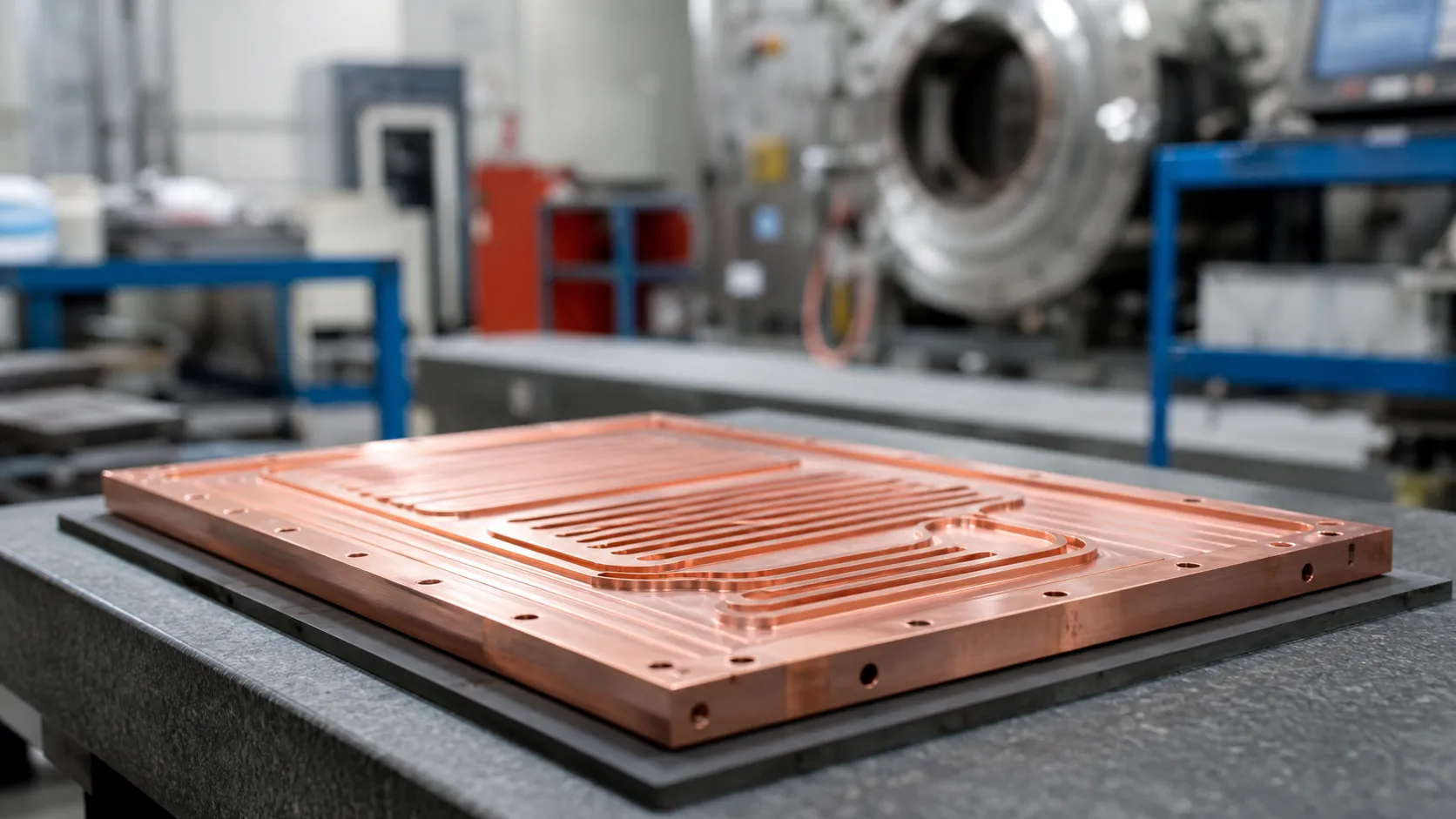
Post-braze machining is critical for controlling vacuum brazing distortion in energy storage liquid cold plates. We use precision CNC processes to restore flat sealing faces, accurate mounting features, and consistent channel-interface geometry without placing unnecessary stress on the brazed assembly.
Stress Relief Heat Treatment Prior to Machining
Residual thermal stress can remain after the brazing cycle, especially in aluminum and copper cold plates with thin walls, large footprints, or complex internal channels. Where the component design and material condition allow, stress-relief heat treatment can help stabilize the plate before final machining.
A controlled stabilization step helps reduce the chance of movement during milling and inspection. For aluminum designs, material selection and stock condition also matter. Our approach to stress-relieved aluminum 6061-T651 CNC machining supports more stable processing for precision components.
CNC Machining Techniques to Maintain Tight Flatness Tolerances
We use multi-axis CNC milling to machine post-braze reference surfaces, sealing lands, O-ring grooves, mounting holes, and connection features. Careful datum selection is essential: the machining setup must reflect the functional surfaces that control assembly fit and thermal contact.
Key flatness-control practices include:
-
- Machining in balanced passes to avoid uneven material removal
- Using light finishing cuts on critical sealing and contact surfaces
- Supporting the plate close to thin-wall areas without over-constraining it
- Sequencing features from stable datums to protect positional accuracy
- Inspecting critical dimensions during production under ISO 9001 quality controls
With 40+ CNC machines, including 5-axis capability, we support micron-level precision for complex energy storage and EV cooling components. Our precision CNC machining services for tight-tolerance parts are suited to projects where flatness, sealing alignment, and repeatable assembly features require close control.
Minimizing Mechanical Deformation During Post-Processing
A cold plate can distort if clamping force, cutting load, or machining sequence is not controlled. We use purpose-designed fixtures and measured clamping methods to hold the brazed part securely while minimizing local compression and secondary warping.
Our post-processing approach focuses on:
-
- Low-force, well-distributed workholding
- Toolpaths that limit heat buildup and cutting pressure
- Reduced stock removal on thin or unsupported regions
- Progressive finishing rather than aggressive single-pass machining
- Dimensional inspection and traceability for critical production batches
This controlled CNC machining process helps energy storage liquid cold plates retain the flatness and interface accuracy needed for reliable thermal management and downstream assembly.
Vacuum Brazing vs. Alternative Joining Methods
Vacuum Brazing vs. Friction Stir Welding (FSW)
Vacuum brazing and friction stir welding are both used to join aluminum liquid cold plate structures, but they support different design needs. Vacuum brazing can join complex internal flow paths, covers, and multi-part assemblies in one controlled thermal cycle. This makes it well suited to cold plates with enclosed channels and demanding sealing surfaces.
Friction stir welding uses solid-state joining and can reduce some heat-related effects compared with fusion welding. However, weld-path access, joint layout, and local material flow must be considered early in the design. For complex cold plates, vacuum brazing distortion remains a key control point because the full assembly experiences the brazing heat cycle. We use post-braze CNC machining to restore critical flatness, mounting features, and sealing areas where required.
| Joining method | Best-fit application | Main control focus |
|---|---|---|
| Vacuum brazing | Complex enclosed channels and multi-part cold plates | Thermal distortion, fixture support, post-braze machining |
| Friction stir welding | Accessible linear or curved joint paths | Tool access, weld design, local deformation |
Vacuum Brazing vs. Controlled Atmosphere Brazing (CAB)
Controlled atmosphere brazing uses a protected gas environment, while vacuum brazing is performed under vacuum conditions. Both methods can be considered for aluminum cooling assemblies, but the selected process should match the plate design, material condition, cleanliness requirements, and production plan.
For energy storage liquid cold plates requiring precise post-joining surfaces, vacuum brazing paired with CNC machining provides a practical route for controlling final geometry. Our multi-axis machining capacity supports corrective machining of flat sealing faces, O-ring grooves, ports, and mounting points after brazing. Material selection also affects the process window; 5083 aluminum machining and welding considerations should be reviewed when evaluating aluminum grades for joined components.
Selection priorities include:
-
- Internal channel complexity and joint accessibility
- Required flatness and sealing-surface accuracy
- Expected thermal stress and risk of vacuum brazing distortion
- Production volume and inspection requirements
- Need for precision CNC machining after joining
Selecting the Ideal Cold Plate Solution for Energy Storage
Design Considerations for Thermal and Structural Performance
The right liquid cold plate design balances thermal management, fluid-channel layout, sealing surfaces, and structural stiffness. For aluminum liquid cold plates, we review wall thickness, channel geometry, mounting locations, material selection, and machining access before production. This helps limit vacuum brazing distortion while retaining the flat, stable surfaces needed for thermal contact and final assembly.
For global energy storage and EV programs, design-for-manufacturability is essential. Our CNC machining and 5-axis capability support precision finishing of mounting faces, O-ring grooves, ports, and other critical features after brazing. For projects using aluminum components, our aluminum CNC machining service for European customers supports custom requirements from prototype quantities through production volumes.
Key design priorities include:
-
- Flat, accessible sealing and mounting surfaces
- Channel layouts that support consistent cooling flow
- Sufficient stiffness around thin walls and brazed joints
- Controlled tolerances for interfaces and assembly points
- Post-braze machining allowance for flatness control
Quality Inspection and Leak Testing Standards
A cold plate is only ready for use when its dimensions, sealing features, and fluid paths meet the project requirements. We apply ISO 9001-aligned inspection protocols and traceability documentation to verify critical machining results. Dimensional checks focus on flatness, hole positions, groove profiles, and other features that can be affected by vacuum brazing distortion.
Leak testing should be defined according to the application, coolant medium, pressure conditions, and customer acceptance criteria. Combined with visual checks and dimensional inspection, this approach helps confirm that the vacuum-brazed cold plate can move into assembly with greater confidence.
Our quality process supports:
-
- Inspection of post-braze machined surfaces
- Verification of critical dimensions and tolerances
- Review of sealing interfaces and fluid-channel integrity
- Batch traceability documentation
- Consistent control from prototype work to larger production runs
 English
  German
  Dutch
Dutch  Russian
  Czech
Czech  French
  Japanese
  Spanish
  Portuguese
  Korean