


You already know that CNC machining for aerospace parts leaves zero room for error.
But how do you ensure your supplier can actually deliver on flight-critical components without compromising safety or timeline?
It’s not just about cutting metal; it’s about mastering the "Big Three" of the industry: extreme precision, exotic materials, and ironclad certification basics.
Whether you are designing structural ribs from Aerospace grade aluminum 7075 or requiring 5-axis CNC milling for complex turbine blades, the difference between a successful launch and a grounded project is often measured in microns.
In this guide, you’re going to learn exactly how to validate a manufacturing partner, from understanding AS9100 and ISO 9001 compliance to the nuances of machining Titanium Grade 5.
Let’s dive into the details.
Aerospace Precision Standards: Why Accuracy Matters
When lives depend on mechanical integrity, there is no room for error. At ZSCNC, we understand that precision CNC machining for aerospace components is not just about cutting metal—it is about mitigating risk and ensuring absolute safety. In an industry where a single failure can be catastrophic, we treat every project as a zero-defect mandate. Our commitment is to deliver parts that perform flawlessly at 30,000 feet.
Defining Aerospace Tolerances and Micron-Level Accuracy
In aerospace manufacturing, "close enough" does not exist. We routinely operate within micron-level tolerance ranges, often holding specifications as tight as ±0.005mm. This precision is critical for flight-critical components where aerodynamic efficiency and structural rigidity are paramount.
Whether we are producing hydraulic manifolds or landing gear components, achieving tight tolerance bores and joints is non-negotiable. Even microscopic deviations can lead to vibration issues, fuel leaks, or premature fatigue failure. We utilize high-precision equipment to ensure every dimension matches the digital twin of your design.
Geometric Dimensioning and Tolerancing (GD&T) Explained
Linear dimensions only tell half the story. To ensure parts fit and function correctly in complex assemblies, we rely strictly on Geometric Dimensioning and Tolerancing (GD&T). It is not enough for a hole to be the correct diameter; its position relative to other features must be exact.
Our engineering team expertly interprets complex GD&T callouts to guarantee:
- True Position: Ensuring perfect alignment for fasteners and mating parts.
- Flatness & Parallelism: Critical for sealing surfaces to prevent pressure loss.
- Cylindricity & Concentricity: Vital for rotating components to prevent oscillation and wear.
5-Axis Machining Technology for Complex Geometries
Modern aircraft designs feature organic, aerodynamic shapes that traditional 3-axis machines cannot handle efficiently. Our advanced 5-axis CNC milling capabilities allow us to machine complex geometries—such as turbine blades, impellers, and airfoils—in a single setup.
By utilizing 5-axis technology, we achieve:
- Reduced Error Stacking: Fewer fixture changes mean higher overall accuracy.
- Superior Surface Finishes: Shorter cutting tools reduce vibration and chatter marks.
- Faster Throughput: Complex features are machined simultaneously, accelerating lead times.
Thermal Stability and Deformation Prevention
Machining generates significant heat, and thermal expansion is the enemy of precision. If a part heats up during cutting, it may measure correctly on the machine but shrink out of tolerance once it cools. We implement rigorous protocols to manage thermal stability and prevent deformation:
- Climate-Controlled Facilities: We maintain a constant ambient temperature to minimize material expansion and contraction.
- In-Process Stress Relief: For thin-walled parts, we perform stress relief steps to prevent warping after material removal.
- High-Pressure Coolant Systems: We utilize advanced cooling strategies to stabilize workpiece temperature during aggressive machining cycles.
Material Selection for Aerospace CNC Machining
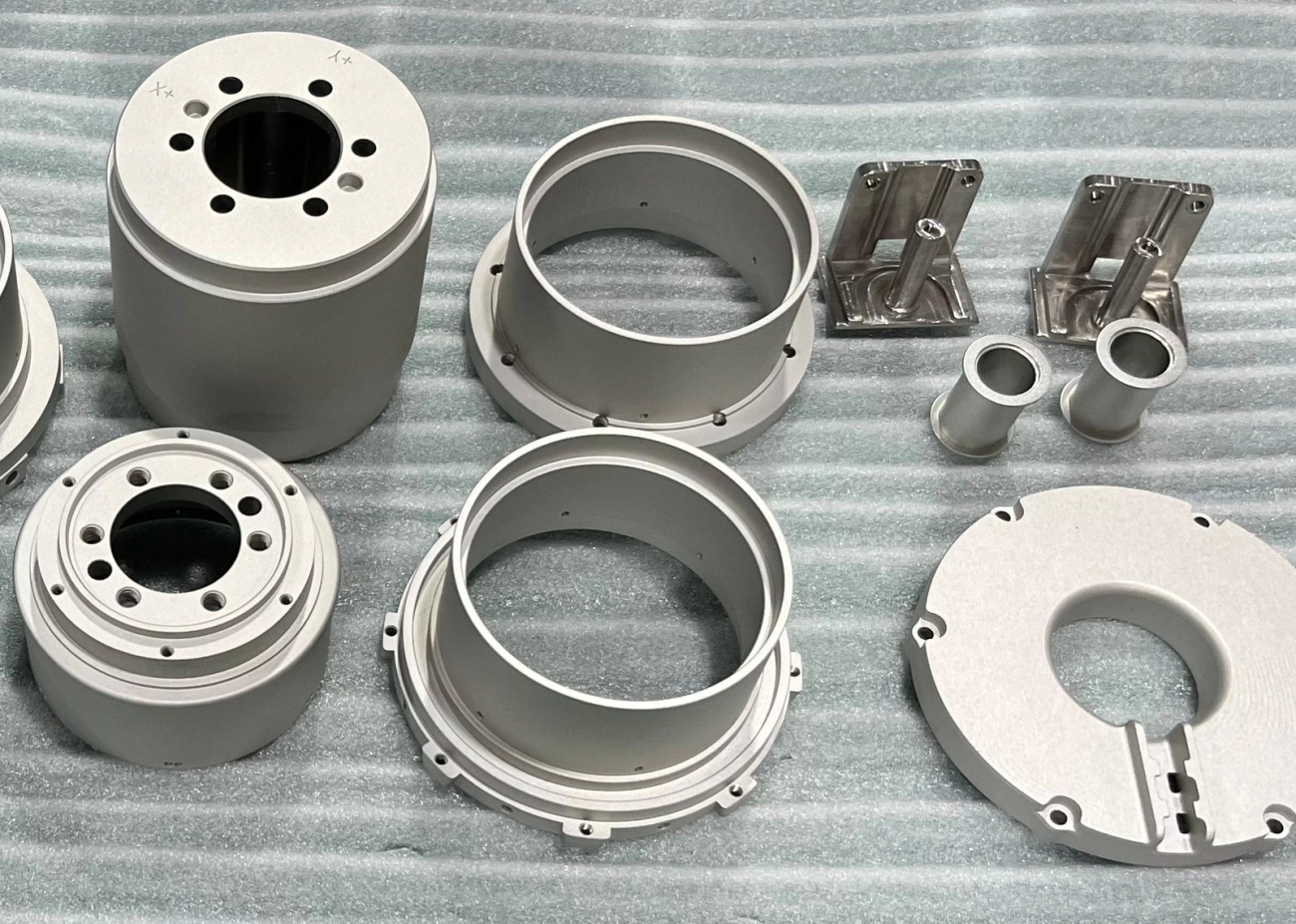
Choosing the right material is critical when manufacturing flight-ready hardware. At ZS CNC, we strictly adhere to material specifications to ensure every component meets the necessary strength-to-weight ratios and thermal resistance standards required for flight. We source high-quality stock to support precision CNC machining for aerospace components, ensuring traceability from the raw block to the finished part.
Aerospace-Grade Aluminum Alloys (7075-T6 & 6061-T6)
Aluminum remains the primary material for aircraft structures due to its excellent strength-to-weight ratio. We frequently utilize aerospace grade aluminum 7075 for highly stressed structural parts, as its strength is comparable to many steels but at a fraction of the weight. For components requiring better corrosion resistance and weldability, we rely on Aluminum 6061 and 2026.
Our 5-axis CNC machining services for complex aluminum parts allow us to mill intricate geometries in these alloys while maintaining tight tolerances. Common applications include:
- Aluminum 7075: Gears, shafts, and fuse parts.
- Aluminum 6061: Wing structures and hydraulic fittings.
- Aluminum 2026: High-tension structural applications.
Machining Titanium Grade 5 and Hard Metals
For parts exposed to extreme heat or requiring superior corrosion resistance, we specialize in Titanium Grade 5 machining. This alloy (Ti-6Al-4V) offers the highest strength-to-weight ratio of any metallurgical element, making it essential for jet engine components and airframe fasteners.
Processing aluminum and titanium for aerospace requires rigid setups and advanced tooling to prevent work hardening. Our facility is equipped to handle these hard metals, as well as various grades of Stainless Steel (303, 304, 316) and standard Steel, ensuring we can deliver durability where it counts.
High-Performance Plastics: PEEK, POM, and PTFE
Aerospace engineering isn't just about metal; engineering plastics play a vital role in weight reduction for interior components, electrical insulators, and seals. We machine high-performance plastics that resist chemical degradation and maintain stability at altitude.
- PEEK: Used for bearings and piston parts due to high thermal stability.
- POM (Delrin): Excellent for stiff, low-friction components.
- PTFE: Ideal for wiring insulation and seals.
We also process PTFE plastic materials and Nylon to exact specifications, providing a complete solution for both structural and non-structural aerospace needs.
Essential Certifications and Quality Assurance
In the aerospace sector, quality isn't just a goal; it is the absolute baseline for safety and performance. When we handle CNC machining for aerospace parts: precision, materials and certification basics are the pillars of our operation. We understand that a single deviation in tolerance can compromise an entire system, which is why our quality management systems are integrated into every step of production.
ISO 9001:2015 and AS9100 Compliance Context
Our facility operates strictly under ISO 9001:2015 certification, which serves as the foundation for consistent, high-quality manufacturing. While AS9100 is the specific standard for the aerospace industry, our ISO 9001:2015 framework ensures that we meet the rigorous process controls and risk management protocols required for flight-critical components. Our rigorous quality control standards allow us to align with the stringent demands of aerospace clients, ensuring that every workflow—from raw material intake to final shipping—is documented, repeatable, and verifiable.
The Inspection Process: CMM and First Article Inspection (FAI)
Verifying micron-level tolerance requires advanced metrology equipment. We don't rely on manual checks for complex geometries. Instead, we utilize Coordinate Measuring Machine (CMM) inspection to validate that the physical part matches the CAD specifications down to the smallest detail.
For new aerospace projects, we implement First Article Inspection (FAI). This process validates the manufacturing method before full-scale production begins, ensuring that our manufacturing processes yield parts that are dimensionally perfect.
- In-Process Inspection: Continuous monitoring during machining to catch deviations early.
- Final Inspection: Comprehensive verification of all dimensions and surface finishes.
- Reporting: Detailed inspection reports provided with every shipment.
Material Traceability, DFARS, and RoHS/REACH Compliance
For aerospace applications, knowing the pedigree of your material is mandatory. We ensure full traceability and material certification for every batch of metal or plastic we machine. Whether we are cutting Aerospace grade aluminum 7075 or Titanium Grade 5, we provide Mill Test Reports (MTRs) that trace the material back to the foundry.
We also support compliance with global standards:
- DFARS: Sourcing materials compliant with US defense acquisition regulations when required.
- RoHS/REACH: Ensuring materials and finishes meet environmental safety standards.
By providing complete documentation and certificates for aerospace machining, we give our partners the confidence that their supply chain is secure, compliant, and ready for flight.
Surface Finishing Options for Aerospace Durability
Aerospace components face some of the harshest environments imaginable, from sub-zero stratospheric temperatures to the scorching heat of engine combustion. A raw machined part simply cannot survive these conditions without proper protection. At ZS CNC, we treat surface finishing not just as an aesthetic step, but as a critical engineering process that extends the lifecycle of flight-critical components. We offer a one-stop solution for machining and finishing, ensuring that parts like aerospace grade aluminum 7075 brackets or titanium fittings are ready for installation upon delivery.
Anodizing (Type II & III) for Corrosion Resistance
For aluminum alloys, anodizing is the industry standard for durability. This electrochemical process thickens the natural oxide layer on the metal surface, making it harder and more resistant to wear.
- Type II (Standard): Provides excellent corrosion resistance and allows for color dyeing, often used for interior cabin parts or non-structural housings.
- Type III (Hard Coat): Creates a thicker, denser coating ideal for high-wear components like gears, pistons, and external structural elements.
Passivation for Stainless Steel Components
When machining stainless steel for aerospace applications, microscopic iron particles can remain on the surface, leading to potential rust. Passivation is a chemical treatment that removes these contaminants, enhancing the metal's natural corrosion resistance without altering the dimensional tolerance of the part. This is non-negotiable for fuel systems and hydraulic fittings where failure is not an option.
Bead Blasting and Polishing for Surface Roughness Control
Surface texture affects everything from fatigue strength to fluid dynamics. We utilize bead blasting to remove tool marks and create a uniform matte finish, which also helps in stress relief by compressing the surface layer. For parts requiring minimal friction, such as shafts or bearing surfaces, we employ precision polishing. Understanding the influence of surface roughness on part performance is vital; a smoother finish (lower Ra value) can significantly reduce wear and tear in moving assemblies.
Comparison of Common Aerospace Finishes
| Finishing Process | Primary Benefit | Typical Material | Application Example |
|---|---|---|---|
| Anodizing (Type III) | Wear & Corrosion Resistance | Aluminum 6061/7075 | Landing gear components, structural brackets |
| Passivation | Chemical Cleanliness | Stainless Steel 304/316 | Fuel valves, fasteners, hydraulic fittings |
| Bead Blasting | Uniform Matte Texture | Metals & Plastics | Instrument panels, non-reflective surfaces |
| Polishing | Low Friction (Low Ra) | Titanium, Steel | Turbine blades, bearing surfaces |
Choosing the Right Aerospace Machining Partner
Selecting a supplier for CNC machining for aerospace parts goes beyond just finding a machine shop; you need a partner who understands the critical nature of flight hardware. At ZS CNC, we combine technical expertise with operational efficiency to support your supply chain from concept to final delivery.
Rapid Response and Prototyping Lead Times
In the aerospace industry, delays are not an option. We prioritize speed without compromising precision. Our team provides detailed quotes within 24 hours of receiving your CAD files. This agility extends to our shop floor, where we specialize in rapid prototyping for aerospace, allowing engineers to test fit and function quickly. By streamlining our workflow, we ensure fast turnaround times and rapid global shipping to keep your development schedule on track.
Free DFM Analysis for Design Optimization
We believe in catching issues before metal is cut. Our engineering team offers free Design for Manufacturability (DFM) analysis for every project. We review your 3D models to suggest modifications that improve machinability and reduce costs. For instance, understanding Aluminum 6061 machinability and design optimization can help you minimize material wastage and shorten cycle times while maintaining structural integrity.
Scalability from Prototype to Production
Our capabilities are built to grow with your project. Whether you need a single complex prototype or a high-volume run of flight-critical components, we have the capacity to deliver. We seamlessly transition from initial sampling to full-scale manufacturing. Our facility is equipped to handle the strict consistency required for mass-produced aerospace turning parts, ensuring that the thousandth part is just as precise as the first.
- Flexibility: Support for both high-mix/low-volume and high-volume production.
- Consistency: ISO 9001:2015 processes applied to every batch size.
- Efficiency: One-stop service including machining and surface finishing.
Frequently Asked Questions About Aerospace CNC Machining
What is the standard tolerance for aerospace parts?
Aerospace components demand exceptional precision because even a microscopic deviation can lead to mechanical failure at high altitudes. While standard commercial machining often operates within ±0.1mm, flight-critical parts require much tighter control. At ZSCNC, our advanced equipment allows us to meet industrial-grade CNC machining accuracy standards, achieving tolerances as tight as ±0.005mm. This level of precision ensures that complex geometries, such as turbine blades or fuel manifolds, fit perfectly within the assembly.
Which aluminum alloy is best for aircraft structures?
Material selection depends heavily on the specific application of the part, but Aluminum 7075-T6 is widely regarded as the top choice for high-stress structural components. It offers a strength-to-weight ratio comparable to some steels, making it ideal for wing structures and fuselage frames. For internal components, brackets, or fittings that require good corrosion resistance and weldability, Aluminum 6061-T6 is the standard. We provide custom aluminum CNC machined parts in both alloys, ensuring the material properties match your engineering requirements.
How does ZSCNC ensure material traceability?
Traceability is non-negotiable in aerospace manufacturing to ensure safety and compliance. As an ISO 9001:2015 certified manufacturer, we implement strict quality management protocols throughout the production cycle.
- Raw Material Verification: We inspect all incoming metals and plastics to verify they meet grade specifications.
- Documentation: We provide comprehensive material certificates and inspection reports with your order.
- Process Control: From the initial CAD file to the final CMM inspection, every step is documented to ensure that the parts we ship match your exact design and material requirements.
 English
  German
  Dutch
Dutch  Russian
  Czech
Czech  French
  Japanese
  Spanish
  Portuguese
  Korean