

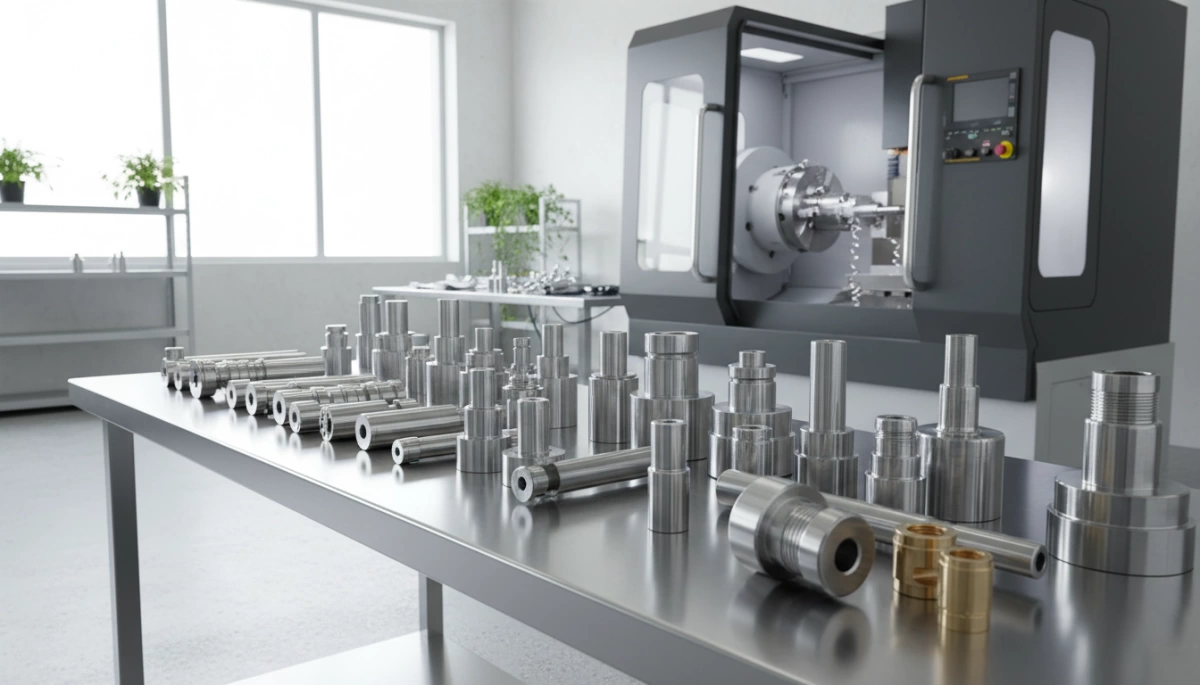
What Are Precision CNC Turning Parts?
Defining High-Accuracy Turned Components
Precision CNC turning parts are high-quality mechanical components created through a subtractive manufacturing process. These parts are specifically engineered for applications where dimensional accuracy and surface integrity are critical. By utilizing advanced computer software to control the machining equipment, manufacturers can produce complex cylindrical shapes that meet the most rigorous industrial standards.
How a CNC Lathe Works
The production of these components relies on a CNC (Computer Numerical Control) lathe. Unlike other machining methods, the turning process follows a specific mechanical logic:
- Workpiece Rotation: The raw material (usually a metal or plastic rod) is held in a chuck and spun at high speeds.
- Stationary Cutting: A single-point cutting tool remains relatively stationary while being fed into the rotating workpiece.
- Material Removal: As the tool moves along the X and Z axes, it shaves off material to create precise diameters, depths, and finishes.
- Automation: The entire sequence is driven by a digital "G-code" program, ensuring that every precision CNC turning part is identical to the last, regardless of production volume.
This automated approach allows for the creation of intricate features such as tapers, threads, slots, and bores with exceptional repeatability and speed.
How the CNC Turning Process Works
The mechanics behind precision CNC turning parts are straightforward but require extreme technical accuracy. We start by securing a block of raw material, usually a round bar, into the lathe's chuck to begin the transformation.
Rotation and Cutting Mechanics
Unlike milling where the tool spins, in CNC turning, the workpiece rotates at high speeds. A stationary cutting tool is then fed into the spinning material, removing layers to create the desired profile. This method ensures that every cut is perfectly concentric, which is vital for parts that need to maintain balance while spinning in their final application.
The Four Main Production Steps
We follow a disciplined workflow to ensure every component meets the exact specifications:
- Setup: We translate your CAD designs into G-code and secure the material and specialized tooling.
- Turning: The machine executes the programmed paths to rough out the shape and then perform fine-finishing cuts.
- Finishing: This involves adding details like threads, knurling, or achieving specific surface textures.
- Inspection: We use high-end measuring tools to confirm the part matches the original design tolerances.
Ideal for Rotational Geometries
CNC turning is the most efficient way to produce cylindrical or "round" parts. Because the part is constantly spinning during the cut, we achieve a level of symmetry and axial accuracy that other methods can't easily replicate. This makes it the standard choice for CNC machining services when manufacturing shafts, pins, bushings, and custom fasteners.
Key Benefits of Precision CNC Turning
Precision CNC turning parts offer unmatched reliability for critical applications. By utilizing computer-controlled movements, we eliminate the variability found in manual machining. This ensures that every component meets your exact specifications without deviation.
Our precision CNC turning services focus on four primary advantages:
- Extreme Dimensional Accuracy: Our lathes maintain tight tolerance CNC turned components, often reaching +/- 0.005mm. This level of detail is a standard requirement for medical device CNC machining services where precision is a matter of safety and performance.
- Perfect Repeatability: Once the program is set, the machine produces identical high precision lathe parts every single time. This consistency eliminates waste and significantly reduces costs over long production runs.
- Production Efficiency: Whether you need a single prototype or a batch of 10,000, CNC turning scales effortlessly. It remains the most cost-effective method for producing cylindrical custom turned parts quickly.
- Superior Surface Finishes: The constant contact between the cutting tool and the rotating workpiece results in a smooth, consistent surface finish that often requires no secondary polishing or grinding.
| Feature | Precision CNC Turning Benefit |
|---|---|
| Accuracy | Micron-level precision for complex geometries |
| Speed | High-speed rotation for rapid material removal |
| Repeatability | 100% identical parts across thousands of units |
| Versatility | Effective for various metal CNC turning solutions |
By choosing our precision turning processes, you ensure that your hardware components are durable, accurate, and ready for immediate assembly.
Common Materials for Precision CNC Turning Parts
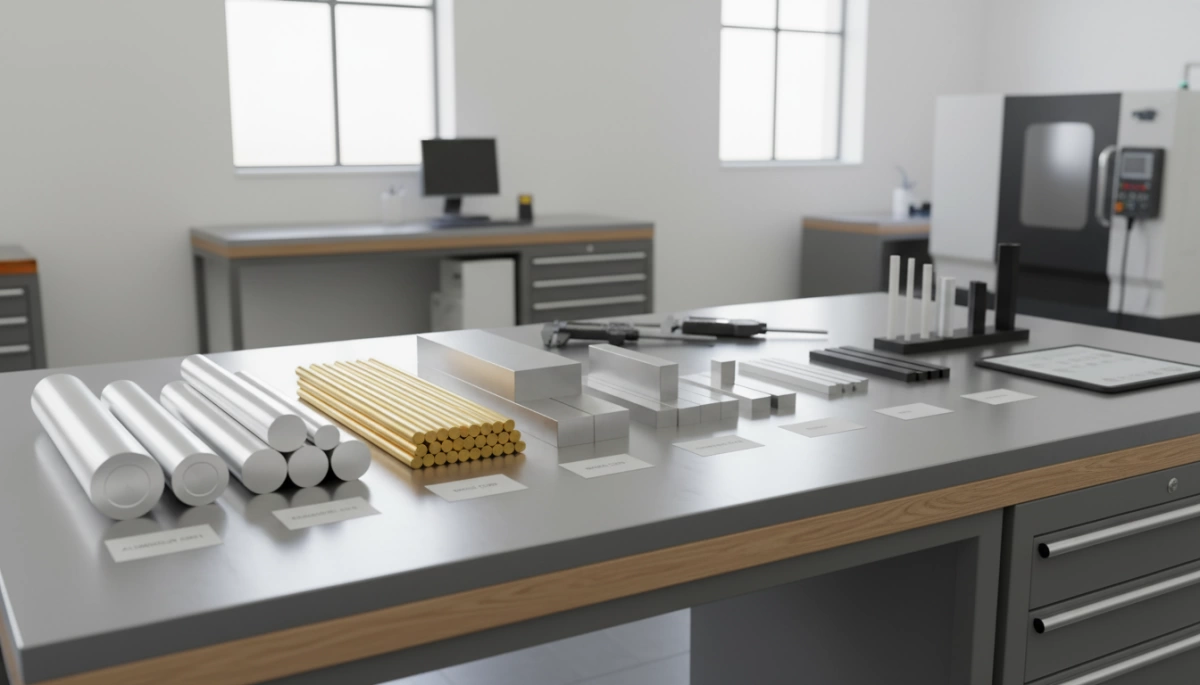
The choice of material is critical for the performance and longevity of precision CNC turning parts. We work with a wide range of metals and alloys to ensure your components meet specific mechanical and environmental requirements.
- Aluminum: Known for being lightweight and having excellent machinability. It is a top choice for aerospace and automotive components due to its high strength-to-weight ratio.
- Stainless Steel: Offers superior corrosion resistance and durability. We frequently use various grades of stainless steel for medical instruments and food processing equipment where hygiene and strength are paramount.
- Brass: Highly valued for its excellent electrical conductivity and natural lubricity. It is the standard for electronic hardware, connectors, and decorative architectural components.
- Carbon Steel: A cost-effective solution for high-strength industrial applications. It provides great toughness and is often used for structural bolts, shafts, and heavy-duty machinery parts.
- Titanium & Exotic Alloys: For extreme environments, titanium offers unmatched strength and heat resistance. We also process difficult-to-machine alloys like Inconel for specialized aerospace and chemical engineering projects.
Selecting the right material ensures that your custom turned parts perform reliably under stress while maintaining the necessary CNC machining accuracy standards required for high-end industrial use.
Typical Applications of Precision CNC Turning Parts
Precision CNC turning parts are essential across various industries where cylindrical accuracy and smooth finishes are non-negotiable. We produce these components to meet the rigorous demands of high-performance environments, ensuring every piece fits perfectly into the final assembly.
Automotive Parts
In the automotive sector, reliability is everything. CNC turning is used to create critical engine components, fuel system parts, transmission shafts, and bushings. These parts must withstand high heat and friction, making the precision of the lathe process vital for vehicle safety and longevity.
Aerospace Components
The aerospace industry requires lightweight yet incredibly strong materials. We often supply aluminum for aerospace CNC parts such as fasteners, connectors, and specialized housings. These parts must adhere to strict weight requirements while maintaining the structural integrity needed for flight.
Medical Device Parts
Precision is a matter of health in the medical field. CNC turning produces surgical instruments, orthopedic implants, and dental components. Because these parts often require biocompatible materials and ultra-smooth surfaces, our precision CNC machining services for tight-tolerance parts are the go-to solution for medical manufacturers.
Industrial Equipment Parts
Heavy machinery relies on turned parts to function without failure. Common applications include:
- Hydraulic valves and pistons
- Nozzles and spray tips
- Gears and rollers
- Custom fittings and adapters
Electronic and Hardware Components
From small heat sinks to complex connector housings, precision CNC turning parts are found in many consumer electronics and industrial hardware. The ability to work with conductive materials like brass and copper allows us to create intricate components that ensure stable electrical connections and efficient heat dissipation.
Achieving High Precision: Tolerances and Surface Finishes
Understanding Tight Tolerances
When we manufacture precision CNC turning parts, we work with measurements that are often thinner than a human hair. In simple terms, "tolerance" is the allowable limit of variation in a part's physical dimensions. For high-stakes industries, we consistently achieve tight tolerances as low as ±0.005mm (0.0002 inches). This level of accuracy ensures that every component fits perfectly into its assembly, eliminating the need for manual adjustments or rework.
Surface Finish Standards
The surface finish defines the texture and smoothness of a part after it leaves the lathe. We measure this using Ra (Roughness Average). Depending on your requirements, we can provide:
- Standard Machined Finish: Ra 1.6 - 3.2 μm (Smooth, visible tool marks).
- Fine Finish: Ra 0.8 μm (Very smooth, ideal for seals).
- Super Fine Finish: Ra 0.4 μm or better (Mirror-like, often used for aerospace precision parts to reduce friction).
Factors Influencing Final Accuracy
Achieving the highest level of precision isn't just about the machine; it is a balance of several technical factors:
- Material Stability: Harder materials like stainless steel hold dimensions differently than softer plastics or aluminum.
- Part Geometry: Long, slender parts or very thin walls require specialized setups to prevent vibration and deflection.
- Tooling and Equipment: We utilize high-end CNC lathes and premium cutting tools to maintain consistency across large production runs.
- Thermal Expansion: Controlling the temperature of the coolant and the work environment is essential for maintaining semiconductor precision parts standards.
By managing these variables, we ensure that every batch of precision CNC turning parts meets your exact engineering specifications without compromise.
CNC Turning vs CNC Milling
While both are subtractive manufacturing methods, the fundamental difference lies in which component moves—the tool or the workpiece. Choosing the right method is essential for optimizing the production of precision CNC turning parts.
Turning for Cylindrical and Rotational Parts
In CNC turning, the workpiece rotates at high speeds while a stationary cutting tool removes material. This process is the gold standard for creating symmetrical, cylindrical components like shafts, pins, and fasteners. Because the part is spinning, it is much easier to maintain perfect concentricity and smooth finishes on round surfaces. For example, our high-precision turning processing of 304 stainless steel parts utilizes this rotation to achieve exact diameters that milling simply cannot match as efficiently.
Milling for Complex Flat or Irregular Shapes
CNC milling works the opposite way: the workpiece stays clamped in place while a multi-point cutting tool rotates and moves across the material. This is the preferred method for parts that aren't round. If your design involves flat faces, deep pockets, or complex 3D contours, milling provides the versatility needed to navigate those irregular geometries.
When to Choose Each Process
Selecting the right process depends entirely on the geometry of your design:
- Choose CNC Turning if: Your part is cylindrical, has a uniform cross-section, or requires high-speed production of round features. It is generally faster and more cost-effective for rotational geometry.
- Choose CNC Milling if: Your part is square, rectangular, or has an irregular shape that requires holes, slots, or pockets on multiple faces.
- The Hybrid Approach: Many precision CNC turning parts require "live tooling" or secondary milling operations. We often start with a turned blank to establish the main diameter and then use milling to add non-rotational features like flats or off-center holes.
How to Choose a Precision CNC Turning Manufacturer
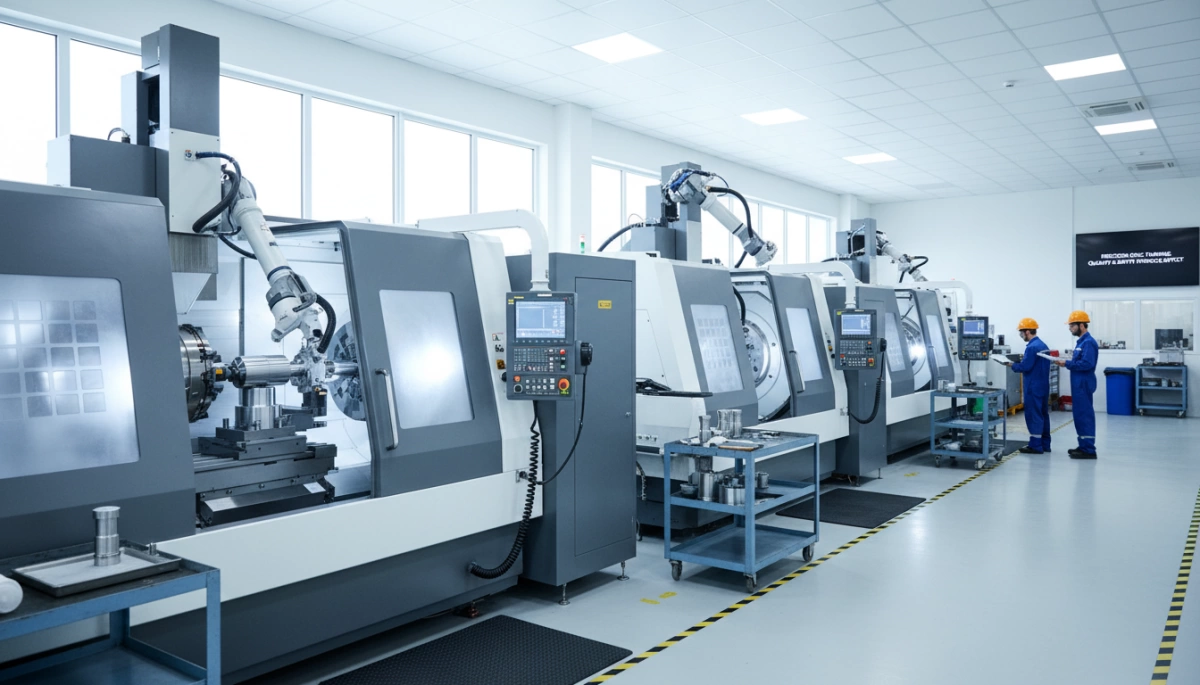
Selecting the right partner for your precision CNC turning parts is about more than just finding the lowest price. It is about technical reliability, consistency, and a deep understanding of machining physics. We focus on delivering components that meet exact specifications every single time.
| Selection Factor | What to Verify |
|---|---|
| Engineering Depth | Expertise in DFM (Design for Manufacturing) and multiaxis turning capabilities to optimize production. |
| Quality Control | Use of CMM (Coordinate Measuring Machines) and ISO-certified inspection processes. |
| Material Range | Proven experience with diverse metals, including 7075 aluminum machining and tough stainless steels. |
| Scalability | The ability to handle rapid prototyping and move seamlessly into high-volume production. |
| Communication | Fast response times and transparent updates on lead times and logistics. |
Engineering and Technical Capability
A top-tier manufacturer should act as an extension of your engineering team. We look at your drawings to identify potential cost-saving adjustments without sacrificing performance. High-precision lathe parts require advanced equipment and programmers who understand how to minimize tool deflection and thermal expansion during long runs.
Quality Control and Inspection
Precision is meaningless without verification. Ensure your manufacturer uses calibrated inspection tools to guarantee that every batch of precision CNC turning parts stays within the specified tolerance. We prioritize documented inspection reports that provide full traceability for every component produced.
Material Experience and Support
Different alloys behave uniquely under cutting pressure. Whether you need lightweight aerospace components or heavy-duty industrial hardware, your manufacturer must have a track record with your specific material. This expertise prevents common issues like poor surface finish or internal stress warping.
Prototyping and Production Speed
In today’s market, speed is a competitive advantage. Choose a partner that offers flexible production schedules. We balance the need for quick-turn prototypes with the stability required for large-scale manufacturing, ensuring your supply chain remains uninterrupted. Clear communication and realistic lead times are the final pillars of a successful manufacturing partnership.
FAQ
What industries use precision CNC turning parts?
We provide precision CNC turning parts to a wide range of high-stakes industries. Because these components offer such high reliability, they are essential in:
- Aerospace: For engine components and high-strength fasteners.
- Medical: For surgical instruments and orthopedic implants.
- Automotive: For shafts, valves, and sensor housings.
- Electronics: For connectors and specialized hardware.
What is the difference between CNC turning and conventional turning?
The main difference is automation and accuracy. Conventional turning relies on a manual operator, which increases the risk of human error. In contrast, our precision CNC turning services use computer-controlled programs to ensure every part is identical. If you are unsure which automated method suits your design, comparing CNC milling vs CNC turning can help you decide based on your part's geometry.
Can CNC turning make custom parts?
Yes. As a dedicated custom turned parts manufacturer, we specialize in creating components tailored to your specific CAD designs. Whether you need a single prototype or a full production run, the flexibility of CNC programming allows us to produce unique metal CNC turning solutions without the need for expensive custom molds.
What affects the cost of precision CNC turning parts?
Several factors influence the final price of high precision lathe parts:
- Material Choice: Standard aluminum is more cost-effective than exotic alloys like titanium.
- Complexity: Parts with intricate features or secondary operations take longer to machine.
- Tolerances: Achieving tight tolerance CNC turned components requires specialized tooling and slower feed rates, which can increase costs.
- Order Volume: Larger batches typically lower the price per unit due to shared setup costs.
For a drawing-based project, review our CNC turning services. To request a quotation, send the drawing, material, quantities, surface finish, and any critical fits or inspection requirements.
 English
  German
  Dutch
Dutch  Russian
  Czech
Czech  French
  Japanese
  Spanish
  Portuguese
  Korean